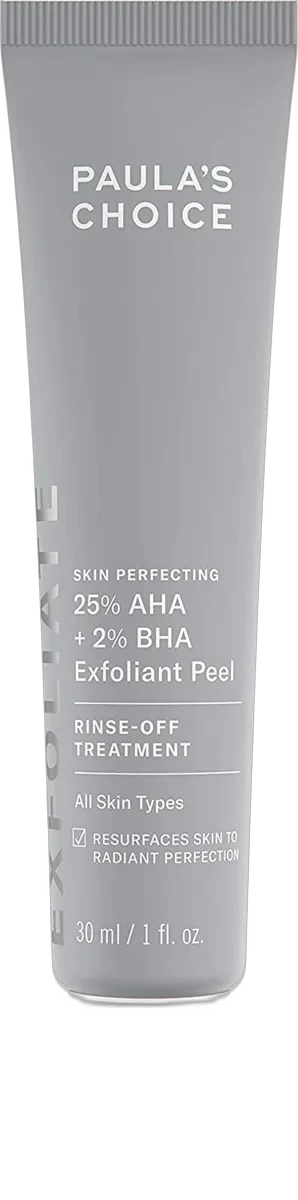
Skin Perfecting 25% AHA + 2% BHA Exfoliant Peel
At-Home Peel Gold Standard
 Verified reviewer
Pros & cons.
- +Five-AHA architecture provides multi-depth exfoliation that is more uniform than single-acid peels
- +Salicylic acid adds pore-clearing capability that AHA-only peels cannot achieve
- +Published pH of 3.5-3.9 confirms acids are in their effective, unbuffered range
- +Thoughtful soothing complex (glycyrrhetinic acid, bisabolol, allantoin) counterbalances acid intensity
- +Immediate visible brightening and texture improvement after a single use
- +Fragrance-free, cruelty-free, vegan formula with full ingredient transparency
- +Allure Best of Beauty award winner with strong clinical credibility
- −Strong tingling during application can be uncomfortable or alarming for first-time users
- −Unpleasant acidic chemical smell during the 10-minute application window
- −Premium price of $39 for 1 oz, though the bottle lasts 3-4 months with weekly use
- −Too intense for sensitive, rosacea-prone, or barrier-compromised skin
- −Requires strict sun protection commitment — increased photosensitivity for 48+ hours after use
The full review.
Most chemical peels are blunt. They pick one acid, increase the concentration, and hope for the best. Paula’s Choice uses a different approach, which explains why this peel feels different than other products at this price point.
The formula contains five distinct alpha hydroxy acids: glycolic, lactic, mandelic, tartaric, and malic. This is not ingredient padding. Each acid has a different molecular weight, so each penetrates to a different depth in the stratum corneum. Glycolic acid is the smallest and goes deepest. Mandelic acid is the largest and works at the surface. The three in between fill the gradient. When you apply this peel, you get layered resurfacing across the entire dead cell layer simultaneously rather than single-depth exfoliation. The result is even, without the patchy intensity glycolic-only peels cause where acid penetrates faster.
The 2% salicylic acid works differently. As a BHA, it is oil-soluble—it dissolves into the sebum in your pores to exfoliate from the inside out. While the five AHAs resurface the top layer, salicylic acid cleans below the surface. This provides surface renewal and pore decongestion in one ten-minute treatment.
The pH is 3.5 to 3.9, the sweet spot for AHA effectiveness. This is not a buffered, gentle-by-design product; the acids are in their active form. Paula’s Choice publishes this number, whereas many brands hide pH to conceal neutralized acids. Here, you know exactly what you are getting.
Application is straightforward but requires caution. The liquid is thin with a subtle blue-purple tint from butterfly pea flower extract, which acts as an antioxidant and a visual guide to show where you applied it. Tingling begins within thirty seconds. It is not subtle. It peaks at two to three minutes and settles into a warm, low-level buzz by five minutes. First-time users should apply it for five minutes and work up to ten. If tingling turns to burning, rinse immediately. This powerful product rewards patience.
Results after rinsing are immediate. Skin looks brighter, feels smoother, and has a glow that lasts into the next day. Blackheads appear diminished and texture feels refined. These are not placebo effects; at this acid concentration and pH, significant desquamation occurs during those ten minutes. Consistent weekly use over weeks yields substantial benefits: finer pores, more even pigmentation, reduced fine lines, and clarity that daily skincare alone struggles to reach.
The soothing architecture around the acids is impressive. Glycyrrhetinic acid from licorice root is an anti-inflammatory. Bisabolol, from chamomile, adds a calming layer. Allantoin promotes healing. Sodium hyaluronate maintains hydration. These are strategic counterweights to the acid payload, not token inclusions. The product performs like a professional peel but recovers like a gentler one. Most users see mild pinkness for thirty to sixty minutes post-rinsing and nothing more.
Paula Begoun built her career calling out bad formulations, and this product reflects that. Every ingredient has a purpose. There is no fragrance, no unnecessary colorants beyond the functional butterfly pea extract, and no filler. The ingredient list reads like a textbook: each component exfoliates, soothes, hydrates, or stabilizes. Nothing here exists for marketing.
The price is a factor. At thirty-nine dollars for one ounce, this is not cheap, even if once-weekly use lasts three to four months. You pay for the five-acid architecture, the precise pH, and the Paula’s Choice quality assurance. Whether the premium is worth it depends on your comparison. Against a hundred-plus dollar dermatologist’s office peel, it is a bargain. Against simpler at-home acid products, the price reflects a more sophisticated formula.
The cruelty-free, vegan, fragrance-free, and paraben-free formulation meets modern consumer needs. Paula’s Choice has Leaping Bunny certification, and the brand’s ingredient transparency is among the best. When they claim 25% AHA at pH 3.7, that is what is in the bottle.
This peel is not for everyone. Sensitive skin, active rosacea, or a compromised barrier require other options. But for normal, oily, and combination skin types addressing texture, dullness, congestion, hyperpigmentation, or early aging, this is one of the most intelligently formulated at-home treatments. It treats chemical exfoliation as calibrated, multi-frequency resurfacing rather than a one-note blast.
Ingredient analysis.
Full INCI list · pH 3.7
Water (Aqua), Aminomethyl Propanol, Glycolic Acid, Lactic Acid, Mandelic Acid, Isoamyl Laurate, Tartaric Acid, Propanediol, Salicylic Acid, Malic Acid, Butylene Glycol, Clitoria Ternatea (Butterfly Pea) Flower Extract, Sodium Hyaluronate, Glycyrrhetinic Acid, Glycerin, Tocopherol, Bisabolol, Allantoin, Hydroxyethylcellulose, Hydrogenated Lecithin, Xanthan Gum, Polyglyceryl-4 Laurate, Polyacrylate Crosspolymer-6, Titanium Dioxide (CI 77891), Mica (CI 77019), Phenoxyethanol
Skin match.
The science.
The Science
This peel uses a multi-acid approach based on the link between AHA molecular weight and skin penetration depth. Glycolic acid (molecular weight 76 g/mol) is the smallest AHA and penetrates most easily, driving the exfoliation. Lactic acid (90 g/mol) is slightly larger; it penetrates less aggressively and acts as a humectant. Mandelic acid (152 g/mol) is the largest AHA in the blend. It penetrates slowly and evenly—research shows this makes it safer for melanin-rich skin tones, where fast acid penetration raises the risk of post-inflammatory hyperpigmentation.
A study in the Indian Journal of Dermatology, Venereology and Leprology (Garg et al., 2009) compared mandelic acid peels to glycolic acid peels in melasma patients. Mandelic acid produced comparable results with fewer side effects, justifying its use here to suit more skin tones.
Salicylic acid at 2% works through a different mechanism than the AHAs. As a lipophilic acid, it dissolves into the lipid-rich pore lining and disrupts corneocyte cohesion within the follicular infundibulum. A study in the Journal of the European Academy of Dermatology and Venereology (Arif, 2015) showed that 20-30% salicylic acid peels significantly improved acne lesions and hyperpigmentation. At 2% in a leave-on-then-rinse context with supporting AHAs, this formula clears pores effectively.
The pH range of 3.5-3.9 is critical. AHA efficacy depends on the proportion of free (unprotonated) acid, which increases as pH drops. At pH 3.7, about 50% of glycolic acid is in its free acid form—enough for vigorous exfoliation without the tissue damage risks of very low pH products. The soothing ingredients—glycyrrhetinic acid (an 18β-glycyrrhetinic acid derivative that inhibits prostaglandin E2 and thromboxane A2), bisabolol, and allantoin—provide anti-inflammatory and wound-healing support so the acids work without excessive inflammation.
References
- Niacinamide: A B vitamin that improves aging facial skin appearance — Dermatologic Surgery (2005)
Dermatologist Perspective
Dermatologists often recommend at-home AHA/BHA peels as a bridge between daily exfoliants and in-office chemical peels. Board-certified dermatologists note that this formula's multi-acid approach exfoliates more nuancedly than single-acid products, lowering the risk of localized over-exfoliation from glycolic-only peels. Dermatologists value the published pH and concentration transparency to see how an at-home product fits a patient's treatment plan. Dermatologists typically advise starting with 5-minute applications and increasing gradually, and they emphasize that daily SPF use is non-negotiable when using any acid peel.
Where it fits in your routine.
Apply a thin, even layer to clean, dry skin at night. Do not apply to the eye area, lips, or open wounds and active irritation. Leave on for 5 minutes during your first use, then increase to 10 minutes as tolerated. Rinse well with lukewarm water. Follow with a gentle, hydrating moisturizer and skip other actives that night. Use once per week initially; experienced acid users can use it twice weekly if tolerated. Apply broad-spectrum SPF 30+ every morning for at least 48 hours after use.
At $39 for 1 fl oz, each weekly treatment costs roughly $2.50-3.00 — an order of magnitude less than any professional peel. The five-acid formulation uses a calibrated pH and soothing complex to justify the premium over simpler acid products. A single in-office glycolic peel costs $100-200, so this is a cost-effective alternative for regular maintenance exfoliation. This offers strong value for anyone spending more on professional peels or multiple separate acid products.
Skincare users with normal, oily, or combination skin want a professional-grade at-home peel for texture, dullness, clogged pores, hyperpigmentation, or early signs of aging. This works for people who use daily AHA or BHA products and want an intensive weekly treatment to speed up results.
Avoid this if you have sensitive, rosacea-prone, or eczema-affected skin. New users of chemical exfoliation should start with a gentler daily AHA product first. Pregnant or breastfeeding individuals should avoid this because of the salicylic acid. Do not use this product if you cannot commit to daily SPF.
Product details.
High-concentration AHA products have a noticeable chemical or acidic smell. This is the natural scent of the acids, not perfume. The smell dissipates after rinsing.
A squeeze tube with a controlled-flow opening dispenses the thin liquid formula. The opaque packaging protects the acids from light degradation. You control the amount dispensed easily.
Expect moderate to strong tingling 30-60 seconds after application; the acids are working and this is normal. Tingling usually peaks at 2-3 minutes and then subsides. Skin may look slightly pink right after rinsing, but this resolves within 30-60 minutes. The tingling is fine if it stays tolerable; stop use only if you feel burning or sharp pain.
3-4 months with once-weekly use
12 months
fall winter
The backstory.
Paula Begoun built her brand on calling out the skincare industry's pseudoscience. This peel represents Paula's Choice at its most ambitious — engineering a professional-grade acid treatment that consumers can safely use at home. The five-AHA approach was developed with their cosmetic chemistry team to deliver the broadest possible exfoliation spectrum without requiring a licensed esthetician to apply it.
About Paula's Choice
Established Brand (5–20 years)Paula Begoun, a beauty critic known as 'The Cosmetics Cop,' founded Paula's Choice in 1995. The brand led the move toward evidence-based skincare before the trend arrived, and Unilever acquired it in 2021. Cosmetic chemists develop their formulations. Published ingredient research supports the brand, which provides full transparency on concentrations and pH levels.
Common myths.
Higher acid percentages always mean better results.
pH matters as much as concentration. This peel has a pH of 3.5-3.9, which keeps the acids in their effective, unbuffered range. A 40% AHA product at pH 5 exfoliates less effectively than this 25% formula at pH 3.7. Paula's Choice publishes their pH range because they know this is the real measure of potency.
Chemical peels thin the skin over time.
AHAs and BHAs remove dead cells from the stratum corneum; they do not thin the living layers of the epidermis or dermis. Regular AHA use actually increases epidermal thickness and collagen density over time, which makes skin structurally stronger.
FAQ.
How often should I use the Paula's Choice 25% AHA + 2% BHA Peel?
Start once per week and check your skin after 2-3 uses. Experienced acid users can use it twice weekly, but once weekly works for most. Using this peel more often does not speed up results; it increases irritation risk. On non-peel nights, use your regular skincare routine and gentler daily exfoliants.
Can I use this peel with retinol?
Do not use them on the same night. Combining 27% acids and retinol in one session overwhelms skin tolerance. Use this peel on one night and retinol on alternate nights, leaving at least 24 hours between them. The peel increases retinol efficacy by removing the dead cell layer that blocks retinoid penetration.
Is this peel safe for darker skin tones?
Mandelic acid is the largest, slowest-penetrating AHA. This makes the peel better for melanin-rich skin than glycolic-only peels. Mandelic acid has a lower risk of post-inflammatory hyperpigmentation. All skin tones should patch test first and start with 5 minute application times before moving to the full 10 minutes.
What is the difference between this and The Ordinary AHA 30% + BHA 2% Peeling Solution?
This Paula's Choice formula uses five AHAs for multi-depth exfoliation at a pH of 3.5-3.9, plus glycyrrhetinic acid and bisabolol to soothe. The Ordinary uses mostly glycolic acid at a 30% concentration and a lower pH. Paula's Choice focuses on nuanced exfoliation; The Ordinary focuses on potency at a lower price.
Why does this peel tingle so much?
Tingling means the acids dissolve protein bonds between dead skin cells — the product is working. At pH 3.5-3.9, the acids are active and unbuffered, so exfoliation occurs. The tingling should be tolerable and fade within minutes. If you feel burning, sharp pain, or if the tingling worsens after 5 minutes, rinse immediately.
What the community says.
"Dramatic visible results after a single use"
"Skin looks glowing and feels baby-smooth after rinsing"
"Multi-acid approach targets multiple concerns simultaneously"
"Well-tolerated despite high acid concentration"
"Visible reduction in blackheads and texture over time"
"Strong tingling sensation during application can be uncomfortable"
"Unpleasant chemical smell"
"Price is high for the small 1 oz size"
"Too intense for sensitive or reactive skin types"
People also looked at.