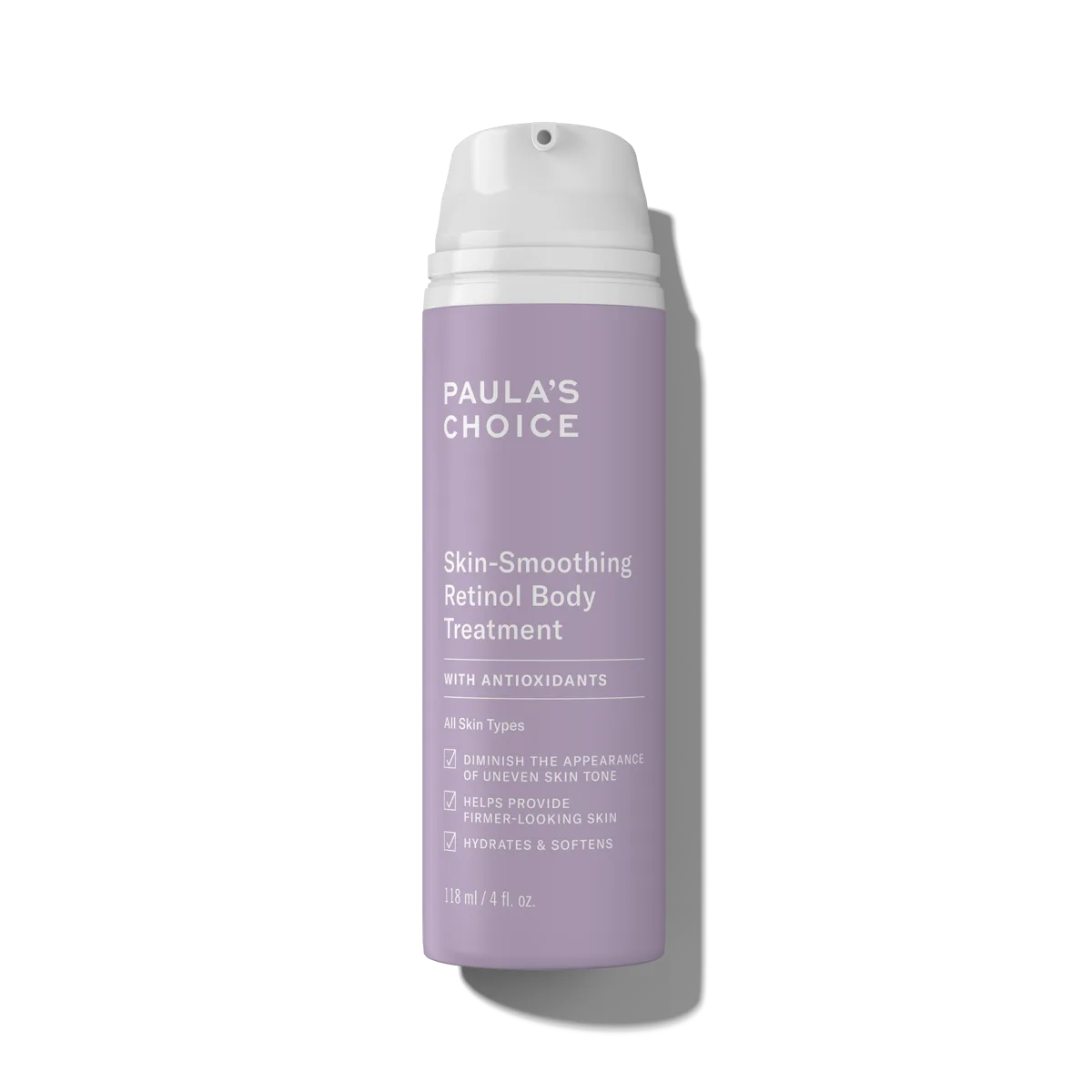
RESIST Retinol Skin-Smoothing Body Treatment
Body Retinol Pioneer
 Verified reviewer
Pros & cons.
- +One of the few well-formulated retinol body treatments available from a reputable brand
- +0.1% retinol concentration effectively addresses body texture, KP, and uneven tone
- +Oil-soluble vitamin C penetrates thicker body skin more effectively than water-soluble forms
- +Evening primrose oil provides anti-inflammatory support that buffers retinol irritation
- +Fragrance-free formula minimizes irritation risk on retinol-sensitized body skin
- +Visible improvement in keratosis pilaris within 6-8 weeks of consistent use
- −Four-ounce tube runs out quickly when applied to large body surface areas
- −Priced as a treatment product but used at body-lotion volumes creates value tension
- −Contains beeswax making it unsuitable for vegan consumers
- −Silicone base may not appeal to ingredient-conscious buyers
- −Not safe for use during pregnancy or breastfeeding due to retinol content
The full review.
You have used retinol on your face for years. You spend money and effort on cell turnover, collagen stimulation, and photoaging reversal from the jawline up. Meanwhile, your arms, chest, legs, and the backs of your hands use whatever body lotion is on the shelf. Paula’s Choice Resist Retinol Skin-Smoothing Body Treatment asks: shouldn’t the rest of your skin get the same quality of care?
The ingredient list says yes. Retinol at 0.1% forms the foundation—a concentration high enough to drive cell turnover but moderate enough for larger body surface areas. It includes tetrahexyldecyl ascorbate, an oil-soluble vitamin C that penetrates body skin more effectively than the water-soluble L-ascorbic acid in most facial products. This is a smart choice: body skin is thicker and has a different lipid composition than facial skin, so an oil-soluble vitamin C works with that reality.
The emollient base meets body skin’s needs. Shea butter, evening primrose oil, and grape seed oil provide a thick but absorbable foundation that addresses retinol-induced dryness. Evening primrose oil’s gamma-linolenic acid is anti-inflammatory and barrier-supportive, which helps when retinol accelerates cell turnover. Silicones allow the formula to spread across large areas without the tackiness many body treatments have.
In practice, this body treatment excels at two things. First, it improves the texture of rough, bumpy body skin. Users with keratosis pilaris—the rough bumps on upper arms and thighs affecting roughly forty percent of adults—report visible smoothing within six to eight weeks. Retinol promotes the cell turnover that unclogs the plugged follicles behind KP, while the moisturizing base keeps the new skin soft rather than flaky.
Second, it addresses uneven pigmentation and sun damage on the chest, arms, and hands. The retinol and vitamin C combination targets melanin production and skin renewal, gradually fading dark spots and creating a more uniform body skin tone. This is noticeable on the décolletage, where sun damage often creates a mottled, uneven appearance that basic moisturizers do not correct.
The texture is thicker than a typical body lotion but thinner than a body butter. It spreads well across arms and legs without using excessive amounts, though covering the full body would deplete the four-ounce tube in under two weeks. Most users apply it strategically—to arms, chest, hands, and specific areas of concern—rather than head-to-toe. This targeted approach is more effective, as concentrating the retinol on problem areas delivers better results than diluting it across the entire body.
The adjustment period is milder than most facial retinol products. At 0.1%, the concentration is gentle enough that most users experience little to no peeling or irritation, even on first use. Areas with thinner skin—the inner arms and chest—may show slight flaking during the first week, which resolves quickly. Body skin is generally more tolerant of retinol than facial skin because it is thicker and typically has no prior exposure to retinoids.
Size and price are the main concerns. Thirty-two dollars for four ounces is reasonable for a facial treatment but feels expensive for a body product, where consumers expect twelve-ounce bottles at half the price. Retinol body treatments are expensive to formulate; retinol is a costly active, and light-protective packaging adds to the cost. Paula’s Choice prices this honestly rather than cutting corners on the formula.
The non-vegan status (beeswax is in the formula) and silicone content will be dealbreakers for some. For others, these are reasonable trade-offs for a product that fills a gap in the body care market. Very few brands offer a retinol body treatment, and even fewer pair it with oil-soluble vitamin C, evening primrose oil, and panthenol in a fragrance-free base. The competition in this category is sparse, leaving this product largely unchallenged.
Carnosine, a naturally occurring dipeptide with anti-glycation properties, is an interesting inclusion. Glycation—where sugar molecules bond to proteins like collagen, making them stiff and less elastic—contributes to the loss of body skin firmness that accelerates after forty. An anti-glycation ingredient alongside retinol addresses body skin aging from two biochemical angles.
If you have a thorough facial skincare routine but your body skin lacks the same attention, this treatment is a logical extension of that evidence-based approach. It will not transform crepey body skin overnight, but with consistent use, it delivers the same cell-turnover and antioxidant benefits below the jawline that facial products deliver above it.
Formula
Ingredient analysis.
Full INCI list
Water, Cetearyl Alcohol, Cetearyl Ethylhexanoate, Cyclopentasiloxane, Dimethicone, Glycerin, Butylene Glycol, Cetyl Palmitate, Butyrospermum Parkii (Shea Butter), Glyceryl Stearate, PEG-100 Stearate, Oenothera Biennis (Evening Primrose) Oil, Vitis Vinifera (Grape) Seed Oil, Cetyl Alcohol, Retinol, Tetrahexyldecyl Ascorbate, Tocopheryl Acetate, Caprylic/Capric Triglyceride, Panthenol, Carnosine, Dimethiconol, Dimethicone/Vinyl Dimethicone Crosspolymer, Cera Alba (Beeswax), Magnesium Aluminum Silicate, Sodium Hydroxide, Xanthan Gum, Dicaprylyl Carbonate, Decylene Glycol, Disodium EDTA, Chlorphenesin, Phenoxyethanol
Skin match.
The science.
The Science
Retinol has one of the most documented mechanisms of action in dermatological literature. Retinol binds to retinoid receptors in the skin to accelerate cell turnover, stimulate collagen production, and regulate melanin synthesis. Most clinical studies focus on facial application, but the biology applies to body skin too.
The 0.1% retinol concentration is effective in clinical trials. A 2007 study in the Archives of Dermatology shows that 0.1% retinol applied three times weekly for 24 weeks improves naturally aged skin by increasing glycosaminoglycan and procollagen I expression. This concentration provides a meaningful starting point for body skin never exposed to retinoids.
Tetrahexyldecyl ascorbate, the oil-soluble vitamin C in this formula, penetrates the skin's lipid barrier more effectively than L-ascorbic acid. Research in the Journal of Cosmetic Dermatology shows this derivative converts to ascorbic acid intracellularly. It provides antioxidant protection with less irritation than acidic vitamin C forms — a benefit for retinol-sensitized skin.
Research in the British Journal of Dermatology shows that topical gamma-linolenic acid (GLA) from evening primrose oil improves barrier function and reduces inflammation. In a retinol body treatment, this anti-inflammatory fatty acid manages the irritation caused by accelerated cell turnover.
Studies in Biochemistry document carnosine's anti-glycation properties. While topical anti-glycation research is still developing, the mechanism is well-established: it prevents sugar-protein cross-links that stiffen collagen. This complements retinol's collagen-stimulating action.
References
- Retinol and retinyl esters: biochemistry and physiology — Journal of the American Academy of Dermatology (2006)
Dermatologist Perspective
Dermatologists recognize that body skin deserves the same evidence-based treatment as facial skin; retinol body products extend anti-aging skincare below the jawline. Board-certified dermatologists note that 0.1% retinol is an appropriate introductory concentration for body use because body skin is generally thicker and more tolerant, though it may be retinoid-naive. Combining it with oil-soluble vitamin C is a smart formulation strategy for cell turnover and antioxidant protection. Dermatologists commonly recommend this type of product for keratosis pilaris, crepey body skin, sun-damaged chest and arms, and overall body skin quality maintenance. Sun protection on treated areas is mandatory.
Where it fits in your routine.
Apply to clean, dry body skin in the evening after showering. Use a nickel-sized amount for each body area (one for each arm, one for the chest, etc.). Massage until absorbed. Avoid broken, irritated, or sunburned skin. For the first two weeks, apply every-other-night to let skin acclimate, then use nightly. Always apply broad-spectrum sunscreen to retinol-treated body areas exposed to daylight the following day.
At thirty-two dollars for four ounces, this is priced as a treatment product rather than a basic body lotion — a distinction that's important to understand. Retinol body treatments are inherently more expensive to formulate than standard body care, and few brands offer them at all. The value proposition is strongest for strategic, targeted application to specific concern areas (arms, chest, hands) rather than full-body coverage. For those dealing with KP, body skin texture issues, or décolletage sun damage, the cost per concern treated is reasonable. Budget-minded buyers may prefer to use it only on priority areas and rely on a basic body lotion elsewhere.
People with keratosis pilaris, rough body skin texture, sun-damaged chest or arms, or uneven body skin tone seeking evidence-based treatment. Users with a facial retinol routine who want that same quality of care for their body. People with crepey or aging body skin who want more than basic moisturization.
Retinol is contraindicated for pregnant or breastfeeding individuals. People with very sensitive body skin that reacts to active ingredients should avoid it. Vegans cannot use it because of the beeswax content. It is not for anyone unwilling to use daily body sunscreen on treated areas. Budget-conscious buyers needing affordable coverage for larger body surface areas may find it useful.
Product details.
Thick, creamy body lotion with a silky feel from the silicone base. It is thicker than a typical body lotion but spreads well and absorbs quickly without a greasy film.
Unscented — no added fragrance.
Squeeze tube with a flip-top cap. Opaque packaging protects the retinol and vitamin C from light. It works well for body application.
Silicones provide good slip for smooth application. Skin feels softer and more hydrated immediately. Some users feel mild tingling or slight peeling on thinner body skin areas (inner arms, décolletage) during the first 1-2 weeks as skin acclimates to retinol. Most users have no significant adjustment period at 0.1% concentration.
4-6 weeks with nightly application to arms and chest
12 months
All Year
The backstory.
Launched as part of the Paula's Choice Resist anti-aging line, this body treatment addressed a genuine gap in the skincare market — the body had been largely ignored by the retinol revolution that transformed facial skincare. While faces were getting exfoliated, retinized, and acid-peeled, body skin was still being treated with little more than basic moisturizer. This product was one of the first to bring evidence-based anti-aging to the neck-down.
About Paula's Choice
Established Brand (5–20 years)Beauty journalist Paula Begoun founded Paula's Choice in 1995. The brand builds its reputation on ingredient transparency and evidence-based formulations. Skincare communities cite Paula's Choice for its research-driven approach, and the brand publishes detailed ingredient explanations for every product.
FAQ.
Can I use this on my face?
The 0.1% retinol concentration works for the face, but this formula targets body skin. It uses a thick base of shea butter, beeswax, and silicones that is often too heavy for most facial skin types. Paula's Choice offers facial retinol products with lighter bases for the face.
Do I need to wear sunscreen on my body when using this?
Yes — retinol increases photosensitivity everywhere it is applied. Protect any body areas treated with this product that see sunlight the next day using broad-spectrum body sunscreen. This is vital for arms, chest, and legs during warm weather.
Why is this only 4 oz for a body product?
Retinol body products cost more to formulate than basic body lotions. Retinol is a costly active that needs light-protective packaging and careful stabilization. The 4 oz size reflects these formulation costs. For best value, many users apply it to specific areas of concern (arms, chest, hands) instead of full-body application.
Is this safe to use during pregnancy?
No — this product contains retinol, which is not recommended during pregnancy or breastfeeding. Topical retinoids are contraindicated during pregnancy as a precaution. Consult your OB/GYN for pregnancy-safe body skincare alternatives.
What the community says.
"Noticeably smoother body skin within weeks"
"Helps fade keratosis pilaris bumps on arms"
"Evens out body skin tone and sun damage"
"Rich enough to moisturize without a separate body lotion"
"One of the only retinol body products available"
"4 oz runs out quickly when used on large body areas"
"Expensive for a body product at this size"
"Can cause initial peeling on sensitive body areas"
"Contains silicones that some users prefer to avoid"
"Beeswax makes it unsuitable for vegans"
People also looked at.