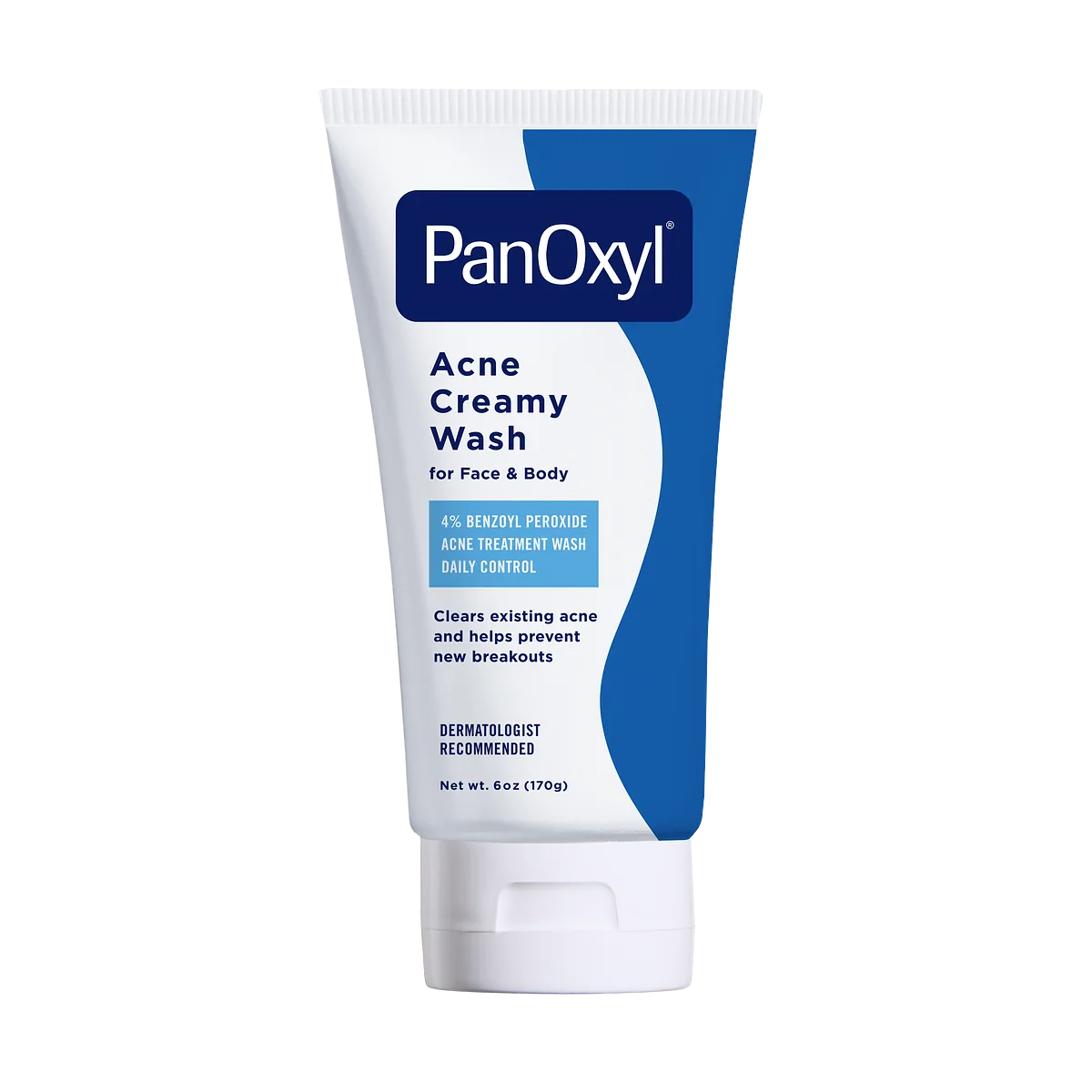
Antimicrobial Hydrating Acne Wash
Derm-Trusted Acne Wash
 Verified reviewer
Pros & cons.
- +4% BP concentration is clinically proven as effective as 10% with significantly less irritation and dryness
- +2023 reformulation with three humectants and four emollients keeps skin hydrated during cleansing
- +Backed by the #1 dermatologist-recommended OTC benzoyl peroxide brand with 50+ year heritage
- +Fragrance-free, paraben-free, sulfate-free — a genuine modernization of the original formula
- +Effective on both face and body acne with visible results within 1-2 weeks
- +HSA/FSA eligible for zero out-of-pocket cost with flexible spending accounts
- −Bleaches colored towels, pillowcases, and clothing on contact — an unavoidable BP characteristic
- −6 oz tube is relatively small and runs out quickly when treating body acne areas
- −Adjustment period of 1-2 weeks with potential mild dryness and redness as skin acclimates
- −4% concentration may be insufficient for stubborn cystic or nodular acne
- −Can bleach eyebrows and hair at the hairline if not rinsed thoroughly
The full review.
For decades, benzoyl peroxide washes used a simple logic: more burning meant more efficacy. PanOxyl’s 10% Foaming Wash became America’s best-selling acne wash using this scorched-earth method—kill bacteria, then worry about the moisture barrier. It worked, but it often left skin feeling power-washed.
The Antimicrobial Hydrating Acne Wash shows PanOxyl refined this approach. Reformulated in 2023, this 4% creamy version has half the benzoyl peroxide concentration of the foaming wash and uses a base with three humectants and four emollients. The goal: fight acne without attacking the skin.
The clinical logic is sound. Multiple peer-reviewed studies—including a 1995 trial in the Journal of the American Academy of Dermatology—show that 2.5-5% benzoyl peroxide reduces acne lesion counts as effectively as 10% with less irritation. The 4% concentration in this wash hits that evidence-supported sweet spot. You do not sacrifice efficacy by switching from 10%; you just eliminate unnecessary collateral damage.
The texture shows the product’s intent. While the 10% Foaming Wash is thin and detergent-like, this is a thick, opaque cream that spreads without sudsing. It lathers slightly on wet skin—enough to feel like a cleanser, but not a soap. The formula uses glycerin, sorbitol, and propanediol as humectants, plus dimethicone and oleic acid as emollients. After rinsing, the difference from a standard BP wash is clear: skin feels clean and slightly soft instead of tight and stripped.
The recommended technique is simple. Apply to wet skin, spread the cream over the affected area, and leave it on for one to two minutes. This contact time lets the benzoyl peroxide start its antimicrobial action. BP works by releasing oxygen into the anaerobic environment inside pores, killing Cutibacterium acnes bacteria that thrive without oxygen. Then rinse thoroughly. This leave-on step separates a benzoyl peroxide wash from a regular cleanser; skipping or shortening it reduces efficacy.
Acne-clearing results match what clinical literature predicts for 4% BP. Most users report fewer new inflammatory breakouts within one to two weeks, with significant improvement by week four to six. The wash is not a spot treatment—it works by reducing the overall bacterial load across the treated area, meaning it prevents new pimples rather than just resolving existing ones faster.
Bleaching is unavoidable. Benzoyl peroxide is an oxidizing agent. It will bleach any colored fabric it touches—towels, pillowcases, shirt collars, or washcloths. This is not a PanOxyl-specific issue; it is inherent to the molecule. Use white towels, rinse thoroughly, watch your hairline and eyebrows, and expect to lose some towels. This is the biggest practical downside of any BP product, and no reformulation changes it.
The formula is fragrance-free, paraben-free, sulfate-free, and vegan. This is an upgrade from the pre-2023 version, which contained parabens, sodium lauryl sulfate, and mineral oil. The new surfactant system (decyl glucoside, sodium laurylglucosides hydroxypropylsulfonate) is gentler and helps cleanse without compromising the skin barrier. For a product with prescription-heritage credentials, the modernized inactive ingredient list reflects what dermatologists now know about maintaining skin barrier health during acne treatment.
PanOxyl’s dermatological pedigree gives it a credibility advantage. It is recommended by 53.8% of dermatologists when prescribing OTC benzoyl peroxide—more than twice any competitor. PanOxyl occupies a market position similar to CeraVe in moisturizers: the product your dermatologist actually tells you to buy. Multiple named dermatologists endorse the brand, and PanOxyl was a prescription product before going OTC in 2011.
Size is a practical limitation. At six ounces for approximately eleven dollars, the tube lasts four to six weeks for face-only use. If you treat body acne—back, chest, or shoulders—the product lasts two to three weeks, making it a relatively expensive per-use option for the body. The 10% Foaming Wash, sold in a similar size, may be more cost-effective for body-only use where thicker skin handles higher concentrations better.
If you found the 10% PanOxyl too harsh, avoided benzoyl peroxide due to dryness, or are new to BP and want a sensible strength, try this wash first. The 2023 reformulation shows PanOxyl can evolve its formula while keeping the clinical rigor that earned five decades of dermatologist trust.
Ingredient analysis.
Full INCI list
Active Ingredient: Benzoyl Peroxide 4%. Inactive Ingredients: Aqua (Water), Carbomer, Decyl Glucoside, Diethylhexyl Sodium Sulfosuccinate, Dimethicone, Glycerin, Oleic Acid, Palmitic Acid, PEG-40 Stearate, Polyacrylate Crosspolymer-6, Propanediol, Silica, Sodium Chloride, Sodium Citrate, Sodium Hydroxide, Sodium Laurylglucosides Hydroxypropylsulfonate, Sorbitan Stearate, Sorbitol, Stearic Acid, t-Butyl Alcohol, Xanthan Gum
Skin match.
The science.
The Science
Benzoyl peroxide is a topically studied acne treatment with over 60 years of clinical use. Its antimicrobial mechanism is unique: BP decomposes into benzoic acid and oxygen free radicals on the skin. The released oxygen kills the anaerobic Cutibacterium acnes (formerly Propionibacterium acnes) bacteria that colonize sebaceous follicles and cause inflammatory acne.
A 1995 study by Mills et al. in the Journal of the American Academy of Dermatology compared 2.5%, 5%, and 10% BP formulations over 12 weeks. It found no statistically significant difference in inflammatory or non-inflammatory lesion reduction between concentrations. However, the 2.5% and 5% groups had significantly less irritation, showing that lower-concentration BP formulations work as well as higher ones but tolerate better.
Benzoyl peroxide resists bacterial resistance better than antibiotics. A 2004 review by Eady et al. in the British Journal of Dermatology noted that no bacterial resistance to benzoyl peroxide has ever been documented, even after decades of use. This makes BP a useful adjunctive treatment or an alternative to topical antibiotics (clindamycin, erythromycin) where resistance is a problem.
The wash-off format affects pharmacokinetics. A 2009 study by Bucks et al. showed that a 2-minute contact time with a benzoyl peroxide wash deposits a meaningful concentration of BP in the follicular reservoir. The drug stays in the pore environment and works after rinse-off. This supports the 1-2 minute leave-on recommendation and explains why short-contact BP washes work clinically despite being rinsed away.
The reformulated vehicle uses glycerin and sorbitol to fix a known BP therapy limitation. A 2019 study in the Journal of Drugs in Dermatology found that humectant and emollient ingredients in the vehicle significantly mitigate benzoyl peroxide-induced irritation and barrier disruption without reducing antimicrobial efficacy. This validates the approach PanOxyl took with this reformulation.
References
- Comparison of 2.5%, 5%, and 10% benzoyl peroxide on inflammatory acne vulgaris — Journal of the American Academy of Dermatology (1995)
- Antibiotic resistance in Propionibacterium acnes: mechanisms and clinical significance — British Journal of Dermatology (2004)
- Short-contact benzoyl peroxide wash: follicular penetration and clinical efficacy — Journal of Drugs in Dermatology (2009)
Dermatologist Perspective
Dermatologists view benzoyl peroxide as a cornerstone of acne treatment. PanOxyl's Creamy Wash follows best practice by using an evidence-based concentration (4%) in a skin-barrier-friendly vehicle. Board-certified dermatologists often prescribe this wash as a first-line OTC treatment before moving to prescription retinoids or antibiotics. The wash-off format minimizes contact time and irritation while still delivering clinically meaningful BP deposition in the follicular reservoir. Dermatologists also value BP's unique resistance profile; unlike topical antibiotics, no bacterial resistance to benzoyl peroxide has ever been documented, making it safe for long-term maintenance therapy.
Where it fits in your routine.
Wet the face or affected body area with lukewarm water. Squeeze a nickel-sized amount onto fingertips and apply using gentle circular motions, avoiding the eye area. Leave it on for 1-2 minutes; benzoyl peroxide needs this contact time to work. Rinse well with lukewarm water and pat dry with a white towel (BP bleaches colored fabrics). Immediately follow with a non-comedogenic moisturizer and, in the morning, a broad-spectrum SPF 30+. Use once daily (preferably in the evening) for the first 1-2 weeks to let your skin adjust, then increase to twice daily if tolerated.
At about $10.69 for 6 oz, the $1.78 per-ounce price is reasonable for a medicated acne cleanser from the #1 dermatologist-recommended BP brand. Using it on the face twice daily lasts 4-6 weeks. This makes the monthly cost roughly $8-11, which matches prescription copays and costs less than many boutique acne treatments. HSA/FSA eligibility removes the cost for insured consumers. The tube depletes faster for body acne treatment, so the 10% Foaming Wash may offer better value per application on thicker body skin.
Acne sufferers get the proven efficacy of benzoyl peroxide without the harsh dryness of the 10% Foaming Wash. This works for people new to BP treatment, those with sensitive or combination skin, and anyone whose dermatologist recommended a gentle benzoyl peroxide wash. It also maintains clear skin after completing a prescription acne regimen.
People with very dry or eczema-prone skin may find 4% BP irritating, even in this hydrating vehicle. If your acne is primarily non-inflammatory (blackheads, whiteheads without redness), a salicylic acid wash works better because BP targets inflammatory, bacteria-driven acne. If you cannot tolerate fabric bleaching, benzoyl peroxide products are not for you.
Product details.
This thick, opaque white cream cleanser lathers lightly on wet skin. It foams significantly less than PanOxyl's 10% Foaming Wash. The creamy consistency feels gentle and non-stripping.
Fragrance-free with no added scent. The benzoyl peroxide has a mild, faint medicinal/clinical note during use, but this does not linger after rinsing.
White squeeze tube with blue-teal PanOxyl branding and a flip-top cap. The 2023 reformulation uses packaging labeled 'NEW & IMPROVED'. The 6 oz tube is compact and travel-friendly.
The creamy cleanser feels gentler than typical benzoyl peroxide washes on first use. Mild tingling is normal during the 1-2 minute leave-on time. Skin feels clean but not tight after rinsing. An adjustment period of 1-2 weeks is typical; mild redness and dryness occur as skin acclimates to benzoyl peroxide. Start with once-daily use and increase to twice daily as tolerated.
4-6 weeks with twice-daily facial use; 2-3 weeks if also using on body areas
12 months
All Year
The backstory.
PanOxyl's Creamy Wash originated as a prescription product under Stiefel Laboratories before going OTC in May 2011. When Crown Laboratories acquired the brand in 2018, they inherited a formulation that was effective but dated — it still contained parabens and sulfates. The 2023 reformulation was Crown's attempt to modernize the product for a market that now demands both efficacy and skin health, adding hydrating ingredients while removing legacy preservatives and harsh surfactants.
About PanOxyl
Legacy Brand (20+ years)Stiefel Laboratories launched PanOxyl in the early 1970s as a prescription benzoyl peroxide brand. Crown Laboratories owns PanOxyl now. It is the #1 dermatologist-recommended OTC benzoyl peroxide brand, with a 53.8% recommendation rate per IQVIA ProVoice survey—double any competitor. The Creamy Wash uses a 2023 reformulation with more hydrating ingredients.
Common myths.
Higher benzoyl peroxide percentages work better than lower percentages
Clinical studies show 2.5-5% benzoyl peroxide reduces acne lesions as well as 10% concentrations, but with less irritation, dryness, and peeling. A 1995 study in the Journal of the American Academy of Dermatology found no statistically significant difference in acne reduction between 2.5%, 5%, and 10% BP formulations. The 4% in this wash balances efficacy and tolerability.
Benzoyl peroxide thins the skin like retinoids do
Benzoyl peroxide does not thin the skin or increase cell turnover like retinoids. It releases oxygen into the pore to kill anaerobic Cutibacterium acnes bacteria. The dryness and peeling some users experience is surface-level irritation, not structural skin thinning. Benzoyl peroxide is safe for daily use over the long term.
FAQ.
What is the difference between PanOxyl 4% Creamy Wash and 10% Foaming Wash?
The Creamy Wash contains 4% benzoyl peroxide in a hydrating, non-foaming cream base designed for daily use with minimal dryness. The Foaming Wash contains 10% BP in a more stripping, foaming formula for stubborn or severe acne. Clinical research shows 4% BP is as effective as 10% for most acne with significantly less irritation, making the Creamy Wash the better choice for sensitive or dry-prone skin.
***
How long should you leave PanOxyl Creamy Wash on your face?
Leave the wash on for 1-2 minutes so benzoyl peroxide has enough contact time with the skin before rinsing thoroughly. This short leave-on period lets the BP start its antimicrobial action. Do not leave it on longer; this increases irritation risk without increasing efficacy.
***
Does PanOxyl Creamy Wash bleach towels and fabrics?
Yes — benzoyl peroxide is an oxidizing agent. It bleaches colored towels, pillowcases, and clothing on contact. Use white towels and rinse well to reduce fabric staining. All benzoyl peroxide products do this; it is not specific to PanOxyl.
***
Can you use PanOxyl Creamy Wash with retinol or tretinoin?
Yes, but time them carefully. Using BP and retinoids together increases irritation. Dermatologists often recommend using the PanOxyl wash in the morning and your retinoid product at night, or using them on alternating days until your skin builds tolerance.
***
Is PanOxyl 4% Creamy Wash safe during pregnancy?
Benzoyl peroxide is generally safe during pregnancy because topical use in a wash-off product results in minimal systemic absorption. The American College of Obstetricians and Gynecologists does not list BP as a pregnancy-contraindicated ingredient. However, always consult your healthcare provider before starting new acne treatments during pregnancy.
***
Is PanOxyl Creamy Wash good for back acne?
Yes — PanOxyl works on body acne on the back, chest, and shoulders. The 4% BP concentration kills acne-causing bacteria on body skin the same way it does on the face. Note that the 6 oz tube runs out fast when covering large body areas — the 10% Foaming Wash in the 5.5 oz bottle is more practical for body-only use.
***
Community
What the community says.
"Effectively clears acne without over-drying skin like the 10% foaming version"
"Creamy texture feels hydrating and leaves skin soft rather than stripped after rinsing"
"Works well on both face and body acne including back and chest"
"Noticeable improvement in breakouts within 1-2 weeks of daily use"
"Fragrance-free and gentle enough for sensitive acne-prone skin"
"Bleaches towels, pillowcases, and colored clothing on contact"
"Can bleach eyebrows and hairline if not rinsed thoroughly"
"Some initial dryness and irritation during the adjustment period (first 1-2 weeks)"
"6 oz tube is relatively small and runs out quickly when used on body areas"
"4% concentration may not be strong enough for stubborn or cystic acne"
People also looked at.