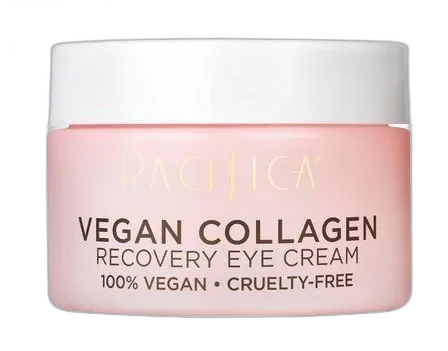
Vegan Collagen Recovery Eye Cream
Drugstore Vegan Pick
 Verified reviewer
Pros & cons.
- +Vegan and certified cruelty-free formulation
- +Lightweight texture absorbs quickly without pilling
- +Caffeine provides visible cosmetic de-puffing effect
- +Bakuchiol as a gentle retinol alternative for sensitive eye area
- +Affordable drugstore pricing at roughly $16 for 15ml
- +Includes niacinamide for supporting barrier function
- −Added fragrance is a real drawback for an eye-area product
- −Small 15ml size depletes faster than larger competitors
- −'Vegan collagen' positioning is marketing, not mechanism
- −Limited effect on pigmented or genetic dark circles
The full review.
‘Vegan collagen’ cannot exist. Collagen is an animal connective tissue protein. Plant-based versions are actually amino acids, phytoplankton extract, bakuchiol, or plant proteins that encourage the skin’s own collagen synthesis. This is not a collagen cream; it is a collagen-synthesis-support cream with a catchy name. Pacifica, the FDA, and informed consumers know this. The question is whether the formula justifies the label.
The answer is mostly yes, with one asterisk. Pacifica uses a reasonable trio of actives for the price: bakuchiol (a plant-derived compound that peer-reviewed research shows is a gentler, slower-acting alternative to retinol), caffeine (for cosmetic vasoconstriction to temporarily de-puff under-eye bags), and niacinamide (for barrier support and mild pigmentation management). With plankton extract as the ‘vegan collagen’ hero, plus hyaluronic acid and panthenol for hydration, this is a lightweight, multi-tasking eye cream with sound ingredient logic.
The texture is excellent. It is soft, whipped, and cloud-like. It absorbs into thin periorbital skin within seconds without pilling under concealer, leaving a greasy finish, or creasing into fine lines. Many vegan eye creams in this price range use thick butters and plant oils that feel heavy in the morning; Pacifica uses a light emulsion with minimal occlusive weight. This is the right choice for an eye cream worn under SPF and makeup, which helps the product succeed in the drugstore category.
Caffeine works within 15 to 30 minutes of application. If you have slept poorly, used a laptop too long, or slept face-down, the under-eye area visibly tightens and puffiness shadows lighten. This effect is transient, not a cure; caffeine alone does not fix volume loss or pigmented dark circles. But for looking less tired, the mechanism is reliable and the delivery is competent. Niacinamide supports barrier function and provides mild brightening over weeks. Bakuchiol—the brand’s main bet—works slower, smoothing texture over eight to twelve weeks of consistent use without the tingling or peeling a retinol eye cream might cause.
The asterisk: Pacifica includes fragrance in the ingredient list. This is a notable choice for an eye cream. The eye area is among the most sensitive skin on the body, and fragrance is a top sensitizer in patch-testing studies. Most users tolerate this light fragrance, but it is an avoidable risk for those with sensitive skin, rosacea, allergic contact dermatitis, or eczema around the eyes. A ‘clean beauty’ brand should leave fragrance out of eye products; including it here prioritizes scent identity over formulation best practice.
The ‘vegan collagen’ claim warrants skepticism. Plankton extract and bakuchiol show promising but preliminary evidence for supporting collagen synthesis. At drugstore concentrations, the effect is likely modest. The name moves product in the clean-beauty aisle rather than describing a mechanism. Most claims at this price point are aspirational, but be clear: you are buying a lightweight vegan eye cream with caffeine, bakuchiol, niacinamide, and fragrance.
At approximately $16 for 15ml, the value is fair. This lasts roughly two to three months with twice-daily use. Compared to a $60-90 prestige eye cream with similar actives and a more conservative, fragrance-free formulation, you trade formulation polish for a price advantage. For vegan and cruelty-free shoppers who want legitimate actives and do not react to fragrance, this is a reasonable pick. For those with sensitive periorbital skin, fragrance-free alternatives exist in this same price range.
Ingredient analysis.
Full INCI list
Water/Aqua/Eau, Caprylic/Capric Triglyceride, Glycerin, Cetearyl Alcohol, Coco-Caprylate/Caprate, Cetearyl Olivate, Sorbitan Olivate, Glyceryl Stearate, Sodium Hyaluronate, Bakuchiol, Caffeine, Niacinamide, Plankton Extract, Tocopherol, Panthenol, Allantoin, Adenosine, Xanthan Gum, Phenoxyethanol, Ethylhexylglycerin, Fragrance/Parfum
Skin match.
The science.
The Science
Bakuchiol drives the 'vegan collagen' claim. A 2019 comparative study in the British Journal of Dermatology (Dhaliwal et al.) compared 0.5% bakuchiol twice daily to 0.5% retinol once daily for 12 weeks. Both ingredients improved wrinkles and hyperpigmentation with no statistical difference in efficacy, but bakuchiol caused less dryness and scaling. This provides the clinical basis for calling bakuchiol a 'retinol alternative,' even if the study used small sample sizes and lacks large-scale replication. Caffeine's ability to reduce periorbital puffiness is well-documented; its vasoconstrictive and anti-inflammatory properties appear in multiple dermatological texts, and topical application reduces the appearance of under-eye bags within 15 to 30 minutes. Niacinamide's barrier-supporting and pigment-modulating effects are among the most studied in cosmetic science (Hakozaki et al., British Journal of Dermatology, 2002). Combining bakuchiol, caffeine, and niacinamide for a thin, reactive skin region is mechanistically sensible, but the formula lacks disclosed concentrations and the fragrance may lower tolerability for the eye area.
References
- Prospective, randomized, double-blind assessment of topical bakuchiol and retinol for facial photoaging — British Journal of Dermatology (2019)
Dermatologist Perspective
Dermatologists view bakuchiol as a reasonable alternative to topical retinol for patients who cannot tolerate retinoid irritation or want a plant-derived active, though most see the evidence as promising rather than definitive. Board-certified dermatologists note that caffeine-based eye creams offer a reliable cosmetic effect on puffiness, making this product a maintenance choice rather than a treatment for genetic dark circles or significant volume loss. Because periorbital skin is sensitive and has a higher rate of allergic contact dermatitis, dermatologists typically recommend fragrance-free formulations. This is the main clinical reservation about this product despite its reasonable active lineup.
Where it fits in your routine.
Divide a small pea-sized amount between both eyes. Pat with your ring finger along the orbital bone instead of rubbing, moving from the inner corner outward. Stay away from the lash line to reduce fragrance exposure to the eye. Use morning and night after serums and before moisturizer and sunscreen. It works with daytime SPF and under makeup. Stop use if you see stinging, watering, or redness around the eye.
At about $16 for 15ml, the price matches other drugstore eye creams and beats comparable vegan options. Using it twice daily under both eyes lasts two to three months, making the monthly cost $5-8. Pacifica is an established brand with good distribution and clean-beauty credibility, so you aren't paying a premium for an unproven line. However, because it contains fragrance, the formulation is less polished than a similarly priced fragrance-free eye cream from a more dermatologically-focused brand. It is good value if the fragrance doesn't bother you; mediocre value if it does.
Vegan and cruelty-free consumers want an affordable eye cream with active ingredients instead of just hydration. This works best for cosmetic puffiness, mild fine lines, and general maintenance, not deep pigmentation or significant aging.
Skip this if you have sensitive skin, rosacea, eczema, or a history of allergic reactions to fragranced products — the added fragrance risks periorbital skin irritation. Also skip if your primary concern is pigmented dark circles; brighter actives at higher concentrations work better.
Product details.
Soft, whipped cream that melts into a lightweight, fast-absorbing finish
Lightly perfumed with a vaguely floral-fresh fragrance
Small airless-style tube with a pump or squeeze applicator
Caffeine makes the first application feel lightweight and cooling. The fragrance is noticeable at first; some users find it too strong for an eye-area product. Cosmetic puffiness reduces within 15-30 minutes. Smoother, better-hydrated under-eye skin appears within the first week.
2-3 months with twice-daily application under both eyes
12 months
All Year
The backstory.
Pacifica launched in 1997 in Portland, Oregon, originally as a candle and perfume brand built around 100% vegan, cruelty-free formulations. It expanded into skincare in the 2010s and carved out a niche in Target's 'clean beauty' aisle. The Vegan Collagen Recovery line launched around 2021 as part of the brand's effort to offer plant-based alternatives to traditional anti-aging ingredients.
About Pacifica
Established Brand (5–20 years)Pacifica launched in 1997 as an early US vegan and cruelty-free beauty brand. The brand has a long retail history and steady drugstore distribution, but its skincare formulations focus more on plant-extract marketing than clinical validation.
Common myths.
Vegan collagen is actual collagen.
Collagen is an animal-derived protein by definition. 'Vegan collagen' is marketing shorthand for plant-based ingredients (amino acids, phytoplankton extracts, bakuchiol) that support the skin's own collagen synthesis. The distinction matters — this cream does not contain collagen and does not deposit collagen on your skin.
Eye creams need to be heavily occlusive to work.
The skin around the eye is thinner and absorbs product faster. Lightweight formulas often work better than heavy ones. This cream's light texture suits the delicate periorbital skin at any age.
FAQ.
Does this eye cream actually contain collagen?
No. Collagen is an animal-derived protein; this formula is vegan. The 'vegan collagen' name refers to plant-based ingredients (bakuchiol, plankton extract, amino acids) that support the skin's own collagen production instead of depositing collagen on the surface.
Is it safe to use around the eye with the added fragrance?
The fragrance is the main drawback of this solid formula. It does not sit directly on the lash line, so most users tolerate it. However, if you have sensitive skin or a history of allergic contact dermatitis, this may not be the right choice.
Can I use this with retinol?
Yes — the bakuchiol in this cream is a gentle alternative that layers well with a traditional retinoid serum applied elsewhere on the face. Apply this eye cream first, then any full-face retinol, but keep the retinol away from the orbital area.
Does it help with dark circles?
Caffeine's vasoconstrictive effect reduces bluish, puffy dark circles. It works less on pigmented dark circles from melanin or deep genetic shadows.
Is it pregnancy safe?
Bakuchiol is generally safer than retinoids during pregnancy, but specific safety data on bakuchiol during pregnancy is limited. Ask your OB before using it during pregnancy or nursing.
How does it compare to The Inkey List Caffeine Eye Cream?
The Inkey List version is fragrance-free and focuses on caffeine and hydration. Pacifica's version adds bakuchiol and plant extracts for anti-aging, but includes fragrance — choose based on whether you want more actives or lower irritation risk.
Can I use it at night?
Yes, use it morning and night. The caffeine effect shows more cosmetically in the morning when puffiness peaks.
What the community says.
"Lightweight absorbent texture"
"Affordable price"
"Vegan and cruelty-free"
"Hydrating without heaviness"
"Fragrance is inappropriate for eye area"
"Small 15ml size"
"Limited results on deep-set dark circles"
"Some users react to the scent"
People also looked at.