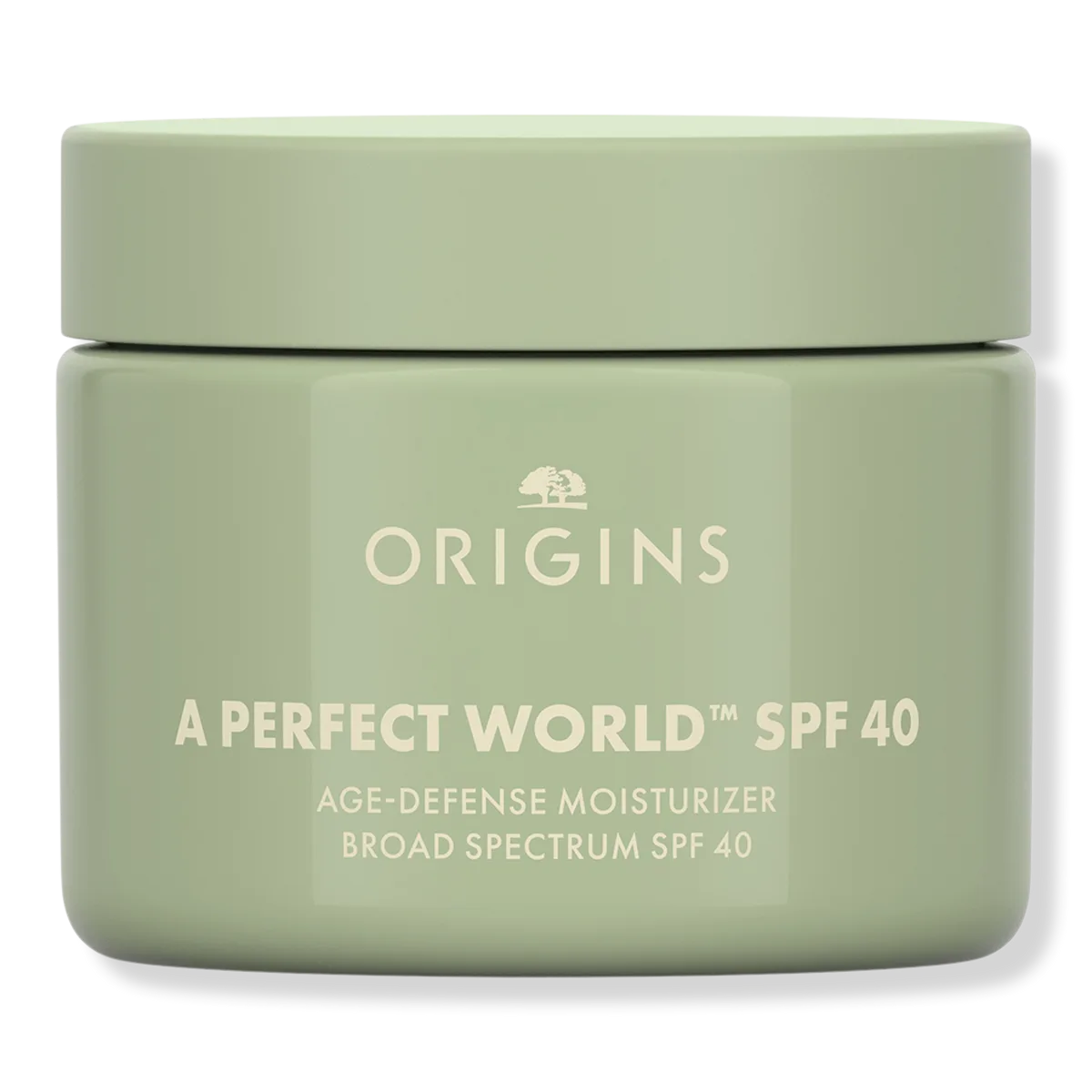
A Perfect World SPF 40 Age-Defense Moisturizer with White Tea
Botanical Sun Shield
 Verified reviewer
Pros & cons.
- +Impressive multi-botanical antioxidant complex with rare ingredients like ergothioneine and edelweiss
- +SPF 40 chemical protection with five UV filters provides reliable broad-spectrum defense
- +Lightweight cream texture feels like a moisturizer — no chalky or greasy sunscreen feel
- +No white cast on any skin tone thanks to 100% chemical UV filter system
- +White tea extract provides superior polyphenol antioxidant protection
- +Absorbs quickly and layers well under makeup
- −Five essential oils including photosensitizing bergamot and lemon are contradictory in a sun protection product
- −Contains citral, linalool, and limonene — declared fragrance allergens that exclude sensitive skin
- −Jar packaging is unhygienic and makes it difficult to measure proper SPF application amounts
- −Octinoxate raises environmental concerns — banned in some regions for coral reef damage
- −Premium price ($58/1.7 oz) for a chemical sunscreen with conventional UV filters
- −Not cruelty-free — parent company Estée Lauder allows animal testing where required by law
The full review.
About Origins
Leonard Lauder founded this in 1990.
Myth
None explicitly stated.
Reality
Bergamot fruit oil, lemon peel oil, camphor bark oil, and spearmint leaf oil in the product are photosensitizing.
How to Use
Apply generously and consistently.
Who Should Buy
Non-sensitive consumers who value botanical philosophy and tolerate the fragrance load.
Texture
Feels like a moisturizer. The cream spreads easily, absorbs in minutes, and leaves a satin-to-dewy finish.
Scent
Contains citral, linalool, and limonene, which are EU-declared contact allergens.
Packaging
Jar packaging.
Best Season
Not specified.
Common Praise
The antioxidant complex is impressive. The UV protection is solid. The texture is pleasant.
Common Complaints
Essential oils undermine the environmental defense the product promises. The jar packaging hinders proper sunscreen habits. The price is a premium the UV filter system alone does not justify.
Pairs Well With
Not specified.
Conflicts With
People with photosensitivity, rosacea, or post-procedure skin.
Best for
Normal and combination skin types.
Works for
Not specified.
Not ideal for
Anyone else.
AM routine
Works as a morning moisturizer and sunscreen in one step.
PM routine
Not specified.
Ingredient analysis.
Full INCI list
Active Ingredients: Avobenzone 3.0%, Homosalate 8.0%, Octinoxate 7.5%, Octisalate 4.5%, Octocrylene 5.0%. Inactive Ingredients: Water/Aqua/Eau, Butylene Glycol, Glycerin, Ammonium Acryloyldimethyltaurate/VP Copolymer, Polyethylene, Citrus Aurantium Bergamia (Bergamot) Fruit Oil, Citrus Limon (Lemon) Peel Oil, Citrus Aurantium Dulcis (Orange) Oil, Cinnamomum Camphora (Camphor) Bark Oil, Mentha Viridis (Spearmint) Leaf Oil, Magnolia Acuminata Flower Extract, Iris Pallida Root Extract, Rosa Damascena Extract, Citral, Linalool, Limonene, Cetyl Alcohol, Glyceryl Stearate, PEG-100 Stearate, PEG-6, Vaccinium Angustifolium (Blueberry) Fruit Extract, Vaccinium Macrocarpon (Cranberry) Fruit Extract, Solanum Tuberosum (Potato) Pulp Extract, Lycium Chinense (Wolfberry) Fruit Extract, Eriobotrya Japonica (Loquat) Leaf Extract, Passiflora Incarnata Flower Extract, Leontopodium Alpinum Extract, Betula Alba (Birch) Bark Extract, Camellia Sinensis (White Tea) Leaf Extract, Boswellia Serrata Extract, Sigesbeckia Orientalis (St. Paul's Wort) Extract, Thermus Thermophillus Ferment, Hordeum Vulgare (Barley) Extract, Triticum Vulgare (Wheat) Germ Extract, Saccharomyces Lysate Extract, Lythrum Salicaria Extract, Yeast Extract/Faex/Extrait De Levure, Algae Extract, Oryzanol, Squalane, Ethylhexylglycerin, Trehalose, Steareth-21, Ergothioneine, Sodium Hyaluronate, VP/Eicosene Copolymer, Nylon-12, Caprylyl Glycol, Sodium PCA, Sodium Dehydroacetate, Tocopheryl Acetate, Urea, Ascorbyl Tocopheryl Maleate, Citric Acid, Polyquaternium-51, Hexylene Glycol, Lecithin, Sodium Phytate, BHT, Mica, Phenoxyethanol
Skin match.
The science.
The Science
This formula's antioxidant strategy goes beyond the vitamin E afterthought in most SPF products. White tea (Camellia sinensis) provides catechins—specifically epigallocatechin gallate (EGCG)—which research shows neutralize UV-induced reactive oxygen species. White tea retains higher polyphenol concentrations than green tea because it undergoes less processing.
Ergothioneine is the most scientifically interesting ingredient. This amino acid, produced by certain fungi and bacteria, enters human cells via the OCTN1 transporter and accumulates in tissues exposed to oxidative stress, such as skin. Research in Free Radical Biology and Medicine shows ergothioneine scavenges singlet oxygen—a reactive species from UVA radiation—more efficiently than vitamin C or glutathione. Including ergothioneine targets the specific free radicals UV exposure generates.
The UV filter system is well-established. Avobenzone at 3% provides the UVA coverage the other four filters lack, while octocrylene at 5% protects against UVB and photostabilizes avobenzone to prevent degradation under sun exposure. The five active UV filters total nearly 30%, a robust load for SPF 40 protection.
Ascorbyl tocopheryl maleate uses an innovative delivery method, combining vitamins C and E into one stabilized molecule. This provides the synergistic antioxidant benefits of both vitamins without the stability issues of standalone ascorbic acid in cosmetic formulations. Research on this specific derivative is limited, but dermatological literature well-documents the photoprotective benefits of the individual vitamins.
Dermatologist Perspective
Board-certified dermatologists would value the SPF 40 rating and the five-filter UV system for reliable broad-spectrum protection. The antioxidant complex—especially the ergothioneine and white tea—aligns with evidence that topical antioxidants enhance photoprotection beyond UV filters alone. However, dermatologists would have concerns about the bergamot and lemon essential oils, as furocoumarins in these oils are documented photosensitizers. Dermatologists specializing in contact dermatitis would also flag the heavy essential oil and fragrance allergen load. The jar packaging is suboptimal for a product requiring consistent, generous application for efficacy.
Where it fits in your routine.
Apply at least a nickel-sized dollop to your face and neck as the final step of your morning skincare routine. Spread it evenly and wait 2-3 minutes to absorb before applying makeup. Reapply every 2 hours when outdoors, after sweating, or after swimming. Use a spatula or clean hands to scoop from the jar. Layer it over serums (vitamin C works well underneath). This is your sunscreen step — do not rely on this alone if layering under another SPF product.
At $58 for 1.7 oz, this SPF moisturizer costs a premium. The botanical antioxidant complex — specifically ergothioneine and edelweiss — sets it apart from cheaper options. But the UV filter system (avobenzone, homosalate, octinoxate, octisalate, octocrylene) exists in many cheaper products. One jar lasts about 6-8 weeks with proper SPF application, making the annual cost roughly $375-500. Value depends on whether you want antioxidant extras or a cheaper chemical sunscreen with basic vitamin E.
Normal to combination skin types want a daily SPF moisturizer that also works as an antioxidant treatment. It suits users who like Origins' botanical philosophy, enjoy essential oil fragrances, and want sun protection with anti-aging antioxidant support.
Avoid this if you have sensitive, rosacea-prone, or eczema-prone skin because of the heavy essential oil and fragrance allergen load. Skip this if you want reef-safe sunscreen (contains octinoxate), cruelty-free products (parent company allows animal testing), or budget-friendly daily SPF protection. Also skip if you prefer fragrance-free skincare or mineral-only sunscreens.
Product details.
Lightweight cream absorbs within 2-3 minutes. It applies smoothly without the thick, pasty feel common in high-SPF products. The texture is creamy but not heavy and has enough slip to spread easily over the face.
Bergamot, lemon, and orange essential oils create a bright citrus opening. This transitions to a soft white tea base with subtle mint and camphor notes. The scent is fresh and uplifting, though the essential oil smell is clear.
Glass or heavy plastic jar with a screw-off lid. It lacks a pump dispenser. This jar format is a drawback for a sunscreen product — it is less hygienic than a tube or pump, makes measuring the correct amount for SPF protection difficult, and exposes the product to air and light every time you use it.
The cream spreads easily on first application and has a citrus-floral scent. It absorbs in minutes, leaving a dewy, non-greasy finish. It leaves no visible white cast. Most users feel no stinging or tingling, but those sensitive to essential oils may feel mild warmth. The texture feels more like a moisturizer than a traditional sunscreen.
Apply daily every morning for 6-8 weeks. Generous SPF application uses a lot per use.
12 months
All Year
The backstory.
Origins has long positioned itself at the intersection of nature and science, and A Perfect World was one of the brand's original franchise products — initially launching as a non-SPF moisturizer before the SPF 40 version debuted in 2017. The formula reflects Origins' philosophy of using botanical extracts as functional ingredients rather than marketing props, packing in white tea, ergothioneine, edelweiss, and over a dozen other plant extracts alongside a robust chemical UV filter system.
About Origins
Established Brand (5–20 years)Leonard Lauder founded Origins in 1990. The brand is a subsidiary of The Estée Lauder Companies. Origins led the prestige skincare market toward natural-meets-science positioning and uses botanical ingredients. Dermatologists did not develop the products, but the brand uses Estée Lauder's R&D resources.
Common myths.
An SPF moisturizer provides the same protection as a dedicated sunscreen.
SPF moisturizers provide equivalent protection if you apply them at the tested thickness — about 2 mg per square centimeter of skin. Most people apply less moisturizer than standalone sunscreens. The jar format of this product makes underapplication easy. Apply a full nickel-sized amount to the face and reapply every 2 hours when outdoors.
Natural essential oils in sunscreen add UV protection.
Some essential oils contain compounds that absorb UV in vitro, but this formula uses them for fragrance, not sun protection. Five chemical sunscreen actives provide all the UV protection. The essential oils add scent and potential irritation but do not change the SPF rating.
FAQ.
Is Origins A Perfect World SPF 40 a mineral or chemical sunscreen?
This is a 100% chemical (organic) sunscreen. It uses five UV filters: avobenzone (3%), homosalate (8%), octinoxate (7.5%), octisalate (4.5%), and octocrylene (5%). It lacks mineral filters like zinc oxide or titanium dioxide. This prevents a white cast but makes it unsuitable for those wanting reef-safe or mineral-only sun protection.
Does Origins A Perfect World SPF 40 leave a white cast?
No. This 100% chemical sunscreen contains no mineral UV filters and absorbs completely clear. It works on all skin tones and leaves no white or ashy residue.
Is Origins cruelty-free?
No. Origins is owned by The Estée Lauder Companies, which allows animal testing where required by law — particularly for sale in mainland China. The brand is not certified by Leaping Bunny or PETA. The products are vegan (no animal-derived ingredients), but the company's animal testing policy means it does not meet cruelty-free certification standards.
Can you use Origins A Perfect World SPF 40 on sensitive skin?
This product is not for sensitive skin. It contains five essential oils (bergamot, lemon, orange, camphor, spearmint) and fragrance allergens citral, linalool, and limonene. These increase the sensitization load. People with reactive, rosacea-prone, or eczema-prone skin should use a fragrance-free SPF moisturizer instead.
Is Origins A Perfect World SPF 40 reef-safe?
No. This formula uses 7.5% octinoxate (ethylhexyl methoxycinnamate). Hawaii and several other regions banned this UV filter because it damages coral reefs. People seeking reef-safe sunscreen should use mineral (zinc oxide/titanium dioxide) formulas.
What the community says.
"Reliable SPF 40 protection that feels like a moisturizer, not a sunscreen"
"Light citrus and white tea scent feels fresh and pleasant for morning use"
"Absorbs quickly and layers well under makeup without pilling"
"Noticeable improvement in skin brightness and hydration over time"
"No white cast — invisible finish on all skin tones"
"Rich antioxidant complex provides visible anti-aging benefits"
"Multiple essential oils (bergamot, lemon, camphor, spearmint) can irritate sensitive skin"
"Jar packaging is inconvenient and unhygienic for a daily sunscreen product"
"Price has increased significantly over the years to $58 for 1.7 oz"
"Contains octinoxate — a UV filter with coral reef environmental concerns"
"Not moisturizing enough for dry skin in winter months"
"Can feel slightly greasy on oily skin types"
People also looked at.