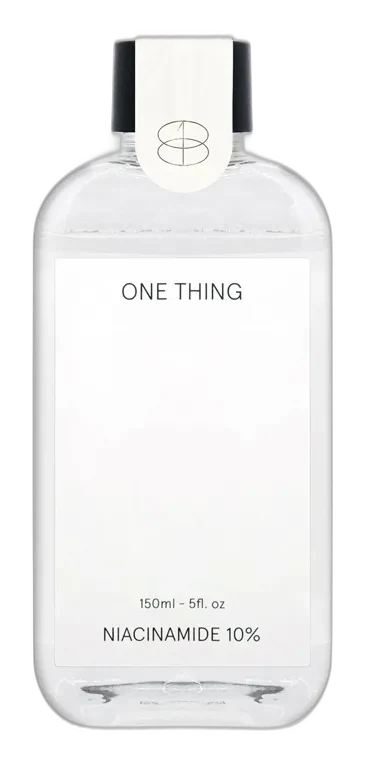
Niacinamide 10%
Budget Niacinamide MVP
 Verified reviewer
Pros & cons.
- +Clinically relevant 10% niacinamide concentration
- +Exceptional value at roughly 10 cents per milliliter
- +Fragrance-free, alcohol-free, and vegan formulation
- +Layers cleanly under any active or makeup without pilling
- +Generous 150ml size supports consistent twice-daily use
- +Includes allantoin and panthenol as irritation buffers
- −Can cause temporary flushing on sensitive or rosacea-prone skin
- −No added zinc for acne-specific formulation preferences
- −Plastic bottle packaging isn't premium-feeling
- −Requires 8-12 weeks of consistent use for PIH results
The full review.
The skincare industry missed a design opportunity: if 10% niacinamide is the dermatologist-standard for sebum control and pigment management, and it is cheap to make, why is it usually sold in 30ml dropper bottles as a precious serum? The Ordinary set this pricing model in 2016, and most brands copied it. One Thing changed this in 2020: they put 10% niacinamide in a 150ml bottle, call it an essence, and let users apply it daily without counting drops.
This format change is significant. At 80 cents per ml, users ration the product—using small amounts every other day only on problem areas. At 10 cents per ml, the math changes. You pour a generous amount, pat it over your whole face, use it morning and night, and treat it as an infrastructure layer rather than a special intervention. That is how niacinamide works. Research on sebum reduction, barrier improvement, and post-inflammatory hyperpigmentation fading relies on twice-daily application for 8 to 12 weeks, not occasional spot treatment.
The formula is intentionally simple. It contains 10% niacinamide, butylene glycol and glycerin as humectants, allantoin and panthenol as barrier soothers, sodium hyaluronate for hydration, a drop of adenosine (a Korean-regulated anti-wrinkle active that provides minor smoothing), 1,2-hexanediol for preservation, and water. It has no fragrance, no essential oils, no plant extracts, and no unnecessary peptides or exotics. The ingredient list is so short that 90% of the essence delivers niacinamide.
On skin, it feels like water with a faint slip. It absorbs in seconds, leaves no tack, and does not pill under sunscreens, silicone primers, or makeup. Because it lacks added zinc (a common niacinamide companion), the texture is thinner and cleaner than formulas with zinc PCA. It also avoids the slight grittiness zinc sometimes causes, which helps daily wearability.
Results follow the standard niacinamide timeline. Oil control and pore appearance improve around weeks 2 to 3—not because pores physically shrink, but because reduced sebum congestion and improved keratin turnover make them look smaller. Post-inflammatory hyperpigmentation fading is slower: expect 8 to 12 weeks of consistent twice-daily use before dark marks visibly fade. Users with compromised barriers often see barrier-calming effects within one or two weeks. Users expecting a dramatic transformation from a 10 cents-per-ml essence will be disappointed, but those expecting incremental, cumulative improvement will see results.
Note the flushing caveat. A small percentage of users—especially those with rosacea or reactive skin—experience temporary vasodilation during the first week of using 10% niacinamide. This causes transient redness lasting 15 to 30 minutes after application, which typically fades as skin adapts. If this happens, use the essence every other day for the first two weeks instead of twice-daily use. This is a tolerance issue, not a formulation flaw, and applies to any 10% niacinamide product.
Value makes this a no-brainer. At roughly $16 for 150ml, you pay about 10 cents per ml for a clinically relevant niacinamide concentration. A typical twice-daily application lasts three to four months, costing $4 to $5 per month. For comparison, Paula’s Choice 10% Niacinamide Booster costs about $44 for 20ml—over 10 times the per-ml cost. Even The Ordinary’s version costs about 5 times more per ml. One Thing is not a legacy derm brand with decades of clinical research, but it does not need to be. The active is off-patent and well-studied, the formula is minimal, and the value is unbeatable. For niacinamide, this is the one to beat.
Formula
Ingredient analysis.
Full INCI list · pH 6
Water, Niacinamide, Butylene Glycol, 1,2-Hexanediol, Glycerin, Allantoin, Panthenol, Sodium Hyaluronate, Adenosine, Ethylhexylglycerin, Disodium EDTA
Skin match.
The science.
The Science
Niacinamide is among the most studied cosmetic actives of the last 30 years. A 2005 study in the British Journal of Dermatology (Hakozaki et al., originally published 2002 and replicated through 2005) shows that 2-5% topical niacinamide reduces facial hyperpigmentation. It works by blocking melanosome transfer from melanocytes to keratinocytes, unlike hydroquinone, which inhibits tyrosinase activity. A 2006 paper in the Journal of Cosmetic and Laser Therapy (Draelos et al.) found 2% niacinamide reduces sebum excretion rates in Japanese and Caucasian subjects within 2-4 weeks. Concentrations up to 10% also improve barrier function by upregulating ceramide and free fatty acid synthesis. One Thing's 10% formulation uses the active at the top of the clinically useful range with a minimal excipient list to prevent dilution or interference. The supporting ingredients — panthenol, allantoin, adenosine, sodium hyaluronate — buffer the mild vasodilation a small minority of users experience at 10% niacinamide. The formula prioritizes tolerance over maximum active delivery, which is the correct real-world trade-off.
References
- The effect of niacinamide on reducing cutaneous pigmentation and suppression of melanosome transfer — British Journal of Dermatology (2002)
Dermatologist Perspective
Dermatologists routinely recommend 2-10% niacinamide as a versatile modern skincare active. Board-certified dermatologists note that niacinamide's mechanism — reducing melanosome transfer instead of inhibiting tyrosinase — complements hydroquinone, azelaic acid, or tranexamic acid in hyperpigmentation protocols. It also works with topical retinoids to offset retinoid-induced barrier disruption. Clinical guidance shows niacinamide is safe during pregnancy and compatible with almost every other topical active, making it a common 'universal add-on'. The 10% concentration in this essence sits at the upper limit of clinical usefulness before flushing or irritation risks outweigh incremental benefits.
Guidance
Where it fits in your routine.
Apply to clean skin after your hydrating toner and before your moisturizer. A dime-sized amount covers the full face and neck — pat it in with palms instead of a cotton pad. If you have sensitive or reactive skin, use it every other day for the first two weeks, then move to twice daily once your skin tolerates it. It layers with vitamin C, retinoids, exfoliants, and peptides. Always use sunscreen in the morning. It is safe during pregnancy and breastfeeding.
At about $16 for 150ml, this 10% niacinamide formulation has the best per-milliliter price on the market. One typical twice-daily face application lasts three to four months, costing $4-5 per month. Prestige niacinamide serums cost $40-60 for 20-30ml, making One Thing 10x more valuable. The brand is emerging and lacks a derm-developed legacy, but 10% niacinamide is a well-studied, off-patent active with little formulation risk. For daily niacinamide habits, the value is clear.
This niacinamide works for anyone seeking an affordable daily habit—especially those with large pores, oiliness, post-inflammatory hyperpigmentation, or dullness. It also complements retinoid routines by helping offset barrier disruption.
Skip if you have severe rosacea and reacted to niacinamide at concentrations above 5%. Also skip if you want a multi-active serum with peptides or antioxidants — this contains only niacinamide and its supporting cast.
Product details.
Thin, watery liquid with a barely perceptible slip
Unscented
Clear plastic bottle with a screw top — matches the One Thing line design.
The first few applications may cause mild flushing on sensitive skin. This happens because niacinamide causes temporary vasodilation; the effect is normal and fades within 15-30 minutes. Most users have no reaction. Visible oil-control and glow improvements start around week 2-3.
3-4 months with twice-daily face use
12 months
All Year
The backstory.
One Thing launched the Niacinamide 10% essence in 2020 as a follow-up to its viral Centella Asiatica and Hyaluronic Acid essences. The brand's pitch was simple: if 10% niacinamide is the clinically meaningful concentration for sebum control and pigmentation, why sell it as a precious 30ml dropper bottle instead of a generous everyday essence? It's now one of the brand's bestsellers globally.
About One Thing
Emerging Brand (2–5 years)One Thing launched in 2018 in South Korea with a minimalist single-ingredient philosophy. The brand is new, but its niacinamide essence uses a well-studied active at a clinically relevant concentration. This makes the formulation conservative despite the brand's short track record.
Common myths.
You can't layer niacinamide with vitamin C.
A 1960s study on pure niacin (not niacinamide) at high temperatures caused this concern. Modern niacinamide and L-ascorbic acid formulations layer well. This essence stays stable when applied before or after any vitamin C serum.
Higher niacinamide concentrations always work better.
Concentrations above 10% increase irritation and flushing risks without adding clear benefits. One Thing's 10% sits at the top of the clinically useful range but stays below the level where most users react.
FAQ.
How does this compare to The Ordinary Niacinamide 10% + Zinc 1%?
Both deliver 10% niacinamide at a budget price. One Thing's formula omits zinc PCA and uses a 150ml format instead of 30ml. The One Thing version pills less under makeup and works better as an everyday essence than a rationed treatment.
Can I use it with retinol?
Yes. Niacinamide and retinoids are actually a classic pairing — the niacinamide's barrier-supportive effect helps offset some of retinol's drying side effects. This essence layers cleanly underneath any retinoid product without causing pilling.
Is it safe for sensitive skin?
Mostly yes, but a small percentage of users see temporary flushing during the first week as skin adjusts to 10% niacinamide. If this occurs, use it every other day for two weeks before daily use.
Can I use it while pregnant or breastfeeding?
Yes. Niacinamide is safe during pregnancy and nursing. The rest of the ingredient list contains only mild humectants and soothers — nothing is restricted.
Will it help with acne?
Indirectly, yes—niacinamide reduces sebum production and has mild anti-inflammatory properties, which helps manage acne. It does not replace benzoyl peroxide or salicylic acid for active breakouts, but it reduces oiliness and post-acne discoloration.
How long before I see results?
Oil control and pore appearance improve within 2-3 weeks. Post-inflammatory hyperpigmentation fades slower; use it twice daily for 8-12 weeks to see results.
Community
What the community says.
"Noticeable improvement in oiliness"
"Large size for the price"
"Non-sticky feel"
"Visible pore appearance improvement"
"Flushing reaction on very sensitive skin"
"Doesn't smell like anything (some expect a 'scent cue')"
"Needs patience for PIH fading"
People also looked at.