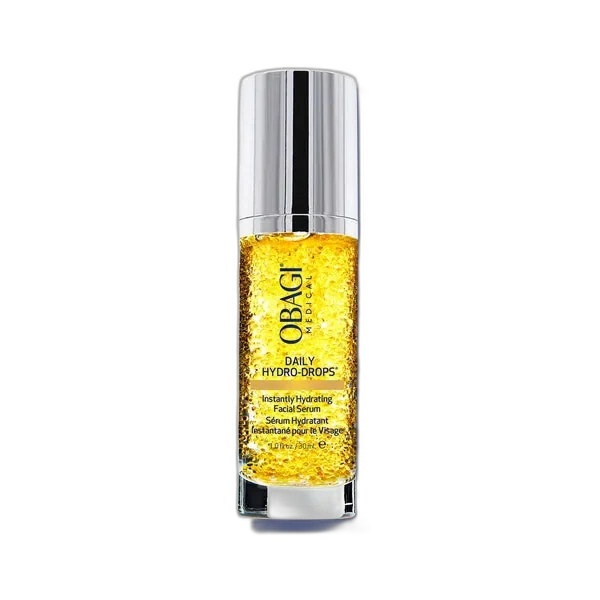
Daily Hydro-Drops Face Moisturizer
Luxury Hydration Experience
 Verified reviewer
Pros & cons.
- +Immediately visible smoothing and dewy glow from first application confirmed by clinical testing
- +Luxurious Isoplentix technology creates a genuinely premium application experience
- +Lightweight gel-serum texture absorbs instantly and layers beautifully under makeup
- +Non-comedogenic and hypoallergenic with dermatologist and ophthalmologist testing
- +Updated pump packaging improves on previous hard-to-use dropper design
- +Versatile enough to use as standalone lightweight moisturizer or layered under heavier cream
- −$115 for 1 oz is difficult to justify given the modest active ingredient concentrations
- −Contains fragrance (Parfum) which contradicts the brand's clinical positioning
- −Niacinamide at ~2% is below the 5% threshold where most clinical benefits are demonstrated
- −Chemical UV filters (octocrylene, homosalate, avobenzone) add irritation potential without providing SPF
- −Hero seed oils, while pleasant, lack robust clinical data differentiating them from more common alternatives
- −Not cruelty-free certified despite being marketed through dermatology practices
The full review.
About Obagi Medical
Obagi Medical built its reputation on products that work. Not products that look beautiful in the bottle, not products that feel like a spa moment, not products that photograph well for Instagram. The Nu-Derm system, the retinol lines, the vitamin C serums — these are products dermatologists recommend because the ingredients are at effective concentrations and the clinical data supports the claims. The Daily Hydro-Drops represents a deliberate departure from that identity, and the result is a product that’s easier to love using than it is to justify buying.
Texture
The first time you pump this serum and watch the visible oil droplets burst on your fingertips, you understand what $115 is buying. The Isoplentix technology suspends oil-filled microdroplets in a clear gel matrix, creating a liquid gold appearance that’s genuinely mesmerizing. When the droplets contact skin and release their payload of abyssinian, hibiscus, and meadowfoam seed oils, the formula transforms from a light gel into a silky, smooth veil that absorbs in seconds. It feels expensive. It looks expensive. The sensorial engineering here is first-rate.
Reality
The immediate effect is legitimate and measurable — Obagi’s own testing found that 91% of participants felt their skin was smoother after first use. And they’re right. The combination of glycerin, betaine, and those released seed oils creates an instant-gratification smoothing effect that makes skin look dewy, plump, and luminous. Under makeup, it functions as an exceptional primer — foundation glides on without catching, and the dewy finish persists through the day without tipping into oiliness. If your primary criterion for a skincare product is how your skin looks and feels in the hour after application, this delivers.
Myth
But DermFND reviews are about what’s in the bottle, not how the bottle looks. And this is where the Hydro-Drops faces honest scrutiny.
Works for
Niacinamide appears seventh in the ingredient list at an estimated 1.5-2% concentration. The bulk of clinical research demonstrating niacinamide’s efficacy for brightening, oil control, and barrier strengthening uses 5% or higher. At this concentration, niacinamide provides modest supporting benefits but falls short of the standalone efficacy that might justify featuring it as a hero ingredient. It’s present, it’s doing something, but it’s not doing what a $115 product from a clinical brand should promise.
Works for
The three hero seed oils — abyssinian, hibiscus, and meadowfoam — are perfectly pleasant emollients. Abyssinian oil is lightweight with high erucic acid content; hibiscus oil contributes phytosterols and essential fatty acids; meadowfoam oil is exceptionally stable and creates a moisture barrier. All three are good. None are rare, particularly potent, or backed by the kind of clinical evidence that justifies a premium over more common but equally effective oils like squalane or jojoba. They’re competent oils chosen partly for their performance and partly for their marketing appeal — they sound more exotic than they are.
Works for
Glycerin, the actual workhorse of this formula at 3-5%, is the humectant doing most of the hydrating heavy lifting. It’s one of the most effective and inexpensive moisturizing ingredients in cosmetic chemistry. It appears in products ranging from $5 drugstore moisturizers to this $115 serum, performing identically in both. The betaine alongside it adds a second humectant layer. Together, they’re why your skin feels hydrated after use — not because of any proprietary technology, but because glycerin is that good.
Scent
The fragrance inclusion is the most disappointing element of the formula. Obagi is a clinical brand trusted in dermatology offices. Adding Parfum to a $115 serum undermines that clinical positioning and excludes genuinely fragrance-sensitive patients who are the core medical-channel audience. The scent is described as delicate and floral — not offensive — but for a brand that charges premium prices partly on the basis of clinical credibility, fragrance is a choice that prioritizes mass-market appeal over dermatological rigor.
Conflicts With
The presence of chemical UV filters (octocrylene, homosalate, and avobenzone) in a non-SPF product raises questions. At the concentrations listed toward the end of the ingredient list, they’re not providing meaningful sun protection — they’re likely serving as photoprotective stabilizers for the formula’s oils and colorants. But their presence adds three more potential irritants to a formula that already contains fragrance, increasing the cumulative sensitization risk without providing functional UV protection.
Works for
The Isoplentix delivery technology, beyond its visual appeal, theoretically preserves the freshness of the oil actives by keeping them separated from the aqueous gel until application. This is a legitimate formulation advantage — isolated oils are less susceptible to oxidation during storage. Whether this translates to a measurable clinical difference compared to properly preserved pre-mixed emulsions has not been demonstrated in published research. The technology is elegant engineering; its clinical significance is assumed rather than proven.
Who Should Buy
At $115 for 1 oz, this is one of Obagi’s most expensive per-ounce products — pricier than their clinically validated retinol line. The per-use cost of approximately $2.00-2.50 per application puts it in luxury skincare territory. For that investment, the formulation should either contain actives at research-validated concentrations or offer a demonstrably unique benefit that cheaper alternatives cannot replicate. The Hydro-Drops achieves neither. What it offers is an experience — a beautiful, gratifying, immediately rewarding moment of skincare that makes your skin look great right now. If that experience is worth $115 to you, the product delivers on its implicit promise. If you’re paying for clinical efficacy, you’ll find better value in Obagi’s own retinol line or in hydrating serums from brands that put their budget into ingredients rather than delivery theater.
Ingredient analysis.
Full INCI list
Water (Aqua), Propanediol, Glycerin, Isononyl Isononanoate, Butylene Glycol, Betaine, Niacinamide, Limnanthes Alba (Meadowfoam) Seed Oil, Pentylene Glycol, Phenoxyethanol, Castor Oil/IPDI Copolymer, Parfum (Fragrance), Carbomer, Caprylic/Capric Triglyceride, Crambe Abyssinica Seed Oil, Hibiscus Sabdariffa Seed Oil, Octocrylene, Disodium EDTA, Sodium Hydroxide, Cellulose Gum, Homosalate, Butyl Methoxydibenzoylmethane, Helianthus Annuus (Sunflower) Seed Oil, Tocopherol, Amodimethicone, Beta-Carotene (CI 40800), Green 6 (CI 61565), Violet 2 (CI 60725)
Skin match.
The science.
The Science
The Obagi Daily Hydro-Drops uses established humectant and emollient science instead of novel actives. Glycerin and betaine drive the formula's hydration; both are proven humectants that pull water from the dermis and environment to maintain stratum corneum hydration.
Dermatological literature extensively documents glycerin's moisturizing properties. A 2016 review in the British Journal of Dermatology confirmed that 2-10% glycerin significantly improves skin hydration, barrier function, and mechanical properties. The estimated 3-5% glycerin in this formula stays within that effective range.
Niacinamide at the estimated 1.5-2% concentration offers some barrier support but sits below most clinically demonstrated thresholds. The 2005 Bissett et al. study in the International Journal of Cosmetic Science used 5% niacinamide to show improvements in fine lines, hyperpigmentation, and skin elasticity. At 2%, niacinamide may still increase ceramide synthesis—a 2000 study in Experimental Dermatology showed niacinamide upregulates ceramide synthesis at 0.01% in vitro—but the in-vivo relevance of sub-5% concentrations for visible anti-aging is less established.
The Isoplentix microfluid technology creates an oil-in-gel suspension. Here, lipophilic ingredients (abyssinian, hibiscus, and meadowfoam seed oils) appear as visible droplets within the aqueous gel phase. This uses established microemulsion science. Theoretically, this reduces oil oxidation during storage because the oils stay physically separated from the aqueous phase and pro-oxidant water-soluble ingredients until application. While the principle is sound, no peer-reviewed studies show the Isoplentix system provides clinically superior outcomes compared to conventional emulsion formulations.
The seed oils work mainly through emollient and occlusive effects. Abyssinian oil contains approximately 55-60% erucic acid, a very-long-chain monounsaturated fatty acid that provides slip and moisture barrier properties. Meadowfoam seed oil has over 98% long-chain fatty acids (mostly eicosenoic acid) and high oxidative stability; a 2019 analysis in Industrial Crops and Products confirmed its resistance to rancidity. Hibiscus seed oil provides oleic, linoleic, and palmitic acids with phytosterols that may have mild anti-inflammatory properties. No robust clinical data supports anti-aging efficacy for these oils beyond general emollient effects.
References
- Glycerol and the skin: holistic approach to its origin and functions — British Journal of Dermatology (2016)
- Niacinamide: A B vitamin that improves aging facial skin appearance — International Journal of Cosmetic Science (2005)
Dermatologist Perspective
Board-certified dermatologists would likely have mixed feelings. The hypoallergenic testing, non-comedogenic classification, and ophthalmologist testing provide clinical credibility through proper safety validation. However, dermatologists tracking ingredient concentrations would note the niacinamide falls below common efficacy thresholds, and the active profile does not match the $115 price point compared to other Obagi products. Including fragrance in a physician-dispensed product concerns dermatologists treating patients with rosacea, eczema, or contact dermatitis, where fragrance avoidance is standard medical advice. Dermatologists would likely recommend this as a hydrating complement to a treatment-focused routine rather than a treatment product.
Where it fits in your routine.
Shake the bottle gently to redistribute suspended oil droplets. Prime the pump on first use by pressing several times until product flows. Apply 1-2 pumps to clean, dry skin after cleansing and toning. Press and pat gently into skin so oil droplets release and absorb. Use morning and evening. Apply sunscreen in the AM. Use alone as a lightweight moisturizer or layer under a richer cream for more hydration.
At $115 for 1 oz, this is one of the most expensive hydrating serums based on its active ingredients. The core formula — glycerin, niacinamide at ~2%, and botanical seed oils — exists in $15-35 products with equal or higher active concentrations. The price pays for the Isoplentix delivery technology, Obagi's brand prestige, physician-channel distribution, and the premium feel, not rare or uniquely potent ingredients. Consumers who value the luxury application ritual and trust the Obagi name may find the cost justifies the experience. Ingredient-focused consumers pay a high premium over formulations with equivalent or better active profiles.
Choose this if you want a premium experience and can afford the price without needing treatment-level efficacy from the actives. It works well for normal to dry skin types that want immediate visible dewiness and smoothness. It adds value to routines that already use dedicated treatment products like retinol and vitamin C.
Budget-conscious consumers who prioritize active ingredient concentrations over sensorial experience. People with fragrance sensitivities should note the formula contains Parfum, despite the hypoallergenic claim. Those seeking measurable anti-aging or brightening results should buy products with higher active concentrations, such as Obagi's own retinol line.
Product details.
Added parfum gives a delicate, fresh, slightly floral fragrance. It is noticeable during application but not overpowering.
An updated pump dispenser replaces the previous dropper pipette, which users found hard to use near the end. The pump needs initial priming. Amber-tinted glass protects light-sensitive ingredients. Visible oil droplets suspended in the gel create a premium visual presentation. Finish dewyglowylightweight
The serum provides an immediate smoothing and dewy effect on first use — 91% of clinical test participants confirmed smoother-feeling skin after first application. Oil droplets burst during application, releasing a subtle slip that lets the serum glide across skin. The dewy finish lasts several hours. The fragrance is present but does not linger. No adjustment period is needed.
2-3 months with twice-daily use
12 months
All Year
The backstory.
The Daily Hydro-Drops represents Obagi's push into the luxury hydration market, expanding beyond their clinical treatment roots (retinol, vitamin C, skin-brightening systems) into daily-use sensorial products. The Isoplentix technology was developed to differentiate the product visually and experientially in a crowded hydrating serum category. The success of this product led to a line extension — a Rejuvenating Eye Gel Cream launched in 2024.
About Obagi
Legacy Brand (20+ years)Dr. Zein Obagi, a board-certified dermatologist with over three decades of clinical experience, founded Obagi Medical in 1988. The brand pioneered physician-dispensed skincare systems and uses extensive clinical research to back its formulations. Dermatology practices and medical spas worldwide use Obagi products.
Common myths.
Suspended oil droplets in this serum deliver ingredients better than mixed formulations.
Isoplentix technology keeps oils suspended separately until application to preserve freshness and prevent oxidation. No published clinical evidence shows this delivery method penetrates ingredients better than properly formulated mixed emulsions. The visual appeal is real; the clinical advantage over conventional formulation is theoretical.
Expensive serums always outperform affordable ones.
This serum's main actives — ~2% niacinamide, glycerin, and seed oils — appear in $15-30 products. The premium price pays for the brand name, the Isoplentix delivery technology, the feel, and physician-channel distribution, not expensive ingredients. Evaluate performance based on formulation quality, not price.
FAQ.
Is the Obagi Hydro-Drops fragrance-free?
No — the formula contains Parfum (fragrance) at approximately 0.4-0.9%. While marketed as hypoallergenic and dermatologist-tested, the fragrance can irritate users with true fragrance sensitivities. The scent is delicate and slightly floral.
Can I use Obagi Hydro-Drops with retinol?
Yes — this serum pairs well with retinol treatments. Apply retinol first in your PM routine, wait a few minutes, then layer this serum on top. The glycerin and seed oils provide hydration that buffers retinol-induced dryness. The niacinamide in the formula also supports barrier function during retinoid use.
Why does Obagi Hydro-Drops contain sunscreen ingredients?
The formula contains octocrylene, homosalate, and avobenzone at low concentrations. These levels do not provide meaningful SPF protection. These chemical UV filters act as photoprotective stabilizers for the formula's oils and actives to prevent light degradation. This product does not replace your daily sunscreen.
How is Obagi Daily Hydro-Drops different from a regular moisturizer?
This is a gel-serum hybrid, not a traditional moisturizer. The Isoplentix technology suspends oil droplets in a lightweight gel base that releases them when they touch skin. It is lighter than most creams, absorbs faster, and uses humectants (glycerin, betaine) for hydration instead of heavy occlusives. In dry climates or for very dry skin, layer a cream moisturizer on top.
What the community says.
"Leaves skin visibly glowing, dewy, and radiant immediately after application"
"Lightweight texture absorbs quickly without greasiness or stickiness"
"Skin feels noticeably smoother after very first use"
"Works beautifully under makeup without settling into fine lines or creases"
"Luxurious spa-like application experience with visible oil droplets"
"$115 for 1 oz is prohibitively expensive for a serum with modest active concentrations"
"Contains fragrance which contradicts the clinical brand positioning for sensitive skin"
"Previous dropper packaging was difficult to use near the end of the bottle"
"Some users report no visible anti-aging improvement despite consistent long-term use"
"Comparable hydration achievable from products at a fraction of the price"
People also looked at.