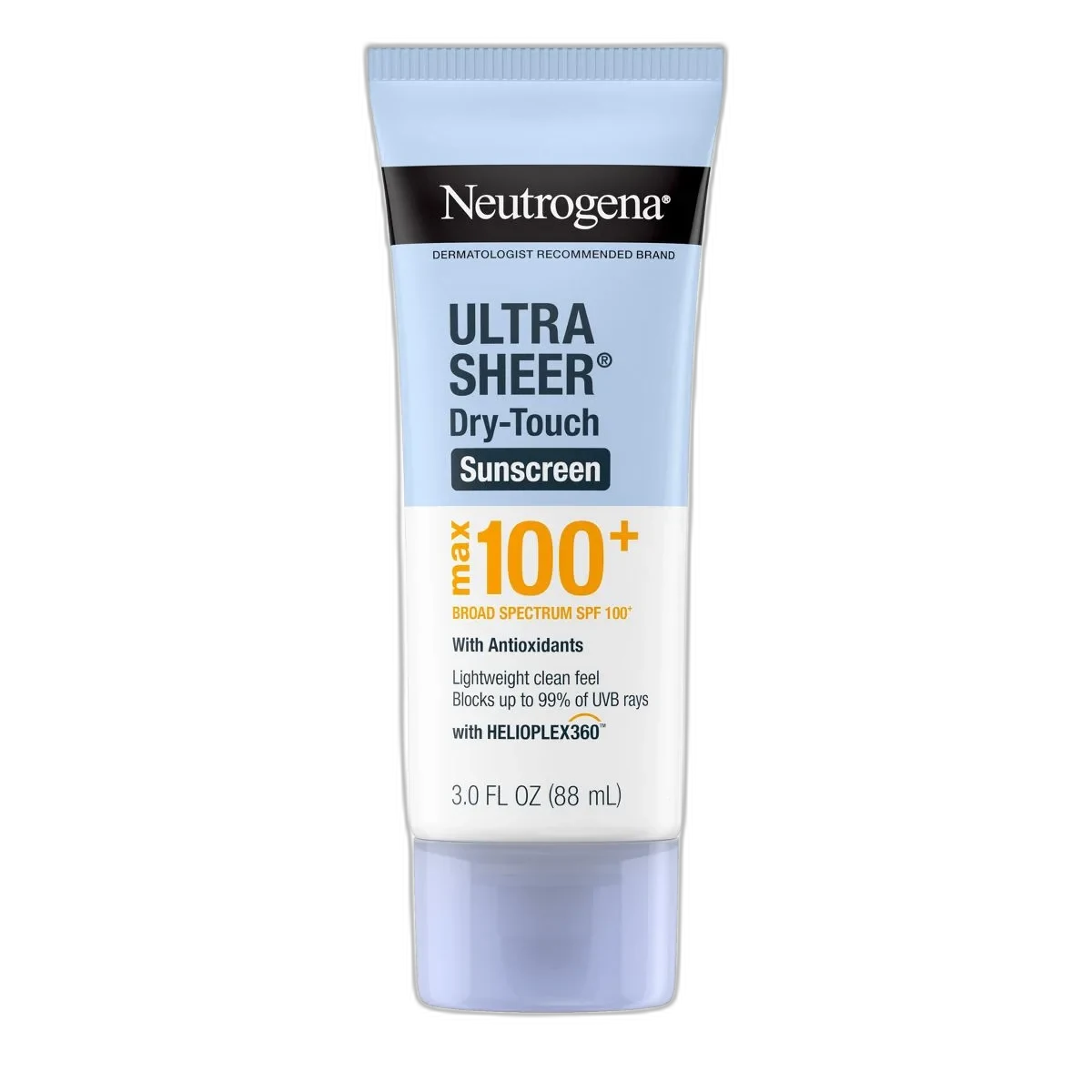
Ultra Sheer Dry-Touch Sunscreen SPF 100+
Maximum Protection Powerhouse
 Verified reviewer
Pros & cons.
- +Highest SPF available in the US market with clinical trial data proving real-world superiority over SPF 50+
- +Matte Dry-Touch finish feels surprisingly lightweight despite containing 33% active UV filters
- +Helioplex360 with ethylhexyl methoxycrylene provides next-generation avobenzone photostabilization
- +No white cast from the all-chemical UV filter system — wearable on all skin tones
- +Reformulated to remove oxybenzone, fragrance, parabens, phthalates, and dyes
- +80-minute water resistance for swimming and outdoor sports
- +Feverfew antioxidant and vitamin E provide secondary defense against UV-generated free radicals
- −Eye stinging during sweating is the most persistent complaint across 17 years of user reviews
- −33% active ingredient load creates moderate irritation risk for sensitive skin types
- −Can pill under makeup and when layered over certain skincare products
- −3 oz tube goes quickly with full-body or frequent reapplication
- −Some users report breakouts from the dense, high-active formulation
The full review.
For years, the skincare community viewed SPF numbers above 50 as marketing theater. The math backed this skepticism: SPF 50 blocks about 98% of UVB rays, while SPF 100 blocks about 99%. A one-percent difference seems like an incremental gain for spreadsheet-obsessed users. Neutrogena’s Ultra Sheer Dry-Touch SPF 100+ has existed in this skeptical market since 2009, selling to people seeking maximum protection while dermatologists debated its value.
Then the 2018 study arrived. Published in the Journal of the American Academy of Dermatology by Williams and colleagues, this randomized, double-blind, split-face trial took place at a ski resort in Vail, Colorado—using real altitude, real UV exposure, and real humans performing outdoor activities. One side of each participant’s face used SPF 100+. The other used SPF 50+. The results differed: 55.3% of subjects had more sunburn on the SPF 50+ side. Only 5% had more sunburn on the SPF 100+ side. A 2019 follow-up study confirmed these findings over five consecutive days of exposure.
Human behavior explains why the difference exceeds the math. Nobody applies sunscreen like the testing protocol requires—a thick, even 2mg per square centimeter layer. In reality, people apply 25-50% of that amount. At half the recommended application, effective SPF drops: SPF 50 becomes roughly SPF 15, while SPF 100 becomes roughly SPF 30. That gap between SPF 15 and SPF 30 is clinically significant. The SPF 100+ rating provides a safety margin for how humans actually use sunscreen, rather than just theoretical perfect application.
The formula solves a technical challenge most consumers ignore. SPF 100+ requires 33% active ingredients: 3% avobenzone, 15% homosalate (the FDA maximum), 5% octisalate, and 10% octocrylene. One-third of the formula consists of UV filters. Making that much active ingredient feel lightweight and non-greasy is a formulation feat. Most SPF 30-50 sunscreens use 15-25% actives and already struggle with texture.
Neutrogena’s Dry-Touch technology creates a matte, almost powdery finish despite a formula loaded with UV filters. Aluminum starch octenylsuccinate absorbs oil, silica adds a dry feel, and a silicone blend (caprylyl methicone, cetyl dimethicone, dimethicone) provides slip that turns into a non-greasy finish as it sets. The result feels lighter than many SPF 50 products, which is counterintuitive.
The 2025 reformulation is a meaningful upgrade. The original formula’s oxybenzone is gone, replaced by ethylhexyl methoxycrylene, a newer photostabilizer that anchors Neutrogena’s Helioplex360 technology. This evolves the original Helioplex system by pairing this new stabilizer with octocrylene for a dual-stabilization approach to avobenzone. The formula is now fragrance-free and lacks parabens, phthalates, and dyes. This addresses the environmental and sensitivity concerns of the original formula.
Feverfew extract (Chrysanthemum parthenium) and tocopheryl acetate provide an antioxidant layer alongside UV filtration. At SPF 100+ exposure levels—such as high altitude skiing, tropical beach days, or marathon training—the UV-generated free radical load is enormous. Antioxidant support adds a second line of defense against photoaging that even excellent UV filtration cannot completely prevent.
The honest limitations remain. Chemical UV filters sting eyes during sweating, the most consistent complaint in nearly two decades of user reviews. With 33% active ingredients, the irritation potential is higher than lower-SPF products. Some users report pilling under makeup and breakouts from the dense formulation. Sensitive skin types should use caution; the filter load is too high for many reactive complexions.
For facial use, the 3 oz tube finishes quickly with daily application and regular reapplication. The economics work at roughly fifteen dollars per tube, but frequent reapplicators during outdoor activities may prefer multi-packs.
The no-white-cast advantage of an all-chemical system is vital here. Mineral sunscreens at SPF 50+ leave significant white residue; an SPF 100+ with zinc oxide would be unwearable on any skin tone darker than porcelain. The chemical system makes SPF 100+ usable for all skin tones.
After seventeen years on the market and a thorough reformulation, this product is a maximum-protection option for people who take sun defense seriously. The clinical evidence for its efficacy is stronger than for almost any other individual sunscreen product. The texture is better than expected for 33% actives. As the JAAD study proved, the safety margin it provides for real-world underapplication is clinically meaningful. Not everyone needs SPF 100+ every day. But for high altitude, tropical sun, extended outdoor exposure, post-procedure skin, or photosensitizing medications, nothing else on the shelf provides this much protection in a wearable format.
Formula
Ingredient analysis.
Full INCI list
Active Ingredients: Avobenzone 3%, Homosalate 15%, Octisalate 5%, Octocrylene 10%. Inactive Ingredients: Water, Ethylhexyl Methoxycrylene, Styrene/Acrylates Copolymer, Copernicia Cerifera (Carnauba) Wax, Hydrogenated Castor Oil, Silica, Triacontanyl PVP, Potassium Cetyl Phosphate, Caprylyl Methicone, Aluminum Starch Octenylsuccinate, Glyceryl Stearate, PEG-100 Stearate, Cetyl Dimethicone, Dimethicone, Phenoxyethanol, Caprylyl Glycol, Ethylhexylglycerin, Acrylates/Dimethicone Copolymer, Xanthan Gum, Chlorphenesin, Sodium Polyacrylate, Hydrolyzed Jojoba Esters, Disodium EDTA, Ethylhexyl Stearate, Tocopheryl Acetate, Jojoba Esters, Trideceth-6, Chrysanthemum Parthenium (Feverfew) Flower/Leaf/Stem Juice
Skin match.
The science.
The Science
Clinical evidence for SPF 100+ efficacy is unusually strong for a consumer sunscreen product. The landmark Williams et al. study in the Journal of the American Academy of Dermatology (2018) used a randomized, double-blind, split-face trial with 199 subjects during outdoor activities at a ski resort at 10,000 feet elevation. After one day of exposure, 55.3% of subjects had more sunburn on the SPF 50+ side, while only 5% had more sunburn on the SPF 100+ side (P < .001). A 2019 follow-up study by Kohli et al. in the same journal confirmed these findings over five consecutive days of exposure, showing sustained superiority.
Application behavior explains the mechanism. A 2012 study in the British Journal of Dermatology found real-world sunscreen application averages 0.5-1.0 mg/cm²—far below the 2 mg/cm² used in SPF testing. At 0.5 mg/cm², the link between labeled SPF and actual protection is exponential, not linear. SPF 50 at half-application provides roughly SPF 7-15 of real protection, while SPF 100 provides roughly SPF 15-30—a gap that explains the clinical difference in the Williams study.
The Helioplex360 system stops avobenzone photodegradation using a dual-stabilizer approach. Octocrylene (10%) quenches avobenzone's excited triplet state, and ethylhexyl methoxycrylene provides photostabilization through a different mechanism. Research on methoxycrylene-class stabilizers shows improved photostability over single-stabilizer systems. This is critical for SPF 100+ formulations, where UV filter integrity must last during extended high-intensity exposure.
References
- SPF 100+ sunscreen is more protective against sunburn than SPF 50+ in actual use: Results of a randomized, double-blind, split-face, natural sunlight exposure clinical trial — Journal of the American Academy of Dermatology (2018)
- Sunscreen SPF 100+ is more protective against sunburn than SPF 50+ in a real-world, 5-consecutive-day exposure study — Journal of the American Academy of Dermatology (2019)
Dermatologist Perspective
Dermatologists increasingly support SPF 100+ sunscreens after the 2018 JAAD clinical trial showed their real-world superiority over SPF 50+. Board-certified dermatologists say the primary value of very high SPF is the safety margin for consumer underapplication—a problem public health messaging has not solved for decades. Dermatologists recommend SPF 100+ for patients on photosensitizing medications (doxycycline, isotretinoin, certain blood pressure medications), post-procedure skin (laser treatments, chemical peels), and individuals with a history of skin cancer. The reformulated oxybenzone-free formula addresses prior dermatologist concerns about endocrine disruption potential.
Where it fits in your routine.
Apply a thick layer to all exposed skin 15 minutes before sun exposure. Use a nickel-sized amount for the face and a shot glass (1 oz) for the full body. The SPF 100+ rating works only with adequate application volume; underapplying defeats the purpose. Reapply every two hours during sun exposure, or immediately after 80 minutes of swimming or sweating. Remove thoroughly at night with an oil-based cleanser or micellar water, then use your regular cleanser.
At approximately $14-17 for 3 fl oz, this provides the highest SPF protection in the consumer market. Clinical trial data supports this protection better than most premium sunscreens. The per-use cost is low for the face, but full-body use at outdoor events uses the tube fast. Multi-packs offer a discount. The SPF 100+, Helioplex360 technology, Dry-Touch finish, and clinical validation make this a strong value at the drugstore tier.
Essential for high UV exposure — outdoor athletes, skiers, beach-goers, and those at high altitudes or tropical latitudes. It also works for post-procedure skin, people on photosensitizing medications, those with a history of skin cancer, and anyone who underapplies sunscreen.
Skip this if sensitive skin reacts to chemical UV filters or if outdoor exercise causes eye stinging — the 33% active load increases this. This is also unnecessary for low-exposure indoor days where SPF 30-50 provides enough protection.
Product details.
This lightweight lotion uses Neutrogena's proprietary Dry-Touch technology to create a matte, non-greasy finish. It contains 33% active UV filters, which is a technical achievement because high-concentration formulas usually feel heavy and occlusive.
Fragrance-free in the current reformulation. The older formula contained fragrance.
Blue and white squeeze tube with a screw-top cap, 3 fl oz. A 0.47 fl oz mini size also exists. Current packaging shows 'Max SPF 100+' and oxybenzone-free claims.
The lotion spreads easily on first application and feels slightly thicker than the lower-SPF Ultra Sheer variants. Within 1-2 minutes, the Dry-Touch technology creates a matte, powdery finish unlike traditional sunscreen. No white cast. The fragrance-free reformulation has no scent. Apply generously; the high SPF only works if you use enough product.
4-6 weeks with daily facial application and regular outdoor reapplication
12 months
spring summer
The backstory.
Launched in 2009 following regulatory approval of SPF 100+ claims, this product became the center of the 'do higher SPF numbers actually matter?' debate. Neutrogena invested in clinical research to answer that question definitively — the 2018 Williams et al. study in the Journal of the American Academy of Dermatology found that in a split-face trial during skiing at high altitude, SPF 100+ provided significantly greater protection than SPF 50+. The product was reformulated in 2025 to remove oxybenzone, maintaining the SPF 100+ rating with the new Helioplex360 stabilization system.
About Neutrogena
Legacy Brand (20+ years)Neutrogena launched in 1930 and is the #1 dermatologist-recommended suncare brand in the United States. A landmark 2018 JAAD randomized clinical trial shows The Ultra Sheer Dry-Touch SPF 100+ is superior to SPF 50+ in real-world use. The current formula uses Neutrogena's next-generation Helioplex360 photostability technology.
Common myths.
SPF 100+ is marketing; it offers no real difference from SPF 50.
A 2018 randomized, double-blind, split-face clinical trial in JAAD shows SPF 100+ sunscreen prevents more sunburn than SPF 50+ in real-world conditions. 55.3% of subjects got more sunburn on the SPF 50+ side, compared to 5% on the SPF 100+ side. This difference is clinically meaningful because consumers typically underapply.
Higher SPF numbers mean more chemicals on your skin.
This formula uses the same four UV filters found in many SPF 30 and 50 sunscreens, but at higher concentrations. The total active load is 33%, while SPF 30-50 products use roughly 15-25%. The change in skin application is incremental, not exponential, but the protection gain is meaningful.
FAQ.
Is SPF 100+ actually better than SPF 50?
Yes — a 2018 randomized, double-blind clinical trial in the Journal of the American Academy of Dermatology shows SPF 100+ sunscreen prevents more sunburn than SPF 50+ in a split-face study during high-altitude outdoor activities. This difference matters because most people underapply sunscreen, making the extra SPF margin clinically relevant.
Does this sunscreen leave a white cast?
No — this uses 100% chemical UV filters and has no zinc oxide or titanium dioxide. It absorbs completely clear on all skin tones. Dry-Touch technology creates a matte, invisible finish.
Is Neutrogena Ultra Sheer SPF 100+ oxybenzone-free?
Yes — the current reformulated version (marketed as Max SPF 100+) contains no oxybenzone. The formula uses avobenzone, homosalate, octisalate, and octocrylene as UV filters, plus ethylhexyl methoxycrylene as a next-generation stabilizer. Older stock may still have oxybenzone — check the active ingredients on your specific tube.
How often should I reapply SPF 100+?
Reapply every two hours during sun exposure, regardless of the SPF number. SPF measures UVB blockage, not how long protection lasts. The 80-minute water resistance means you must reapply after swimming or heavy sweating. No sunscreen provides all-day protection from one application, even at SPF 100+.
Why does this sunscreen sting my eyes?
The high concentration of chemical UV filters (33% total active ingredients)—specifically avobenzone and homosalate—migrates into the eyes when you sweat and causes stinging. This is the most common complaint for all chemical sunscreens. Use a separate mineral sunscreen stick around the eye area if you sweat.
Is this sunscreen reef-safe?
The current formula is oxybenzone-free and octinoxate-free, so it meets Hawaii's reef protection requirements. It contains homosalate and octocrylene, which some environmental organizations flag as harmful to marine life. It is not fully reef-safe by the strictest definitions.
Community
What the community says.
"Maximum SPF available provides unmatched sunburn protection for outdoor activities"
"Matte dry-touch finish feels lightweight despite 33% active ingredient load"
"No white cast from the all-chemical UV filter system"
"Water-resistant for 80 minutes during swimming and sweating"
"Oxybenzone-free reformulation addresses prior environmental and safety concerns"
"Affordable drugstore pricing for the highest SPF protection level"
"Chemical UV filters cause eye stinging and burning during sweating"
"High active ingredient concentration may irritate sensitive skin"
"Can pill when layered over certain skincare products or under makeup"
"May feel heavier than lower-SPF Ultra Sheer variants due to higher active load"
"Some reports of breakouts from the dense formulation"
People also looked at.