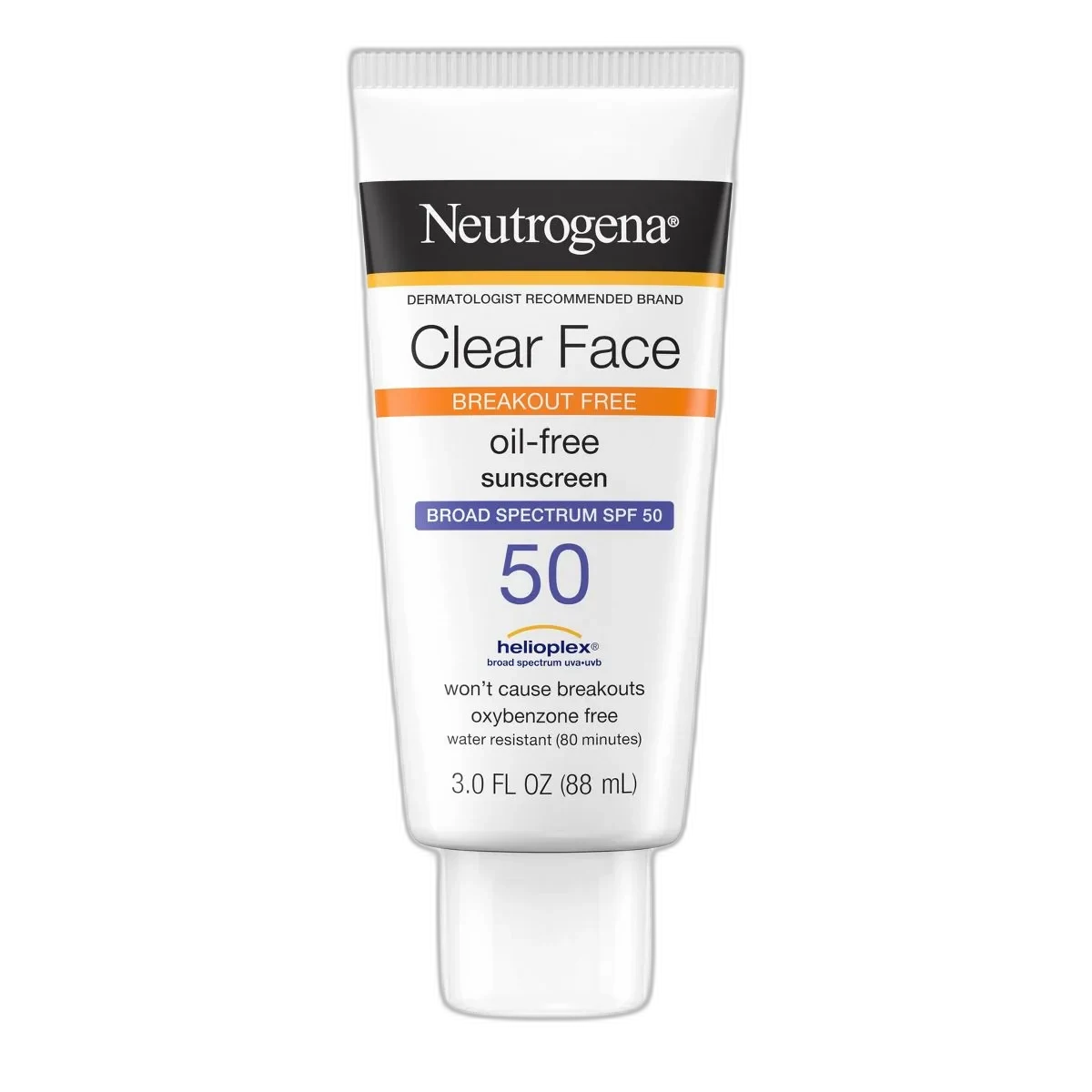
Clear Face Break-Out Free Liquid Lotion Sunscreen SPF 50
Oily Skin Sunscreen Staple
 Verified reviewer
Pros & cons.
- +Genuinely matte finish with oil-absorbing starches and silica that lasts through the morning
- +No white cast whatsoever thanks to the all-chemical UV filter system
- +Helioplex technology keeps UVA protection stable longer than unstabilized avobenzone formulas
- +Antimicrobial botanical complex actively fights breakout-causing conditions beyond just being non-comedogenic
- +Water-light liquid texture that feels nothing like traditional heavy sunscreen lotions
- +80-minute water resistance is unusual and welcome for a daily-wear facial sunscreen
- +Drugstore pricing around $12-13 makes daily use and generous reapplication financially painless
- +Fragrance-free formula eliminates one common source of irritation and breakouts
- −Chemical UV filters commonly cause eye stinging and burning during sweating or exercise
- −Cinnamon bark extract is a known sensitizer that makes this unsuitable for sensitive skin
- −No meaningful moisturizing ingredients — dry skin types will feel uncomfortably tight
- −Can pill under silicone-heavy primers and certain foundation formulas
- −Not fully reef-safe by strictest standards despite oxybenzone removal
The full review.
About Neutrogena
The Clear Face line is designed for oily-skinned sun avoider.
Reality
The formula is a chemical sunscreen through and through — avobenzone at 3%, homosalate at 10%, octisalate at 5%, and octocrylene at 10%. That’s a robust four-filter system delivering broad-spectrum SPF 50 with 80 minutes of water resistance. The real story, though, is Helioplex. Neutrogena’s proprietary stabilization technology pairs octocrylene with avobenzone to prevent the photodegradation that plagues unstabilized avobenzone formulas. In plain terms: your UVA protection doesn’t quietly clock out after two hours in the sun while you think you’re still covered.
But UV filters are only half the equation when your target audience has skin that treats most topicals like an invitation to break out. The vehicle — the stuff carrying those UV filters — is where Clear Face earns its name. Cetyl dimethicone and dimethicone form a silicone-based vehicle that feels nothing like traditional sunscreen. It’s thin, almost watery, spreading across skin with zero resistance. Aluminum starch octenylsuccinate and silica then do the heavy lifting on oil control, absorbing sebum throughout the day and delivering a matte finish that actually holds.
What’s genuinely interesting is buried deeper in the ingredient list. Cedrus atlantica bark extract, cinnamomum zeylanicum bark extract, and portulaca oleracea extract form a quiet antimicrobial and anti-inflammatory trio. Paired with capryloyl glycine and sarcosine — amino acid derivatives with sebum-regulating properties — this isn’t just a sunscreen that avoids causing breakouts. It’s a sunscreen that actively creates conditions hostile to the bacteria and excess oil that cause them. Most ‘acne-safe’ sunscreens simply remove the bad stuff; this one adds ingredients that fight back.
Texture
On the skin, it delivers exactly what the texture promises. The liquid-lotion format is noticeably thinner than anything labeled ‘lotion’ has a right to be. It absorbs in under a minute, dries matte, and leaves no white cast whatsoever — a genuine advantage of the all-chemical filter system, especially for deeper skin tones tired of mineral sunscreens turning them ashy. Under makeup, it behaves well as long as you give it a minute to set and avoid layering silicone-heavy primers on top.
Common Praise
The matte finish is real. Not ‘matte for a sunscreen’ — actually matte. On oily skin, it holds reasonably well through a morning, though the truly oil-productive among us will still see some shine by early afternoon. This isn’t a mattifying primer; it’s a sunscreen that happens to control oil well, which is a meaningful distinction.
Common Complaints
Honesty requires acknowledging where this formula stumbles. The chemical UV filter system, while effective and cosmetically elegant, is not friendly to everyone. Eye stinging is the most common complaint, and it’s legitimate — avobenzone in particular is notorious for migrating into the eyes during sweating and causing a burning sensation. If you exercise outdoors, this is worth knowing. The product also contains cinnamon bark extract, which is a known sensitizer. For genuinely sensitive or rosacea-prone skin, this is not your sunscreen. The ‘Clear Face’ name targets acne-prone skin, not sensitive skin, and that distinction matters.
Dry-skinned folks will also want to look elsewhere. There are no significant moisturizing agents here — no hyaluronic acid, no ceramides, no glycerin in meaningful amounts. This is deliberate. Every formulation choice prioritizes oil control and breakout prevention over hydration. If your skin is already producing plenty of oil, that’s perfect. If it’s not, you’ll feel tight and parched.
Ingredient analysis.
Full INCI list
Active Ingredients: Avobenzone 3%, Homosalate 10%, Octisalate 5%, Octocrylene 10%. Inactive Ingredients: Water, Silica, Cetyl Dimethicone, Styrene/Acrylates Copolymer, C12-15 Alkyl Benzoate, Steareth-100, Ethylhexylglycerin, Aluminum Starch Octenylsuccinate, Phenoxyethanol, Caprylyl Glycol, Sodium Polyacrylate, Dimethicone, Steareth-2, Polyester-7, Chlorphenesin, Ethylhexyl Stearate, Disodium EDTA, Propylene Glycol, Neopentyl Glycol Diheptanoate, Bisabolol, Acrylates/Dimethicone Copolymer, Butylene Glycol, Mannan, Xanthan Gum, BHT, Capryloyl Glycine, Trideceth-6, Sarcosine, Cedrus Atlantica Bark Extract, Cinnamomum Zeylanicum Bark Extract, Portulaca Oleracea Extract
Skin match.
The science.
The Science
The Helioplex system at the core of this sunscreen addresses one of the most persistent problems in chemical sun protection: avobenzone photodegradation. Avobenzone is the most widely used UVA filter in the United States, but it's inherently unstable — absorbing UV energy causes it to break down, losing protective capacity. A study published in the Journal of the American Academy of Dermatology (2006) demonstrated that Helioplex-stabilized avobenzone maintained significantly higher UVA protection after UV exposure compared to unstabilized formulations, with photostability testing showing maintained protection even after extended irradiation periods.
The four-filter system — avobenzone, homosalate, octisalate, and octocrylene — provides overlapping UVA and UVB coverage. Octocrylene serves double duty: it absorbs UVB radiation directly while also acting as a photostabilizer for avobenzone by quenching the excited-state energy that would otherwise cause degradation. This synergistic approach means the SPF 50 rating holds up better in real-world conditions than the same SPF from an unstabilized formula.
The antimicrobial botanical complex is more than decoration. Cinnamomum zeylanicum (cinnamon) bark extract has demonstrated antimicrobial activity against Cutibacterium acnes in vitro, as documented in research published in the Journal of Cosmetic Dermatology. Portulaca oleracea extract has shown anti-inflammatory properties in dermatological research, potentially helping to calm the inflammatory cascade that turns clogged pores into full-blown acne lesions. Combined with capryloyl glycine and sarcosine — amino acid derivatives that help regulate sebum composition and pH — the formula creates an environment less hospitable to the microbial overgrowth that drives acne.
Aluminum starch octenylsuccinate, the primary oil-absorbing agent, works through physical adsorption of sebum onto its modified starch particles. Unlike alcohol-based mattifying agents that strip oil and trigger rebound production, starch-based absorption manages surface oil without disrupting the skin's lipid balance — a critical distinction for acne-prone skin where barrier disruption can worsen breakouts.
References
- Photostabilization of avobenzone with Helioplex technology — Journal of the American Academy of Dermatology (2006)
Dermatologist Perspective
Dermatologists frequently recommend this sunscreen to patients with oily and acne-prone skin who have historically avoided daily sun protection. Board-certified dermatologists note that the non-comedogenic, oil-free formulation addresses the primary barrier to sunscreen compliance in acne patients — the fear of triggering new breakouts. The Helioplex-stabilized avobenzone system is recognized in dermatological practice as providing more reliable UVA protection than unstabilized alternatives. Dermatologists typically advise patients to apply this as the final morning skincare step, allowing acne treatments like benzoyl peroxide or retinoids to be used in the evening routine. For patients on isotretinoin or other photosensitizing acne medications, consistent broad-spectrum SPF 50 protection like this becomes especially important.
Where it fits in your routine.
Apply liberally to face and neck 15 minutes before sun exposure. Use about a nickel-sized amount for the face; most people use half that amount. Spread evenly and let it dry to a matte finish for 1-2 minutes before applying makeup. Reapply every two hours during sun exposure, or immediately after swimming, heavy sweating, or towel-drying. For best results, use an oil-free moisturizer underneath if your skin needs hydration. Remove thoroughly at night with a double-cleansing method — an oil cleanser or micellar water first, then your regular cleanser.
At roughly $12-13 for 3 fl oz at major retailers, this is an affordable facial sunscreen. The value is high because it uses Helioplex stabilization technology, an oil-control formulation, and SPF 50 broad-spectrum protection. Since daily use and frequent reapplication are necessary, the drugstore price prevents rationing — and generous application is the single most important factor in sunscreen efficacy. The only size is 3 fl oz, which lasts about 6-8 weeks with daily facial use. No larger economy size exists for this specific variant, missing a chance for better per-ounce value.
This product works for oily or combination skin that breaks out from most sunscreens. It is also ideal for anyone wanting a no-white-cast, matte-finish SPF 50 at a drugstore price that allows for generous reapplication.
Skip this if dry skin requires moisturizing ingredients in your sunscreen, or if you have sensitive skin or rosacea — the chemical UV filters and cinnamon bark extract cause irritation. Also avoid if outdoor exercise causes eye stinging.
Product details.
This water-light, thin liquid lotion has a watery consistency. It spreads easily and absorbs quickly, making it lighter than traditional sunscreen lotions.
Fragrance-free, though a faint chemical sunscreen smell lasts for minutes after application.
White and light blue squeeze tube with a flip-top cap. This 3 fl oz plastic tube is a travel-friendly size that fits easily in a bag.
The liquid lotion feels thinner than most sunscreens on first application. It spreads like water and dries to a matte finish within 1-2 minutes. The oil-control effect is immediate with no adjustment period. Some users with sensitive eyes may feel mild stinging if the product migrates during sweating.
Apply daily to the face for 6-8 weeks, reapplying regularly during sun exposure
12 months
spring summer
The backstory.
Born from Neutrogena's recognition that acne-prone consumers were skipping sunscreen entirely because most formulas felt heavy and triggered breakouts. The Clear Face line was engineered specifically to remove every excuse for not wearing SPF — oil-free, non-comedogenic, lightweight, and actively breakout-fighting. The current SPF 50 formula was reformulated around 2020 to remove oxybenzone in response to both environmental concerns and Hawaii's reef-protection legislation.
About Neutrogena
Legacy Brand (20+ years)Neutrogena launched in 1930 and is the #1 dermatologist-recommended suncare brand in the United States. People have used its sunscreen formulations, especially those with proprietary Helioplex technology, in clinical and consumer settings for nearly two decades.
Common myths.
Chemical sunscreens always cause breakouts on acne-prone skin.
This formula uses a silicone-based vehicle, oil-absorbing starches, and an antimicrobial botanical complex to prevent the pore-clogging and bacterial proliferation that cause sunscreen-related breakouts. The vehicle causes the issue, not the UV filters.
SPF 50 is overkill for daily use.
Most people apply only 25-50% of the recommended sunscreen amount. SPF 50 provides a safety margin for under-application, giving roughly SPF 15-25 protection at typical real-world usage levels.
FAQ.
Does Neutrogena Clear Face sunscreen cause breakouts?
This formula prevents breakouts using an oil-free, non-comedogenic base, aluminum starch for oil absorption, and antimicrobial botanical extracts. Individual reactions vary. A small percentage of users with highly reactive skin reported breakouts, likely from sensitivity to the chemical UV filters instead of pore-clogging.
Is Neutrogena Clear Face SPF 50 reef safe?
The current formulation is oxybenzone-free and octinoxate-free, so it meets Hawaii's reef protection legislation (Act 104). It does contain octocrylene and homosalate, which some environmental groups flag as harmful to marine life. It moves toward reef safety but is not fully reef-safe by the strictest definitions.
Can I wear makeup over Neutrogena Clear Face sunscreen?
Yes — the matte, quick-drying finish works well as a makeup base. Wait 1-2 minutes for the sunscreen to set before you apply primer or foundation. Some users report pilling with silicone-heavy primers; a water-based primer layers better over this formula.
Does this sunscreen leave a white cast?
No. This sunscreen uses only organic UV filters without zinc oxide or titanium dioxide. It leaves no white cast on any skin tone and dries completely clear.
How often should I reapply Neutrogena Clear Face SPF 50?
Reapply every two hours during direct sun exposure, or after swimming, sweating heavily, or towel-drying. The formula is water-resistant for 80 minutes. Reapplication is essential for protection; no sunscreen lasts all day from a single application.
Is Neutrogena Clear Face sunscreen good for sensitive skin?
This formula works better for oily and acne-prone skin than sensitive skin. The four chemical UV filters (avobenzone, homosalate, octisalate, octocrylene) and cinnamon bark extract cause stinging or irritation on sensitive skin. For sensitive skin, a mineral sunscreen with zinc oxide is a gentler choice.
What is Helioplex technology in this sunscreen?
Helioplex is Neutrogena's proprietary system that stabilizes avobenzone — the primary UVA-blocking ingredient — by pairing it with octocrylene. Without stabilization, avobenzone degrades within hours of sun exposure and loses UVA protection. Helioplex keeps avobenzone effective longer than unstabilized formulations.
What the community says.
"Does not cause breakouts on acne-prone skin"
"Lightweight, non-greasy texture"
"No white cast on any skin tone"
"Matte finish controls oil throughout the day"
"Great drugstore price point for SPF 50"
"Layers well under makeup"
"Can sting or burn the eyes during sweating"
"Some users still experienced breakouts despite claims"
"May pill under certain foundations"
"Can feel drying on non-oily skin types"
"Needs frequent reapplication during heavy activity"
Featured in.
People also looked at.