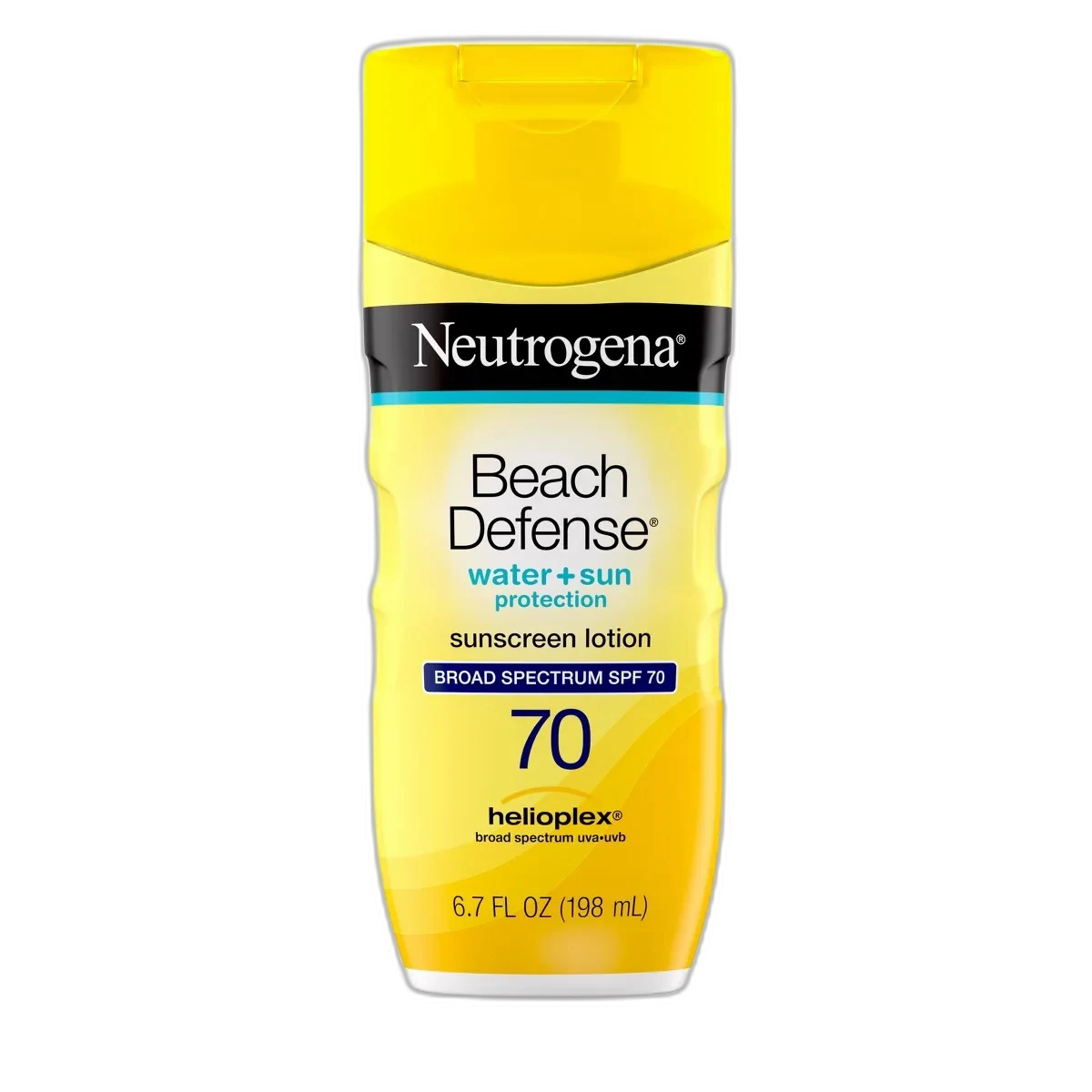
Beach Defense Sunscreen Lotion SPF 70
Beach Day Budget Pick
 Verified reviewer
Pros & cons.
- +SPF 70 provides a meaningful real-world safety margin for the universal problem of under-application
- +Reformulated oxybenzone-free Helioplex system stabilizes avobenzone for lasting UVA protection
- +80-minute water resistance at the maximum FDA-allowed claim holds up during swimming
- +Exceptional value at roughly for 6.7 ounces of high-SPF protection
- +Lightweight, fast-absorbing texture that spreads easily over large body areas
- +No white cast on any skin tone — absorbs completely clear
- +Hawaii Act 104 compliant without sacrificing SPF or broad-spectrum protection
- +Available in multiple sizes including a 1 oz travel tube
- −Contains fragrance — unnecessary addition that limits use for sensitive or fragrance-averse skin
- −Homosalate at 15% (FDA max) exceeds the EU-recommended limit of 7.34% for precautionary reasons
- −Too heavy and comedogenic for facial use — strictly a body sunscreen
- −Contains ethylhexyl stearate which may trigger breakouts on acne-prone skin
- −No antioxidant or skincare actives beyond basic UV protection
- −Not suitable for sensitive skin due to high chemical filter concentration plus fragrance
The full review.
Here is a number that should change how you think about sunscreen: most people apply only 25 to 50 percent of the amount used in SPF testing. That means your SPF 30 sunscreen is functionally delivering SPF 10 to 15. Your SPF 50 is giving you maybe SPF 20. This is not carelessness. It is human nature — nobody applies a full shot glass of sunscreen to their face and body the way lab technicians do under controlled conditions.
Neutrogena Beach Defense SPF 70 exists because of this math. An SPF 70 product, even applied at half the recommended amount, still delivers meaningful protection in the SPF 30 to 40 range. It is an engineering solution to a behavioral problem, and it is one of the most honest reasons a sunscreen brand has ever given for going above SPF 50.
The UV filter system tells the story of a product that has evolved with the times. When Beach Defense originally launched around 2013, it rode on Neutrogena’s proprietary Helioplex technology — a stabilization system that kept avobenzone from degrading under UV exposure, which had been a notorious weakness of avobenzone-based sunscreens. The original Helioplex relied on oxybenzone as part of its stabilization chemistry. Then came Hawaii Act 104, growing consumer concern about reef safety, and a broader cultural reckoning with oxybenzone. Neutrogena reformulated. The current version uses octocrylene at 10% as the primary avobenzone stabilizer, flanked by homosalate at 15% and octisalate at 5% to drive the UVB protection up to SPF 70.
That reformulation deserves credit. Removing oxybenzone from a high-SPF sunscreen without losing protection efficacy is not trivial. Many brands that made the switch ended up with lower SPF ratings or compromised UVA protection. Neutrogena managed to maintain both, though the tradeoff is a high concentration of homosalate — at 15%, it sits at the FDA maximum, and notably above the 7.34% limit the European Scientific Committee on Consumer Safety recommended in 2022 over endocrine disruption concerns. This is a body sunscreen applied to intact skin, and systemic absorption at meaningful levels from topical sunscreen remains debated, but it is worth acknowledging for those who track these regulatory conversations.
Texture
The texture is beach-friendly in the best sense. It is a smooth white lotion that spreads without resistance, absorbs within a minute or two, and does not feel like you are wearing armor. Compared to mineral sunscreens at similar SPF levels, it is dramatically lighter and leaves no white cast on any skin tone.
Scent
There is a pleasant, recognizably beachy fragrance — light enough that it fades within minutes, but present enough that the fragrance-averse will notice. It is the kind of scent that triggers Pavlovian associations with summer weekends and salt water.
Packaging
The 80-minute water resistance is the maximum claim the FDA allows, and in practice it holds up well. Swimmers and surfers report that the sunscreen stays put through vigorous activity, though towel-drying obviously removes it. The dimethicone in the formula creates a film that helps the UV filters cling to skin even when wet — this is where the silicone earns its place in the INCI list.
Best for
As a body sunscreen, it performs admirably. On the face, less so. The texture is heavier than most dedicated facial sunscreens, and the inclusion of ethylhexyl stearate — a moderately comedogenic emollient — makes it a poor choice for acne-prone skin. The fragrance is another reason to keep this below the jawline. Neutrogena makes excellent facial sunscreens in their Invisible Daily Defense and Ultra Sheer lines; Beach Defense is not trying to be that product.
Common Praise
The value proposition is where Beach Defense genuinely shines. At roughly nine dollars for 6.7 ounces, this is one of the most affordable high-SPF, water-resistant body sunscreens on the market. For families spending a week at the beach and going through multiple bottles, the math matters — you can buy four bottles of Beach Defense for the price of one boutique mineral sunscreen, and you are more likely to reapply generously when it does not feel like you are spreading liquid gold on your arms.
Ingredient List
The ingredient list beyond the UV filters is unremarkable — jojoba esters for conditioning, standard emulsifiers, and a preservation system that includes benzyl alcohol, chlorphenesin, and BHT. None of these are remarkable or problematic for most users, though the BHT is an older antioxidant preservative that some formulators have moved away from. There are no bonus skincare actives — no vitamin C, no niacinamide, no antioxidant complex. This is a sunscreen that sunscreens, and it does not pretend to be a treatment product.
Common Complaints
The honest limitations center on what this formula chooses to include. Fragrance in a sunscreen is divisive and unnecessary. Homosalate at 15% will concern those following EU regulatory developments. The texture, while excellent for a body sunscreen, is too heavy for facial use. And the formula is not suitable for sensitive skin — the combination of four chemical UV filters plus fragrance creates too many potential triggers for reactive complexions.
Works for
But for its intended purpose — affordable, high-protection body sunscreen for active days in the sun — Beach Defense SPF 70 delivers on every claim it makes. It protects. It resists water. It does not break the bank. And that SPF 70 rating quietly compensates for the fact that you, like everyone else, are not applying enough sunscreen. Sometimes the most useful innovation is not a new ingredient. It is a safety margin.
Ingredient analysis.
Full INCI list
Active Ingredients: Avobenzone 3%, Homosalate 15%, Octisalate 5%, Octocrylene 10%. Inactive Ingredients: Water, Butyloctyl Salicylate, Styrene/Acrylates Copolymer, Potassium Cetyl Phosphate, Benzyl Alcohol, Silica, Glyceryl Stearate, PEG-100 Stearate, Dimethicone, Caprylyl Glycol, Synthetic Beeswax, Ethylhexylglycerin, Acrylates/C12-22 Alkyl Methacrylate Copolymer, Behenyl Alcohol, Fragrance, Xanthan Gum, Chlorphenesin, Dimethicone/PEG-10/15 Crosspolymer, Hydrolyzed Jojoba Esters, Disodium EDTA, Sodium Polyacrylate, Ethylhexyl Stearate, BHT, Jojoba Esters, Trideceth-6
Skin match.
The science.
The Science
The Neutrogena Beach Defense SPF 70 formula uses a four-filter chemical UV protection system: avobenzone (3%) for UVA, plus homosalate (15%), octisalate (5%), and octocrylene (10%) for UVB protection and photostabilization.
Avobenzone photostability is the main formulation challenge. Avobenzone is an effective FDA-approved UVA filter, but it is inherently photounstable; UV radiation degrades it, reducing protection over time. Research in the Journal of Photochemistry and Photobiology B (2014) shows avobenzone undergoes significant photodegradation under UV exposure, and different stabilization strategies vary in effectiveness. Octocrylene is a reliable avobenzone photostabilizer; at 10%, it forms the backbone of the reformulated Helioplex system.
A Pharmaceutics (2023) review examined drug delivery strategies to maintain avobenzone stability. It confirmed that combining octocrylene with avobenzone extends UVA protection duration significantly compared to avobenzone alone. This matters for beach sunscreens where users face extended sun exposure.
The homosalate concentration requires scientific scrutiny. The European Commission's Scientific Committee on Consumer Safety (SCCS) published a 2022 opinion stating homosalate is not safe at 10% concentration due to potential endocrine-disrupting properties, recommending a 7.34% maximum for facial products. This formula uses 15% — the FDA maximum — but markets the product as a body sunscreen rather than a facial product. The systemic absorption debate continues: FDA-commissioned studies detected chemical UV filters in blood after topical application, but the clinical significance of these findings at real-world usage levels is unestablished.
References
- Photodegradation of avobenzone: stabilization effect of antioxidants — Journal of Photochemistry and Photobiology B: Biology (2014)
- Drug Delivery Strategies for Avobenzone: A Case Study of Photostabilization — Pharmaceutics (2023)
- SCCS Opinion on Homosalate — European Commission Scientific Committee on Consumer Safety (2022)
Dermatologist Perspective
Dermatologists often recommend high-SPF sunscreens like Beach Defense because of the application gap — studies show real-world sunscreen application delivers only 20-50% of the labeled SPF. Board-certified dermatologists note SPF 70 compensates for under-application, providing reliable SPF 30-40 range protection even when applied imperfectly. The 80-minute water resistance suits patients with active outdoor lifestyles. However, dermatologists treating sensitive or rosacea-prone patients usually choose fragrance-free mineral alternatives, as the four chemical UV filters and fragrance increase irritation risk for reactive skin.
Where it fits in your routine.
Apply liberally to all exposed body areas at least 15 minutes before sun exposure. Use about one ounce (a shot glass full) for full-body coverage. Reapply every two hours, immediately after swimming or heavy sweating, and after towel drying. For best results, apply to dry skin instead of wet skin. Store in a cool place and discard after one year of opening or the expiration date, whichever comes first.
At approximately 6.7 ounces, Beach Defense SPF 70 has one of the best price-to-protection ratios in the sunscreen market. Sizes range from a 1 oz travel tube to an 8.5 oz large bottle. For families or anyone using sunscreen at the recommended rate during summer months, the low cost makes proper reapplication easy. A sunscreen you can afford to apply generously works better than a premium sunscreen you ration. This value is genuine.
Beach-goers, swimmers, and outdoor enthusiasts need reliable, high-SPF body sunscreen at a price that allows generous application. This works for families stocking up for summer vacations and anyone wanting maximum protection without a premium price tag.
This is for people with sensitive or reactive skin who need fragrance-free sun protection. Skip this if you want a facial sunscreen; the formula is too heavy and comedogenic for daily face use. Also skip if you prefer mineral-only UV filters or worry about high concentrations of homosalate.
Product details.
This smooth, white lotion spreads easily. It is lighter than mineral sunscreens but feels present on the skin. It absorbs within one or two minutes, though a slight film remains — typical for high-SPF body sunscreens.
Light, classic "beachy" sunscreen fragrance — pleasant and not overpowering. Fades within a few minutes of application. Recognizably a Neutrogena sunscreen scent.
Neutrogena's teal Beach Defense branding defines this standard drugstore sunscreen squeeze bottle with a flip-top cap. It comes in sizes from travel (1 oz) to large (8.5 oz). The design is functional and portable for beach bags.
The lotion spreads smoothly on first application and has a faint beachy scent. It absorbs quickly for an SPF 70 product, leaving a slight sheen that fades after a few minutes. It causes no stinging, tingling, or white cast. The texture feels comfortable and is not heavy or suffocating on the body.
2-4 weeks with daily full-body summer use; 2-3 months with occasional weekend outdoor use
12 months
spring summer
The backstory.
Neutrogena developed Helioplex technology in 2005 as a breakthrough in avobenzone stabilization, and Beach Defense launched around 2013 as the brand's beach-specific line. The product was significantly reformulated around 2020-2021 to remove oxybenzone and octinoxate in response to Hawaii's reef protection legislation and growing consumer concern, with octocrylene at 10% taking over the avobenzone stabilization role.
About Neutrogena
Legacy Brand (20+ years)Neutrogena launched in 1930 and has topped dermatologist-recommended suncare brand rankings in the United States for decades. Now owned by Kenvue (spun off from Johnson & Johnson in 2023), the brand created proprietary Helioplex technology in 2005 and has extensive clinical data on UV protection.
Common myths.
SPF 70 provides more protection than SPF 30 or 50.
SPF 70 blocks about 98.6% of UVB rays, compared to 97% for SPF 30 and 98% for SPF 50. The real-world benefit is the safety margin. Because most people under-apply sunscreen by 50% or more, the higher SPF compensates and provides effective SPF 35+ protection during imperfect application.
Water-resistant means waterproof — you can swim all day without reapplying.
The FDA banned the term "waterproof" for sunscreens in 2011. An 80-minute water resistance rating shows protection lasts after 80 minutes of water immersion in testing. You must reapply after swimming, heavy sweating, and at least every two hours.
Avoid chemical sunscreens like this; they are unsafe.
The FDA classifies these UV filters as Category III (more data needed), not as unsafe. They have decades of use history. The EU restricted homosalate concentrations as a precaution, but the risk of UV damage from skipping sunscreen outweighs the theoretical risks from topical chemical UV filters at approved concentrations.
FAQ.
Is Neutrogena Beach Defense SPF 70 reef-safe?
The reformulated version is oxybenzone-free and octinoxate-free, so it meets Hawaii Act 104 reef protection legislation. It still contains octocrylene, which some environmental groups flag. For a fully reef-safe option, use mineral sunscreens with only zinc oxide or titanium dioxide.
Can I use Neutrogena Beach Defense on my face?
This product is a body sunscreen, though it is technically safe for the face. Its thick texture, fragrance, and comedogenic ethylhexyl stearate make it less ideal for facial use, especially for acne-prone or sensitive skin. Use a dedicated face sunscreen from the Neutrogena line for the face instead.
How often should I reapply Neutrogena Beach Defense SPF 70?
Reapply every two hours, right after swimming, heavy sweating, or towel drying—even with the 80-minute water resistance rating. The SPF 70 provides a safety margin if you under-apply, but it does not change the standard two-hour reapplication interval.
Is Neutrogena Beach Defense safe during pregnancy?
Debate exists regarding the safety of chemical UV filters during pregnancy. This formula uses 15% homosalate (the FDA maximum), which the EU flags for potential endocrine-disrupting properties. Many dermatologists say chemical sunscreens are acceptable in pregnancy, but mineral sunscreens are the most cautious option. Consult your healthcare provider.
Does Neutrogena Beach Defense SPF 70 leave a white cast?
No — the Beach Defense formula is a chemical sunscreen. It absorbs UV radiation instead of reflecting it, so it leaves no visible white cast on any skin tone. It absorbs clear with a slight sheen that fades within minutes.
What the community says.
"Excellent sun protection at a drugstore price point"
"Lightweight and easy to spread compared to similar SPF levels"
"Pleasant light beach scent that fades quickly"
"80-minute water resistance holds up well during swimming"
"Does not sting or burn eyes when sweating"
"Widely available at every drugstore and grocery store"
"Can feel greasy or shiny on the skin, especially on the face"
"Tendency to pill when layered heavily or over certain products"
"Contains fragrance — not suitable for fragrance-sensitive individuals"
"Not ideal for facial use due to heavier texture"
"Homosalate at 15% may concern those tracking EU regulatory updates"
Featured in.
People also looked at.