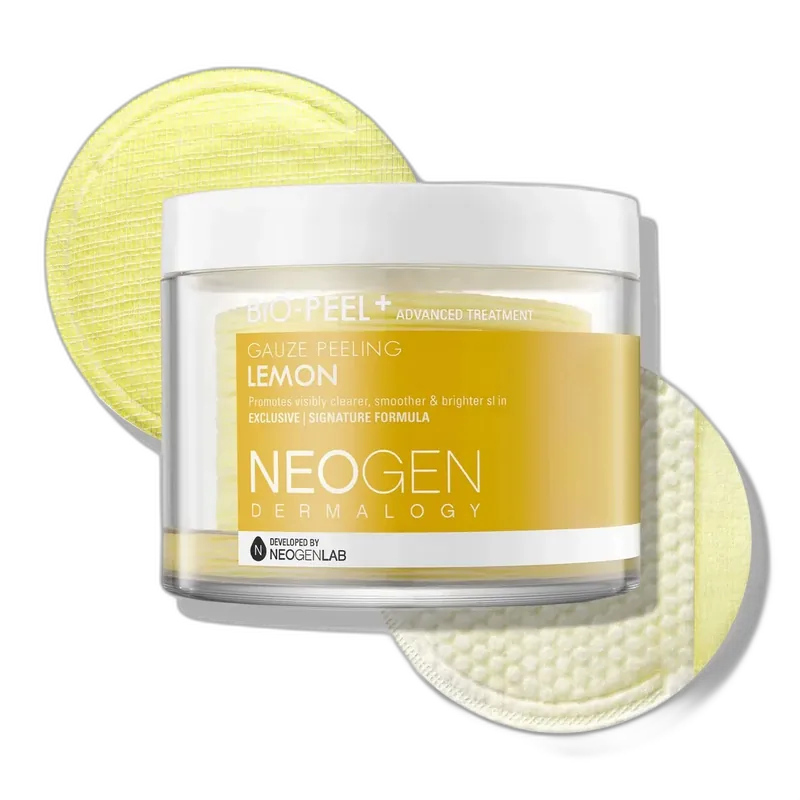
Bio-Peel Gauze Peeling Lemon
K-Beauty Cult Favorite
 Verified reviewer
Pros & cons.
- +Signature dual-texture gauze pad format combines physical and chemical exfoliation
- +Three-acid AHA blend (glycolic, lactic, tartaric) at active pH
- +Visible brightening effect after first use
- +Long-established product with 10+ years of user data
- +Good value at $27 for 30 pads
- +Convenient format for pre-event skin prep
- −Denatured alcohol and fragrance create an irritation risk modern formulations avoid
- −Strong citrus scent can be polarizing or trigger sensitivity
- −Contains added color dyes (CI 19140, CI 17200)
- −Not suitable for sensitive, rosacea-prone, or compromised skin
- −Formula has not been meaningfully updated since launch
The full review.
One product usually sets the standard for an entire skincare category. In K-beauty exfoliating pads, that product is Neogen’s Bio-Peel Gauze Peeling line. When it launched around 2012, most exfoliating pads were smooth cotton rounds soaked in one acid. Neogen’s innovation used a dual-texture pad: one smooth side to apply the liquid and one cotton gauze side for mild mechanical exfoliation. This was a new format in 2012. By the mid-2010s, it became a K-beauty cult object on Soko Glam and in early Western K-beauty blogger routines, shaping US expectations for Korean exfoliating pads.
The Lemon variant focuses on brightening. The acid blend does the work: glycolic acid (the best-studied AHA for cell turnover), lactic acid (a gentler, larger-molecule AHA that also acts as a humectant), and tartaric acid (a fruit-sourced AHA). The pH is in the high-3s—low enough for the AHAs to be active, but high enough to avoid being a “chemical peel you should do at home.” The rest of the formula contains a large list of botanical extracts (a dozen citrus, herb, and root extracts) that mostly provide brightening marketing and scent, with Citrus Limon extract driving the ‘Lemon’ branding. The gauze pad texture provides mild mechanical exfoliation that most users enjoy; it feels more satisfying than serum-saturated smooth pads.
The application follows an older K-beauty style. Wipe across clean, dry skin using the textured side in small circular motions, then optionally use the smooth side to press the remaining liquid into your face. The tingle is immediate—the three-acid blend at a pH around 3.8 works on the stratum corneum—and the citrus scent is strong. Skin feels notably smoother ten to 30 minutes later. The next morning, most users see subtle brightening that builds with consistent weekly use. This is the 80% of the product that works, which is why the line has remained a cult favorite for over a decade.
The 20% that has aged poorly is the ingredient list beyond the acids. Denatured alcohol is high in the formula, fragrance is listed, several citrus extracts are stacked, and dyes (CI 19140 and CI 17200) provide the yellow color. These are standard cosmetic ingredients and not inherently dangerous, but together they create an irritation footprint that modern sensitive-skin K-beauty brands would not use in a new launch. If you have reactive skin, rosacea, or a compromised barrier, this product will sting, and that sting does not indicate efficacy. Modern K-beauty brands (Pyunkang Yul, Beauty of Joseon, Some By Mi’s gentler lines) mostly avoid this alcohol-and-fragrance-forward approach. Neogen’s decision to keep the Bio-Peel formula unchanged is a trade-off: you get an established, affordable, well-known product, but also a 2012 formulation that lacks meaningful updates.
Usage is straightforward. Start once a week. If your skin tolerates it, use it at most 2-3 times weekly. Daily use destroys the skin barrier. Always follow with a hydrating essence or ceramide cream because the AHA blend strips the skin; recovery is not optional. Never use this on the same night as a retinoid. Always wear broad-spectrum SPF 30 or higher the next morning; chemical exfoliants increase sun sensitivity for days. Do not use on sunburned, windburned, or actively-healing skin.
Who this product serves well
This product serves oily, normal, and combination users with skin tough enough for older K-beauty formulations who enjoy the dual-texture gauze pad ritual. At around $27 for 30 pads—roughly 2-3 months of use—it is a good value, and the brightening effect works for buyers with sun-driven dullness and mild uneven tone.
Who it doesn’t serve
This product does not serve sensitive skin, rosacea-prone users, people with active barrier damage, or anyone using modern fragrance-free minimalism. For those users, a gentler PHA pad (COSRX One Step Moisture Up) or a mandelic acid serum provides 80% of the result with much less irritation risk. As a category-defining product, this line still deserves its place. As a 2026 purchase, the decision depends on your skin sensitivity and how much you value the original K-beauty ritual.
Ingredient analysis.
Full INCI list · pH 3.8
Water, Butylene Glycol, Glycerin, Citrus Limon (Lemon) Fruit Extract, Phenoxyethanol, Ethylhexylglycerin, Alcohol Denat., PEG/PPG-17/6 Copolymer, Sodium Hyaluronate, Melissa Officinalis Leaf Extract, Cymbopogon Citratus Extract, Citrus Unshiu Peel Extract, Citrus Aurantium Dulcis (Orange) Fruit Extract, Carica Papaya (Papaya) Fruit Extract, Tricholoma Matsutake Extract, Cordyceps Sinensis Extract, Citrus Paradisi (Grapefruit) Fruit Extract, Pisum Sativum (Pea) Extract, Glycine Soja (Soybean) Seed Extract, Vitis Vinifera (Grape) Fruit Extract, Saururus Chinensis Leaf/Root Extract, Arnica Montana Flower Extract, Artemisia Absinthium Extract, Broussonetia Kazinoki Bark Extract, Coptis Chinensis Root Extract, PEG-60 Hydrogenated Castor Oil, Carbomer, Tartaric Acid, Glycolic Acid, Lactic Acid, Tromethamine, Disodium EDTA, Benzophenone-5, CI 19140, CI 17200, Fragrance
Skin match.
The science.
The Science
This product works via a three-acid AHA blend: glycolic, lactic, and tartaric. Glycolic acid is the most studied AHA in dermatological research. Its small molecular size allows it to penetrate the stratum corneum efficiently, weakening corneodesmosome bonds between dead skin cells to accelerate desquamation. Clinical studies from over two decades show that regular glycolic acid use at 5-10% concentrations improves hyperpigmentation, fine lines, and texture over 8-12 weeks. Lactic acid has a larger molecule and penetrates slower, but it also acts as a natural moisturizing factor component; it is generally the more tolerable AHA for sensitive users. Tartaric acid is less studied but has similar alpha-hydroxy mechanism activity. This product's AHA blend is active at a pH in the high-3s—meaning the acids are in their protonated, skin-penetrating forms—but the pH is not low enough for chemical peel-level effects. The gauze pad texture provides mechanical desquamation through physical exfoliation, though mechanical exfoliation is more controversial in dermatology literature than chemical exfoliation because users can overdo it more easily. The botanical extract list is extensive, but most extracts exist at levels that support marketing rather than measurable skin effects. The AHA blend drives the efficacy, a fact supported by decades of research. The main concern for this formula is the denatured alcohol, fragrance, and multiple citrus essential-oil-adjacent extracts. In the 2020s research environment, these are recognized as unnecessary irritation risks in exfoliating products used on stressed skin.
Dermatologist Perspective
Dermatologists see pad-format AHA exfoliants as convenient but easy to overuse, and Bio-Peel Gauze Peeling Lemon fits this category. Board-certified dermatologists typically recommend starting once a week, advancing gradually, and watching for over-exfoliation signs like persistent redness, tightness, or small bumps that indicate a compromised barrier. For brightening and mild hyperpigmentation, dermatologists usually recommend pad exfoliants as supporting tools alongside a daily vitamin C serum and consistent sunscreen, not as standalone pigmentation treatments. The main caution dermatologists raise about Bio-Peel Gauze Peeling Lemon is the combination of denatured alcohol, fragrance, and citrus extracts. For sensitive or rosacea-prone patients, clinicians generally suggest gentler PHA or low-dose mandelic acid alternatives. For oily or normal-skinned patients without reactivity, this product is a reasonable option within a routine that emphasizes barrier support and sun protection.
Where it fits in your routine.
Apply only to clean, dry skin at night. Start once a week. Use one pad to wipe the face gently with the textured (gauze) side in small circular motions. Avoid the eye area and active breakouts. Flip the pad and use the smooth side to spread the remaining liquid. Wait 10 minutes, then apply a hydrating essence and a ceramide or HA-rich moisturizer. Apply broad-spectrum SPF 30 or higher the next morning — non-negotiable. Do not use retinol, other exfoliating acids, or physical scrubs on the same night. Increase use to 2-3 times weekly only if your skin shows no redness, tightness, or stinging.
At about $27 for 30 pads, this K-beauty exfoliating treatment offers reasonable value. Using it 1-3 times weekly makes a tub last 2-3 months. This costs roughly $9-13 monthly, matching or undercutting similar pad exfoliants from Sephora and US K-beauty retailers. For a true value comparison, look at modern, gentler alternatives: a bottle of mandelic acid serum or a jar of PHA pads from a newer brand can provide similar efficacy and less irritation for a similar price. This specific product wins on its established track record, its dual-texture gauze pad format, and its strong brightening effect on tolerant skin. The downside is that simpler, less fragranced modern formulations provide comparable acid-based brightening.
Buy this for normal, oily, or combination skin without sensitivity. It is an established K-beauty brightening exfoliating product in a dual-texture pad format. This works well for dullness and mild sun-related hyperpigmentation if you enjoy traditional K-beauty exfoliating steps.
Skip this if you have sensitive, rosacea-prone, dry, or compromised-barrier skin. The denatured alcohol, fragrance, and citrus extracts cause irritation that outweighs the benefits for your skin type. Also skip this if you prefer modern fragrance-free, minimal-ingredient formulations or if your current retinoid use leaves little room for more exfoliation.
Product details.
Cotton gauze pads soak in a thin, slightly viscous liquid. One side is smooth for application; the other is textured for gentle mechanical exfoliation.
Strong citrus and lemongrass notes make this the brightest scent in the Bio-Peel lineup.
Round plastic tub with a screw-top lid and inner seal. It contains 30 presaturated pads in peel liquid.
The AHA blend causes a distinct tingling sensation and a clear citrus scent upon first use. Most users feel smoother skin within 30 minutes and see faint brightening the next morning. Mild warming or slight pinkness after use is normal; intense stinging means you should reduce use frequency.
About 2-3 months using 1-3 pads per week.
12 months
All Year
The backstory.
Neogen launched the Bio-Peel Gauze Peeling line around 2012 as one of the earliest dual-texture exfoliating pads on the market. It became a cult favorite on K-beauty blogs and early Soko Glam era US retailers, and helped shape Western expectations for what a Korean exfoliating step should feel like. The line now includes Wine (for resurfacing) and Green Tea (for oil control) variants in addition to the original Lemon for brightening.
About Neogen
Established Brand (5–20 years)Neogen launched in 2001 in South Korea. Its Dermalogy line is stocked in K-beauty specialty retailers across the US, Europe, and Southeast Asia. The Bio-Peel Gauze Peeling line is a top export and helped popularize the dual-texture exfoliating pad format globally.
FAQ.
How often should I use Neogen Bio-Peel Gauze Peeling Lemon pads?
Use once a week at night. Increase to 2-3 times weekly if your skin tolerates it. Do not use daily; daily use causes the most irritation and barrier damage from pad exfoliants.
Can I use these pads with retinol?
Do not use them on the same night. Alternate them—use the pads one night and the retinoid another—to prevent irritation. If your skin is sensitive or newly adjusted to retinoids, use the pads only on non-retinoid evenings.
Is this product suitable for sensitive skin?
Not ideally. The formula has denatured alcohol, fragrance, citrus extracts, and a low-pH AHA blend, which can irritate sensitive or rosacea-prone skin. Sensitive users can use the Wine variant with lower-pH tolerance or try a gentler PHA or mandelic acid alternative.
What makes the gauze pad format special?
The pad has a smooth side to apply the peel solution and a textured side for gentle mechanical exfoliation. This dual action combines chemical (AHA) and physical exfoliation in one step. This signature feature made the product a K-beauty export favorite.
Should I use sunscreen after using these pads?
Yes, always. Chemical exfoliants increase sun sensitivity for up to a week after use. Use daily broad-spectrum SPF 30 or higher with any AHA-based exfoliating product. Skipping SPF undoes brightening benefits and accelerates sun damage.
How is the Lemon version different from Wine and Green Tea?
Lemon is the brightening variant in the Bio-Peel lineup. It uses a citrus complex and AHA blend for dull skin and uneven tone. Wine resurfaces skin with more BHA activity, while Green Tea targets oil control and blemish-prone skin. All three use the same pad format and three-acid base.
What the community says.
"Noticeable brightening after one use"
"Dual-texture pad format is satisfying"
"Visibly smooths texture"
"Good value at the price"
"Fragrance and alcohol can sting sensitive users"
"Not suitable for everyday use"
"Citrus scent can be polarizing"
"Plastic tub packaging feels dated"
People also looked at.