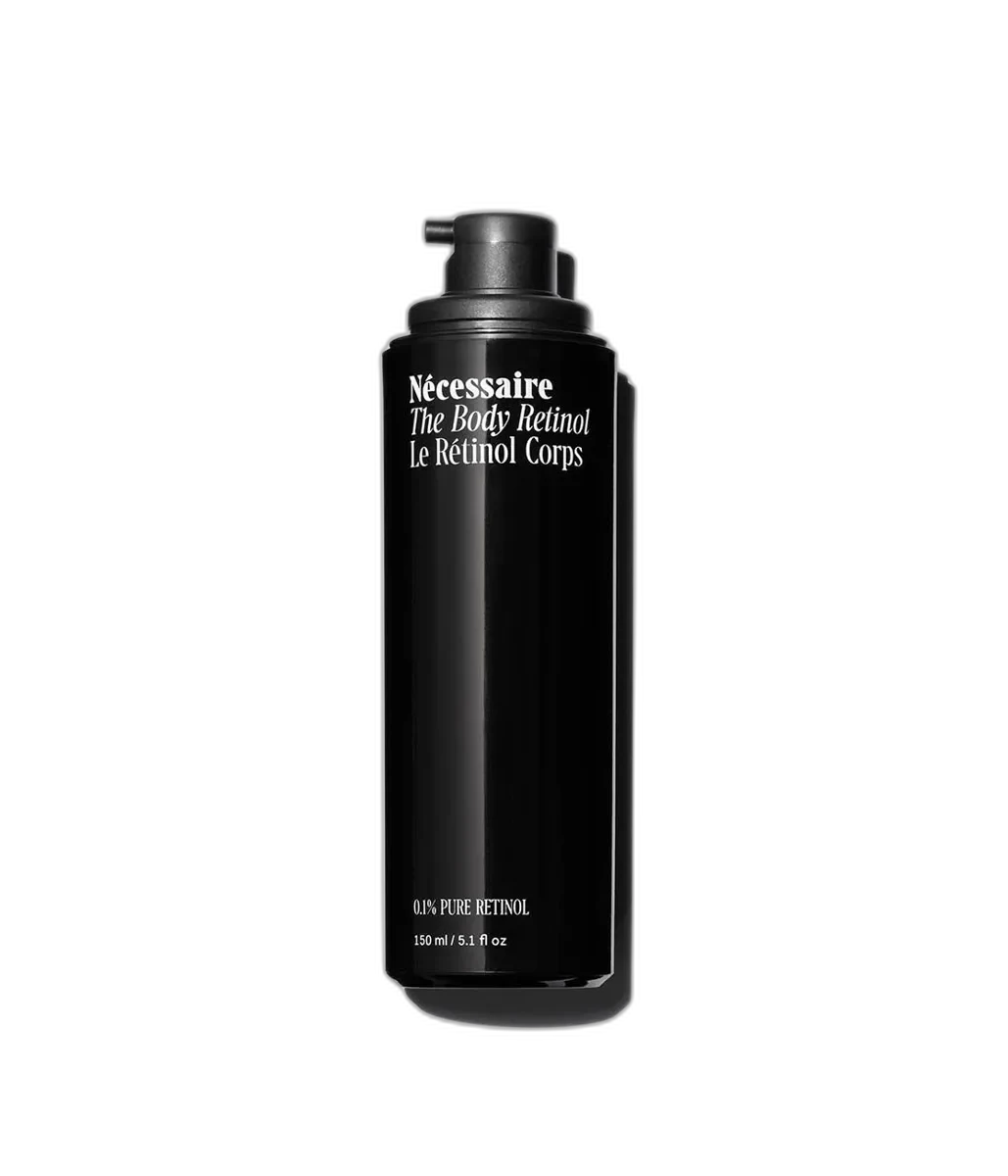
The Body Retinol
Body Retinol Pioneer
 Verified reviewer
Pros & cons.
- +0.1% retinol concentration is well-calibrated for body use
- +Niacinamide and lactic acid buffer tolerability over large areas
- +Ceramide NP and shea butter minimize retinol-induced dryness
- +Genuine improvement in KP, body hyperpigmentation and aging
- +Lightweight serum texture makes nightly body use practical
- +Category pioneer with six years of real-world validation
- +Vegan, cruelty-free and packaged in light-protective bottle
- −Expensive at $55 and requires generous full-body dosing
- −Results are slow and require 6-8 weeks minimum commitment
- −Contains fragrance and fragrance allergens
- −Not safe during pregnancy or breastfeeding
- −Mandatory daily SPF commitment on treated body areas
The full review.
Before 2020, body retinol options were mediocre. You either used expensive face retinol serums on your arms, chest, and legs—which costs too much per use—or used drugstore body lotions with concentrations too low to do more than look cosmetic. Nécessaire’s The Body Retinol was the first serious product built specifically for body skin. Competitors arrived six years later, but this remains the reference formula. The 0.1% retinol concentration is correct for the body. It is high enough to drive collagen stimulation, hyperpigmentation fading, KP improvement, and smoother texture on sun-damaged décolletage, but low enough to apply nightly to large areas without irritation. This dose fits the geometry of body skin, which is why this product works where repurposed face serums fail. The supporting ingredients are strategic. Niacinamide buffers the inflammatory response retinol triggers; research supports this, and it matters on body skin where large-area redness is visible and uncomfortable. Lactic acid at a modest dose loosens the surface stratum corneum for even retinol penetration, which helps body skin that develops a thickened, uneven surface. Bakuchiol acts as a retinoid-adjacent supporter, while ceramide NP and shea butter repair the barrier to offset retinol-induced lipid depletion. The texture is a serum-lotion hybrid—lighter than the brand’s flagship Body Lotion—designed for pre-moisturizer application. It absorbs in under two minutes without greasy drag. One full-body application uses eight to ten pumps, which is more than face retinol but fits the surface area. At $55 for 150 ml, you get four to six months of use at three times weekly, or three months at nightly use. What are the results? For keratosis pilaris, the answer is “a lot, eventually.” Retinol directly addresses the follicular keratinization causing KP bumps; results over six to eight weeks beat AHA alone. For body hyperpigmentation—dark spots, post-inflammatory marks, or uneven tone on shins and arms—the retinol and niacinamide combination shows measurable fading over two to three months. For aging concerns like crepey chest skin or fine texture on hands and décolletage, results are slower but real, appearing most after three to six months of consistent use. Note these caveats. First, retinol is not safe during pregnancy or breastfeeding. Do not use it; switch to the regular Body Lotion instead. Second, even with buffering, users who ramp up too fast will see peeling, redness, and flaking. Start at two or three nights a week. Third, it contains fragrance and fragrance allergens, so it is not for the most reactive users. Fourth, daily SPF on treated areas is mandatory. Retinol-treated skin is more photosensitive, and a multi-month regimen without SPF is counterproductive. Fifth, results are slow. This does not deliver visible change in a week. For quick wins, use an AHA body wash. This product delivers measurable changes over months, and the payoff is category-leading for committed users.
Ingredient analysis.
Full INCI list · pH 5.5
Water, Glycerin, Caprylic/Capric Triglyceride, Niacinamide, Cetearyl Alcohol, Glyceryl Stearate, Squalane, Retinol, Dimethicone, Sodium Hyaluronate, Lactic Acid, Panthenol, Tocopherol, Bakuchiol, Phytosterols, Ceramide NP, Bisabolol, Allantoin, Butyrospermum Parkii (Shea) Butter, Sodium Ascorbyl Phosphate, Dimethyl Isosorbide, BHT, Xanthan Gum, Sclerotium Gum, Glyceryl Behenate, Disodium EDTA, Phenoxyethanol, Ethylhexylglycerin
Skin match.
The science.
The Science
Dermatology has researched Retinol's skin mechanism extensively. Once applied topically, enzymes convert retinol to retinaldehyde and then to retinoic acid. This retinoic acid binds to skin receptors, driving transcriptional changes that speed keratinocyte turnover, boost collagen synthesis, lower matrix metalloproteinase activity, and modulate melanogenesis. Decades of dermatology literature, including landmark studies in the New England Journal of Medicine and the Archives of Dermatology, prove Retinol's efficacy on photoaged skin. Research on Retinol for body skin is less common but growing. Studies show topical retinoids work as first-line therapy for keratosis pilaris. Research on post-inflammatory hyperpigmentation also shows Retinol-niacinamide combinations reduce body pigmentation over 8-12 week windows. This formula's buffering strategy—pairing Retinol with niacinamide—has its own evidence. Clinical trials show niacinamide reduces transepidermal water loss and modulates inflammatory response, which helps mitigate Retinol-induced irritation. The lactic acid addition works as a gentle exfoliant and natural moisturizing factor contributor. Bakuchiol has a thinner but growing research base; studies show it produces similar downstream effects to Retinol without the same irritation. Using Bakuchiol here as a support act rather than a primary active matches current evidence.
Dermatologist Perspective
Dermatologists often recommend dedicated body retinols like this one for patients with keratosis pilaris, body hyperpigmentation, crepey chest skin, and photoaging on the hands and décolletage. Board-certified dermatologists note that body-specific retinol formulations tolerate better than repurposed face serums because concentrations and buffering systems suit larger application surfaces. Clinical caveats follow standard retinoid cautions: pregnancy and breastfeeding are absolute contraindications, photosensitivity requires daily SPF on treated areas, and patients with active eczema, rosacea, or compromised barriers should avoid Retinol or introduce it very slowly. For patients with severe KP or established photoaging, dermatologists generally recommend a 3-6 month commitment before evaluating results.
Where it fits in your routine.
Apply to clean, dry skin at night, beginning with 2-3 nights per week. Use enough to cover target areas—arms, chest, shins, hands, and any area with KP or hyperpigmentation—usually six to ten pumps for the full body. Massage until absorbed, then use a ceramide body lotion to prevent dryness. Increase to nightly use over 4-6 weeks as tolerated. Always apply daily body SPF to treated areas, especially the hands, chest, and shins. Do not use with AHA body washes or benzoyl peroxide on the same night during the initial ramp-up period.
At $55 for 150 ml, Nécessaire The Body Retinol is premium-priced, but the per-use math is more reasonable than it first appears. Used three nights a week on full body, one bottle lasts four to six months, which brings the monthly cost to roughly $10-14 — similar to what you'd spend on a mid-tier face retinol over the same period. Compared to the practice of using face retinol serums on body skin (which typically costs $60-100 per month), this is genuinely the cheaper option. Against other body retinols that have entered the market since 2020, Nécessaire's version holds up on ingredient quality — most competitors cut corners on either retinol concentration, buffering agents, or barrier support, and few match this formula's overall sophistication. For users actively treating a specific concern like KP or body hyperpigmentation, the price reflects honest ingredient value.
Use this if you treat keratosis pilaris, body hyperpigmentation, crepey chest skin, or photoaging on visible body areas and commit to 3-6 months of use. It works for users already using face retinol who want benefits below the jawline without using expensive face serum.
Skip this if you are pregnant or breastfeeding, have reactive skin, or have an active eczema or rosacea flare. Do not use this if you cannot apply daily body SPF to treated areas or want fast visible results. Skip this if you have strong fragrance sensitivity—the current range has no fragrance-free version of this product.
Product details.
Lightweight serum-lotion hybrid with good slip and no tackiness
Subtle botanical with eucalyptus top note — lighter than the main Body Lotion line
Tall white cylindrical bottle with pump dispenser, darker than other Nécessaire packaging to protect retinol from light
The first few uses are uneventful — no sting or redness, just a lightweight serum that absorbs quickly into arms and legs. By week three, most users notice smoother body skin, and by week six, tone even out on spots that have bothered them for years.
4-6 months using it 2-3 nights per week on full body, or 3 months with nightly full-body use
6 months
fall winter
The backstory.
When Nécessaire launched The Body Retinol in 2020, dedicated body retinols barely existed as a category. Users who wanted retinol on their arms, chest or legs had to repurpose face serums, which was either wasteful or irritating. Nécessaire built this product specifically to fill that gap and effectively created the category.
About Nécessaire
Established Brand (5–20 years)Nécessaire launched Body Retinol in 2020. It was among the first brands to market a retinol formulated for body skin instead of repurposed face serum. Sephora stocks the brand, and editorial reviews have covered it widely since.
Common myths.
You can just use your face retinol on your body instead
You can, but it is rarely ideal. Face retinol serums at prestige prices cost too much per milliliter for full-body use, and most lack buffering for larger surface areas. Body-specific formulations are usually more tolerable and cost less per use.
Body retinol works faster than face retinol
The opposite is usually true. Body skin turnover is slower than facial skin, and retinoid-induced changes take months instead of weeks. You need patience.
FAQ.
How often should I use Nécessaire The Body Retinol?
Apply 2 to 3 nights a week on clean, dry skin and increase use slowly. Most users tolerate nightly application after four to six weeks of ramp-up. If you see peeling or redness, use it every other night until your skin adapts.
Does it really work for keratosis pilaris?
Yes, for many users — retinol is a top topical ingredient for KP because it targets follicular keratinization. Expect visible improvement after six to eight weeks of consistent use. Pair it with a lactic acid body wash twice weekly for the best results.
Is Nécessaire The Body Retinol safe during pregnancy?
No. Avoid Retinol and all retinoids during pregnancy and breastfeeding as a standard precaution. Use non-retinoid alternatives like niacinamide and AHA-based body products during pregnancy, then return to this product afterward.
Can I use body retinol on sun-damaged skin?
Yes, and this is a primary reason people buy this product. The retinol treats photoaging on the chest, hands and décolletage within three-to-six months. Use daily SPF on treated areas; retinol-treated skin is more photosensitive.
Will it help with body hyperpigmentation and dark spots?
Yes, gradually. Retinol and niacinamide work together to reduce hyperpigmentation, while lactic acid speeds surface cell turnover. Visible improvement on older dark spots takes 6-12 weeks.
Can I use it on my face if I run out of face retinol?
You can use it once or twice without damaging facial skin. However, the formula targets body skin's tolerance and texture. Consistent facial use yields sub-optimal results and uses up this expensive product faster than intended.
What the community says.
"smooths KP over time"
"evens body hyperpigmentation"
"absorbs well for a retinol"
"firming effect over months"
"manageable tolerability"
"expensive at $55"
"slow to show results"
"can flake if used too often"
"not suitable for pregnancy"
"fragrance load"
People also looked at.