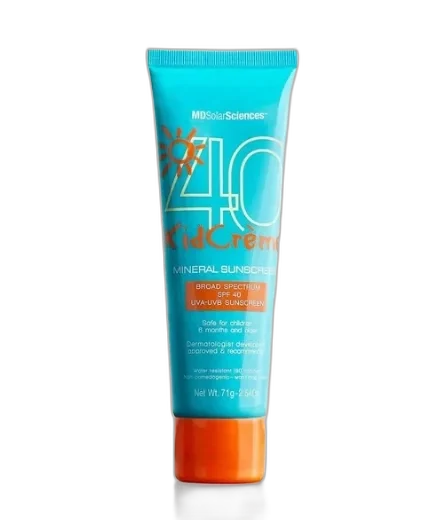
KidCrème Mineral Sunscreen SPF 40
Pediatric Derm Beach Bag Staple
 Verified reviewer
Pros & cons.
- +Dual-mineral 10.5% filter load covers full UVA and UVB spectrum
- +National Eczema Association Seal of Acceptance
- +No fragrance and no chemical filters — exceptionally low sting risk
- +Niacinamide and bisabolol add real anti-inflammatory support
- +Developed by a practicing Mohs surgeon and melanoma researcher
- +Water-resistant texture holds up during beach and pool days
- +Reef-safe and compliant with Hawaii sunscreen regulations
- −Visible white cast on medium and deeper skin tones
- −Thick texture requires deliberate rubbing to blend
- −3 oz tube is small relative to family-use needs
- −Per-ounce cost higher than drugstore mineral sunscreens
- −Semi-matte finish looks chalky immediately after application
The full review.
Pediatric dermatologists face a specific problem: they want to recommend mineral sunscreens to parents of eczema-prone kids, but most pediatric mineral options on drugstore shelves sting, smell like fruit punch, or leave a white cast that makes application a twenty-minute negotiation. The truth about pediatric sun protection is that the best sunscreen is the one a kid tolerates — a category where texture, fragrance, and application speed matter more than marketing claims.
MDSolarSciences KidCrème solves this problem. Dr. Robert Friedman, a Mohs surgeon and melanoma researcher at NYU, founded the brand in 2009 to bring clinical dermatology rigor to consumer products. KidCrème launched in 2014 as the brand’s pediatric SKU. The formulation reflects his experience seeing kids with avoidable sunburns because families bought sunscreens nobody could stand to use.
The actives are the priority. KidCrème uses 5.5% titanium dioxide and 5.0% zinc oxide, providing a 10.5% combined mineral filter load that covers the full UVA and UVB spectrum. This dual-filter approach works: zinc oxide handles most long UVA, titanium dioxide strengthens UVB and short UVA coverage, and the combination offers broader, more balanced photoprotection than single-filter formulas. The tradeoff for these mineral percentages is a visible white cast that requires rubbing to blend. Parents used to thinner, more cosmetically elegant mineral sunscreens may find the opacity off-putting, but it helps pediatric application by showing exactly where you applied it. You can see the white sheen on a kid’s ears instead of guessing.
The supporting ingredients distinguish this formula from pediatric mineral sunscreens containing only two filters and water. Niacinamide appears high in the ingredient list to provide anti-inflammatory and barrier-supporting effects for eczema-prone skin. Bisabolol, a chamomile-derived anti-irritant, adds soothing properties; this helped the National Eczema Association grant this sunscreen its Seal of Acceptance. Panthenol, allantoin, calendula, aloe vera, and cucumber extracts provide a chorus of gentle botanicals. The goal is to block UV and prevent skin irritation during a hot afternoon.
The texture is thick. A mineral sunscreen at this percentage should feel substantial, and KidCrème does. It spreads slower than chemical formulas but blends to a pale sheen within a minute of rubbing, and it stays on. Water resistance meets the forty-minute claim, and the thick cream resists being sweated off at the beach.
KidCrème does not sting. This is a vital virtue for pediatric sunscreen, as chemical filters in a child’s eyes can ruin sunscreen compliance. Because mineral filters sit on the skin surface and do not migrate into the aqueous phase like chemical filters, KidCrème has high eye tolerance. Parents report that even when it runs down a sweaty forehead, it does not sting like a chemical sunscreen stick.
The cost is the main hurdle. At around $32 for 3 ounces, this costs more per ounce than nearby pediatric mineral sunscreens at the drugstore. The premium depends on your priorities. If you have a reactive child whose skin flared with cheaper options, these formulation specifics justify the price. If your kid tolerates everything and you apply it twice a day to three kids, you will use the tube quickly.
This is a dermatology-grade pediatric mineral sunscreen that does its job. It is not thin, glamorous, or invisible, but it is well-formulated, eczema-tested, and built to solve real-world pediatric sun protection problems rather than marketing ones.
Ingredient analysis.
Full INCI list
Active Ingredients: Titanium Dioxide 5.5%, Zinc Oxide 5.0%. Inactive Ingredients: Water, Propanediol, Caprylic/Capric Triglyceride, Cetearyl Olivate, Sorbitan Olivate, Glycerin, Isohexadecane, Polyhydroxystearic Acid, Coco-Caprylate, Aloe Barbadensis Leaf Juice, Tocopheryl Acetate, Panthenol, Allantoin, Bisabolol, Calendula Officinalis Flower Extract, Chamomilla Recutita (Matricaria) Flower Extract, Cucumis Sativus (Cucumber) Fruit Extract, Sodium Hyaluronate, Niacinamide, Xanthan Gum, Alumina, Stearic Acid, Polyglyceryl-3 Polyricinoleate, Caprylyl Glycol, Phenoxyethanol, Ethylhexylglycerin
Skin match.
The science.
The Science
Research supports dual-mineral pediatric sunscreens through several channels. The FDA classifies titanium dioxide and zinc oxide as Category I sunscreen actives — generally recognized as safe and effective. A 2019 review in the Journal of the American Academy of Dermatology notes that mineral filters are the preferred choice for pediatric photoprotection because they do not absorb systemically and have a favorable tolerability profile. Zinc oxide covers the UVA1 range (340-400 nm), which is vital for long-term skin cancer prevention; research since the 1990s links UVA to photocarcinogenesis. Research on topical B3 as an anti-inflammatory agent supports the niacinamide in KidCrème. A 2005 study in the British Journal of Dermatology shows niacinamide improves skin barrier function and reduces transepidermal water loss, and later work confirms its use for sensitive and compromised skin. A 2010 review in Natural Product Communications characterized Bisabolol's anti-inflammatory activity and its mechanisms for reducing cutaneous inflammation. Pairing these additives with non-nano mineral filters follows current best practice for pediatric sunscreen formulation: use physical filters for protection, then reduce low-grade inflammation from prolonged sun exposure instead of relying on actives alone.
References
- Sunscreens: A review of health benefits, regulations, and controversies — Journal of the American Academy of Dermatology (2019)
- Topical niacinamide improves the epidermal permeability barrier and microvascular function in vivo — British Journal of Dermatology (2005)
Dermatologist Perspective
Pediatric dermatologists often recommend dual-mineral sunscreens like this one for children with eczema, atopic dermatitis, or sensitive skin histories. Board-certified dermatologists say fragrance-free mineral formulas with soothing additives are the photoprotection category most likely to be tolerated through a full beach day without triggering flares. When counseling families, dermatologists emphasize that the best sunscreen is the one used consistently and reapplied correctly — meaning texture, stinginess, and fragrance matter as much as the SPF number. This formula's National Eczema Association seal and the inclusion of niacinamide and bisabolol make it an option dermatologists commonly suggest when parents ask for a pediatric sunscreen for reactive skin.
Where it fits in your routine.
Apply a thick layer to clean, dry skin fifteen minutes before sun exposure. Mineral filters work immediately, but letting the cream set improves water resistance. Use one shot-glass amount for full body coverage on a child. Cover ears, tops of feet, and the back of the neck. Reapply every two hours during prolonged sun exposure, and immediately after swimming, heavy sweating, or toweling off. For daily use, one morning application after moisturizer works for standard activity levels.
At $32 for 3 ounces, KidCrème costs more than drugstore pediatric mineral sunscreens but less than most derm-brand adult mineral sunscreens. The value is highest for families with eczema-prone or reactive children who found cheaper sunscreens ineffective. For those parents, the dual-mineral formula, soothing additives, and NEA seal justify the premium. Families with kids who tolerate most sunscreens may find the per-ounce cost harder to justify — a $12 Blue Lizard or Thinkbaby tube lasts longer. The lack of a larger size is the main packaging downside for heavy-use families.
Parents of kids with eczema, atopic dermatitis, or history of reacting to fragranced or chemical sunscreens use this. It also works for adults with very sensitive skin who want a no-fragrance mineral formula without paying double for adult-marketed versions of the same formulation.
Families seeking the lowest-cost pediatric option, parents choosing an invisible finish over filter completeness, and anyone with deep skin tones who rejects white cast for daily kid use. If your child tolerates cheaper mineral sunscreens without issue, you do not need this premium.
Product details.
All Year Certifications National Eczema Association Seal of AcceptanceReef-friendly formula
The backstory.
MDSolarSciences was founded in 2009 by Dr. Robert Friedman, a dermatologist and melanoma researcher at NYU, who wanted to build photoprotection products around the needs of the skin cancer patients he was treating in clinic. KidCrème was released in 2014 as the brand's pediatric formula, designed to meet the tolerability standards of eczema-prone children while delivering actual broad-spectrum protection.
About MDSolarSciences
Established Brand (5–20 years)Dr. Robert Friedman, a Mohs surgeon and melanoma researcher, founded MDSolarSciences in 2009. He built the brand to create photoprotection products for skin cancer patients. MDSolarSciences relies on its dermatologic origin instead of venture marketing.
Common myths.
Mineral sunscreens are less effective than chemical ones.
Apply dual-mineral formulas like this in the correct amount for full broad-spectrum protection. Underapplication creates the real-world gap; mineral creams are hard to spread evenly, so families often use too little. This cream meets its SPF 40 rating in testing when applied generously.
You don't need sunscreen for kids under the age of six months.
Babies under six months rely mostly on shade and clothing. Dermatologists now routinely support small amounts of mineral-only sunscreen on exposed areas like the cheeks and backs of hands when physical protection is not possible.
FAQ.
Is this safe for babies under six months?
Formal pediatric guidelines recommend shade and clothing for infants under six months. However, dermatologists often approve this dual-mineral fragrance-free formula for small amounts on exposed skin like cheeks and backs of hands when physical protection is unavailable. Talk to your pediatrician before use on infants.
Does this sunscreen leave a white cast?
Yes — the 10.5% mineral filter load causes a visible white cast. This is a fair tradeoff for a pediatric formula, where parents need visible, even coverage to confirm placement. It blends to a pale sheen on most skin tones but stays more visible on deeper complexions.
Will this sunscreen work for eczema-prone children?
Yes — this is why it has the National Eczema Association Seal of Acceptance. The formula is fragrance-free, uses only mineral filters, and includes niacinamide and bisabolol to calm reactive skin. Many dermatologists recommend it for kids whose eczema flares with other sunscreens.
How often should I reapply this on a beach day?
Apply every two hours, or more often after swimming or heavy toweling. Water and sand physically displace mineral filters rather than breaking them down chemically. Reapply after water play because the formula is water-resistant.
Does this sting in the eyes?
This formula rarely stings eyes, even when kids sweat it down their faces. Mineral filters sit on the skin surface instead of absorbing into the water phase, so they irritate eyes less than chemical sunscreens.
Can adults use this sunscreen too?
This formula is not pediatric-exclusive. Adults with very reactive or eczema-prone skin often prefer gentle pediatric sunscreens, and this one works well on sensitive adult skin despite the white cast.
Is this reef-safe?
Yes — the formula uses only non-nano titanium dioxide and zinc oxide, which meet Hawaii's reef-safe sunscreen laws. It contains no oxybenzone or octinoxate filters.
Community
What the community says.
"Gentle on eczema-prone kids"
"No stinging in eyes"
"Stays on during water play"
"No chemical filter concerns"
"Fragrance-free"
"White cast is noticeable"
"Thicker texture takes effort to rub in"
"Price higher than drugstore mineral sunscreens"
"Tube is on the smaller side for family use"
People also looked at.