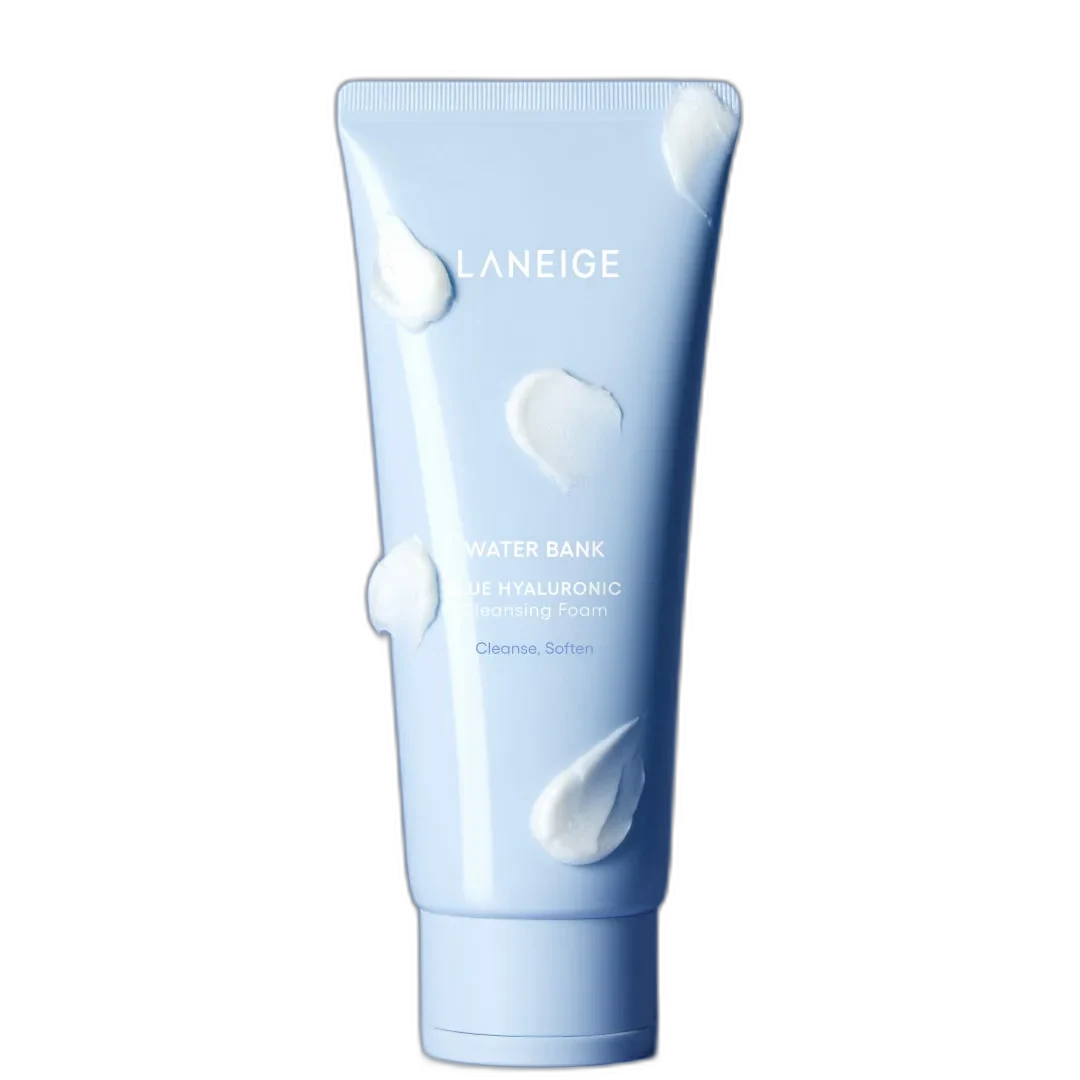
Water Bank Blue Hyaluronic Cleansing Foam
K-Beauty Hydrating Cleanser
 Verified reviewer
Pros & cons.
- +Dense, bouncy foam forms from a very small amount of product, making the tube last months
- +Dual exfoliation via papain enzyme and cellulose capsules smooths texture without harshness
- +Hydrolyzed hyaluronic acid and panthenol genuinely reduce post-wash tightness compared to typical foam cleansers
- +Rinses completely clean with no residual film or slippery feeling
- +Sulfate-free surfactant system is less stripping than many traditional foam cleansers
- +Effective as a second cleanse in a double-cleansing routine for thorough makeup residue removal
- +Paraben-free and silicone-free formulation
- −Contains added fragrance and mentha extract, making it unsuitable for sensitive or reactive skin
- −At $25 for a rinse-off product, the price is steep for what the active ingredients can realistically deliver
- −Berry and botanical extracts are present at likely negligible concentrations in a wash-off format
- −Soap-based surfactant system is still more stripping than cream or gel alternatives for very dry skin
- −The mild cooling tingle from mentha may be unwelcome for those who prefer zero-sensation cleansing
The full review.
Laneige focuses on water, a theme rooted in its name. Since 1994, the Amorepacific subsidiary has researched moisture movement through skin, creating its Advanced Water Science technology portfolio. When the Water Bank line received its Blue Hyaluronic overhaul in 2022, adding a foam cleanser to this hydration-focused line was expected. The challenge is whether a product rinsed off the face in sixty seconds can provide meaningful hydration.
The answer is a qualified yes. This cleansing foam uses hydrolyzed hyaluronic acid—a smaller molecular weight version Laneige calls Blue HA—within a soap-based surfactant system of myristic, stearic, and palmitic acids neutralized with potassium hydroxide. As a traditional saponified cleanser, it foams well and cleans effectively. It distinguishes itself through its supporting ingredients: high levels of glycerin, panthenol for soothing, and hydrolyzed HA to reduce the post-wash tightness common in soap-based cleansers.
The texture is a thick, opaque cream containing visible microcrystalline cellulose capsules. Adding water turns the cream into a dense, bouncy, springy foam. A small amount lasts a long time. The cellulose beads melt on the skin, providing enough physical exfoliation to feel without causing scratchiness. This tactile element makes the cleansing step feel like a treatment.
The papain enzyme is the main differentiator. This proteolytic enzyme from papaya gently dissolves the protein bonds of dead skin cells. Because contact time in a rinse-off cleanser is short, the effect is subtle, but consistent use over weeks improves skin texture. The cellulose capsules and papain provide a dual-exfoliation approach rare for an everyday foam cleanser. Most category products focus on either cleansing or exfoliating; this one does both.
The antioxidant berry blend—raspberry, blueberry, cranberry, strawberry, and cloudberry—is low on the INCI list. These likely exist at concentrations too low to provide topical benefits in a rinse-off product. Undaria pinnatifida (kelp) extract and Ly Lycium chinense (goji berry) extract are also supporting players that add to the brand story more than performance.
The skin experience is pleasant. The foam feels cushiony and rinses without leaving a film. Skin feels less tight than with typical foam cleansers, though “truly hydrating” may be an overstatement. Mentha arvensis leaf extract provides a mild cooling sensation, which is refreshing for some but potentially irritating for others. The fragrance is a restrained, clean, soapy-floral scent that disappears quickly after rinsing.
There are honest limitations. Because it contains fragrance and mentha extract, this cleanser is not for those with fragrance sensitivities, rosacea, eczema, or a compromised skin barrier. This choice is puzzling for a line marketed as gentle and hydrating. The surfactant base remains soap-based; cream and milk cleansers are inherently gentler. At twenty-five dollars for a product rinsed off in under a minute, shoppers may wonder if they are paying for the Laneige name and blue packaging.
However, the product meets its core promise for suitable skin types. Normal, combination, and oily skin types will benefit from a thorough cleanse that does not strip the skin, alongside the texture-smoothing effects of the enzyme and cellulose. It works well as a second cleanse in a double-cleansing routine to remove oil cleanser, sunscreen, and grime. The tube lasts a long time because little product is needed per wash, lowering the per-use cost.
Laneige aims to make hydration interesting, and this cleanser follows that ethos despite the difficult format. It will not replace a serum or moisturizer, and it will not work for everyone. But for users who want more from their cleanser and can tolerate fragrance, it is a well-formulated option in a category where such care is rare.
Ingredient analysis.
Full INCI list
Water, Glycerin, Myristic Acid, Stearic Acid, PEG-32, Potassium Hydroxide, Palmitic Acid, Lauric Acid, Cocamidopropyl Betaine, Glyceryl Stearate, PEG-100 Stearate, Microcrystalline Cellulose, Fragrance, Sodium Chloride, Disodium EDTA, Butylene Glycol, Sodium Benzoate, Mentha Arvensis Leaf Extract, Hydrolyzed Hyaluronic Acid, Polycaprolactone, Titanium Dioxide, Propanediol, 1,2-Hexanediol, Lactic Acid, PEG-75, Polyquaternium-10, Lactic Acid/Glycolic Acid Copolymer, Ethylhexylglycerin, Aluminum Hydroxide, Triethoxycaprylylsilane, Lycium Chinense Fruit Extract, Panthenol, Papain, Rubus Idaeus (Raspberry) Fruit Extract, Vaccinium Angustifolium (Blueberry) Fruit Extract, Coffea Arabica (Coffee) Seed Extract, Sapindus Mukorossi Fruit Extract, Vaccinium Macrocarpon (Cranberry) Fruit Extract, Fragaria Chiloensis (Strawberry) Fruit Extract, Rubus Chamaemorus Seed Extract, Phenoxyethanol, Undaria Pinnatifida Extract
Skin match.
The science.
The Science
The core claim behind this cleanser rests on hydrolyzed hyaluronic acid's ability to deliver hydration during a brief cleansing window. Hydrolyzed HA has a lower molecular weight than standard sodium hyaluronate, typically ranging from 3-50 kDa compared to the 1,000-1,400 kDa of high-molecular-weight HA. A 2011 study published in the Journal of Drugs in Dermatology demonstrated that low-molecular-weight HA fragments can penetrate deeper into the epidermis, though the clinical significance in a rinse-off product with sub-60-second contact time is debatable. What is more likely contributing to the reduced tightness is the combination of glycerin — a proven humectant listed second in the formula — and the relatively mild cocamidopropyl betaine co-surfactant buffering the stronger saponified fatty acid base.
Papain enzyme has well-documented keratolytic properties. A study published in the Journal of Cosmetic Dermatology (2013) confirmed that papain effectively breaks down keratin protein in the stratum corneum, facilitating the removal of dead skin cells without mechanical abrasion. In this formulation, the enzyme works synergistically with the physical action of the microcrystalline cellulose beads, creating two complementary pathways for surface exfoliation. The contact time limits the enzymatic effect per wash, but cumulative daily use can produce measurable improvements in skin smoothness.
Panthenol's role as a soothing agent is backed by extensive research. A review in the Journal of Dermatological Treatment (2017) documented panthenol's ability to improve skin hydration, reduce transepidermal water loss, and support barrier recovery. In this formula, it helps mitigate the disruption caused by the surfactant system and exfoliating agents, making the overall cleansing experience less irritating.
References
- Low molecular weight hyaluronic acid induces expression of genes involved in wound healing and tissue repair — Journal of Drugs in Dermatology (2011)
- Papain-based enzymatic exfoliation for keratolytic skin treatment — Journal of Cosmetic Dermatology (2013)
- Dexpanthenol in skin care: A review of the scientific evidence — Journal of Dermatological Treatment (2017)
Dermatologist Perspective
Dermatologists generally acknowledge that foam cleansers have improved significantly from the harsh, stripping formulations of decades past, and this Laneige offering reflects that evolution. Board-certified dermatologists note that the inclusion of humectants like glycerin and hyaluronic acid in cleanser formulations can reduce transepidermal water loss during cleansing, though the benefits are modest in a rinse-off product. The papain enzyme provides a gentler alternative to physical scrubs, which dermatologists increasingly recommend avoiding due to risk of micro-tears. However, dermatologists would caution that the fragrance and mentha arvensis extract make this unsuitable for patients with rosacea, eczema, or contact dermatitis — populations who should opt for fragrance-free, minimal-ingredient cleansers instead.
Where it fits in your routine.
Wet your face and hands with lukewarm water. Squeeze a pea-sized amount onto your palm and lather with water to form a dense foam. Massage onto your face in circular motions for 30-60 seconds so the cellulose beads dissolve and the papain enzyme works. Rinse well with lukewarm water and pat dry. Use morning and evening. In the PM, use as a second cleanse after an oil-based makeup remover for double cleansing. Apply toner immediately while skin stays slightly damp.
At $25 for 150g, this K-beauty foam cleanser costs mid-premium. The dual-exfoliation system adds treatment qualities beyond basic cleansing. Because you need very little per use, one tube lasts 3-4 months with twice-daily use, making the per-wash cost roughly $0.10-0.14. However, the price also covers Laneige's brand positioning and elegant packaging. hydrolyzed HA and papain are inexpensive actives; less premium K-beauty brands offer similar ingredient profiles for less. The price fits Laneige's reputation, but budget-conscious shoppers can find equivalent cleansing performance at lower prices.
Normal, combination, and oily skin types want a satisfying foam cleanser that leaves skin feeling soft, not tight. It works for anyone adding gentle daily exfoliation to their cleansing step without a separate exfoliating product, and for K-beauty enthusiasts building a Water Bank routine.
Avoid this if you have fragrance sensitivities, rosacea, eczema, or a compromised skin barrier because it contains added fragrance and mentha extract. People with very dry skin may find even this gentler foam format too stripping for daily use.
Product details.
It has a clean, mildly floral-soapy fragrance. The mentha extract adds a subtle cooling undertone. The scent is present but not overwhelming.
A standard squeeze tube in Laneige's signature blue-and-white Water Bank branding. The flip-top cap is convenient and travel-friendly. Finish cleanlightweightnon-greasy
A pea-sized amount produces a dense, cushiony foam on first use. The cellulose beads feel soft and dissolve fast without scratching. The mentha causes a mild cooling tingle that typically fades within seconds. Skin feels clean and smooth immediately after rinsing.
Use twice daily for 3-4 months; a small amount creates ample lather.
12 months
All Year
The backstory.
Laneige's Water Bank line has been the brand's flagship hydration range since the early 2000s. The 2022 reformulation as 'Water Bank Blue Hyaluronic' introduced the brand's proprietary micro-sized hyaluronic acid across the entire line, and this cleansing foam extended the hydration-first philosophy to the often-overlooked first step of any routine.
About Laneige
Established Brand (5–20 years)Amorepacific, South Korea's largest beauty conglomerate, launched Laneige in 1994. Over three decades, the brand gained global recognition for hydration-focused formulations, especially its Water Bank and Sleeping Mask lines. You can find Laneige at Sephora and other prestige retailers.
Common myths.
Foam cleansers strip the skin and damage the moisture barrier.
Many traditional foam cleansers strip the skin. This formula uses glycerin, hydrolyzed hyaluronic acid, and panthenol to offset the surfactant base's drying effects. It leaves less tightness than a typical foam cleanser, but is not as gentle as a non-foaming option for very dry or compromised skin.
The cellulose beads are microplastics that harm the environment.
Microcrystalline cellulose comes from plant fiber and is fully biodegradable; it is not a microplastic. The polycaprolactone in the formula is a synthetic polymer, but it biodegrades under industrial composting conditions.
FAQ.
Is the Laneige Water Bank Blue Hyaluronic Cleansing Foam good for dry skin?
The hydrolyzed hyaluronic acid and panthenol offset the surfactant base to work for dry skin, but those with very dry or compromised barriers may find it slightly stripping. If your skin tends toward dryness, use it only in the PM and use a gentler, non-foaming cleanser in the morning.
Can I use this cleanser every day?
The papain enzyme and cellulose capsules exfoliate gently enough for daily use. This enzymatic and physical exfoliation is mild compared to dedicated exfoliating treatments. Most skin types won't over-exfoliate with regular use.
Does the Laneige cleansing foam remove makeup?
This foam removes light makeup and leftover residue after a first cleanse, but it does not break down heavy or waterproof makeup alone. For a thorough PM cleanse, use an oil-based cleanser first, then use this foam as a second step.
Is the Laneige Water Bank Cleansing Foam fragrance-free?
No, it has added fragrance and Mentha Arvensis Leaf Extract, which causes a mild cooling sensation. This is not the best choice if you have fragrance sensitivities or reactive skin.
What is the Blue Hyaluronic Acid in Laneige products?
Laneige's Blue Hyaluronic Acid uses a hydrolyzed (micro-sized) form of hyaluronic acid. Laneige claims this penetrates skin better than standard hyaluronic acid. This cleanser uses it to maintain skin hydration during cleansing so skin does not feel tight or stripped afterward.
What the community says.
"Creates a rich, creamy lather with very little product needed"
"Skin feels clean without that tight, stripped sensation"
"Noticeably smoother texture with consistent use"
"Lasts a long time due to small amount needed per use"
"Contains fragrance which some users find noticeable"
"Some users with dry skin feel it can be slightly drying"
"Price is high for a cleanser that gets rinsed off"
"Mentha extract may cause tingling for sensitive skin"
People also looked at.