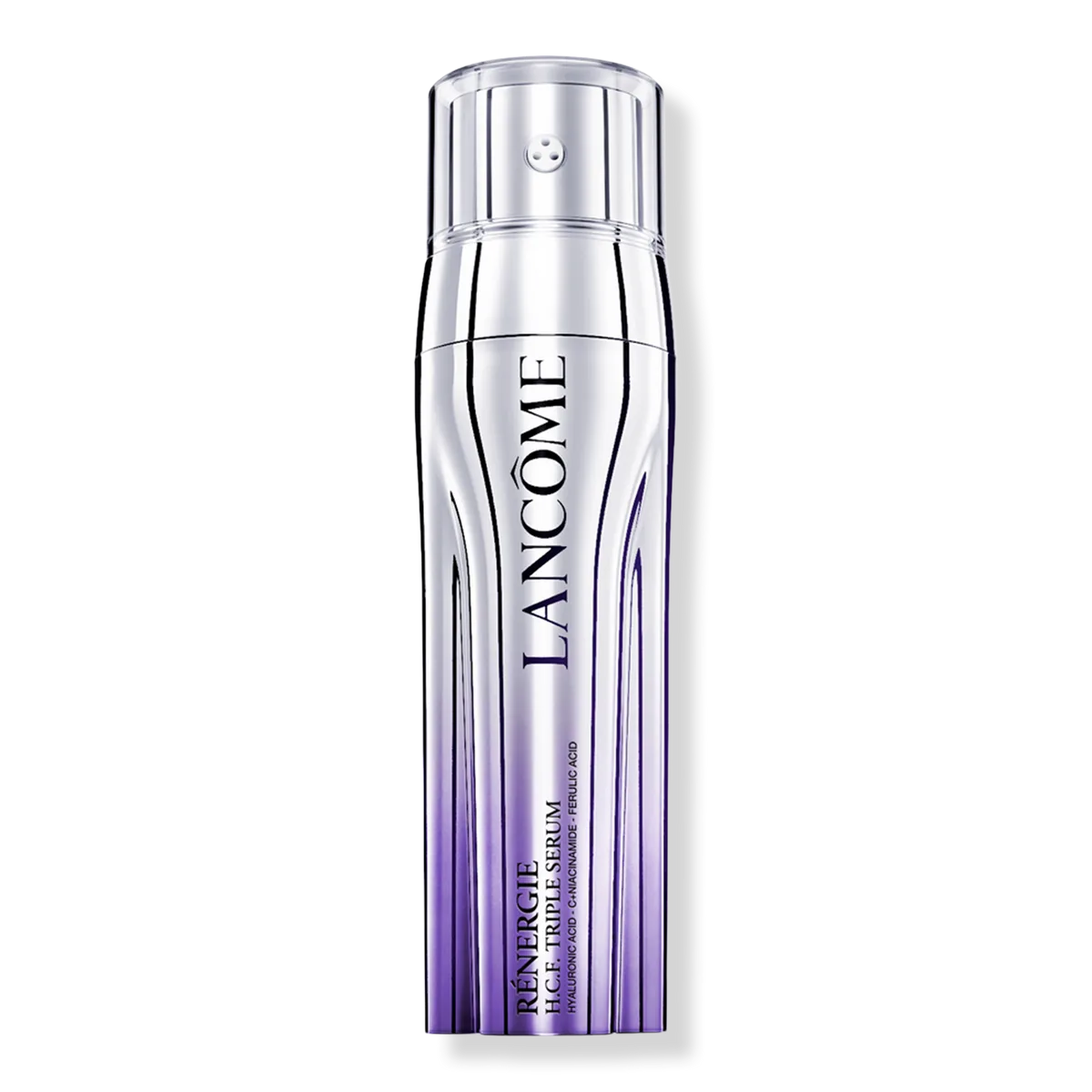
Rénergie H.C.F. Triple Serum
Anti-Aging Engineering Marvel
 Verified reviewer
Pros & cons.
- +Triple-chamber engineering genuinely solves vitamin C and ferulic acid stability problems
- +Outstanding active ingredient lineup: two forms of HA, vitamin C, ferulic acid, niacinamide, adenosine
- +Clinical data showing 30% smoothness improvement and 14% dark spot reduction at 8 weeks
- +Lightweight, fast-absorbing texture that layers well under moisturizer and sunscreen
- +2022 Allure Best of Beauty Award winner
- +Freshly combined ingredients with every pump ensure maximum potency throughout shelf life
- +Oil-free and non-comedogenic formula suitable for multiple skin types
- −Triple-chamber dispenser requires angled holding and is prone to air bubbles and inconsistent flow
- −Alcohol Denat. present despite the $150 premium price point
- −Contains fragrance allergens (limonene, geraniol, citronellol)
- −Expensive at $150 for 1.7 oz with a 2-3 month lifespan
- −Overcomplicated for users who prefer simple, straightforward serums
The full review.
Cosmetic chemists know a frustrating truth: the most powerful anti-aging ingredients often destroy each other in a bottle. Vitamin C degrades in water. Ferulic acid breaks down in aqueous solutions. Hyaluronic acid needs water to function. Combining them creates a formula that stays potent for only two weeks before the vitamin C oxidizes and the ferulic acid destabilizes. Most brands use less potent derivatives for stability or require you to layer three separate serums yourself.
Lancôme uses a literal solution: a bottle with three separate rooms. The H.C.F. Triple Serum keeps hyaluronic acid in an aqueous chamber, vitamin C and niacinamide in a low-pH emulsion, and ferulic acid in an anhydrous gel. Each ingredient stays in its optimal environment until the pump meets them on your fingertips. This is material science applied to skincare with impressive engineering.
About
The ‘H’ stands for hyaluronic acid—specifically, two forms. Standard sodium hyaluronate provides immediate surface hydration, while sodium acetylated hyaluronate binds more effectively to the stratum corneum to extend hydration beyond standard HA. These live in the water-based chamber.
About
The ‘C’ is 3-O-Ethyl Ascorbic Acid, a vitamin C derivative more stable than pure L-ascorbic acid that still converts to active ascorbic acid in the skin. Niacinamide joins it in the same chamber. This pairing was once controversial due to debunked flushing concerns, but modern research shows they are synergistic for targeting hyperpigmentation. This chamber uses a lower pH to keep the vitamin C derivative effective.
About
The ‘F’ is ferulic acid, stored alone in an anhydrous gel. This ingredient is highly sensitive to degradation, so a water-free environment is critical for potency. When ferulic acid meets vitamin C on your skin, research in the Journal of Investigative Dermatology by Pinnell et al. shows the combination roughly doubles the photoprotective capacity of vitamin C alone. The 2005 study on L-ascorbic acid established ferulic acid as the gold standard antioxidant stabilizer; the synergy principle holds here even with a vitamin C derivative.
Texture
Using the Triple Serum is a daily spectacle. Press the pump to release three distinct textures from tiny spouts: a clear gel, a white cream, and a golden emulsion. They look different. Mixing them on your fingertips creates a cohesive serum that feels lightweight, absorbs quickly, and leaves skin plump and glowing. The texture is neither watery nor heavy; it sits in a middle ground that works under moisturizer and sunscreen without pilling.
Packaging
The dispenser is the product’s engineering triumph and its main weakness. You must hold the bottle at a slight angle for even flow. Air bubbles accumulate in the chambers, especially the white emulsion, causing inconsistent dispensing. Some pumps deliver all three serums perfectly, while others need a second or third press for a full dose. This minor frustration is hard to ignore at $150. You expect luxury packaging to work flawlessly, but this one has a learning curve.
Ingredients
Beyond the main trio, the formula includes adenosine for collagen stimulation, caffeine for an energizing effect, and hydrolyzed linseed extract for firming. Phenylethyl resorcinol, a skin-brightening agent, adds dark spot targeting alongside the vitamin C and niacinamide. The ingredient deck is one of the most comprehensive anti-aging lineups in the prestige market, targeting wrinkles, dark spots, loss of firmness, dehydration, and dullness.
Clinical Results
Lancôme’s clinical data supports this. An eight-week study of 45 women showed 30.1 percent improvement in smoothness, 14.1 percent reduction in dark spot size, and 13.8 percent reduction in fine lines. A twelve-week study showed measurable improvement in firmness. These brand-funded studies have small sample sizes, but the results match what the ingredient combination should deliver based on independent research.
Concerns
The usual Lancôme tension remains: Alcohol Denat. is present to enhance penetration and optimize texture. This seems to be a Lancôme house style, choosing sensorial elegance via alcohol over a purist approach. Fragrance compounds (limonene, geraniol, citronellol) are also present, though the scent is barely perceptible.
Price
At $150 for 1.7 ounces, the Triple Serum charges for engineering as much as ingredients. The three-chamber technology is expensive to manufacture, but the freshness guarantee is a benefit—your vitamin C and ferulic acid are more potent on day 60 than in a pre-mixed formula. Whether this premium is worth it depends on how much you value ingredient stability. If you have used a vitamin C serum that turned orange within a month, you understand the problem Lancôme solves.
Overall
The H.C.F. Triple Serum is Lancôme at its most ambitious, applying L’Oréal’s material science to a formulation challenge to deliver a product that differs from the competition in kind, not just branding. The active ingredient lineup is outstanding. The delivery technology is innovative. The clinical results are solid. However, the alcohol, fragrance, and finicky dispenser remind you that even thoughtful engineering is not perfect.
Ingredient analysis.
Full INCI list
Water/Aqua/Eau, Dipropylene Glycol, Glycerin, Butylene Glycol, Propylene Glycol, Alcohol Denat., Niacinamide, Isopropyl Lauroyl Sarcosinate, Pentylene Glycol, CI 77891/Titanium Dioxide, Guanosine, Mica, Tocopheryl Acetate, Hydrolyzed Linseed Extract, Sodium Acetylated Hyaluronate, Sodium Benzoate, Phenoxyethanol, Phenylethyl Resorcinol, Stearic Acid, Adenosine, Caffeine, PEG-100 Stearate, 3-O-Ethyl Ascorbic Acid, Sodium Hyaluronate, Ferulic Acid, Parfum/Fragrance, Limonene, Geraniol, Citronellol
Skin match.
The science.
The Science
The triple-chamber design solves the instability of key actives. A 2005 Pinnell et al. study in the Journal of Investigative Dermatology shows that combining ferulic acid with vitamins C and E doubles the antioxidant cocktail's photoprotective capacity. However, L-ascorbic acid and its derivatives degrade quickly in aqueous solutions, especially at neutral pH or when exposed to light, heat, and air. Ferulic acid also degrades in water-based formulations.
The formula uses 3-O-Ethyl Ascorbic Acid, a derivative more stable than pure L-ascorbic acid. Research in the International Journal of Cosmetic Science shows ethyl ascorbic acid stays potent in formulation longer while still converting to active ascorbic acid in the skin. Storing it in a low-pH emulsion chamber separate from the aqueous hyaluronic acid phase maximizes stability and efficacy.
Sodium acetylated hyaluronate, the formula's modified HA, has higher skin binding affinity than standard sodium hyaluronate. This acetyl modification increases lipophilicity, so it integrates better into the stratum corneum's lipid matrix. Studies show acetylated HA provides more sustained hydration for up to 72 hours post-application.
Niacinamide and vitamin C work synergistically on melanin production. Niacinamide inhibits melanosome transfer from melanocytes to keratinocytes, while vitamin C interrupts melanin synthesis. These two mechanisms target dark spot reduction through different pathways. Clinical data showing 14-15% dark spot reduction at 8 weeks reflects this dual-pathway approach.
References
- Ferulic acid stabilizes a solution of vitamins C and E and doubles its photoprotection of skin — Journal of Investigative Dermatology (2005)
Dermatologist Perspective
Dermatologists view the vitamin C, ferulic acid, and hyaluronic acid combination as a top evidence-based anti-aging regimen. Board-certified dermatologists note the triple-chamber approach solves a real stability issue—oxidized vitamin C serums (brown or orange) lose benefits. Adding niacinamide provides more options for hyperpigmentation. However, dermatologists treating sensitive skin may flag the alcohol and fragrance as potential irritants. Some also find the engineering impressive but unnecessary since stable vitamin C derivatives work well in conventional packaging.
Where it fits in your routine.
Cleanse and tone first, then tilt the bottle and press the pump once. The triple spout releases three distinct textures. Mix these on your fingertips into a uniform serum. Press the serum into your face, neck, and décolletage. Wait 30-60 seconds for absorption before applying moisturizer. Use morning and night. Apply sunscreen SPF 30+ every morning.
At $150 for 1.7 ounces, the Triple Serum costs a lot. The 0.7 oz travel size at $77 lets you test it first. One bottle lasts about 2-3 months with twice-daily use, so the monthly cost is $50-75. The price covers the active ingredient lineup and the triple-chamber manufacturing technology. You can find comparable actives (hyaluronic acid, vitamin C, niacinamide, ferulic acid) in separate products for much less. The value lies in the single-step convenience, the freshness from separated chambers, and the clinical validation — it makes sense for people who would otherwise buy (and potentially waste) three separate unstable serums.
People in their 30s and older want one anti-aging serum for wrinkles, dark spots, firmness, and dullness. This works for anyone who values ingredient stability and needs vitamin C and ferulic acid to stay potent with every use.
People with sensitive or reactive skin who avoid alcohol and fragrance. Budget-conscious shoppers who can build a comparable routine with individual products for less. Anyone who prefers simple products — the dispenser and multi-chamber concept add complexity some users do not want.
Product details.
A light, clean fragrance is barely perceptible during application. Limonene, geraniol, and citronellol are the fragrance components, but the scent is minimal and fades fast.
The defining feature is a glass bottle with three internal chambers, each holding a separate serum formula. A single pump dispenses all three through tiny spouts for mixing on your fingertips. This engineering keeps ingredients isolated until use, so vitamin C and ferulic acid do not degrade. You must hold the bottle at a slight angle for even dispensing.
The first pump looks striking — three distinct textures emerge at once from the triple spout. Mixing them on your fingertips creates a cohesive serum. Skin feels hydrated and slightly plumper immediately. Most users experience no stinging or irritation. The dispensing mechanism has a learning curve — air bubbles and inconsistent flow occur during the first few uses.
2-3 months with twice-daily use for the 1.7 oz size
6 months
All Year
The backstory.
The H.C.F. Triple Serum emerged from L'Oréal's material science division tackling a fundamental problem in cosmetic chemistry: the ingredients dermatologists most want to combine (vitamin C, ferulic acid, hyaluronic acid) are inherently incompatible in a single stable formula. Rather than accept the compromises that every other brand makes — using less potent vitamin C derivatives, accepting degradation over shelf life, or separating products into multiple bottles — Lancôme's engineers built a bottle that keeps three formulas separate until you press the pump.
About Lancôme
Legacy Brand (20+ years)Lancôme launched in 1935 in France and belongs to L'Oréal's luxury division. The Rénergie line is the brand's flagship anti-aging collection. The H.C.F. Triple Serum won the 2022 Allure Best of Beauty Award. The triple-chamber technology shows L'Oréal's engineering investment in ingredient stability.
Common myths.
Triple-chamber packaging is just a marketing gimmick
The separation has a chemical purpose. Vitamin C (ascorbic acid derivatives) degrades fast in aqueous solutions, especially at neutral pH. Ferulic acid is unstable in water. Keeping each in its ideal environment — water-based for HA, low-pH emulsion for vitamin C, anhydrous gel for ferulic acid — keeps the formula potent throughout its shelf life. This engineering solves a formulation challenge.
You can't use niacinamide and vitamin C together
This skincare myth is false. Modern research shows niacinamide and vitamin C do not cancel each other out or cause flushing. This serum uses both intentionally — niacinamide and 3-O-Ethyl Ascorbic Acid work together on hyperpigmentation using different mechanisms.
FAQ.
What does H.C.F. stand for in the Lancôme serum?
H.C.F. names the three active ingredient groups: H is Hyaluronic Acid (two forms for plumping and hydration), C is Vitamin C (3-O-Ethyl Ascorbic Acid) and Niacinamide (for brightening and dark spots), and F is Ferulic Acid (antioxidant protection). Separate chambers store each ingredient to ensure maximum stability.
Why does the Lancôme Triple Serum have three chambers?
The triple-chamber design solves a chemistry problem. Vitamin C degrades in water and ferulic acid is unstable in aqueous solutions, but hyaluronic acid needs water. By keeping each in its optimal environment — aqueous for hyaluronic acid, low-pH emulsion for vitamin C, and anhydrous gel for ferulic acid — the ingredients stay potent until you mix them.
Is Lancôme Rénergie H.C.F. Triple Serum worth $150?
The formula combines hyaluronic acid, vitamin C, niacinamide, ferulic acid, and adenosine—a well-researched anti-aging lineup. The triple-chamber engineering preserves ingredient potency. Clinical studies show dark spots reduce by 14-15%, fine lines by 14%, and smoothness improves by 30% at 8 weeks. The technology and clinical backing justify the premium, but the alcohol and fragrance inclusions are disappointing at this price.
Can I use Lancôme H.C.F. Triple Serum with retinol?
Yes — you can use this serum with retinol, but alternate them. Use the H.C.F. Triple Serum in the morning (with sunscreen) and retinol in the evening, or use them on alternate nights. Do not layer both in one routine to avoid irritation from the combined actives.
How do you use the Lancôme Triple Serum dispenser?
Tilt the bottle slightly and press the pump once. Three tiny spouts dispense three distinct formulations at once. Mix the three textures on your fingertips, then press into your face and neck. Wait 30-60 seconds for absorption before applying moisturizer. Expect a slight learning curve; the first few pumps may contain air bubbles.
What the community says.
"Visible plumping and hydration improvement within weeks"
"Innovative triple-chamber keeps ingredients fresh and potent"
"Lightweight texture absorbs well without greasiness"
"Noticeable improvement in skin radiance and dark spots"
"Well-formulated combination of proven anti-aging actives"
"Triple-chamber dispenser can be finicky — requires holding at an angle"
"Air bubbles in chambers cause inconsistent dispensing"
"Expensive at $150 for 1.7 oz"
"Contains Alcohol Denat. despite premium positioning"
"Some users find the concept overcomplicated for what could be simpler"
Featured in.
People also looked at.