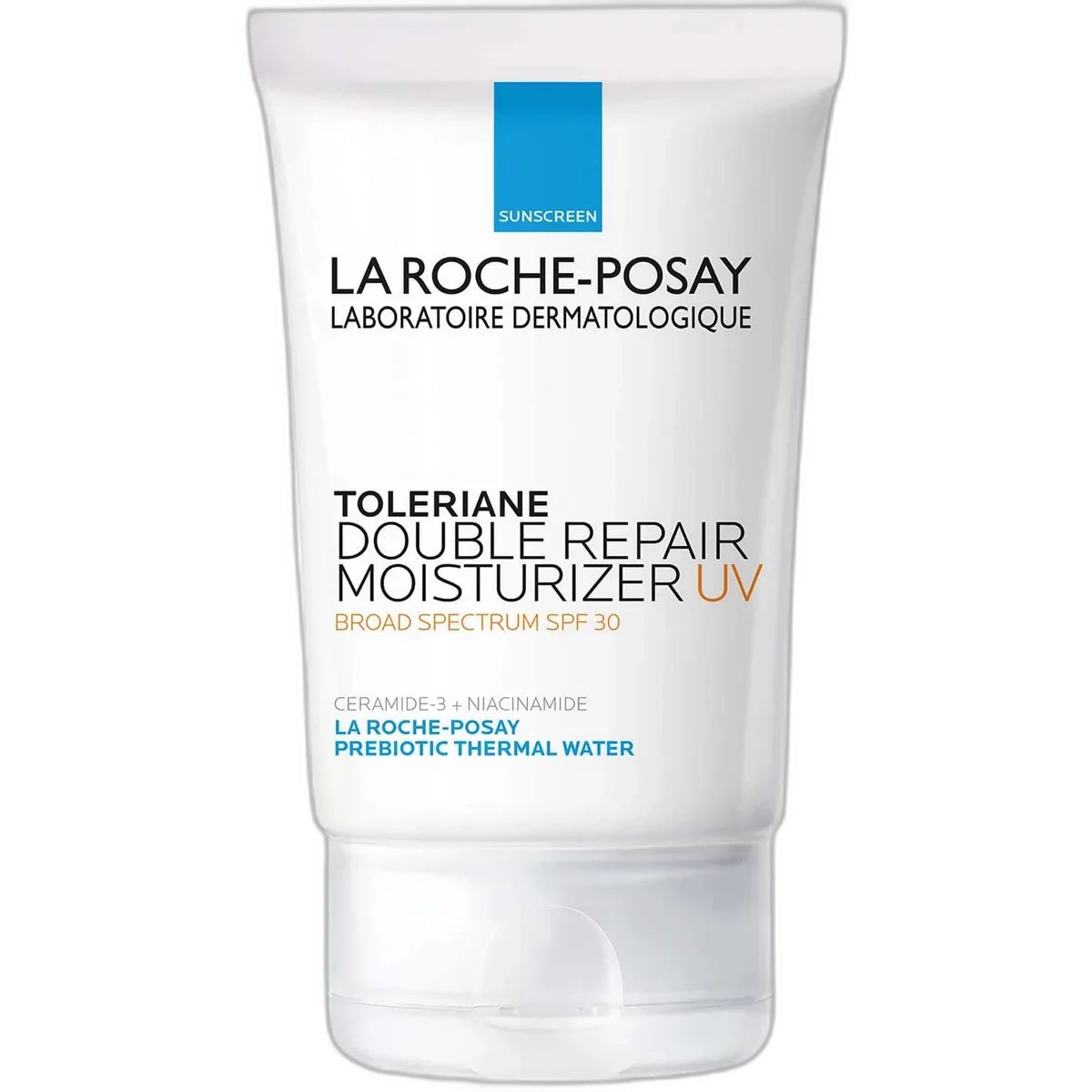
Toleriane Double Repair UV Face Moisturizer SPF 30
Daily Defense Essential
 Verified reviewer
Pros & cons.
- +Genuine two-in-one that eliminates the need for a separate sunscreen step without compromising either function
- +Four chemical UV filters at legitimate concentrations provide reliable broad-spectrum SPF 30 protection
- +Same ceramide-niacinamide barrier-repair system as the proven original Double Repair
- +No white cast and lightweight texture that encourages proper application amounts
- +Allantoin soothes potential irritation from chemical UV filters
- +Fragrance-free formulation reduces sensitization risk alongside the chemical sunscreens
- +Excellent value — one product replacing two at $25.99 for 3.38 oz
- −SPF 30 may be insufficient for extended outdoor exposure or high-UV environments
- −Chemical UV filters (especially avobenzone) can irritate very sensitive or rosacea-prone skin
- −Avobenzone can stain light-colored fabrics with a yellow tint over time
- −Slightly dewier finish than the non-SPF version — may cause midday shine on combination skin
- −Requires reapplication every 2 hours during direct sun exposure, limiting convenience
The full review.
The single most impactful thing you can do for your skin is wear sunscreen daily. Dermatologists have been saying this for decades. The research is unambiguous. And yet, a staggering percentage of people skip this step — not because they disagree with the science, but because sunscreen feels like an extra thing. It is heavy, or greasy, or it pills under makeup, or it requires buying a separate product and adding another step to an already-full morning routine. La Roche-Posay looked at this compliance problem and built a solution: make the sunscreen invisible inside a moisturizer people already want to use.
The Toleriane Double Repair UV takes the proven ceramide-niacinamide-glycerin foundation of the original Double Repair and integrates a four-filter broad-spectrum SPF 30 system directly into the formula. Avobenzone handles UVA protection — the longer wavelengths that penetrate deeper into the skin and drive photoaging. Octocrylene and octisalate absorb UVB, preventing the surface burns that announce acute damage. And octocrylene pulls double duty by stabilizing the avobenzone, which is notoriously prone to photodegradation without support. At concentrations of 3%, 5%, 5%, and 7% respectively, these are not token amounts — this is a legitimate sunscreen that happens to also be a moisturizer.
The skincare side of the formula remains faithful to the Double Repair’s barrier-repair mission. Ceramide NP restores the intercellular lipids that UV radiation steadily depletes. Niacinamide stimulates endogenous ceramide production and adds its own photoprotective benefits — research has demonstrated niacinamide’s ability to reduce UV-induced immunosuppression and DNA damage, making it a meaningful complement to chemical UV filters rather than a marketing addition. Glycerin provides humectant hydration, dimethicone offers occlusive protection, and the free fatty acids complete the barrier-repair lipid profile.
Allantoin deserves special mention in this context. Chemical sunscreen filters, for all their UV-blocking efficacy, can irritate sensitive skin. Allantoin’s inclusion provides soothing insurance — calming any potential reaction to the avobenzone or homosalate before it becomes noticeable. It is the kind of thoughtful formulation detail that distinguishes pharmacy-brand sun protection from the generic SPF moisturizers that treat skincare and sun protection as separate problems awkwardly sharing a tube.
The texture is where this product earns its compliance advantage. Most SPF moisturizers feel like one or the other: either a thick sunscreen pretending to be lightweight, or a watery moisturizer with inadequate sun protection. The Double Repair UV manages a genuine middle ground. It applies like a lightweight lotion, spreads without resistance, and absorbs into a natural finish within about sixty seconds. There is no white cast — chemical filters dissolve into the skin rather than sitting on top of it. There is no greasy film, no heavy sunscreen feel, no resistance when you apply makeup over it. If someone had not told you it contained SPF 30, you might not guess from the application experience alone.
This cosmetic elegance matters more than it might seem, because sunscreen only works if people actually use enough of it. The FDA testing protocol for SPF ratings uses 2 milligrams per square centimeter — which translates to roughly a nickel-sized dollop for the face, significantly more than most people instinctively apply as moisturizer. The Double Repair UV’s lightweight texture makes this generous application comfortable rather than suffocating, which is precisely what compliance requires.
The limitations are worth honest acknowledgment. SPF 30 blocks approximately 97% of UVB rays, which is adequate for daily indoor-focused activities but may be insufficient for extended outdoor exposure, beach days, or high-altitude environments where dermatologists typically recommend SPF 50 or higher. The chemical UV filters can irritate very sensitive or rosacea-prone skin — if you react to avobenzone or homosalate, this product will not be the exception. The filters can also stain light-colored fabrics over time, particularly around collar lines — an inherent property of avobenzone that no formulation trick can entirely prevent. And the finish, while natural, is slightly more dewy than the original non-SPF Double Repair, which some users with combination skin notice as borderline shiny by midday.
The value proposition is compelling. At $25.99 for 3.38 fl oz, you are getting a legitimate SPF 30 sunscreen and a ceramide barrier-repair moisturizer for the price of a single mid-range product. For users who were previously buying the Double Repair moisturizer and a separate sunscreen, consolidating to this one product saves both money and a morning step. A travel size is also available for those wanting to try before committing to the full-size tube.
For the specific consumer who wants to do the right thing for their skin — wear sunscreen daily, maintain their barrier, not spend fifteen minutes layering products before leaving the house — the Double Repair UV removes every friction point between intention and action. It is not the highest SPF available, not the most sophisticated UV filter system, and not the richest moisturizer. But it is an honest, well-formulated product that makes the most important skincare habit feel like no effort at all. And in the real world where consistency matters more than perfection, that pragmatism might be its greatest achievement.
Ingredient analysis.
Full INCI list
Active Ingredients: Avobenzone 3%, Homosalate 5%, Octisalate 5%, Octocrylene 7%. Inactive Ingredients: Water (La Roche-Posay Prebiotic Thermal Water), Glycerin, Silica, Dimethicone, Niacinamide, PEG-100 Stearate, Glyceryl Stearate, Stearic Acid, Stearyl Alcohol, Allantoin, Ceramide NP, Dimethicone/Vinyl Dimethicone Crosspolymer, Sodium Hydroxide, Myristic Acid, Myristyl Alcohol, Palmitic Acid, Ammonium Polyacryloyldimethyl Taurate, Disodium EDTA, Capryloyl Glycine, Caprylyl Glycol, Citric Acid, Xanthan Gum, T-Butyl Alcohol, Cetyl Alcohol, Tocopherol
Skin match.
The science.
The Science
This formula's four-filter UV system covers complementary wavelengths across the UV spectrum. Avobenzone absorbs UVA radiation from 310-400nm. This matters because UVA penetrates deep into the dermis and drives photoaging processes—collagen degradation, elastin damage, and hyperpigmentation—which cause an estimated 80% of visible facial aging. A study in the Journal of the American Academy of Dermatology (Lim et al., 2007) shows that daily broad-spectrum sunscreen use reduces clinical signs of photoaging over time.
Sunscreen chemistry well-characterizes the octocrylene-avobenzone interaction. Avobenzone undergoes photodegradation; the UV radiation it absorbs breaks it down, reducing protection. Octocrylene acts as a photostabilizer. It absorbs triplet-state energy from excited avobenzone molecules to prevent decomposition. This photostability mechanism extends the formula's effective protection period.
Niacinamide has photoprotective properties beyond barrier repair. Research in Photodermatology, Photoimmunology and Photomedicine (Damian et al., 2008) shows oral nicotinamide (a related form) reduced UV-induced immunosuppression in humans. While the topical form works differently, niacinamide's anti-inflammatory and barrier-strengthening effects support UV filter-based protection.
Ceramide NP is relevant in an SPF context. UV radiation depletes ceramide levels in the stratum corneum, weakening the barrier and increasing UV damage susceptibility. By replenishing these lipids, the Double Repair UV creates a positive cycle: the sunscreen prevents UV-induced ceramide depletion, and the ceramide maintains the barrier integrity that supports effective sunscreen adhesion and distribution on the skin surface.
References
- Ultraviolet radiation and the skin: photobiology and sunscreen photoprotection — Journal of the American Academy of Dermatology (2007)
- UV-induced immunosuppression and nicotinamide — Photodermatology, Photoimmunology and Photomedicine (2008)
Dermatologist Perspective
Dermatologists recommend the Double Repair UV as a daily morning moisturizer for patients needing both barrier support and sun protection who may not follow a multi-step routine. Board-certified dermatologists note that sunscreen compliance—not the SPF number—determines photoprotection outcomes, and two-in-one formulas like this one improve daily usage rates. For retinol users, this often serves as the morning counterpart: the SPF protects retinol-sensitized skin while the ceramides buffer barrier disruption. Dermatologists advise patients with chemical sunscreen sensitivities to use mineral SPF alternatives instead.
Where it fits in your routine.
Apply a nickel-sized amount to your face and neck after cleansing and serums. Spread it evenly over all exposed areas. Wait 1-2 minutes to absorb before you apply makeup. Reapply every 2 hours during direct sun exposure. This product replaces your morning moisturizer and sunscreen; you do not need additional SPF for daily indoor or commute activities.
At $25.99 for 3.38 fl oz, the Double Repair UV provides high value as a moisturizer-sunscreen with barrier-repair ingredients. Buying a separate Double Repair moisturizer ($25.99) and a standalone SPF product ($15-30) costs more. The per-ounce price of approximately $7.69 is competitive. A travel size exists for trial. The only value drawback is that sunscreen requires reapplication during direct sun exposure, which uses more product daily than a moisturizer alone.
People who want to simplify their morning routine by combining moisturizer and sunscreen. Retinol users needing daily SPF protection on sensitized skin. Normal to combination skin types seeking a lightweight daily SPF that does not feel like sunscreen. Barrier-compromised skin needing both ceramide repair and UV protection.
Those with known sensitivity to chemical UV filters like avobenzone or homosalate — consider a mineral SPF instead. Anyone requiring SPF 50+ for extended outdoor exposure or high-UV environments. Very oily skin types who find the finish too dewy — the Matte UV version may be more appropriate. People who prefer mineral sunscreens for environmental or personal preference reasons.
Product details.
This lightweight lotion spreads easily and absorbs to a natural finish. It is slightly more fluid than the original Double Repair cream because it integrates sunscreen filters.
Minimal chemical sunscreen scent dissipates within minutes; it has no added fragrance.
White squeeze tube with flip-top cap, 3.38 fl oz. A smaller travel size also exists. The packaging design matches the original Double Repair for brand consistency.
It applies like a lightweight lotion, not a thick sunscreen. Most users report no white cast, no heavy feel, and no burning on sensitive skin. It leaves a natural, slightly dewy finish that works under makeup. The sunscreen filters have a faint chemical scent that fades quickly.
2-3 months with daily face application at proper sunscreen amounts
12 months
All Year
The backstory.
La Roche-Posay introduced the UV version in 2018, recognizing that many Double Repair users were applying the original moisturizer in the morning and then layering a separate sunscreen on top — an extra step that some users skipped. By integrating SPF 30 into the same barrier-repair base, the brand removed the friction between two essential dermatological priorities: barrier health and sun protection.
About La Roche-Posay
Legacy Brand (20+ years)La Roche-Posay launched in 1975 near its namesake thermal spring in France. The Double Repair UV combines the brand's proven barrier-repair technology with broad-spectrum UV protection. This follows the dermatological principle that sun protection and barrier health are inseparable priorities.
Common myths.
SPF moisturizers provide less sun protection than dedicated sunscreens.
This formula uses the same UV filter concentrations found in standalone sunscreens — Avobenzone 3%, Homosalate 5%, Octisalate 5%, Octocrylene 7% — to provide SPF 30 broad-spectrum protection. Application matters: use a nickel-sized dollop for the face, not the thin layer used for moisturizer.
Chemical sunscreens damage the skin barrier.
Chemical UV filters can irritate very sensitive skin, but the ceramide and niacinamide in this formula repair the barrier while the sunscreen protects against UV-induced damage. This results in positive barrier health — for most skin types, UV protection outweighs any irritation from the filters.
FAQ.
Is SPF 30 enough for daily protection?
SPF 30 provides enough protection for daily activities like commuting, working indoors, or running errands if you apply a nickel-sized dollop to the face. SPF 30 blocks about 97% of UVB rays. Dermatologists recommend SPF 50 or higher and reapplication every 2 hours for high-altitude activities, beach days, or extended outdoor exposure.
Can I skip a separate sunscreen if I use this moisturizer?
Yes, for daily wear — this product is an SPF 30 broad-spectrum sunscreen with four UV filters at concentrations that meet FDA requirements. You must apply enough product: use a nickel-sized dollop for the face, not the thin layer used for a regular moisturizer. Reapply every 2 hours during direct sun exposure.
Does this leave a white cast?
No. This formula uses chemical (organic) UV filters instead of mineral (physical) filters like zinc oxide or titanium dioxide. Chemical filters absorb UV radiation instead of reflecting it. This prevents a white cast or ghostly appearance on any skin tone.
Can I use this with retinol?
Yes—this is an ideal morning companion for retinol users. Apply retinol at night, then use this SPF moisturizer in the morning to protect retinol-sensitized skin from UV damage. The ceramide and niacinamide also buffer the barrier disruption retinol causes, making this a comprehensive morning-after-retinol product.
What is the difference between this and the regular Toleriane Double Repair?
The UV version adds SPF 30 broad-spectrum protection using four chemical sunscreen filters (avobenzone, homosalate, octisalate, octocrylene) and allantoin to soothe. The base barrier-repair system — ceramide NP, niacinamide, glycerin, and thermal water — is unchanged. Use the UV version as a morning moisturizer and the regular version at night.
Will this stain my clothes?
Chemical sunscreen filters, especially avobenzone, stain light fabrics yellow over time. This happens with chemical sunscreens in general, not just this product. Let the product absorb fully before wearing white clothing, and wash stained items quickly using an enzyme-based detergent.
What the community says.
"Convenient two-in-one replaces separate moisturizer and sunscreen"
"No white cast or greasy residue"
"Lightweight enough for daily wear under makeup"
"Good value for an SPF moisturizer with barrier-repair ingredients"
"Chemical sunscreen filters may irritate very sensitive or rosacea-prone skin"
"SPF 30 may not be sufficient for high-UV environments — some prefer SPF 50"
"Can stain light-colored fabrics"
"Slightly shinier finish than the non-SPF version"
Featured in.
People also looked at.