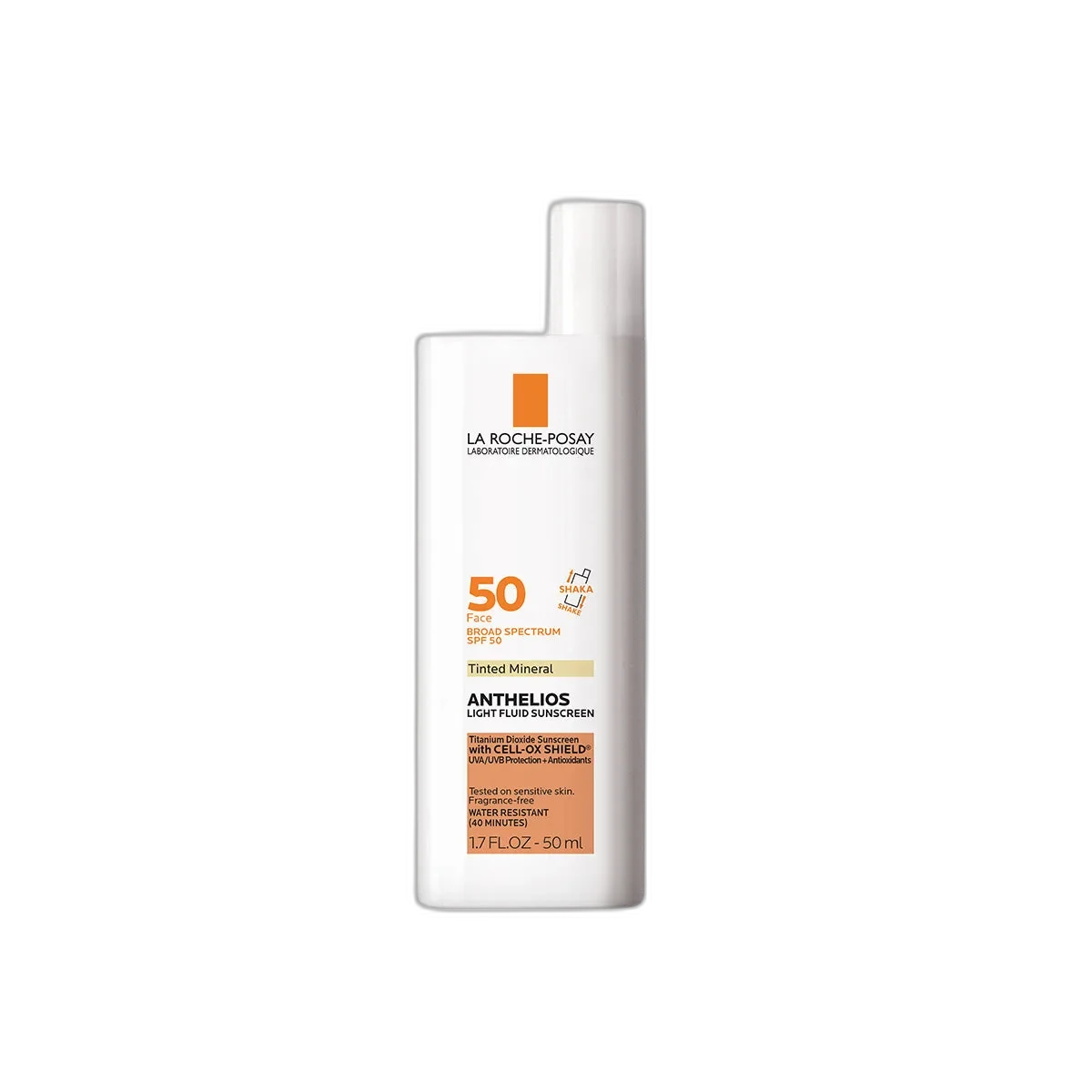
Anthelios Mineral Tinted Sunscreen SPF 50
Sensitive Skin Go-To
 Verified reviewer
Pros & cons.
- +100% mineral formula ideal for sensitive, reactive, and post-procedure skin
- +Ultra-fluid texture eliminates the chalky heaviness of typical mineral sunscreens
- +Iron oxide tint provides visible light protection relevant for melasma patients
- +Functions as an excellent makeup primer with a smooth satin finish
- +Fragrance-free, alcohol-free, and oil-free — minimal irritation potential
- +Non-comedogenic formula suitable for acne-prone sensitive skin types
- −Universal tint can appear ashy on deeper skin tones
- −Expensive at $39.99 for just 1.7 ounces of product
- −Titanium dioxide alone provides weaker UVA1 coverage than chemical alternatives
- −Not water-resistant — unsuitable for swimming or heavy exercise
- −Single size option with no larger economy size available
The full review.
In dermatology offices across the country, there is an informal ritual that plays out dozens of times a day: a patient finishes a chemical peel, a laser session, or a microneedling treatment, and the dermatologist or aesthetician reaches for a sunscreen to apply before they walk out the door. More often than not, that sunscreen is this one. La Roche-Posay’s Anthelios Mineral Tinted Sunscreen SPF 50 earned its place on the treatment room shelf not through marketing, but through the simple fact that it does not sting freshly treated skin, does not cake over raw or peeling areas, and provides genuine mineral protection without looking like you walked through a cloud of chalk.
The formula achieves this with a single active ingredient: titanium dioxide at 11%. No chemical filters, no avobenzone, no homosalate. Just a mineral that sits on the skin’s surface and physically deflects UV radiation. For skin that is compromised — whether from a procedure, from conditions like rosacea, or from a damaged barrier — this distinction matters. Chemical filters absorb into the upper layers of skin and can cause stinging and irritation when the barrier is impaired. Titanium dioxide stays put.
But what makes this product genuinely impressive is not the filter choice — it’s the vehicle. Mineral sunscreens have historically been miserable to wear. Thick, white, streaky, and prone to balling up under makeup. La Roche-Posay solved this by suspending micronized titanium dioxide in an ultra-fluid emulsion that behaves more like a serum than a sunscreen. You shake the bottle, pour out something that looks like tinted water, blend it across your face, and 30 seconds later you have a smooth, satin-finish surface that looks like skin, not sunscreen.
The tint deserves specific attention because it’s doing more than cosmetic work. The iron oxides responsible for the color also provide protection against visible light — specifically, high-energy visible (HEV) light in the blue wavelength range. Research published in the Journal of Cosmetic Dermatology has demonstrated that tinted sunscreens containing iron oxides provide superior protection against visible light-induced pigmentation compared to untinted SPF products. For anyone managing melasma or post-inflammatory hyperpigmentation, this is not a trivial feature. Visible light can trigger melanocyte activity even when UV is fully blocked, which is why dermatologists specifically recommend tinted formulas for pigmentation patients.
The shade is described as universal, and it works well on light to medium skin tones, where it blends to near-invisibility and provides a subtle evening effect. On deeper skin tones, however, the tint can read as ashy or gray rather than seamlessly blending. This is the formula’s most significant limitation. A truly universal tint in a single shade is an engineering challenge that no brand has fully cracked, and La Roche-Posay’s offering, while better than many, still falls short for a meaningful portion of potential users.
Texture-wise, this is one of the most pleasant mineral sunscreens on the market. The fluid consistency means it layers beautifully over serums and moisturizers without the dreaded pilling that heavier mineral sunscreens often cause. Many users report skipping primer entirely when wearing it, and foundation applies smoothly on top. The oil-free formula keeps shine at bay for several hours without being aggressively mattifying — it sits in that sweet spot of satin rather than matte or dewy.
The ingredient list is notably clean. Fragrance-free, alcohol-free, paraben-free, and oil-free. There is very little here to cause a reaction, which is the entire point. Pentylene glycol provides mild antimicrobial preservation alongside phenoxyethanol, and the Cassia Alata leaf extract plus tocopherol deliver antioxidant support through La Roche-Posay’s Cell-Ox Shield technology.
Now, the uncomfortable conversation: price. At $39.99 for 1.7 ounces, this is expensive. Not luxury-brand expensive, but certainly premium for a pharmacy-brand sunscreen. The counterargument is that 1.7 ounces of a face-only sunscreen lasts 2-3 months with daily use, which brings the daily cost to well under a dollar. And the formulation technology required to make titanium dioxide feel like water rather than paste does cost more to produce. But there’s no getting around the sticker shock, especially when you see the same brand’s 5-ounce chemical sunscreen at a similar price point.
The protection profile has one caveat worth noting. Titanium dioxide alone provides strong UVB protection and moderate UVA2 protection, but its UVA1 coverage is weaker than what you get from avobenzone or newer European UV filters. For everyday commuting and indoor work with some outdoor exposure, this SPF 50 mineral formula is more than adequate. For extended outdoor activity in intense sun, a broad-spectrum chemical or hybrid formula might provide more robust UVA1 shielding.
But for the use case this sunscreen was designed for — daily facial protection for sensitive, reactive, or post-procedure skin — it remains a benchmark. It’s the rare product where the dermatologist recommendation isn’t a marketing badge but a genuine reflection of clinical confidence. The formula earns that confidence by doing something deceptively difficult: being a mineral sunscreen you actually want to put on your face every morning.
Texture
Texture-wise, this is one of the most pleasant mineral sunscreens on the market. The fluid consistency means it layers beautifully over serums and moisturizers without the dreaded pilling that heavier mineral sunscreens often cause. Many users report skipping primer entirely when wearing it, and foundation applies smoothly on top. The oil-free formula keeps shine at bay for several hours without being aggressively mattifying — it sits in that sweet spot of satin rather than matte or dewy.
Scent
The ingredient list is notably clean. Fragrance-free, alcohol-free, paraben-free, and oil-free. There is very little here to cause a reaction, which is the entire point. Pentylene glycol provides mild antimicrobial preservation alongside phenoxyethanol, and the Cassia Alata leaf extract plus tocopherol deliver antioxidant support through La Roche-Posay’s Cell-Ox Shield technology.
Price
Now, the uncomfortable conversation: price. At $39.99 for 1.7 ounces, this is expensive. Not luxury-brand expensive, but certainly premium for a pharmacy-brand sunscreen. The counterargument is that 1.7 ounces of a face-only sunscreen lasts 2-3 months with daily use, which brings the daily cost to well under a dollar. And the formulation technology required to make titanium dioxide feel like water rather than paste does cost more to produce. But there’s no getting around the sticker shock, especially when you see the same brand’s 5-ounce chemical sunscreen at a similar price point.
Best for
But for the use case this sunscreen was designed for — daily facial protection for sensitive, reactive, or post-procedure skin — it remains a benchmark. It’s the rare product where the dermatologist recommendation isn’t a marketing badge but a genuine reflection of clinical confidence. The formula earns that confidence by doing something deceptively difficult: being a mineral sunscreen you actually want to put on your face every morning.
Ingredient analysis.
Full INCI list
Active Ingredient: Titanium Dioxide 11%. Inactive Ingredients: Water, Isododecane, C12-15 Alkyl Benzoate, Dimethicone, Undecane, Triethylhexanoin, Isohexadecane, Styrene/Acrylates Copolymer, Nylon-12, Caprylyl Methicone, Butyloctyl Salicylate, Phenethyl Benzoate, Silica, Tridecane, Dicaprylyl Carbonate, Dicaprylyl Ether, Talc, Dimethicone/PEG-10/15 Crosspolymer, Aluminum Stearate, Pentylene Glycol, PEG-9 Polydimethylsiloxyethyl Dimethicone, Iron Oxides, Alumina, Polyhydroxystearic Acid, Phenoxyethanol, Magnesium Sulfate, Propylene Glycol, Caprylyl Glycol, Aluminum Hydroxide, PEG-8 Laurate, Stearic Acid, Disteardimonium Hectorite, Diethylhexyl Syringylidenemalonate, Tocopherol, Propylene Carbonate, Cassia Alata Leaf Extract, Maltodextrin, Benzoic Acid, Disodium EDTA, Disodium Stearoyl Glutamate
Skin match.
The science.
The Science
Titanium dioxide is a physical UV filter that reflects and scatters UV radiation instead of absorbing it. At 11% concentration, this formula gives reliable SPF 50 broad-spectrum protection, but titanium dioxide's absorption spectrum peaks in the UVB and UVA2 range (290-340 nm) and has less efficacy in longer UVA1 wavelengths (340-400 nm). This is a known trait of titanium dioxide compared to chemical UVA filters like avobenzone.
The iron oxides in this formula do more than provide a cosmetic tint. A 2014 study in the Journal of Cosmetic Dermatology by Dumbuya et al. shows that sunscreens with iron oxides protect better against visible light-induced pigmentation than untinted sunscreens with equivalent UV filter systems. A 2019 study in Photodermatology, Photoimmunology & Photomedicine confirms that iron oxide-containing sunscreens offer superior protection against melasma relapse compared to untinted broad-spectrum sunscreens. This matters because visible light (400-700 nm) stimulates melanogenesis through opsin-3 receptors in melanocytes—a pathway traditional UV filters do not address.
The Cell-Ox Shield technology uses Cassia Alata leaf extract and tocopherol as antioxidants. While any sunscreen benefits from antioxidant defense, it is more important in a mineral-only formula where the single UV filter leaves some UVA1 radiation partially unblocked. The antioxidant system helps reduce oxidative stress from UV radiation that penetrates the titanium dioxide barrier.
References
- Visible light protection in sunscreens containing iron oxides — Journal of Cosmetic Dermatology (2014)
- Iron oxide-containing sunscreens and melasma protection — Photodermatology, Photoimmunology & Photomedicine (2019)
Dermatologist Perspective
Board-certified dermatologists recommend this formula for patients with reactive skin conditions, post-procedure healing, and pigmentary disorders. Dermatologists note the 100% mineral formulation avoids the stinging and irritation chemical UV filters cause on compromised skin barriers. Dermatologists specifically recommend the tinted formula for melasma management because iron oxides provide visible light protection that standard UV-only sunscreens lack. For post-procedure care, dermatologists value the alcohol-free, fragrance-free vehicle that lowers contact irritation risk on freshly treated skin.
Where it fits in your routine.
Shake the bottle well before each use because the fluid formula separates. Apply a nickel-sized amount to the face and neck after moisturizer as the final step in your morning skincare routine. Blend evenly with fingertips. Let it set for 30-60 seconds before applying makeup. Reapply every two hours during prolonged sun exposure. This formula is not water-resistant; reapply after sweating or getting wet.
At $39.99 for 1.7 ounces, this pharmacy-brand sunscreen has premium pricing. However, context matters: this face-only product lasts 2-3 months with daily application, making the daily cost roughly $0.45-$0.65. The specialized formulation technology makes titanium dioxide feel like a weightless fluid instead of a paste, which justifies the price premium seen across the mineral sunscreen category. La Roche-Posay's history of dermatological development and decades of clinical validation justify the price, though budget-conscious consumers have cheaper mineral options. No larger economy size exists.
Anyone with sensitive, reactive, or post-procedure skin who needs a mineral sunscreen they'll actually enjoy wearing. Particularly valuable for melasma and hyperpigmentation patients who need visible light protection. Also ideal for those who want a sunscreen that doubles as a primer.
People with deeper skin tones find the universal tint ashy. Users need water-resistant sun protection for swimming or outdoor activities. Budget-conscious consumers can find comparable mineral protection at lower prices.
Product details.
No added fragrance. The minimal sunscreen base scent is virtually undetectable once applied.
Small white bottle has a twist-off cap and controlled-pour opening. The 1.7 oz size is compact for travel but feels small for the price. Shake well before use because the fluid formula separates. Finish satinnaturallightweight
This lightly tinted fluid blends into a sheer, skin-evening wash of color within 30 seconds. It does not sting, tingle, or feel heavy. The finish is smooth and primer-like immediately. Users with darker skin tones should test the tint, as it may look slightly ashy instead of blending invisibly.
2-3 months with daily face and neck application
12 months
All Year
The backstory.
Developed as La Roche-Posay's answer to the most common complaint about mineral sunscreens — that they feel awful on the skin. The Anthelios Mineral Tinted leveraged the brand's expertise in sun care formulation to create a mineral sunscreen in an ultra-fluid vehicle that dermatologists could confidently recommend to their most sensitive patients, including those recovering from laser treatments and chemical peels.
About La Roche-Posay
Legacy Brand (20+ years)La Roche-Posay launched in 1975 near central France's thermal springs. Dermatologists have recommended the brand for nearly five decades. Dermatologists develop its formulations, which undergo extensive clinical testing, and the brand has multiple Skin Cancer Foundation seals of recommendation.
Common myths.
Mineral sunscreens always leave a white cast.
This formula uses micronized titanium dioxide and iron oxide tint to remove white cast. Mineral sunscreen technology has evolved to make products cosmetically elegant, and this product shows that progress.
Tinted sunscreens are regular sunscreens with added color for cosmetic use.
The iron oxides in this formula block visible light (HEV), which standard UV filters — both mineral and chemical — do not. This matters for melasma patients, as visible light triggers pigmentation even when UV is fully blocked.
FAQ.
Does this tinted sunscreen match all skin tones?
The universal tint blends most seamlessly with light to medium skin tones. On deeper skin tones, it can look slightly ashy or leave a grayish cast instead of blending invisibly. If you have a deeper complexion, test it on a small area first to check the match.
Can I use this sunscreen after a chemical peel or laser treatment?
Yes — dermatologists frequently recommend this post-procedure sunscreen. The 100% mineral formula with titanium dioxide sits on the skin surface instead of absorbing, so it works for compromised or healing skin. The fragrance-free, alcohol-free formulation reduces irritation risk.
Is this sunscreen safe during pregnancy?
Yes. Titanium dioxide is a mineral UV filter that stays on the skin's surface and does not enter the bloodstream, making it a safe sunscreen option during pregnancy. This formula lacks chemical UV filters, retinoids, or other pregnancy-contraindicated ingredients.
Can I wear this under makeup?
This is one of its strongest use cases. The ultra-fluid texture sets to a smooth, satin finish that works as a primer. Many users skip a separate primer when wearing this sunscreen. Foundation and concealer layer cleanly on top without pilling.
Does this protect against blue light?
The iron oxides in this tinted formula protect against visible light, including high-energy visible (HEV/blue) light. Research shows iron oxide-containing sunscreens offer better protection against visible light-induced pigmentation than untinted mineral or chemical sunscreens.
Why is this sunscreen so expensive for such a small bottle?
At $39.99 for 1.7 ounces, the price covers the specialized mineral formulation technology that makes titanium dioxide feel light instead of chalky. This is a face-only product — 1.7 ounces lasts 2-3 months with daily facial application, so the daily cost is roughly $0.45-$0.65.
Community
What the community says.
"Ultra-light fluid texture that doesn't feel heavy"
"Works beautifully as a makeup primer"
"No white cast thanks to the universal tint"
"Gentle enough for sensitive and post-procedure skin"
"Fragrance-free and alcohol-free formula"
"Expensive for the 1.7 oz size"
"Single tint shade doesn't suit all skin tones equally"
"Can look slightly ashy on deeper skin tones"
"Not water-resistant enough for active outdoor use"
"Titanium dioxide-only may provide less UVA protection than broad-filter formulas"
People also looked at.