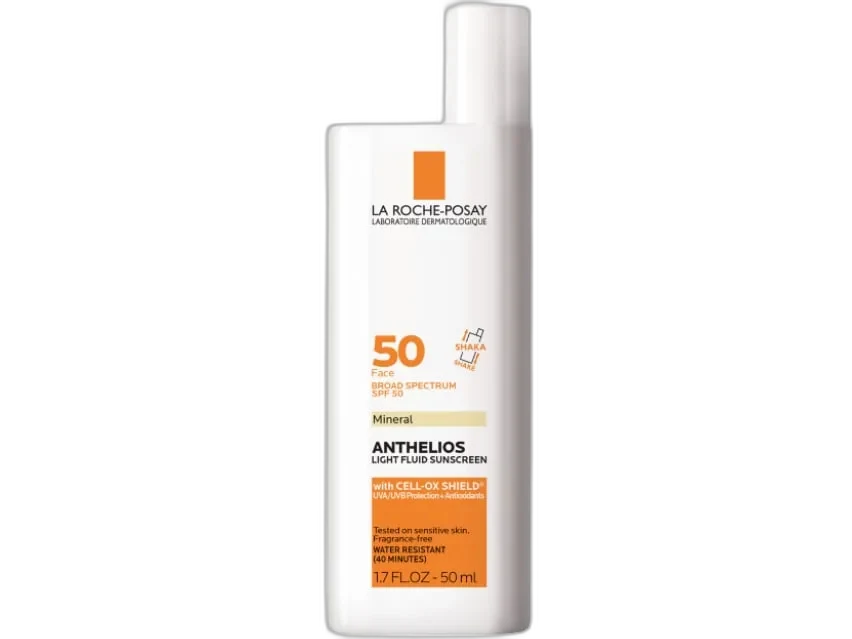
Anthelios Light Fluid Face Sunscreen SPF 50
Sensitive Skin Sun Shield
 Verified reviewer
Pros & cons.
- +100% mineral UV protection suitable for sensitive, post-procedure, and pregnant skin
- +Ultra-lightweight fluid texture unlike any traditional mineral sunscreen
- +Immediate UV protection on application — no 15-minute wait needed
- +Fragrance-free and chemical-filter-free for maximum sensitive skin tolerance
- +Cell-Ox Shield antioxidant technology adds free radical defense beyond UV filtering
- +Works well as a makeup primer with a soft matte finish
- +Mineral filters don't degrade in sunlight for sustained protection
- −White cast visible on medium to dark skin tones despite improved dispersion
- −Premium price at $43 for 1.7 oz
- −Only 40-minute water resistance versus 80 minutes for some chemical sunscreens
- −Can pill over silicone-based skincare products
- −Requires thorough shaking before each use — mineral particles settle quickly
- −Contains dimethicone and silicones which some users prefer to avoid
The full review.
Mineral sunscreen has a reputation problem. For decades, zinc oxide and titanium dioxide — the only two UV filters recognized as safe and gentle — felt like spreading toothpaste on your face. You got SPF protection, but also a chalky white mask, a texture that won’t blend under makeup, and the sensation of spackling compound on your skin. It was sun protection through suffering.
La Roche-Posay’s Anthelios Mineral Ultra-Light Fluid argues this trade-off is unnecessary. They use the same titanium dioxide and zinc oxide that make mineral sunscreens work, but disperse them with a fluid technology that behaves differently than traditional mineral sunscreen. Shake the bottle, squeeze out a thin, milky fluid, and it spreads like a lightweight serum. It doesn’t fight you, ball up, or leave you looking like a ghost.
The UV protection system is purely mineral: 6% titanium dioxide for UVB protection and 5% zinc oxide for UVA coverage. There are no chemical filters, no avobenzone, no homosalate, and no octocrylene. This appeals to people with sensitive skin, post-procedure skin, pregnant women, or anyone avoiding synthetic UV filters. Mineral filters work by physically scattering and reflecting UV radiation; they provide instant protection without a 15-minute activation period and do not degrade in sunlight like chemical filters.
La Roche-Posay adds Cell-Ox Shield technology — Cassia alata leaf extract and tocopherol — to address oxidative damage that passes UV filters. Since no sunscreen blocks 100% of UV radiation, this antioxidant layer mops up free radicals from the UV that gets through. This formulation detail comes from five decades of sun protection research.
The texture is the product’s primary achievement. After shaking (essential, as mineral particles settle), the fluid pours like a face milk rather than a sunscreen. It spreads without dragging, absorbs within a minute, and sets to a soft matte finish that works under makeup. Many users use it as a primer to create a smooth canvas for foundation. This level of cosmetic elegance is unusual for a 100% mineral sunscreen.
The white cast is unavoidable. Titanium dioxide and zinc oxide are white minerals, and formulation technology cannot completely eliminate their visibility. On fair to light-medium skin tones, the white cast is minimal and fades as the product sets. On medium to dark skin tones, it is more apparent, especially when applying the amount needed for full SPF protection. La Roche-Posay offers a tinted version, though the tinted shade range is limited.
The 40-minute water resistance is shorter than the 80 minutes offered by many chemical sunscreens, including the Anthelios Clear Skin. This matters for beach days or intense exercise. For daily commutes and office use, it is sufficient, as you must reapply every two hours anyway.
At $42.99 for 1.7 ounces, this is premium for a drugstore-brand sunscreen, but comparable to elegant mineral formulations from EltaMD and Supergoop. The mineral-only formulation, La Roche-Posay’s clinical heritage, and the texture justify the price over basic zinc oxide sunscreens. HSA/FSA eligibility partially offsets the cost.
Some users report pilling. Mineral sunscreen particles can interact with certain skincare ingredients — particularly silicone-based products — and ball up. If you experience pilling, simplify your morning routine or switch to a water-based moisturizer underneath.
La Roche-Posay did not invent mineral sunscreen, but they may have solved its biggest obstacle to daily use. The Anthelios Mineral Ultra-Light Fluid shows that 100% mineral protection at SPF 50 can feel like wearing nothing. For the millions of people whose sensitive skin makes chemical sunscreens a non-starter, this is a major achievement. It is the difference between theoretical protection and the sunscreen they will actually use every morning.
Formula
PM routine
Ingredient analysis.
Full INCI list
Active Ingredients: Titanium Dioxide 6%, Zinc Oxide 5%. Inactive Ingredients: Water, Dimethicone, Isododecane, C12-15 Alkyl Benzoate, Undecane, Triethylhexanoin, Isohexadecane, Nylon-12, Caprylyl Methicone, Butyloctyl Salicylate, Phenethyl Benzoate, Styrene/Acrylates Copolymer, Silica, Tridecane, Dicaprylyl Carbonate, Dicaprylyl Ether, Talc, Dimethicone/PEG-10/15 Crosspolymer, Polyhydroxystearic Acid, Phenoxyethanol, Magnesium Sulfate, Propylene Glycol, Caprylyl Glycol, PEG-8 Laurate, Disteardimonium Hectorite, Triethoxycaprylylsilane, Diethylhexyl Syringylidenemalonate, Tocopherol, Propylene Carbonate, Cassia Alata Leaf Extract, Maltodextrin, Benzoic Acid, PEG-9
Skin match.
The science.
The Science
The Anthelios Mineral Ultra-Light Fluid leverages 100% mineral UV filtration through two inorganic filters — titanium dioxide and zinc oxide — whose photoprotective mechanisms are well-established in dermatological literature.
Titanium dioxide at 6% provides primary UVB protection through a combination of UV absorption and scattering. Research published in Photodermatology, Photoimmunology & Photomedicine has demonstrated that titanium dioxide particles absorb UV photons and convert the energy to heat through lattice vibrations, while also scattering UV radiation away from the skin surface. The particle size in modern formulations like this one is typically in the 20-50nm range — small enough to reduce visible whiteness while maintaining UV-blocking efficacy.
Zinc oxide at 5% contributes critical UVA protection that extends further into the UVA-I range (340-400nm) than titanium dioxide alone. A study published in the Journal of the American Academy of Dermatology (Pinnell et al., 2000) demonstrated that microfine zinc oxide provides superior broad-spectrum protection when combined with titanium dioxide, as the two minerals' absorption spectra overlap complementarily to cover the full UV spectrum more effectively than either mineral alone.
The mineral-only approach offers significant advantages for sensitive skin populations. Unlike organic (chemical) UV filters, mineral filters sit on the skin surface rather than being absorbed systemically. Research published in JAMA (Matta et al., 2019) found that certain chemical UV filters were absorbed into the bloodstream at levels exceeding FDA thresholds after a single day of application — a finding that does not apply to mineral filters. For post-procedure skin, where the barrier is compromised and systemic absorption is increased, mineral sunscreens represent the standard of care.
The antioxidant component — Cassia alata leaf extract — contains flavonoid compounds that scavenge reactive oxygen species. Published research supports the principle that combining UV filters with topical antioxidants provides photoprotection superior to UV filters alone, as antioxidants address the approximately 10-20% of UV-mediated oxidative damage that even well-formulated sunscreens cannot prevent through UV blocking alone.
Dermatologist Perspective
Dermatologists widely recommend the Anthelios Mineral Ultra-Light Fluid as a first-line daily sunscreen for patients with sensitive skin, rosacea, or those recovering from dermatological procedures. Board-certified dermatologists note that mineral sunscreens are the standard of care for post-laser, post-chemical peel, and post-microneedling skin because they sit on the surface without being absorbed through the compromised barrier. The fluid texture addresses the primary compliance barrier with mineral sunscreens — most patients stop using them because they find the texture intolerable. La Roche-Posay's formulation makes mineral protection genuinely wearable for daily use. Dermatologists also recommend this for pregnant and breastfeeding patients who prefer to avoid chemical UV filter exposure.
Where it fits in your routine.
Shake the bottle vigorously for 5-10 seconds before each use because mineral particles settle. Apply a nickel-sized amount evenly to the face 15 minutes before sun exposure, though mineral filters work immediately on contact. Reapply every 2 hours during sun exposure, and immediately after swimming, sweating, or toweling off. You can apply it over moisturizer and serums — wait for them to absorb fully to minimize pilling. In the evening, use an oil-based cleanser or micellar water first to remove the mineral filters.
At $42.99 for 1.7 ounces, this costs more than typical drugstore sunscreens but matches prices in the elegant mineral sunscreen category. Prestige brands use similar fluid mineral technology and cost $38-55. The 100% mineral formulation, La Roche-Posay's five-decade UV protection heritage, and Cell-Ox Shield antioxidant technology provide value above basic zinc oxide sunscreens priced under $15. HSA/FSA eligibility lowers the out-of-pocket cost for many users. One bottle lasts 2-3 months with daily use, costing about $14-21 per month for daily facial sun protection.
This works for sensitive, reactive, or post-procedure skin needing gentle, effective daily UV protection. It is excellent for pregnant or breastfeeding individuals who prefer mineral-only sunscreen. It suits those who dislike mineral sunscreen textures — this formula changes that.
People with darker skin tones sensitive to white cast can use the tinted version. For maximum water resistance during athletic activities, a water-resistant chemical sunscreen works better. The price is high for daily use if you are on a budget.
Product details.
Fragrance-free. A faint mineral/silicone base scent dissipates immediately.
Squeeze bottle (1.7 oz) has a small opening for controlled dispensing. Shake well before each use because the mineral filter is a suspension. Finish mattelightweightfast-absorbing
The fluid applies thinner than expected for a mineral sunscreen. It spreads easily and sets to a matte finish. Some initial white cast shows on darker skin tones, but it fades as the product settles. Mineral filters provide instant protection and require no waiting period.
2-3 months with daily face application
12 months
All Year
The backstory.
La Roche-Posay has been developing sun protection near the thermal springs of La Roche-Posay, France, since the brand's founding in 1975. The Anthelios line represents decades of UV filter research and is the flagship of the brand's sun care expertise. This mineral version was developed for the growing population of consumers seeking chemical-free UV protection without sacrificing the cosmetic elegance that La Roche-Posay's chemical sunscreens are known for.
About La Roche-Posay
Legacy Brand (20+ years)La Roche-Posay launched in 1975 near the thermal springs of La Roche-Posay, France. Dermatologists have recommended the brand for over four decades. L'Oréal owns La Roche-Posay, the #1 dermatologist-recommended skincare brand in Europe, which uses extensive clinical research for its formulations.
Common myths.
Mineral sunscreens always leave a thick, white layer on the skin.
This fluid technology disperses titanium dioxide and zinc oxide particles finely. The formula applies nearly transparent on most skin tones. Generous application causes some white cast, but it is less than traditional mineral sunscreens.
Chemical sunscreens work better than mineral sunscreens.
The titanium dioxide and zinc oxide in this formula provide effective broad-spectrum SPF 50 protection through physical UV blocking. Mineral filters work immediately on application (no 15-minute wait), don't degrade in sunlight, and are better tolerated by sensitive and post-procedure skin.
FAQ.
Does La Roche-Posay Anthelios Mineral SPF 50 leave a white cast?
The white cast is minimal on fair to light-medium skin tones and fades as the product sets. Medium to dark skin tones show some white cast, especially with generous application. La Roche-Posay offers a tinted version to address this.
Is this sunscreen safe during pregnancy?
Yes — the 100% mineral formula (titanium dioxide and zinc oxide) stays on the skin surface and does not absorb systemically. It lacks chemical UV filters, retinoids, or other ingredients typically flagged during pregnancy. Dermatologists frequently recommend this sunscreen to pregnant patients.
Can I use this sunscreen after a chemical peel or laser treatment?
Yes — mineral sunscreens are the standard of care for post-procedure skin. They provide UV protection without absorbing through the compromised barrier. Follow your dermatologist's guidance on when to resume sunscreen application after your specific procedure.
Why does this sunscreen need to be shaken before use?
The mineral UV filters (titanium dioxide and zinc oxide) are suspended particles that settle at the bottom between uses. Shaking redistributes them evenly through the fluid to ensure consistent UV protection with each application. Skipping this step causes uneven filter distribution and inadequate protection.
Why does this sunscreen pill on my face?
Mineral sunscreen particles can react with silicone-based products underneath and ball up when you apply them. Simplify your morning routine, switch to a water-based moisturizer, or let your skincare absorb fully before applying this sunscreen. Patting instead of rubbing also helps.
Community
What the community says.
"Lightweight fluid texture unlike most mineral sunscreens"
"Works well under makeup as a primer"
"Suitable for very sensitive and reactive skin"
"Matte finish without excessive drying"
"No harsh chemical filter stinging"
"White cast visible on medium to dark skin tones"
"Can pill over certain moisturizers or serums"
"Some users find it drying for combination skin"
"Premium price for a drugstore brand"
"Water resistance only 40 minutes"
Featured in.
People also looked at.