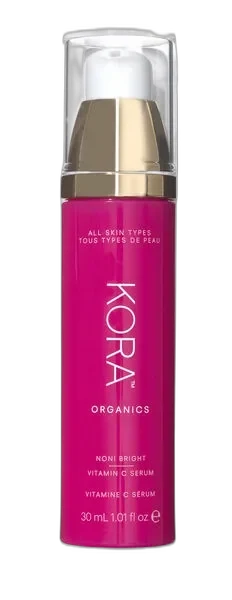
Noni Bright Vitamin C Serum
Celebrity Clean Beauty Glow
 Verified reviewer
Pros & cons.
- +Thoughtful stack of 12% ascorbyl glucoside plus Kakadu plum and acerola cherry ferment
- +Lightweight, fast-absorbing watery gel texture
- +Genuine gradual brightening over 6 to 10 weeks
- +Stable vitamin C derivative appropriate for clear packaging
- +Pleasant citrus sensory experience for users who enjoy scent
- +Established clean beauty brand with 15 plus years of history
- +Leaping Bunny certified and vegan
- −Premium $68 price for a derivative rather than L-ascorbic serum
- −Contains alcohol and multiple citrus peel extracts with fragrance allergens
- −Not a good fit for melasma or rosacea-prone skin
- −Clear glass packaging is not ideal for vitamin C longevity
- −Marketing leans heavily on celebrity ownership story
The full review.
About Kora Organics
Miranda Kerr launched Kora Organics in 2009 with a bet that most of the celebrity skincare world would rediscover only a decade later: that there was room for a clean beauty brand built around a single hero ingredient with a specific geographic story. The ingredient was noni fruit, the geography was Australia, and the brand quietly put together more than fifteen years of growth while louder celebrity launches came and went. Noni Bright Vitamin C Serum is the product that takes that positioning into one of the most crowded categories in skincare and asks whether a botanical-first formula can compete with the high-dose L-ascorbic serums that dominate the vitamin C shelf. The answer is more nuanced than the marketing suggests, and the nuance is worth walking through if you are considering spending sixty-eight dollars on it.
Reality
The formulation logic is actually smarter than a lot of clean beauty brightening serums. The primary active is ascorbyl glucoside at 12%, which is a stable, water-soluble vitamin C derivative that converts enzymatically to ascorbic acid in the skin. It is not as fast or as potent as a well-formulated 15% L-ascorbic acid serum, but it is meaningfully more stable in a clear glass dropper bottle and much less prone to the orange-brown oxidation that a classic C serum develops within weeks of opening. Kora Organics layers on top of that with Kakadu plum, which is one of the highest natural vitamin C sources on earth, acerola cherry fermented with lactobacillus for additional natural vitamin C and postbiotic activity, and a small amount of pure L-ascorbic acid tucked into the middle of the list for an extra kick on application. It is a thoughtful stack, and in practice it does what ascorbyl glucoside serums do. Over three to four weeks of daily morning use, with rigorous sunscreen underneath it, you start to see the kind of tone evening and gradual spot fading that distinguishes a working vitamin C product from a feel-good one.
Texture
The texture is one of the real pleasures of using this product. A light, watery gel that absorbs almost on contact with a subtle glowy finish and none of the stickiness that plagues some C serums.
Scent
The scent is distinctly citrus, cut with a faint earthiness from the noni extract, and for a lot of users that is genuinely part of the enjoyment. It feels expensive, it looks expensive, and it performs like a product that has been refined over several years in an established clean beauty brand rather than rushed out for a launch window.
Common Complaints
The drawbacks are where this review has to do more work than most. The first is the price. Sixty-eight dollars for a 30 ml bottle of ascorbyl glucoside serum is firmly in the premium tier, and the comparison point for that money is a well-formulated L-ascorbic acid product from Skinceuticals, Paula’s Choice, or Timeless, some of which run meaningfully cheaper and deliver a more direct hit of vitamin C. You are paying for the clean beauty positioning, the brand heritage, and the botanical story, not for a class-leading active delivery system. That is a fair trade for some shoppers and not for others, and the review has to name it clearly rather than dance around it.
The second drawback is the irritation profile. The formula contains alcohol at a functional level, along with lemon peel, orange peel, and clary sage extracts that introduce citral, limonene, and linalool, all documented fragrance allergens. For a subset of sensitive, rosacea-prone, or melasma-prone users, this combination is a reliable way to trigger a flare-up, and it is specifically bad news for anyone trying to manage pigmentation, since photosensitizing citrus peel oils are exactly what you do not want on skin you are trying to brighten. The citrus scent that helps the product feel pleasant to most users is actively working against the very audience the brightening category is supposed to serve. That tension deserves to be named, not buried.
The third and smaller drawback is packaging. Clear frosted glass is a premium look, but clear glass is not ideal for any vitamin C product, even a derivative-based one, and the dropper exposes the formula to air on every use. You will want to finish the bottle within the six-month PAO window and not push it further than that.
Who Should Buy
The reader this product is genuinely for is someone who wants a clean beauty vitamin C serum with a distinctive brand story, does not have reactive or fragrance-sensitive skin, and is willing to pay for the format and the aesthetic rather than chasing the highest possible active dose. For that reader, Noni Bright is an enjoyable, well-refined product that delivers modest but real brightening with a texture and experience that justify some of the price. For anyone with melasma, rosacea, or a sensitivity profile, there are better, less scented, less expensive options that will do the same brightening work without the friction.
Ingredient analysis.
Full INCI list
Aloe Barbadensis (Aloe Vera) Leaf Juice, Ascorbyl Glucoside, Glycerin, Water/Aqua/Eau, Lactobacillus Ferment, Lactobacillus/Acerola Cherry Ferment, Potassium Hydroxide, Dicaprylyl Carbonate, Capsicum Annuum (Capsicum) Fruit Extract, Lactobacillus, Citrus Limon (Lemon) Peel Extract, Cocos Nucifera (Coconut) Fruit Extract, Terminalia Ferdinandiana Fruit Extract, Morinda Citrifolia (Noni) Fruit Extract, Hydrolyzed Sodium Hyaluronate, Olea Europaea (Olive) Leaf Extract, Zinc PCA, Lysolecithin, Sclerotium Gum, Xanthan Gum, Pullulan, Caprylic/Capric Triglyceride, Ascorbic Acid, Leuconostoc/Radish Root Ferment Filtrate, Salvia Sclarea (Clary Sage) Extract, Citrus Aurantium Dulcis (Orange) Peel Extract, Potassium Sorbate, Sodium Phytate, Sodium Benzoate, Citric Acid, Sodium Salicylate, Euterpe Oleracea (Acai) Juice, Tocopherol, Silica, Maltodextrin, Alcohol, Glycine Soja (Soybean) Oil, Quartz, Citral, Limonene, Linalool.
Skin match.
The science.
The Science
The vitamin C evidence for this serum combines established and emerging data. Ascorbyl glucoside, the main 12% active, has data in journals like the International Journal of Cosmetic Science showing in vivo conversion to ascorbic acid via skin enzymes. Daily use for several weeks shows measurable improvements in pigmentation and brightness. While L-ascorbic acid has a stronger published evidence base than ascorbyl glucoside, the latter has a much stronger stability profile, which matters in a clear-glass product. Kakadu plum (Terminalia ferdinandiana) has some of the highest natural vitamin C concentrations of any known plant, but published research on topical Kakadu plum is mostly preliminary in vitro work. Acerola cherry ferment pairs a high-vitamin C fruit with fermentation-driven postbiotic activity; lactobacillus ferments generally have growing literature on barrier support. Noni fruit has weaker published evidence for topical application, though oral and in vitro literature identifies interesting phenolic compounds. A small amount of pure L-ascorbic acid mid-list adds direct antioxidant and brightening activity. The science shows ascorbyl glucoside and the L-ascorbic kicker do the core brightening work, supported by the antioxidant botanical layer. The brand story highlights the botanicals, but the clinical foundation sits with the synthetic and fermented vitamin C components.
Dermatologist Perspective
Dermatologists view ascorbyl glucoside as a legitimate vitamin C option for patients who cannot tolerate pure L-ascorbic acid serums due to sensitivity, tingling, or oxidation. Board-certified dermatologists note that ascorbyl glucoside works more slowly than L-ascorbic acid but provides a reasonable middle ground for daytime antioxidant protection and gradual tone improvement, especially for normal to dry skin. The citrus extract and alcohol content are common cautions. Dermatologists managing melasma and post-inflammatory pigmentation advise patients to avoid leave-on products with bergamot, lemon, and orange peel derivatives due to photosensitizing potential; Noni Bright is harder to recommend to these patients than a plain synthetic C serum. It is also positioned as a pregnancy-friendly vitamin C option because its actives are non-retinoid and well-tolerated.
Where it fits in your routine.
Apply in the morning to clean skin after a hydrating toner or essence. Use three to four drops on the face and neck, but avoid the eye area, and pat until absorbed. Use moisturizer and a full dose of broad-spectrum SPF 30 or higher next. Do not use with copper peptides at the same time or layer with strong AHAs or retinoids in the same routine. Keep the bottle away from direct light and use within six months of opening to maintain vitamin C integrity.
At $68 for 30 ml, Noni Bright sits at the upper end of the mid-premium vitamin C tier and is meaningfully more expensive than alternatives that deliver more direct active vitamin C. A 30 ml Skinceuticals C E Ferulic or a properly formulated Timeless 20% C serum will deliver a stronger direct vitamin C hit for comparable or lower money. What Kora Organics is charging for is the clean beauty aesthetic, the established brand heritage, and the botanical formulation philosophy. For readers who care specifically about certified-organic ingredients and a sensory experience built around noni and Kakadu plum, the price is defensible. For readers who care primarily about the shortest path to brightening results, the value calculation is less favorable, and there are more cost-effective options.
This serum works for normal, combination, or dry skin in the twenties through fifties. It fits users seeking a clean beauty vitamin C serum with a botanical-first story and a citrus sensory experience. It is also a good choice for users who cannot tolerate L-ascorbic acid serums due to tingling or stability concerns and want a stable, slower-acting alternative.
People with sensitive, rosacea-prone, or fragrance-intolerant skin will react to the citrus extracts and alcohol. Those managing melasma or stubborn hyperpigmentation face risks from the citrus peel components. Budget shoppers can get stronger direct vitamin C activity using a less expensive L-ascorbic or plain synthetic derivative serum.
Product details.
A light, watery gel serum that absorbs almost on contact with no residue.
Lemon peel, orange peel, and clary sage extracts provide fresh citrus scents with a subtle noni undertone. This skincare serum has a distinct perfume.
A frosted glass bottle uses a dropper and a screw-on cap. It looks like a premium clean beauty serum, but clear glass is not ideal for a vitamin C product.
Citrus and capsicum extracts make the skin feel cool and slightly tingly during the first few applications. A glow shows within minutes. Consistent morning use and daily SPF even out skin tone around week 3.
Use twice daily for 2 to 3 months, or longer if applying only in the morning.
6 months
All Year
The backstory.
Kora Organics was founded by Miranda Kerr in 2009 after her own struggles with skin sensitivity while modeling, and the brand has centered on noni fruit from Day One. Noni Bright Vitamin C Serum was launched in 2020 as the brand's flagship brightening step, positioned to appeal to the clean beauty audience that wanted a vitamin C serum without the harsher L-ascorbic acid formulations that dominated the category.
About Kora Organics
Established Brand (5–20 years)Miranda Kerr founded Kora Organics in 2009. This Australian certified-organic skincare brand uses noni fruit extract as its base. Parts of the line have COSMOS certification. The brand has a steady clean beauty retail following for over a decade, but its claims rely on ingredient-level research instead of brand-owned clinical trials.
Common myths.
Ascorbyl glucoside is ineffective because it is a derivative, not pure vitamin C.
Ascorbyl glucoside converts to ascorbic acid in the skin via enzymes. Published work shows it improves brightness and pigmentation over several weeks of use. It works slower and more subtly than L-ascorbic acid, but it is not inactive.
Clean beauty vitamin C serums are gentler than conventional ones.
This formula contains alcohol and several citrus peel extracts with limonene, linalool, and citral, which are documented fragrance allergens. Clean does not mean hypoallergenic; sensitive users often tolerate a plain synthetic vitamin C serum better.
FAQ.
Is 12% ascorbyl glucoside as effective as L-ascorbic acid?
Ascorbyl glucoside converts to active vitamin C in the skin over several weeks. This process improves brightness and pigmentation. It works slower and more subtly than a 15% to 20% L-ascorbic serum, but it is more stable in clear packaging.
Can I use this product if I am sensitive to fragrance?
Use caution. The formula contains citrus peel extracts and fragrance components like limonene, linalool, and citral. Fragrance-sensitive users will likely prefer a plain synthetic ascorbic acid serum.
Is this safe during pregnancy?
Yes. Vitamin C in its ascorbyl glucoside and L-ascorbic acid forms is generally pregnancy-safe. The formula contains no retinoids or high-strength salicylic acid.
Why does the serum contain alcohol?
A small amount of ethanol helps botanical extracts dissolve and penetrate. This low level won't cause dryness for most users, but it increases irritation potential for reactive skin.
Can I use it with retinol?
Yes, separate them. Use this serum in the morning and apply your retinol at night. Most skin types should not layer them in the same routine.
How long until I see results?
Aloe and hyaluronic components create an immediate, subtle glow. Brightness and early tone evening show by week 3. Consistent daily use and rigorous sunscreen fade sun spots and pigmentation between weeks 8 and 12.
Is the formula vegan and cruelty-free?
Yes. Kora Organics is Leaping Bunny certified cruelty-free, and this serum contains no animal-derived ingredients.
Community
What the community says.
"Noticeable glow after first use"
"Comfortable watery-gel texture that absorbs fast"
"Fades early sun spots over 6 to 10 weeks"
"Smells fresh and citrusy"
"Feels premium in the bottle"
"Expensive for an ascorbyl glucoside rather than L-ascorbic serum"
"Citrus extracts and alcohol can irritate reactive skin"
"Small 30 ml bottle disappears quickly"
"Marketing leans hard on celebrity ownership"
People also looked at.