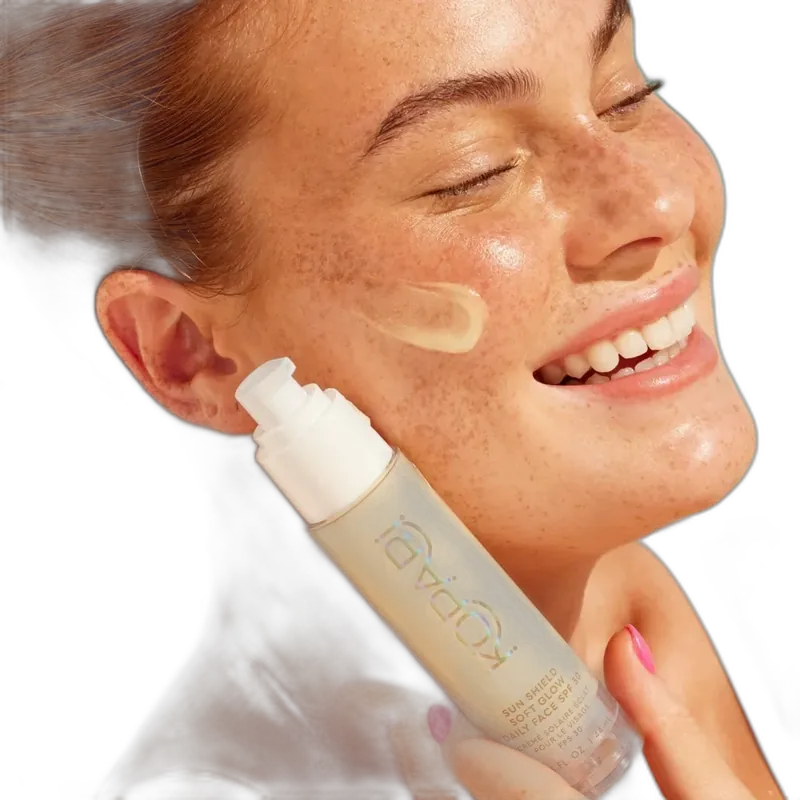
Sun Shield Soft Glow Daily Face SPF 30
Glow-Finish Daily SPF
 Verified reviewer
Pros & cons.
- +Completely fragrance-free — no perfume, essential oils, or fragrance allergens
- +Excellent primer compatibility with a silicone-based slip that prevents pilling
- +Subtle satin glow finish that enhances skin without obvious shimmer
- +No white cast — suitable for all skin tones
- +Proven four-filter broad-spectrum UV protection system
- +Vegan, cruelty-free, and paraben-free
- −Very small 1.5 oz tube for $38 — roughly $25 per ounce
- −SPF 30 when many face sunscreens offer SPF 50 at similar or lower prices
- −Satin-glow finish may be too luminous for oily skin types
- −No additional skincare actives beyond vitamin E — purely a sunscreen
- −Silicone-based formula may not appeal to those avoiding silicones
The full review.
If Kopari’s Sun Shield Body Glow SPF 50 is a bold, fragrant, shimmery vacation sunscreen, then the Soft Glow Daily Face SPF 30 is its responsible, dermatology-focused sibling. This version removes every problematic element from the body formula: the fragrance, allergens, coconut oil, and Lilial are all gone. What remains is a clean, silicone-based face sunscreen with a subtle luminous finish that works as a makeup primer.
The UV filter system uses the standard four-filter combination: avobenzone for UVA, homosalate and octisalate for UVB, and octocrylene as both a UVB absorber and avobenzone stabilizer. Concentrations are lower than the body version—octocrylene drops from 10% to 4%—which lightens the texture but sets the UV protection at SPF 30 instead of 50. For daily use, dermatologists agree that properly applied SPF 30 provides excellent protection, blocking about 97% of UVB rays.
The vehicle distinguishes this product from its body-version sibling and most competing face sunscreens. The base uses silicones—dimethicone crosspolymers and caprylyl methicone—to create a primer-like slip. It glides on like a lightweight serum, sets within one to two minutes, and leaves a smooth satin finish. There is no tackiness, no greasy film, and no sunscreen smell. It feels like a primer that protects from the sun.
Finely milled mica and tin oxide provide the glow, creating soft-focus luminosity instead of visible shimmer particles. The effect looks more like “your skin after a really good night’s sleep” than “your skin wearing highlighter.” It looks healthy and lit from within. Under foundation, it adds subtle radiance to prevent makeup from looking flat or cakey. On bare skin, it gives an effortless, glass-skin-adjacent, naturally dewy finish.
The fragrance-free formulation is a key distinction. While the body sunscreen contains multiple fragrance allergens including EU-banned Lilial, this face formula contains zero fragrance ingredients. There is no parfum, no essential oils, and no individual fragrance compounds in the INCI list. This matters for people with rosacea, contact dermatitis, or fragrance sensitivity—groups that need daily sunscreen but often lack products that prioritize tolerance over scent.
The sunscreen performs well in real-world conditions. It does not pill when layered over serums and moisturizers. It does not break down into an oily mess by midday. It does not sting the eyes (though applying any chemical sunscreen too close to the waterline is ill-advised). The silicone base does not add moisture; dry skin types will need a hydrating step underneath. However, it does not dry the skin out either.
The value proposition is the weakness. At $38 for 1.5 ounces, the price is approximately $25 per ounce. Dermatologists recommend a nickel-to-quarter-sized amount for the face, so this tube lasts about four to six weeks with daily use. That costs roughly nine to ten dollars per month for face sunscreen. Established dermatological brands offer excellent fragrance-free face sunscreens at lower prices and in larger sizes. Kopari charges a premium for the brand name, the glow finish, and the clean beauty positioning—not for a superior UV filter system or unique active ingredients.
For buyers wanting a glowing, primer-compatible, fragrance-free face sunscreen who do not mind the cost, this is a well-executed product. The corrections from the body formula are genuine. The texture and finish rank among the best in the category. But at this price, it competes with brands having decades of dermatological validation, and “pretty packaging from a coconut oil company” is a hard sell at twenty-five dollars an ounce.
Ingredient analysis.
Full INCI list
Active Ingredients: Homosalate 10%, Octisalate 5%, Octocrylene 4%, Avobenzone 3%. Inactive Ingredients: Isododecane, Dimethicone/Bis-Isobutyl PPG-20 Crosspolymer, Butyloctyl Salicylate, C12-15 Alkyl Benzoate, Caprylyl Methicone, Caprylic/Capric Triglyceride, Dimethicone/Vinyl Dimethicone Crosspolymer, Mica, Titanium Dioxide (CI 77891), Tocopheryl Acetate, Silica, Tin Oxide, Tocopherol
Skin match.
The science.
The Science
The Kopari Sun Shield Soft Glow Daily Face SPF 30 uses the same four-filter chemical UV protection system common across US sunscreens. Avobenzone at 3% provides UVA absorption with peak efficacy around 357 nm, covering the UVA I range responsible for photoaging. Research published in Photochemical and Photobiological Sciences (2007) documented avobenzone's tendency to photodegrade, but its combination with octocrylene (at 4% here) provides photostabilization that maintains protection throughout the wear period.
Homosalate at 10% and octisalate at 5% provide UVB absorption in the critical 290-320 nm range. These concentrations are FDA-approved and widely used, though the European Commission's SCCS recommended reducing homosalate's maximum concentration to 7.34% based on potential endocrine activity findings — a recommendation not yet adopted in the US.
The cosmetic luminosity is achieved through mica (CI 77019) and tin oxide, which function as light-diffusing particles. These minerals reflect and scatter light at skin level, creating a soft-focus effect. Titanium dioxide (CI 77891) at non-sunscreen concentrations contributes to the opacity-free, sheer finish while providing minimal additional UV scattering.
Tocopherol and tocopheryl acetate (vitamin E) serve as antioxidants. A study published in the Journal of the American Academy of Dermatology (2003) demonstrated that topical vitamin E can reduce UV-induced immunosuppression and erythema formation, providing photoprotective benefit complementary to UV filters.
References
- Photostability of sunscreen formulations containing avobenzone and UV filter combinations — Photochemical and Photobiological Sciences (2007)
Dermatologist Perspective
Dermatologists note that SPF 30 is considered adequate for daily facial sun protection when applied in sufficient quantity — approximately 1/4 teaspoon for the face. Board-certified dermatologists appreciate the fragrance-free formulation for patients with sensitive skin conditions who need daily UV protection, and the cosmetically elegant texture addresses one of the primary barriers to sunscreen compliance: unpleasant application feel. The silicone-based vehicle eliminates the white cast issue that drives many patients away from mineral sunscreens. For patients who prioritize cosmetic elegance and are willing to pay a premium, this product provides reliable broad-spectrum protection in a pleasant daily-wear format.
Where it fits in your routine.
Apply a nickel-sized amount to a clean, moisturized face and neck as the final morning skincare step. Blend evenly with fingertips using gentle pressing motions instead of rubbing. Let it set for 1-2 minutes before applying makeup. Reapply every 2 hours during prolonged sun exposure. Pat gently to reapply over makeup.
At $38 for 1.5 fl oz, this face sunscreen is one of the more expensive options per ounce. Daily use on the face and neck lasts about 4-6 weeks, making the monthly cost $6-10 based on application amount. The fragrance-free formulation and glow finish add value, but dermatological brands offer similar face sunscreens for $15-25 in 1.7-2.5 oz tubes. The Kopari premium buys the brand experience and the specific satin-glow finish, not a superior protection system.
Use this fragrance-free, primer-compatible face sunscreen for a subtle glow finish. It works for makeup wearers who want SPF to enhance foundation application. It suits normal, combination, and dry skin types seeking a luminous daily SPF.
Very oily skin types needing a matte-finish sunscreen. Budget-conscious shoppers who find equally effective fragrance-free face SPF at lower prices. Anyone preferring mineral-only UV filters. Those needing SPF 50 for high UV environments.
Product details.
This lightweight, silky lotion uses silicone-based slip to glide on sheer. It sets to a satin finish with subtle luminosity from finely milled mica and tin oxide.
Fragrance-free — no added perfume or essential oils.
Kopari uses a small, clean white squeeze tube. The 1.5 oz size is travel-friendly, but the price feels high for daily use.
The silicone-based slip applies smoothly, similar to a primer. It sets in 1-2 minutes to a satin finish with a subtle, diffused glow. It looks more "your skin but better" than shimmery. It has no stinging, no white cast, and no heavy sunscreen smell.
4-6 weeks with daily face and neck application.
12 months
All Year
The backstory.
The Sun Shield Soft Glow represents Kopari's evolution from body-focused products to daily facial skincare. Recognizing that their body sunscreen's heavy fragrance wouldn't work for daily face use, they reformulated with a fragrance-free, silicone-based vehicle specifically designed as a makeup primer that happens to deliver SPF 30 protection.
About Kopari
Kopari Beauty launched in 2015 in San Diego, California. The Sun Shield face sunscreen line marks the brand's move from body care to daily facial products. Kopari has strong retail presence and clean beauty credentials, but the Sun Shield face sunscreen line is new compared to SPF brands with decades of dermatological validation.
Common myths.
Mineral (zinc oxide/titanium dioxide) filters are safer than chemical sunscreen filters.
The chemical filters in this product — avobenzone, homosalate, octisalate, and octocrylene — have appeared in FDA-approved sunscreens for decades. The FDA requested more safety data in 2019, but this was a procedural step, not a safety finding. No regulatory body finds these filters unsafe at approved concentrations.
You don't need sunscreen if your makeup has SPF.
Most people apply less makeup than the amount required for the labeled SPF protection. Only a dedicated sunscreen applied in the recommended amount achieves the protection stated on the label.
FAQ.
Does Kopari Sun Shield Soft Glow work as a makeup primer?
Yes — the silicone-based formula creates a smooth, satin canvas so makeup glides and adheres. Finely milled mica adds a subtle glow, creating a luminous base visible through sheer foundations. Wait 1-2 minutes for the SPF to set before applying makeup.
Does Kopari Sun Shield Soft Glow have a white cast?
No — this is a chemical sunscreen, not mineral, so it leaves no white cast. It applies sheer and absorbs fully, so it works for all skin tones. The subtle glow is universal and flattering.
Is Kopari Sun Shield Soft Glow fragrance-free?
Yes — Kopari's body sunscreen products use heavy fragrance, but this face formula is fragrance-free. It has no added perfumes, essential oils, or fragrance allergens. It works for fragrance-sensitive skin.
Why is Kopari face SPF only SPF 30 and not 50?
SPF 30 blocks about 97% of UVB rays, and SPF 50 blocks about 98%. This difference is marginal. Many dermatologists consider SPF 30 adequate for daily use. Kopari likely chose SPF 30 to create a lighter, more cosmetically elegant formula for daily wear under makeup.
Is Kopari Sun Shield Soft Glow good for oily skin?
The satin-glow finish adds luminosity that feels too dewy for very oily skin. The formula absorbs well, but oily skin types may prefer a matte-finish sunscreen. It works best for normal, combination, and dry skin types seeking subtle radiance.
What the community says.
"Sheer finish with no white cast"
"Works beautifully as a makeup primer"
"Subtle glow without obvious shimmer"
"Lightweight and doesn't feel greasy on the face"
"Small tube for the price — 1.5 oz runs out fast"
"Satin finish may be too dewy for very oily skin"
"Chemical filters may sting eyes if applied too close"
"SPF 30 when many competitors offer SPF 50 at similar prices"
People also looked at.