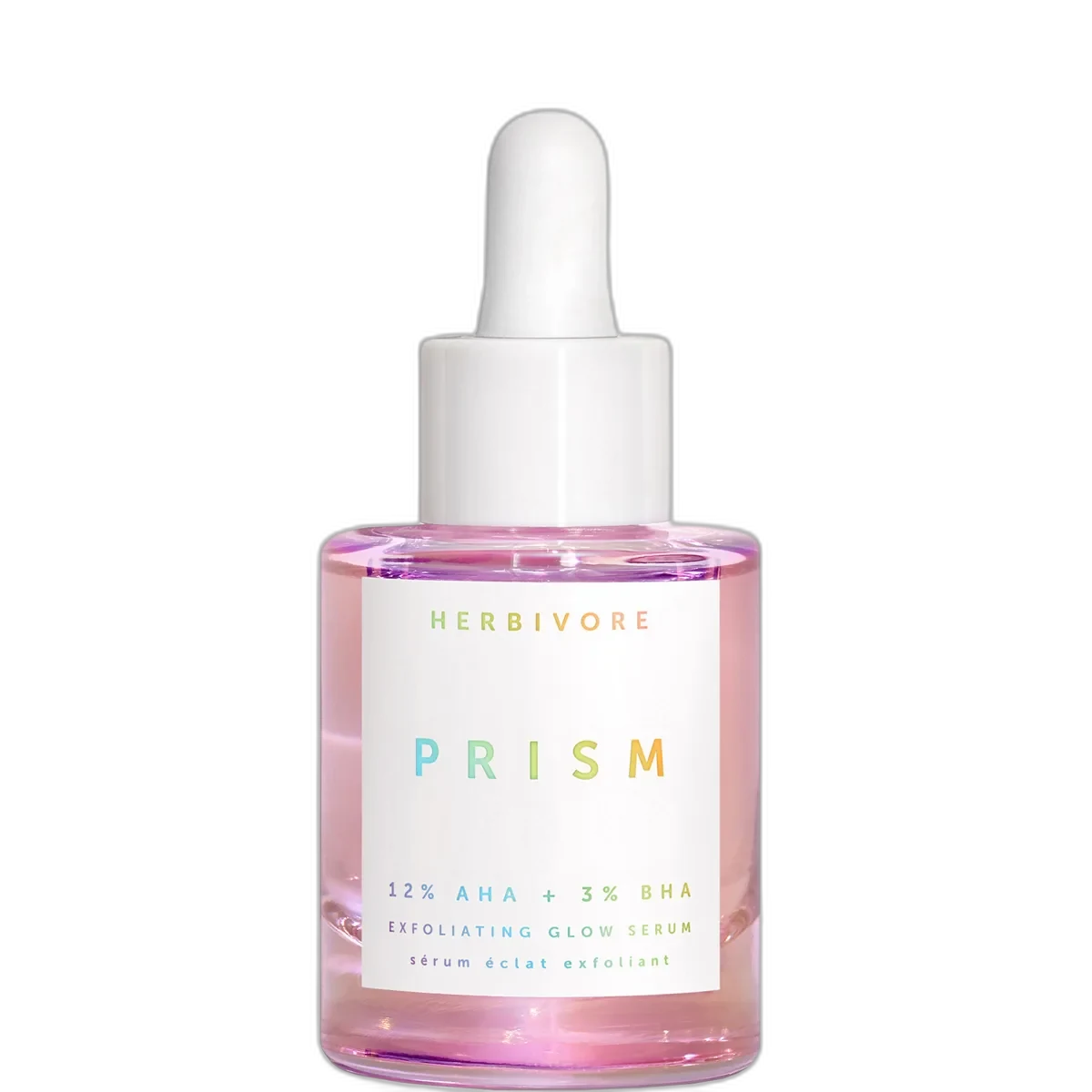
Prism AHA + BHA Exfoliating Glow Serum
Clean Beauty Acid Peel
 Verified reviewer
Pros & cons.
- +12% AHA concentration genuinely delivers visible resurfacing
- +Willow bark adds a mild pore-clarifying BHA element
- +Natural vitamin C from Kakadu plum amplifies brightening
- +Sodium hyaluronate buffers the dryness AHAs typically cause
- +Plant-forward formulation without cutting acid strength
- +Beautiful pink serum with a soft natural rose scent
- −Scented and contains citrus and rose — not sensitive-skin friendly
- −Clear glass bottle exposes the formula to light if not stored away
- −Willow bark BHA is weaker than synthetic salicylic acid
- −Prestige pricing for what is chemically a 12% AHA serum
The full review.
Prestige skincare marketing for 12% AHA serums almost always claims this concentration is the strongest your skin needs. Marketing ignores that a 12% AHA serum is a 12% AHA serum, whether the acid comes from synthetic glycolic, sugarcane ferment, or fruit and bilberry extracts. Concentration and pH drive the biology; the source is just a sourcing story. Herbivore Botanicals centers its identity on sourcing with Prism. For better or worse, Prism also delivers on the other half of the promise: it works exactly like a 12% leave-on AHA serum should, with the tingle, purging period, and required SPF discipline. If you expect a ‘clean beauty’ version of a peeling solution that is softer, you will learn that plant-forward is not forgiving. The product is a thin, watery pink serum—colored by bilberry and mixed botanical extracts—in a glass dropper bottle that looks good in photos but blocks light poorly, so store it in a drawer. Application causes an immediate tingle that lasts about thirty seconds for most users. The acid load is significant: glycolic, lactic, and malic acids from sugarcane and fruit sources total 12%, plus 3% willow bark extract for the ‘BHA’ element. Willow bark deserves attention. Willow bark contains salicin, which the body metabolizes into salicylic acid, but it does not enter pores like synthetic salicylic acid. Treat the BHA claim as a bonus; the AHA side does the real work by resurfacing the stratum corneum and driving the glow. A soothing, hydrating supporting cast surrounds the acid core: aloe and rose water lead the INCI, sodium hyaluronate buffers dryness, leuconostoc/radish root ferment filtrate acts as a natural preservative, and Kakadu plum extract provides natural vitamin C. Aloe and rose water provide the soothing baseline. Hyaluronic acid is a non-negotiable hydrator for leave-on high-concentration AHA because acid exfoliation accelerates water loss. Vitamin C is a smart pairing because freshly resurfaced skin absorbs vitamin C more easily, boosting the brightening effect without a separate serum. This part of the formula justifies its prestige pricing. A cheaper 12% AHA product is just a 12% AHA serum in water; Prism is a 12% AHA serum formulated for what happens to the skin after the acid works. Regarding results, this is one of the more dramatic leave-on acid products in the clean-beauty aisle. Most users see visible brightness and smoothness within the first week of twice-weekly use. After two to four weeks of consistent twice-to-three-times-weekly use, hyperpigmentation softens, pores look smaller, and skin texture becomes smoother. Acne-prone skin benefits from the gentle pore clarifying of willow bark, but those seeking dedicated blemish treatment should use a proper salicylic acid product instead of relying on Prism alone. The limits are standard for any serious AHA product. It stings. It requires building tolerance. It increases photosensitivity, so daily broad-spectrum SPF 30+ the next morning is non-negotiable. It does not work with retinol, vitamin C serums, or benzoyl peroxide on the same night—space them out. It contains rose water and natural citrus extracts, so sensitive and rosacea-prone skin should look elsewhere. At $54 for a 30 ml bottle, you pay clean-beauty prestige pricing for a product that performs the same biology as a $15 drugstore 10% glycolic serum. That price only makes sense if plant-based sourcing matters to you, or if you prefer the texture, scent, and sensorial experience of Herbivore Botanicals over clinical alternatives. Both are valid reasons to buy. They are also why this is a Sephora staple rather than a derm-office one. Used correctly—two to three nights per week, with SPF the next morning and no acid-stacking—Prism delivers the glow. Used casually or over-applied, it delivers acid irritation. It is an honest expression of clean beauty for users who know ‘clean’ and ‘gentle’ are not the same word.
Ingredient analysis.
Full INCI list · pH 3.5
Aloe Barbadensis Leaf Juice, Aqua, Rosa Damascena Flower Water, Glycerin, Vaccinium Myrtillus Fruit/Leaf Extract, Salix Nigra (Willow) Bark Extract, Leuconostoc/Radish Root Ferment Filtrate, Citrus Aurantium Dulcis (Orange) Fruit Extract, Terminalia Ferdinandiana Fruit Extract, Populus Tremuloides Bark Extract, Gluconolactone, Sodium Hyaluronate, Sodium Phytate, Saccharum Officinarum (Sugarcane) Extract, Citrus Limon (Lemon) Fruit Extract, Acer Saccharum (Sugar Maple) Extract
Skin match.
The science.
The Science
Alpha hydroxy acids are among the most studied ingredient classes in topical dermatology. Glycolic acid has decades of evidence showing it improves photoaging, fine lines, hyperpigmentation, and skin texture at leave-on concentrations of 5–12% and pH values between 3.0 and 4.0. Lactic acid and malic acid belong to the same biological family and use the same mechanism at similar free-acid concentrations, but have different molecule sizes and irritation profiles. Prism's 12% total AHA concentration at pH 3.5 hits the top of the effective leave-on window, which drives both the visible results and the irritation potential. The BHA side lacks the same scientific clarity. Willow bark extract contains salicin, a glycoside that the body metabolizes to salicylic acid in vivo, but salicin is not chemically identical to salicylic acid and does not penetrate sebum-filled pores as directly. The 'BHA' label on willow bark products is a reasonable shorthand but is not perfect; for patients seeking a dedicated BHA treatment for pore congestion, synthetic salicylic acid at 1–2% is the better-studied choice. Kakadu plum extract is a validated natural vitamin C source with an unusually high ascorbic acid content per gram of fruit. Pairing it with AHAs follows general dermatology principles on sequential absorption, though the evidence base for topical Kakadu plum extract is smaller than for synthetic L-ascorbic acid. Sodium hyaluronate is the most-studied hydration ingredient in cosmetic chemistry. It is vital in leave-on acid products because AHAs accelerate transepidermal water loss in the first days of use. The rose water, aloe, and bilberry components provide minor antioxidant and soothing benefits but are not the scientific main event.
Dermatologist Perspective
Dermatologists routinely recommend leave-on AHA serums at 8–12% for patients with dullness, uneven tone, mild photoaging, and post-inflammatory hyperpigmentation. This product's 12% concentration at pH 3.5 sits at the top of that window; clinical commentary frames it as appropriate for experienced users rather than beginners. Board-certified dermatologists caution that leave-on AHAs increase photosensitivity and that broad-spectrum SPF 30+ the morning after use is non-negotiable. Patients should also avoid stacking AHAs with retinol, BPO, or high-percentage vitamin C serums on the same night. The product's fragrance elements — rose water and citrus — often cause patients with rosacea, eczema, or sensitive skin to avoid it. For a first-time acid user, dermatologists typically recommend starting with a lower concentration like 5–8% before moving to a 12% product like Prism.
Where it fits in your routine.
Apply at night only to clean, dry skin after toner and before moisturizer. Press two to three drops onto fingertips and spread evenly across the face. Avoid the eye area, mouth corners, and broken skin. Use one to two nights per week for the first two weeks, then increase to three nights per week if tolerated. Follow with a ceramide-rich moisturizer to buffer dryness. Always apply broad-spectrum SPF 30+ the next morning; skipping sunscreen after this product worsens hyperpigmentation. Do not use on the same night as retinol, vitamin C serums, or benzoyl peroxide.
At $54 for 30 ml, Prism is at the top of the 'prestige clean' price tier for leave-on AHAs. Value depends on your priorities. Compared to drugstore acid serums — The Ordinary Glycolic 7% Toning Solution, The Inkey List Glycolic Acid, Paula's Choice 8% AHA — you pay a premium for the plant-forward formulation philosophy and the Herbivore aesthetic. The per-ml cost is reasonable if you use it two-to-three-times-weekly, as one bottle lasts three months. The product is formulated with care, but value hunters get the same biological effect from products costing a third as much. The spend makes sense for buyers who prioritize clean-beauty positioning, the Sephora retail channel, or Herbivore's specific sensorial experience.
Normal, combination, or oily skin types wanting one leave-on acid serum for resurfacing and mild pore clarifying. This suits plant-based formulation users who already tolerate AHAs well.
Sensitive, rosacea-prone, or eczema-prone skin, first-time acid users needing lower concentrations, pregnant users, and anyone targeting pore congestion with a dedicated BHA — a proper salicylic acid serum works better.
Product details.
A thin, watery pink serum that absorbs fast with a slightly cool feel.
Soft natural rose note from rose water and a subtle citrus freshness.
The clear glass dropper bottle shows the signature pink serum. It looks good but exposes the formula to light; store it in a dark drawer.
The first application causes a tingle for about 30 seconds as the acids work. Most users see smoother skin and a subtle glow the next morning. Acne-prone skin may purge for two to three weeks. Expect faint flaking during the first week; this is standard for a 12% AHA product.
Approximately 3 months with two to three nights per week use.
12 months
fall winter
The backstory.
Herbivore Botanicals launched in Seattle in 2011 as a farmer's-market indie brand and grew into one of the clean beauty staples at Sephora. Prism was added to the line in 2019 and reformulated in 2022 to include a dedicated BHA element from willow bark, which was the brand's response to Sephora shoppers asking for a single leave-on serum that could replace both AHA and BHA treatments in one step.
About Herbivore Botanicals
Established Brand (5–20 years)Herbivore Botanicals started in Seattle in 2011. It is a long-standing indie clean-beauty brand sold at Sephora with many reviews. Prism launched in 2019 and underwent a 2022 reformulation to add a dedicated BHA.
Common myths.
Natural fruit acids are gentler than synthetic glycolic.
Biological effects are similar at equivalent free-acid concentrations. A 12% AHA serum is a 12% AHA serum whether it uses sugarcane or synthetic glycolic — Prism is not a gentle product.
Willow bark extract is the same as salicylic acid.
Willow bark has salicin, a precursor the body converts. Salicin is not salicylic acid and penetrates pores less directly. Treat the 'BHA' claim as a bonus, not the main event.
FAQ.
Is Prism really 12% AHA?
Yes. Herbivore uses 12% AHAs from a blend of glycolic, lactic and malic acids from sugarcane, bilberry and fruit extracts, plus 3% willow bark as a BHA. This free-acid concentration is the highest in the leave-on cosmetic range.
How often should I use it?
Use this one to two nights per week for the first two weeks. If your skin tolerates it, increase to three nights per week. Use it no more than four nights per week. Never layer it with retinol or benzoyl peroxide on the same night.
Is it safer than The Ordinary AHA 30% + BHA 2% Peeling Solution?
These are different categories. The Ordinary peel is a 10-minute rinse-off with 30% acid concentration; Prism is a 12% leave-on serum you wear all night. 12% leave-on products require a slower ramp-up than a short contact peel. Neither is universally "safer."
Does it make skin more sun-sensitive?
Yes. AHAs increase photosensitivity. Prism's 12% concentration requires daily broad-spectrum SPF 30+ the next morning. Skipping sunscreen after using Prism will worsen hyperpigmentation.
Is it safe during pregnancy?
We flag this as use-with-caution during pregnancy due to the willow bark salicin content and total acid concentration. Many OB/GYNs advise patients to avoid high-concentration BHAs during pregnancy. Check with your provider before continuing.
Why does it sting?
At pH 3.5 and 12% free-acid concentration, a brief tingle on application is normal. If stinging is severe, lasts over a minute, or causes visible redness the next day, use it less often—switch to once per week.
Community
What the community says.
"Visible smoothness and glow in a few uses"
"Beautiful pink serum texture and packaging"
"Lightweight and fast-absorbing"
"Plant-based formulation holds up on formula merit"
"Can sting on sensitive skin"
"Scented from rose water and citrus"
"Expensive for a 30 ml bottle"
"Willow bark BHA is weaker than salicylic acid"
Featured in.
People also looked at.