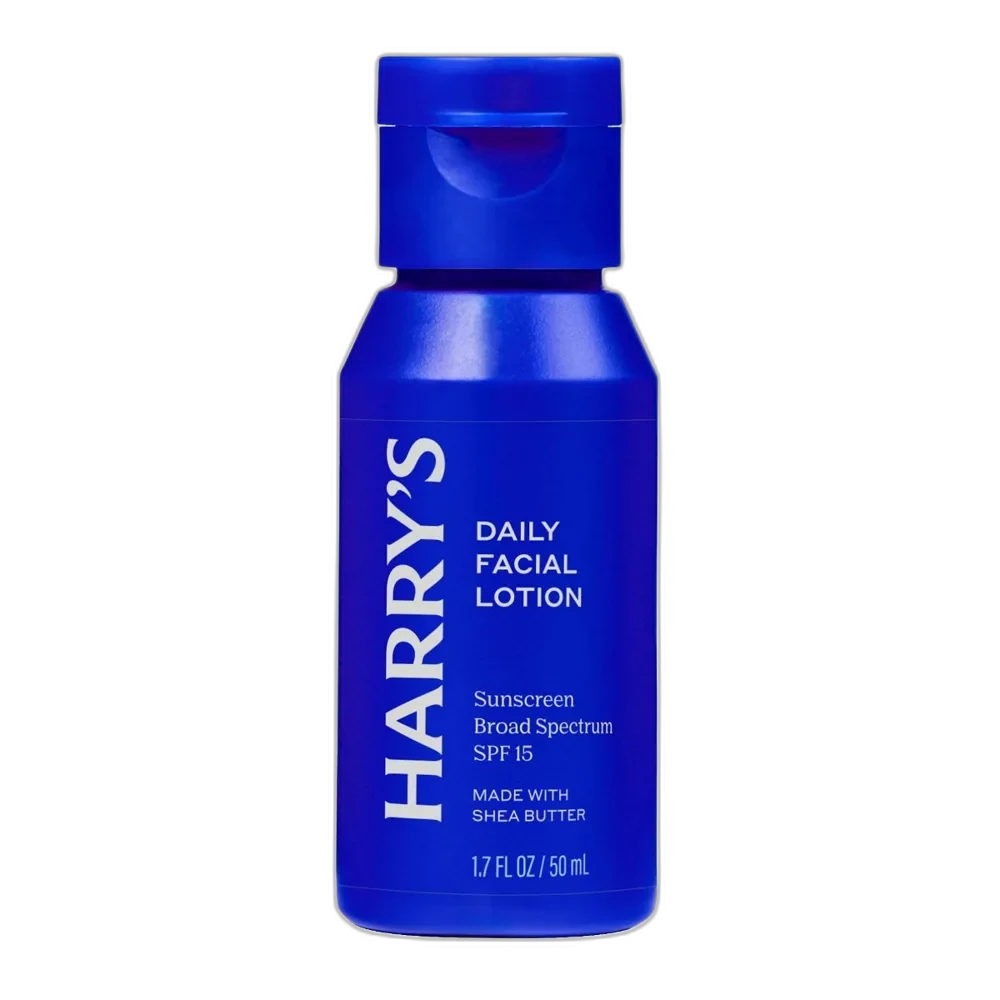
Face Lotion with SPF 15
Men's Sunscreen Gateway Product
 Verified reviewer
Pros & cons.
- +Mineral zinc oxide formula is one of the gentlest approaches to sun protection
- +Lightweight texture absorbs quickly with minimal white cast
- +Caffeine provides a practical morning de-puffing benefit
- +Moisturizer-SPF combo eliminates an extra step for minimalist routines
- +Botanical extras (licorice root, vitamin E, willow bark) add antioxidant value
- +Comfortable matte finish that works well under clothing
- +Affordable price point lowers the barrier to daily SPF use
- −SPF 15 falls below the dermatologist-recommended minimum of SPF 30
- −Tiny 1.7 oz tube empties within 4-6 weeks requiring frequent repurchase
- −Peppermint and eucalyptus oils are irritants in a leave-on formula
- −Not water-resistant — unsuitable for outdoor activity or exercise
- −May leave slight white cast on darker skin tones
The full review.
Harry’s knows a specific type of man: he uses peppermint-scented face wash but refuses to use sunscreen. He lacks a separate moisturizer and skins his face in the shower or immediately after. Harry’s Face Lotion SPF 15 targets this user. It acts as a Trojan horse: a moisturizer that provides sun protection to consumers who avoid traditional sunscreen.
The UV filter is 6.6% zinc oxide. This mineral sunscreen active sits on the skin surface to physically reflect UV radiation instead of absorbing it chemically. It is one of the safest, most broadly tolerated sun protection ingredients. At 6.6%, it delivers SPF 15, which reduces daily UVB exposure by about 93% if applied correctly and generously. Dermatologists say this is insufficient. They are right. The American Academy of Dermatology recommends SPF 30 as a minimum to block approximately 97% of UVB. That 4% difference matters; over years of daily exposure, it changes cumulative UV damage and skin cancer risk.
The uncomfortable truth SPF absolutists ignore is that the best sunscreen is the one you actually wear. If Harry’s Face Lotion SPF 15 is the difference between daily protection and none at all, it does more practical good than an SPF 50 product sitting unused in a cabinet. Harry’s likely chose the SPF 15 rating deliberately. Higher zinc oxide concentrations cause heavier texture, more white cast, and the obvious sunscreen feel their target customer rejects. At 6.6%, the formula stays lightweight, absorbs quickly, and leaves minimal white cast. It feels like a moisturizer, not a chore.
The moisturizing base is competent. Caprylic/capric triglyceride and shea butter ethyl esters provide emollient moisture, dimethicone creates a smooth silicone base to help the zinc oxide blend, and glycerin adds humectant hydration. The formula absorbs well and leaves a matte finish that sits under clothing without feeling greasy. The texture works for men who want to apply one product after washing and stop thinking about skincare.
Harry’s adds value with extras. Caffeine provides a mild vasoconstrictive effect to temporarily reduce morning puffiness—a relevant benefit for a product used after waking up. Licorice root extract brings anti-inflammatory and antioxidant properties. Willow bark extract offers natural salicylic activity. Tocopheryl acetate (vitamin E) adds antioxidant support. These ingredients are not transformative at these concentrations, but they show more formulation thought than standard products at this price point.
Harry’s peppermint oil and eucalyptus oil are present, though at lower levels than in the Exfoliating Face Wash. The mint scent is subtle and barely there after application. However, these essential oils mean this product has the same irritation potential as the rest of the Harry’s lineup. Most skin types will be fine with rinse-free contact. People with sensitive or rosacea-prone skin should avoid even trace amounts of peppermint oil in a leave-on product.
The packaging is a practical weakness. The 1.7-ounce tube is tiny. Using a nickel-sized dollop daily, this tube lasts roughly four to six weeks. At nine dollars per tube, the cost is about two dollars per week. While not expensive, constant repurchasing creates friction in the effortless routine Harry’s intends to create.
There is no water resistance claim. This is for incidental exposure—office commutes, lunch walks, or driving. Sweat or water will compromise protection quickly. For outdoor exercise, beach days, or extended sun exposure, a dedicated water-resistant SPF 30+ product is non-negotiable.
The product’s tension lies between its purpose and its limits. As a concept—a mineral SPF moisturizer serving as a simple entry point to sun protection for men who resist sunscreen—it is well-executed. As a sun protection product judged against dermatological standards, SPF 15 in 2026 is hard to defend when the market offers SPF 30 and 50 products with elegant textures and minimal white cast. The excuse that higher SPF ruins wearability is no longer true.
Formula
Ingredient analysis.
Full INCI list
Active Ingredient: Zinc Oxide 6.6%. Inactive Ingredients: Water/Aqua/Eau, Caprylic/Capric Triglyceride, Butylene Glycol, Dimethicone, Shea Butter Ethyl Esters, Cetearyl Alcohol, Glyceryl Stearate, PEG-100 Stearate, Glycerin, Mentha Piperita (Peppermint) Oil, Eucalyptus Globulus Leaf Oil, Salix Alba (Willow) Bark Extract, Glycyrrhiza Glabra (Licorice) Root Extract, Tocopheryl Acetate, Caffeine, Polyacrylamide, Steareth-100, C13-14 Isoparaffin, Xanthan Gum, Caprylyl Glycol, Polysorbate 20, Citric Acid, Potassium Sorbate, Laureth-7, Sodium Polyacrylate, Hexylene Glycol, Phenoxyethanol, Chlorphenesin, Limonene
Skin match.
The science.
The Science
Zinc oxide is a broad-spectrum UV filter. It protects against UVA and UVB radiation by scattering and absorbing light. At 6.6%, this concentration provides SPF 15, which blocks about 93% of UVB radiation per FDA testing standards. A 2013 study in the Annals of Internal Medicine (Green et al.) shows that daily sunscreen use reduces melanoma risk. Even regular use of lower-SPF products provides protection compared to no sunscreen use.
The gap between SPF 15 and SPF 30 matters over years. SPF 30 blocks about 97% of UVB, so SPF 15 allows twice the UVB penetration (7% vs 3%). The Skin Cancer Foundation recommends SPF 15 as a minimum for incidental exposure, but the American Academy of Dermatology recommends SPF 30 as the baseline for all daily use.
Topical caffeine has antioxidant properties and protects against UV-induced DNA damage. A 2007 study in the Journal of Investigative Dermatology shows that topical caffeine application increases UVB-induced apoptosis in damaged skin cells, which helps eliminate precancerous cells. In this formula, caffeine's vasoconstrictive properties also de-puff skin by reducing local blood flow.
Dermatologist Perspective
Dermatologists agree any sunscreen is better than none, but they recommend SPF 30 or higher for daily use. Board-certified dermatologists note that mineral zinc oxide works well for post-shave use and sensitive skin because it stings less than chemical UV filters. However, the peppermint and eucalyptus oils in a leave-on SPF product cause concern; dermatologists specializing in contact dermatitis prefer a fragrance-free formulation. For patients starting daily SPF, this product is a reasonable starting point, but dermatologists encourage moving to a higher-SPF product once the habit is established.
Where it fits in your routine.
Apply a nickel-sized amount to a clean, dry face every morning. Smooth it over the face, ears, and neck. Wait 1-2 minutes for absorption before leaving. Use this product only in the morning; applying SPF before bed provides no benefit. Reapply every two hours during extended outdoor time, though the small tube makes this impractical. For prolonged sun exposure, use or replace this product with a dedicated SPF 30+ water-resistant sunscreen.
At about $8.97 for 1.7 ounces, the price per tube is reasonable, but the small size requires frequent repurchasing. Daily use uses one tube every 4-6 weeks, making the annual cost $80-120. Many SPF 30+ moisturizers offer larger sizes (2-3 oz) at similar or slightly higher prices, providing better value and better protection. The caffeine, licorice root, and botanical extras add formulation value, but the SPF 15 limitation means the product does not meet current clinical sun protection standards.
Men who use no sun protection and want the simplest, easiest way to add daily SPF to their routine. It also works for those who work indoors with minimal sun exposure and want a lightweight mineral moisturizer for incidental protection during commutes and brief outdoor moments.
Serious sun protection requires a dedicated SPF 30+ product. People with sensitive or rosacea-prone skin should avoid the essential oils. This low concentration may still cause white cast issues for people with deeper skin tones using mineral sunscreens. This product lacks water resistance and sufficient SPF for significant outdoor time.
Product details.
Lightweight, creamy white lotion that absorbs fast to a matte finish
Subtle peppermint and eucalyptus — less intense than the brand's face wash
Small 1.7 fl oz squeezable tube with a screw cap. The size works for travel, but daily use empties it quickly.
Applies smoothly with little white cast. It absorbs in one to two minutes into a comfortable matte finish that stays under clothing collars. The mint scent is subtle. It does not sting or irritate non-freshly-shaved skin. It feels hydrated but not heavy.
4-6 weeks with daily facial application
12 months
All Year
Common myths.
SPF 15 is sufficient for daily sun protection
Dermatologists recommend at least SPF 30 for daily use. SPF 15 blocks about 93% of UVB rays, but SPF 30 blocks about 97%. That 4% difference adds up over years of daily exposure. SPF 15 is better than nothing but misses clinical recommendations.
Mineral sunscreens always leave a white cast
With 6.6% zinc oxide, this formula minimizes white cast. Mineral sunscreens using higher concentrations (15-25%) show more white cast. This formula trades SPF for better cosmetic elegance.
FAQ.
Can I use Harry's Face Lotion SPF 15 after shaving?
You can, but peppermint oil and eucalyptus oil may sting freshly shaved skin. If you feel irritation, apply a fragrance-free post-shave balm first, let it absorb, then apply this lotion as your SPF step. Or wait 10-15 minutes after shaving before applying.
Does Harry's Face Lotion SPF 15 leave a white cast?
The low 6.6% zinc oxide concentration keeps white cast minimal on light to medium skin tones. On darker skin tones, a slight white cast may remain until you rub it in for a few minutes. This formulation handles white cast better than most mineral sunscreens.
Is Harry's Face Lotion SPF 15 water-resistant?
This product is not water-resistant. It works for daily incidental exposure, not beach or athletic use. Swimming or heavy sweating requires a separate water-resistant sunscreen with higher SPF.
How often should I reapply Harry's Face Lotion SPF 15?
Reapply all sunscreens every two hours of continuous sun exposure. One morning application protects office workers from incidental window exposure and brief outdoor moments. The small tube size makes reapplication while carrying it impractical.
What the community says.
"Lightweight and absorbs quickly without white cast"
"Good for men who don't want to think about sunscreen separately"
"Subtle mint scent feels refreshing in the morning"
"Mineral formula is gentler than chemical sunscreens"
"Affordable and easy to incorporate into a simple routine"
"SPF 15 is too low for adequate sun protection"
"Small tube runs out quickly for daily use"
"Peppermint and eucalyptus can irritate freshly shaved skin"
"Not water-resistant for outdoor activity"
"Slight white cast on darker skin tones"
People also looked at.