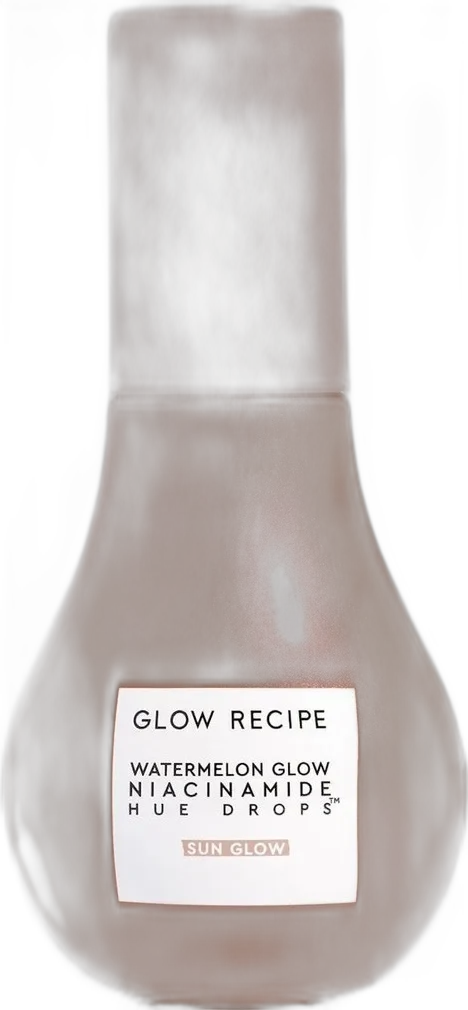
Watermelon Glow Niacinamide Hue Drops
Skincare-Meets-Bronzer Hybrid
 Verified reviewer
Pros & cons.
- +Sheer buildable warmth creates a convincing sun-kissed glow without looking like applied product
- +Centella asiatica addition provides genuine soothing benefits not found in the original Dew Drops
- +No glitter or shimmer particles that transfer to clothes, pillows, or hands
- +Niacinamide, hyaluronic acid, and Lipidure deliver real skincare benefits with each use
- +Recyclable packaging made from 70% post-consumer recycled glass
- +Multifunctional as tinted serum, bronzing drops, or glow-boosting primer
- −Can look patchy on dry skin or textured areas without thorough moisturizing first
- −Only two shades available limiting suitability for very fair or very deep skin tones
- −Contains synthetic fragrance and benzyl benzoate unsuitable for sensitive skin
- −Too sheer for those wanting strong bronzer-level color payoff
- −Not waterproof or transfer-proof and fades throughout the day
The full review.
The Glow Recipe Dew Drops became one of the most recognizable skincare products of the 2020s. Selling one bottle every twelve seconds at peak, becoming the best-selling serum at Sephora and Cult Beauty, defining the glass-skin aesthetic for an entire generation of skincare consumers. So when the brand announced a tinted version in early 2024, the question was not whether people would buy it but whether the formula could support color without sacrificing the thing that made the original special: a glow that looked like healthy skin rather than applied product.
The answer leaked before Glow Recipe could answer it themselves. A TikTok creator swatched the unreleased Hue Drops in early February 2024, and the video hit 3.2 million views before the brand’s marketing team had finalized the launch assets. By the time Hue Drops officially arrived at Sephora on February 23, the product had already generated the kind of anticipation that most launches spend months building.
Hue Drops take the original Dew Drops formula — niacinamide, hyaluronic acid, Lipidure, watermelon extract — and add sheer pigment through ethically-sourced mica and iron oxides. The result is available in two shades: Sun Glow, a warm bronze that creates a sun-kissed effect, and Rosy Glow, a soft pink that adds cool-toned luminosity. The tint is genuinely sheer — this is not a liquid bronzer pretending to be skincare, but a skincare serum that happens to deposit a whisper of warm color.
The most interesting formulation choice is the addition of centella asiatica extract, which was not in the original Dew Drops. Centella is one of the most well-studied soothing ingredients in dermatology, with documented anti-inflammatory properties. In a tinted product designed to create warmth, the inclusion of an anti-redness ingredient creates a clever dual mechanism: the centella calms actual redness from underneath while the tint applies cosmetic warmth on top. You end up with warm-toned skin that is genuinely less inflamed rather than warm-toned skin that is just hiding redness.
The texture is nearly identical to the original Dew Drops — a lightweight gel-serum that feels thicker in the dropper than on the skin. It blends easily with fingers and absorbs quickly, leaving behind a dewy, luminous finish that photographs beautifully. The mica provides a subtle light-reflecting quality that the original Dew Drops achieved through formulation alone, while the iron oxides add the warm or rosy tint. There is no glitter, no chunky shimmer, no visible particles on the skin. The effect is more Instagram filter than bronzer swatch.
Application technique matters more with Hue Drops than with the original. The tint can look patchy on dry skin or textured areas, so adequate moisturizing beforehand is essential. Applying to well-hydrated skin and pressing rather than rubbing produces the most even result. Building layers adds depth without heaviness — three to four drops on cheekbones and across the nose creates a convincing just-back-from-vacation effect, while mixing two drops into moisturizer provides an all-over subtle warmth.
The sheerness is both the product’s greatest strength and its most common criticism. Those expecting a bronzer-level tint will find Hue Drops underwhelming — the color payoff is deliberately minimal, designed to look like sun exposure rather than product. Those who want a barely-there warmth that enhances their natural skin rather than covering it will find it perfect. There is no right answer here, only a matter of expectations.
The fragrance situation is identical to the original Dew Drops: watermelon-scented parfum at less than 0.5%, with benzyl benzoate as a regulated allergen. It smells pleasant and dissipates quickly, but it remains the product’s most valid criticism for sensitive skin types. The centella asiatica may calm some irritation, but fragrance sensitivity is a different pathway — centella cannot prevent a fragrance reaction.
The limited shade range — only Sun Glow and Rosy Glow — constrains the product’s universality. Sun Glow works across a broad range of medium skin tones but can appear too dark on very fair skin or too ashy on very deep skin tones. Rosy Glow offers an alternative for cooler complexions. Given the diversity of the brand’s audience, expansion beyond two shades would significantly improve the product’s accessibility.
At thirty-six dollars for 1.35 ounces, Hue Drops cost just one dollar more than the original Dew Drops. For a product that replaces both a hydrating serum and a liquid bronzer, the value is reasonable — particularly since each application delivers niacinamide, centella, hyaluronic acid, and Lipidure alongside the cosmetic effect. The mini size at twenty dollars offers a lower-risk entry point.
Hue Drops are not trying to replace your bronzer. They are trying to make the line between skincare and makeup disappear entirely — a product that improves your skin and your appearance simultaneously, in the same step, from the same bottle. The centella addition is smart, the tint execution is elegant, and the skincare base is genuinely functional. Whether you need both warmth and hydration in one product depends on your routine, but if you do, nothing else quite occupies this exact space.
Formula
Texture
The texture is nearly identical to the original Dew Drops — a lightweight gel-serum that feels thicker in the dropper than on the skin. It blends easily with fingers and absorbs quickly, leaving behind a dewy, luminous finish that photographs beautifully. The mica provides a subtle light-reflecting quality that the original Dew Drops achieved through formulation alone, while the iron oxides add the warm or rosy tint. There is no glitter, no chunky shimmer, no visible particles on the skin. The effect is more Instagram filter than bronzer swatch.
Scent
The fragrance situation is identical to the original Dew Drops: watermelon-scented parfum at less than 0.5%, with benzyl benzoate as a regulated allergen. It smells pleasant and dissipates quickly, but it remains the product’s most valid criticism for sensitive skin types. The centella asiatica may calm some irritation, but fragrance sensitivity is a different pathway — centella cannot prevent a fragrance reaction.
Best for
Hue Drops are not trying to replace your bronzer. They are trying to make the line between skincare and makeup disappear entirely — a product that improves your skin and your appearance simultaneously, in the same step, from the same bottle. The centella addition is smart, the tint execution is elegant, and the skincare base is genuinely functional. Whether you need both warmth and hydration in one product depends on your routine, but if you do, nothing else quite occupies this exact space.
Ingredient analysis.
Full INCI list
Aqua/Water/Eau, Propanediol, Glycereth-26, Glycerin, Niacinamide, 2,3-Butanediol, 1,2-Hexanediol, Cetyl Ethylhexanoate, Citrullus Lanatus Fruit Extract, Centella Asiatica Extract, Sodium Hyaluronate, Mica, Coffea Arabica Seed Extract, Polyglyceryl-3 Methylglucose Distearate, Tromethamine, Glyceryl Stearate SE, Carbomer, Acrylates/C10-30 Alkyl Acrylate Crosspolymer, Ethylhexylglycerin, Xanthan Gum, Polyquaternium-51, Butylene Glycol, Tocopherol, Fragrance/Parfum, Benzyl Benzoate, Iron Oxides (CI 77491, CI 77499), Titanium Dioxide (CI 77891)
Skin match.
The science.
The Science
The Hue Drops formula uses the original Dew Drops skincare base but adds centella asiatica extract — a heavily studied botanical in dermatology. Studies show centella's active compounds (asiaticoside, madecassoside, asiatic acid, and madecassic acid) promote collagen synthesis, reduce inflammation, and speed wound healing. A 2021 review in the International Journal of Molecular Sciences summarized centella's mechanisms: it inhibits pro-inflammatory cytokines, stimulates collagen type I synthesis, and provides antioxidant protection. In a tinted product, centella reduces genuine redness while mineral pigments add cosmetic warmth — treating skin tone via inflammatory and cosmetic pathways.
The niacinamide in the formula, at an estimated 2-5% concentration, provides cumulative skin-brightening and barrier-supporting benefits. A study in the British Journal of Dermatology showed 5% niacinamide significantly reduced hyperpigmentation by inhibiting melanosome transfer from melanocytes to keratinocytes. At the lower end of this formula's estimated concentration, the effect is gentler but still measurable with consistent daily use.
The mineral pigments — mica, iron oxides, and titanium dioxide — are dermatologically favorable for coverage. Unlike organic dyes, mineral pigments sit on the skin surface instead of absorbing into the epidermis. Iron oxides also provide protection against visible light-induced pigmentation, which matters for melasma-prone individuals. A 2014 study in the Journal of the American Academy of Dermatology showed iron oxides in tinted sunscreens provide superior visible light protection compared to untinted formulations.
Polyquaternium-51 (Lipidure), the biomimetic moisturizer, binds water approximately twice as effectively as hyaluronic acid by weight. Its structure mimics the phospholipid bilayer of cell membranes, so it integrates with the skin's surface lipids and maintains hydration longer.
Dermatologist Perspective
Dermatologists favor skincare-makeup hybrids like Hue Drops when they contain clinically active ingredients. Board-certified dermatologists note the centella asiatica addition is a meaningful upgrade over the original Dew Drops, providing documented anti-inflammatory benefits that complement the cosmetic tint. The mineral pigments (iron oxides, titanium dioxide) are non-comedogenic and may provide mild visible light protection. Dermatologists caution that the fragrance content may counteract the centella's soothing benefits for truly sensitive skin types. They recommend patients seeking significant brightening or tone correction use a dedicated niacinamide treatment at 5-10% concentration rather than relying on this hybrid product's modest dose.
Where it fits in your routine.
Apply 3-4 drops to well-moisturized skin. Use it as the last skincare step before sunscreen, or after sunscreen as a tinted highlight. Press it into cheekbones, brow bones, nose bridge, and forehead for a concentrated sun-kissed effect. Mix 2 drops into moisturizer or foundation for subtle, all-over warmth. Layer it over the original Dew Drops for more luminosity. Apply to hydrated skin only; dry patches cause uneven distribution.
Hue Drops cost thirty-six dollars for 1.35 ounces — only one dollar more than the untinted Dew Drops. This price is reasonable for a skincare-makeup hybrid. If Hue Drops replace a hydrating serum and a liquid bronzer or highlighter, the cost-per-use is competitive. One bottle lasts two to three months with daily use. The twenty dollar mini size lets users test shade suitability with less commitment. The limited two-shade range reduces value if neither shade matches a consumer's skin tone.
Fans of the original Dew Drops will like this tinted version with centella asiatica. It works for normal, combination, and oily skin types wanting a warm, no-makeup-makeup glow and skincare benefits. It fits low-maintenance routines where one product acts as both serum and bronzer.
People with fragrance sensitivities should avoid this because of the synthetic parfum and benzyl benzoate. This formula is too sheer for those wanting strong bronzer-level color payoff. The two-shade range is insufficient for very fair or very deep skin tones. The luminous quality is a drawback if you prefer a matte, non-dewy finish.
Product details.
This lightweight gel-serum is slightly thicker than water but applies sheer and weightless. It blends easily with fingers and sinks into skin quickly. The texture is more viscous than a traditional liquid bronzer but lighter than a cream product.
Sweet watermelon fragrance matches the original Dew Drops. The brand says it is less than 0.5% of the formula. It dissipates within a few minutes of application.
A glass dropper bottle uses 70% post-consumer recycled glass and a recycled plastic cap. It comes in two shades: Sun Glow (warm bronze) and Rosy Glow (soft pink). The carton is curbside recyclable; the cap and pump are recyclable via the Pact partnership.
It gives instant warm luminosity from the first application. The tint is sheerer than expected, providing lit-from-within warmth rather than noticeable color. Layering adds depth without heaviness. Apply to well-moisturized skin to prevent patchiness on dry areas.
2-3 months with daily use, using 3-4 drops per application
12 months
All Year
The backstory.
After the Dew Drops became Sephora's best-selling serum, consumer demand for a tinted version was overwhelming. Glow Recipe developed Hue Drops as the natural extension — same skincare base, same glass-skin philosophy, but with sheer pigment for a sun-kissed effect. The product leaked on TikTok before its official February 2024 launch, generating 3.2 million views and pre-launch buzz that the brand could not have manufactured. Available in Sun Glow (warm bronze) and Rosy Glow (soft pink), it represents Glow Recipe's expansion into the skincare-makeup hybrid category.
About Glow Recipe
Established Brand (5–20 years)Former L'Oreal executives Christine Chang and Sarah Lee founded Glow Recipe in 2014. The brand is Leaping Bunny and PETA certified, fully vegan, and exceeds $100M in business. Hue Drops won multiple 2024 beauty awards, including recognition from Who What Wear and Byrdie.
Common myths.
Pigments in tinted skincare products clog pores.
Hue Drops uses iron oxides and mica for color. These mineral pigments have negligible comedogenic potential. Mineral sunscreens and dermatologist-recommended tinted moisturizers use these same pigments. The hydrating base causes more acne-prone skin issues than the pigments.
Choose between skincare benefits and cosmetic coverage.
Hue Drops work in two ways. niacinamide brightens, centella soothes redness, and hyaluronic acid hydrates, while mica and iron oxides add immediate visual warmth. Each application acts as a treatment step and a cosmetic step.
FAQ.
What is the difference between Glow Recipe Dew Drops and Hue Drops?
Dew Drops is a clear, untinted glow serum that creates luminosity without shimmer particles. Hue Drops add sheer, buildable tint using ethically-sourced mica and iron oxides for sun-kissed warmth (Sun Glow) or a soft pink glow (Rosy Glow). Hue Drops also include centella asiatica extract to soothe skin, which the original Dew Drops lack.
Which Glow Recipe Hue Drops shade should I choose?
Sun Glow provides a warm, bronze-toned luminosity for a sun-kissed effect. Rosy Glow offers a soft pink luminosity for cooler undertones. Both formulas are sheer and buildable across many skin tones. Sun Glow works on the broadest range of complexions for a versatile, universally flattering option.
Can I use Glow Recipe Hue Drops as a bronzer?
Hue Drops give a subtle, natural warmth compared to traditional bronzer. The sheer, buildable tint lacks the intensity of a powder or cream bronzer. They work best for a lit-from-within, no-makeup-makeup glow instead of sculpted bronzer definition.
Do Glow Recipe Hue Drops transfer?
Yes — Hue Drops are not waterproof or transfer-proof. The tint transfers to hands, clothes, or masks if touched. A light powder improves longevity but may reduce the dewy finish. A setting spray helps for long-wearing occasions.
Are Glow Recipe Hue Drops safe during pregnancy?
The formula has niacinamide, hyaluronic acid, centella asiatica, and mineral pigments — most dermatologists consider these pregnancy-safe. It lacks retinoids, salicylic acid, or other pregnancy-contraindicated ingredients. Consult your healthcare provider for personalized advice.
Community
What the community says.
"Creates a subtle natural sun-kissed glow filter effect on the skin"
"Blends easily and provides buildable sheer coverage that never looks heavy"
"Skincare benefits from niacinamide and centella beyond just cosmetic tint"
"No glitter or shimmer particles that transfer onto clothes or pillows"
"Flatters a wide range of skin tones with a natural warmth"
"Recyclable packaging made with 70% post-consumer recycled glass"
"Can look patchy on dry skin or textured areas without proper moisturizing first"
"Too sheer for those wanting a strong bronzer or noticeable tint effect"
"Contains fragrance and benzyl benzoate unsuitable for fragrance-sensitive skin"
"Color transfers and fades throughout the day without being waterproof"
"Only two shades available limiting options for very fair or very deep skin tones"
"Price feels high for the minimal tint payoff compared to traditional bronzers"
People also looked at.