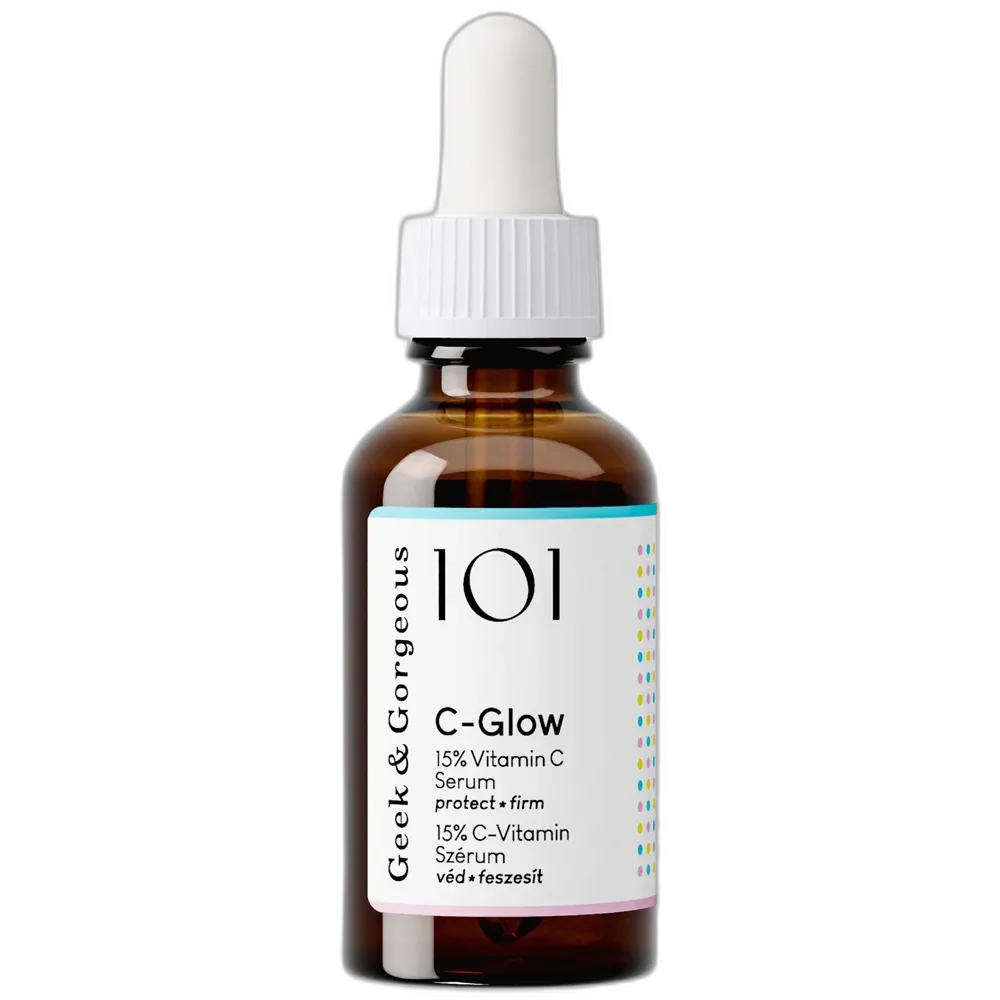
Liquid Gold 101 Vitamin C Serum
Beginner-Friendly Vitamin C Pick
 Verified reviewer
Pros & cons.
- +Classic C-E-ferulic framework at a beginner-friendly 10% concentration
- +Added panthenol, bisabolol, and allantoin meaningfully reduce irritation
- +Stable pH 3.2 formulation in light-protective amber glass
- +Outstanding price for a genuinely functional L-ascorbic acid serum
- +Visible brightening and tone evening within 2-4 weeks of consistent use
- +Fragrance-free, fungal acne safe, and suitable for most skin types
- +Cruelty-free and vegan certified by the brand
- −30ml bottle runs out faster than larger competitor sizes
- −Will oxidize and yellow within 2-3 months — normal but expected
- −Mild stinging on first application for pH-sensitive users
- −Should not be layered in the same pass with niacinamide or BHAs
The full review.
About Geek & Gorgeous
Since the SkinCeuticals C E Ferulic formula defined the category in 2005, L-ascorbic acid serum wisdom has favored higher concentrations. Fifteen percent became the standard, twenty percent became the target, and anything lower was dismissed as weak. This pushed the market toward effective concentrations, but it left people with sensitive skin, beginners, or those who cannot tolerate a pH 2.5 serum at 7am with no clear starting point.
Geek & Gorgeous saw this gap. Their Liquid Gold 15 was a respected budget version of the 15% formula that worked well for its target. However, the brand heard from users who wanted L-ascorbic acid benefits without the irritation, as many stopped using the 15% version within a week. They reformulated to create a 10% version. Despite internet claims that anything under 15% is ineffective, published evidence shows 10% provides meaningful antioxidant and depigmenting effects. Vitamin C research shows a plateau curve starting well below 20%, and a stabilized 10% formula delivers results with less irritation.
The framework uses the classic C-E-ferulic triad from the SkinCeuticals original. Ascorbic acid provides antioxidant and tyrosinase-inhibiting action, vitamin E handles lipid-phase free radical neutralization, and ferulic acid stabilizes the network and doubles the photoprotective effect. This combination stems from Pinnell’s work at Duke in the early 2000s and appears in many formulations. Success depends on execution: the pH must be low enough for ascorbic acid to penetrate (below 3.5 is the rule of thumb), the packaging must block light and air, and the formula must remain stable. Liquid Gold 101 meets all three. The pH is around 3.2. The amber glass bottle provides protection. Adding sodium metabisulfite as a secondary antioxidant extends stability beyond plain C-E-ferulic.
Tolerability additions distinguish this serum from other budget options. Panthenol supports the barrier and draws in water, softening the tight feeling of a pH 3.2 vitamin C application. Bisabolol provides anti-inflammatory action. Allantoin supports skin turnover and adds a soothing layer. The brand uses these same ingredients in their Jelly Joker Gel Moisturizer for post-actives recovery. This inclusion is intentional; the serum is designed for people who could not use the 15% version, using more than just a lower acid concentration.
The serum feels thinner and lighter than expected upon application. It spreads easily, absorbs within a minute, and leaves no residue or sticky film. Users may feel brief warming or mild tingling that fades within 60 seconds—this is a normal low-pH response, not a formulation failure. By the end of week one, skin shows a detectable glow and more even tone. By weeks four to six, if you use daily sunscreen (required for vitamin C to work fully), you will see reductions in superficial pigmentation and a more even complexion. Post-inflammatory hyperpigmentation from acne fades on an 8-to-12 week timeline, the realistic window for any vitamin C formulation.
Known limitations: the 30ml bottle is small for daily use and lasts two to three months. The ascorbic acid will yellow as it oxidizes—this is normal chemistry. Discard the product when the color turns deep orange or the scent smells fermented. The pH 3.2 acidity means you should not layer it directly with niacinamide in one pass (apply vitamin C first, wait 10-15 minutes, then proceed) or stack it with BHA or AHA in the same step. These are inherent tradeoffs of any L-ascorbic acid serum, applying to the $180 SkinCeuticals original as much as this $12 version.
The price is clear. Premium C-E-ferulic serums typically cost $70 to $180. This costs $12. The formulation is stable, the concentration is active, and the tolerability additions make it more usable than most budget alternatives. For those seeking a comfortable entry point to vitamin C or building a budget routine, Liquid Gold 101 is a top recommendation. It will not outperform fresh 15% serums on a per-application basis, but it is a usable daily antioxidant.
Ingredient analysis.
Full INCI list · pH 3.2
Aqua, Ethoxydiglycol, Ascorbic Acid, Propanediol, Glycerin, Ferulic Acid, Sodium Hyaluronate, Tocopherol, Panthenol, Allantoin, Bisabolol, Xanthan Gum, Disodium EDTA, Sodium Metabisulfite, Phenoxyethanol, Ethylhexylglycerin
Skin match.
The science.
The Science
The core claim of any L-ascorbic acid serum rests on two established mechanisms: antioxidant neutralization of reactive oxygen species generated by UV exposure, and inhibition of tyrosinase — the enzyme responsible for melanin synthesis. Both mechanisms have been studied extensively since the 1990s, with the most cited foundational work coming from the Pinnell lab at Duke University, which established that topical ascorbic acid in a stable, low-pH formulation can provide photoprotective benefits comparable to some sunscreens and can measurably reduce UV-induced erythema and pigmentation over time.
The C-E-ferulic framework used in this serum is not a marketing convenience. It emerged from the same line of research showing that combining ascorbic acid with vitamin E and ferulic acid produces a synergistic antioxidant network: vitamin E handles lipid-phase free radicals that water-soluble vitamin C cannot reach, ferulic acid stabilizes the ascorbic acid against oxidation while contributing its own antioxidant activity, and the combination doubles the photoprotective effect relative to ascorbic acid alone. This is the same framework used by SkinCeuticals' original formula and by virtually every serious budget competitor since.
The 10% concentration question deserves direct engagement. Published studies on topical ascorbic acid efficacy generally show a penetration and activity curve that rises steeply from roughly 5% up to 15-20%, then plateaus. A 10% formulation sits squarely in the meaningful-effect range — not maximal, but not marginal either. For pigmentation and antioxidant benefits, 10% delivers measurable results, particularly when paired with daily sunscreen use. The tradeoff is tolerability: higher concentrations produce more irritation in a linear fashion, so for sensitive users or beginners, a 10% serum is often the only way to successfully integrate vitamin C into a routine.
The added panthenol, bisabolol, and allantoin in this formula don't enhance the ascorbic acid's core mechanism, but they do reduce the inflammatory response that sometimes accompanies low-pH applications. This improves compliance, which in turn improves real-world outcomes — a serum you can actually use every day outperforms a stronger one you abandon after a week.
Dermatologist Perspective
Dermatologists routinely recommend topical vitamin C as a cornerstone of both anti-aging and hyperpigmentation protocols, and L-ascorbic acid remains the most studied form. Board-certified dermatologists typically emphasize that concentration matters less than compliance — a lower-concentration serum used daily will outperform a higher-concentration serum used sporadically or abandoned due to irritation. For patients with sensitive skin, rosacea, or a history of reactive responses to acids, dermatologists commonly suggest starting at the 8-10% concentration range rather than jumping to 15-20%, and this serum sits in exactly that recommended entry window. The inclusion of panthenol and bisabolol is also consistent with how dermatologists frame tolerability — these soothing additions don't diminish the vitamin C's efficacy and can meaningfully reduce the incidence of contact irritation in sensitive users.
Where it fits in your routine.
Apply 4-5 drops to clean, dry skin every morning after cleansing and before moisturizer. Press gently into the skin and allow 30-60 seconds to absorb before layering your moisturizer and sunscreen. For first-time users, start with every-other-day application for the first week to build tolerance, then move to daily use. Avoid layering directly with niacinamide, BHA, or AHA in the same step — if you use these, apply the vitamin C first and wait 10-15 minutes before the next product. Store the bottle in a cool, dark place with the dropper tightly closed to maximize stability, and discard when the serum turns deep orange or develops a strong fermented smell.
At about $12 for 30ml, this is one of the cheapest functional L-ascorbic acid serums available. Premium derm-office C-E-ferulic formulations cost $70 to $180, while mid-range alternatives rarely exceed $25. The 30ml size is smaller than some, shortening the usable window, but the per-use cost stays below drugstore alternatives that often use less stable ascorbic acid derivatives. For those building a budget routine or starting vitamin C, the value is uncontested.
Vitamin C beginners, sensitive users who struggle with 15-20% formulations, and those building a budget routine want a real antioxidant serum without spending $80. It also works well daily for hyperpigmentation and dullness on most skin types.
Skip this if you already tolerate and prefer a 15-20% L-ascorbic acid serum; the lower concentration may lack potency. Also skip if you have severely compromised barrier function or active rosacea flares. In those cases, wait before using any low-pH vitamin C.
Product details.
Thin, slightly viscous serum that spreads easily and absorbs in 30-60 seconds.
Characteristic slightly metallic vitamin C smell — no added fragrance.
Amber glass bottle with dropper — the amber tint protects ascorbic acid from light degradation.
First-time use may produce a mild tingling or warming sensation on application, which is normal for a low-pH L-ascorbic acid serum and typically subsides within a minute. Expect a slight brightening effect after the first week and a noticeable glow by week two. The serum will gradually yellow over 2-3 months as the ascorbic acid oxidizes — this is expected and not an immediate sign to discard unless it turns deep orange or brown.
2-3 months with daily morning use
3 months
All Year
The backstory.
Geek & Gorgeous already sold a 15% vitamin C serum (Liquid Gold 15) when they launched the 101 version. The '101' naming reflects its intended role as an introductory vitamin C for users who found 15% too harsh or were starting their skincare routine from scratch. The brand built it as the gentler sibling, using the same stable C-E-ferulic framework but at a beginner-friendly concentration.
About Geek & Gorgeous
Emerging Brand (2–5 years)Geek & Gorgeous launched in 2020. This Hungarian indie brand makes formulator-led single-active products and sells them at near-cost prices. Ingredient transparency and community validation build the brand's credibility instead of marketing spend.
FAQ.
What's the difference between Liquid Gold 101 and Liquid Gold 15?
The 101 version has 10% L-ascorbic acid and works for beginners or sensitive skin. The 15 version has 15% and targets users who tolerate vitamin C and want a higher concentration. Both use the same stable C-E-ferulic framework.
Can I use this every day?
Yes — use it once daily in the morning. Apply to clean dry skin before moisturizer and sunscreen. If you are new to vitamin C, use it every other day for the first week to build tolerance.
Is it safe for sensitive skin?
Unlike most 10% L-ascorbic acid serums, the added panthenol, bisabolol, and allantoin soothe irritation from low-pH vitamin C. Patch test first if your skin is reactive, and use it every other day to start.
Can I use it with niacinamide?
Yes, but they act in different layers. Apply vitamin C first. Wait 10-15 minutes for full absorption, then apply niacinamide or a niacinamide-containing moisturizer. The claim that "they cancel each other out" is overblown, but separating them avoids formulation conflicts.
How long before the bottle oxidizes?
Daily use causes gradual yellowing over 2-3 months. Discard the product if the color turns deep orange or brown, a strong metallic or fermented odor develops, or the effect reduces. Store in a cool dark place with the dropper tightly closed.
Can I use this at night?
You can, but morning use works best because vitamin C's antioxidant benefits complement daily UV exposure. Use retinoids or other treatments at night, and give vitamin C its own AM slot.
What the community says.
"remarkable brightening effect for the price"
"tolerable for vitamin C beginners"
"stable and effective formulation"
"visible dark spot fading"
"oxidizes to yellow-orange within 2-3 months"
"small 30ml bottle for a daily serum"
"tingles on application for some users"
People also looked at.