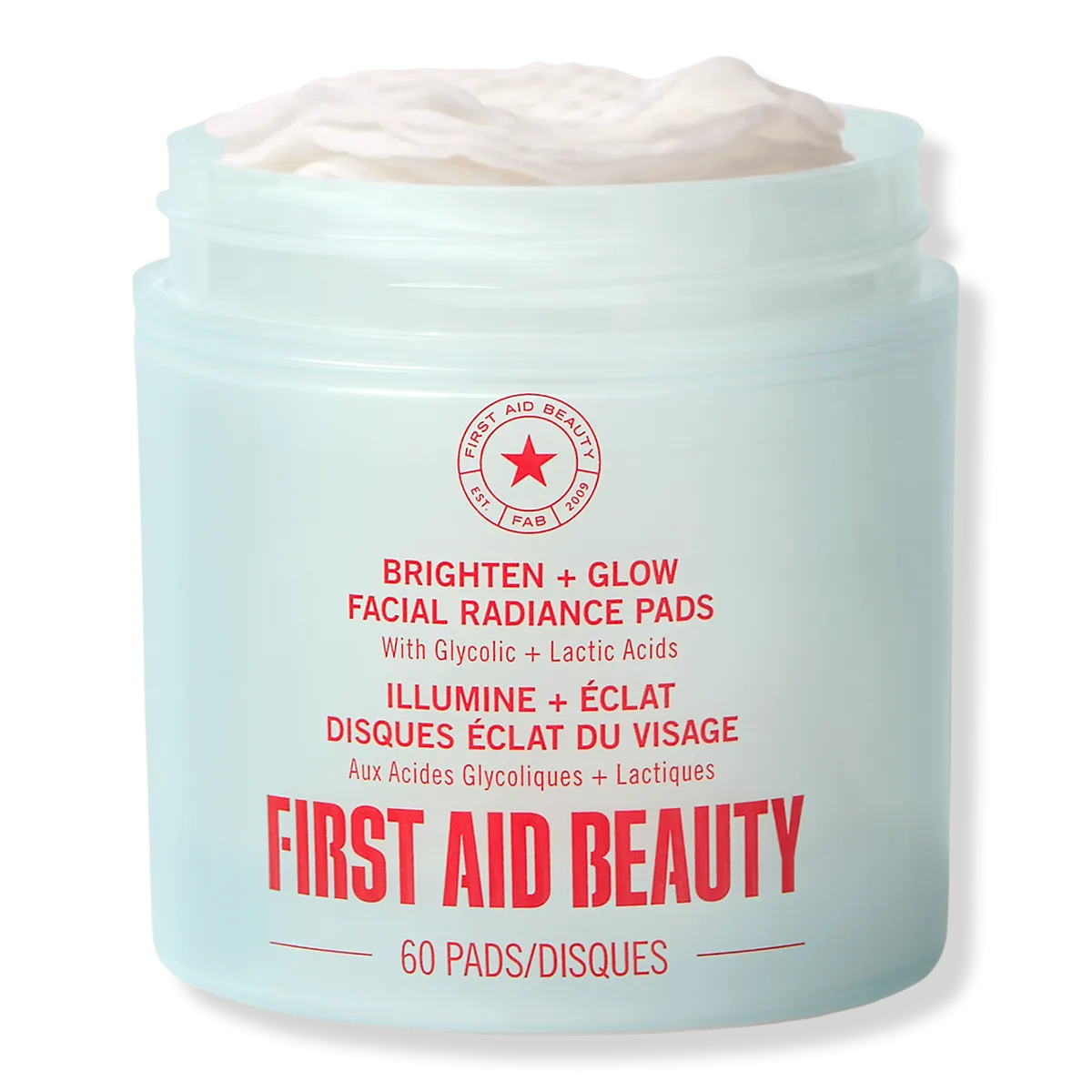
Facial Radiance Pads
Beginner-Friendly Glow Pad
 Verified reviewer
Pros & cons.
- +Dual AHA system calibrated for sensitive skin tolerance without sacrificing results
- +Robust soothing complex — aloe, cucumber, hyaluronic acid, feverfew — prevents post-exfoliation irritation
- +Fragrance-free, vegan, and now made with compostable pads
- +Licorice root and Indian gooseberry add targeted brightening beyond simple exfoliation
- +Convenient one-step pad format removes barriers to consistent exfoliation
- +Over a decade of market presence validates long-term safety and efficacy
- −AHA concentration is too mild for experienced acid users seeking intensive results
- −Jar packaging allows pads to dry out if not properly sealed after each use
- −Contains citrus extracts (lemon peel, mandarin orange) that may concern some users
- −More expensive per use than a liquid AHA toner applied with a cotton pad
- −Not individually wrapped — less portable and hygienic than single-use packets
The full review.
Before First Aid Beauty’s Facial Radiance Pads, the AHA exfoliant category had a gatekeeping problem. Products were either clinical-strength peels that scared sensitive skin or were too dilute to work. The gap for effective exfoliation without a recovery day was largely unoccupied. FAB filled that gap in the early 2010s and has sold through it ever since.
The format is simple: a jar of pre-soaked pads to swipe across the face after cleansing. One step. No mixing, timing, or neutralizing. This simplicity removes the friction points that cause people to abandon exfoliating routines. You open the jar, grab a pad, swipe, and you’re done. The pad’s gentle physical texture provides mechanical exfoliation alongside the chemical action of the acids.
The dual-AHA system pairs lactic acid and glycolic acid, with lactic acid leading the formula. This is deliberate. Lactic acid has a larger molecular size than glycolic acid, so it penetrates the skin more gradually and causes less irritation at equivalent concentrations. It also has natural humectant properties—it draws moisture into the skin as it exfoliates, making lactic acid the gentler sibling in the AHA family. Glycolic acid is smaller and more penetrative, providing deeper exfoliation. Together, they create a layered approach: lactic acid handles the surface, glycolic acid reaches slightly deeper, and neither causes distress.
The soothing complex shows FAB’s sensitive-skin philosophy. Aloe vera is the second ingredient and provides immediate calming. Cucumber fruit water adds cooling hydration. Hyaluronic acid binds moisture to freshly exfoliated skin to prevent the dehydrated tightness that makes people abandon acid products. Feverfew extract—a parthenolide-free anti-inflammatory FAB uses across multiple products—reduces the redness AHAs can trigger. Licorice root extract adds anti-inflammatory and tyrosinase-inhibiting action, calming the skin and working on dark spots simultaneously.
The brightening strategy extends beyond the acids. Indian gooseberry (Phyllanthus emblica) extract is a concentrated vitamin C source, adding antioxidant protection for the skin cells AHA exfoliation brings to the surface. Green tea extract adds a polyphenol antioxidant layer. The result is a pad that exfoliates, protects, and brightens the skin it reveals.
In practice, the experience is unremarkable—which is the point. You swipe, feel a smooth, slightly cool sensation, and move on. No stinging, burning, or dramatic flush. For acid veterans, this gentleness might feel like the product does nothing. It does. The results arrive quietly over days rather than minutes. By the end of the first week of daily use, skin looks more luminous. By week four, texture is smoother, tone is more even, and pores appear refined.
The trade-off is that experienced acid users—those tolerant of 10% glycolic or 30% AHA peels—will find these pads underwhelming. They are not designed for chemical peel intensity. They are designed for consistent, daily exfoliation without risk. If you have never used AHAs, or if every acid product has irritated your skin, start here.
The formula contains lemon peel and mandarin orange extracts. These are standardized botanical extracts, not raw citrus juice; they deliver vitamin C and brightening compounds without the phototoxic furancoumarin compounds found in raw citrus. Still, note their presence if you have a known citrus sensitivity.
At $32 for 60 pads (roughly $0.53 per pad), the price is fair for a well-formulated AHA product from an established brand. A jar lasts one to two months depending on frequency. The 28-pad travel size at around $18 lets you trial the product. Since P&G’s 2018 acquisition, formulation quality has remained consistent, and the recent switch to compostable pads shows continued investment.
A decade is a long time for a skincare product to remain relevant without a rebrand or a viral moment. The Facial Radiance Pads lack a celebrity face, a meme-worthy name, or a TikTok origin story. They have a formula that works, a convenient format, and a tolerance profile that welcomes the skin types most other acid products reject. Sometimes the least dramatic product earns the most repurchases.
Ingredient analysis.
Full INCI list
Water/Aqua/Eau, Aloe Barbadensis Leaf Juice, Glycerin, Cucumis Sativus (Cucumber) Fruit Water, Lactic Acid, Glycolic Acid, Sodium Hydroxide, Phenoxyethanol, Chrysanthemum Parthenium (Feverfew) Extract, Polysorbate 20, Camellia Sinensis Leaf Extract, Citrus Medica Limonum (Lemon) Peel Extract, Citrus Nobilis (Mandarin Orange) Fruit Extract, Glycyrrhiza Glabra (Licorice) Root Extract, Potassium Sorbate, Phyllanthus Emblica Fruit Extract, Sodium Benzoate, Citric Acid, Hyaluronic Acid, Chlorphenesin, EDTA, Tetrasodium EDTA
Skin match.
The science.
The Science
The Facial Radiance Pads exfoliate using two alpha-hydroxy acids with different penetration profiles. Lactic acid (2-hydroxypropanoic acid) has a molecular weight of 90.08 g/mol. This weight limits its penetration depth, making it gentler than glycolic acid. A 1996 study by Smith in the Journal of the American Academy of Dermatology shows that moderate concentrations of lactic acid increase epidermal turnover and boost ceramide production. This property strengthens the barrier while exfoliating, which is unique among AHAs.
Glycolic acid (hydroxyacetic acid) has a molecular weight of 76.05 g/mol. As the smallest AHA, it penetrates more deeply. It works by disrupting ionic bonds between corneocytes in the stratum corneum to promote desquamation of the outermost dead cell layer. Using both acids in one formula exfoliates at multiple epidermal depths.
Sodium hydroxide partially buffers the formula's pH, which reduces free acid concentration and irritation potential. This buffering allows daily use on sensitive skin by slowing acid penetration without stopping exfoliation.
Phyllanthus emblica (Indian gooseberry) extract is a potent natural source of L-ascorbic acid and tannins. Research shows it inhibits collagenase and hyaluronidase enzymes, providing anti-aging benefits beyond antioxidant activity. In this formula, it provides antioxidant support for newly revealed skin cells to complement AHA-driven cell turnover.
Glycyrrhiza glabra (licorice root) extract contains glabridin, a flavonoid that inhibits tyrosinase activity, the enzyme that produces melanin. This creates a second brightening pathway that works with the AHAs' exfoliation to improve uneven pigmentation.
Dermatologist Perspective
Dermatologists recommend gentle AHA exfoliation for dull skin, mild hyperpigmentation, and texture concerns. They often cite the Facial Radiance Pads as an entry point for acid-naive patients. Board-certified dermatologists note the buffered dual-AHA system works well for sensitive skin; it is strong enough for cell turnover but gentle enough to avoid the barrier disruption caused by higher-concentration peels. The fragrance-free formulation and soothing botanical complex support daily use. Dermatologists recommend starting every other day and emphasize strict morning sunscreen use because AHAs increase UV sensitivity. For patients needing more exfoliation, dermatologists may suggest moving to higher-concentration AHA products once tolerance to these pads is established.
Where it fits in your routine.
After evening cleansing, take one pad from the jar and swipe it over your face, neck, and décolleté, avoiding the immediate eye area. Do not rinse; let the solution absorb. Apply serum and moisturizer next. Use every other day for the first two weeks, then use daily if your skin tolerates it. Always apply sunscreen SPF 30+ the next morning. Do not use on the same evening as retinoids or other strong exfoliants until your skin acclimates to both products individually. Close the jar tightly after each use so the pads do not dry out.
At $32 for 60 pads ($0.53 per pad), the Facial Radiance Pads cost fairly for a well-formulated AHA exfoliant from a P&G-backed brand. One jar lasts one to two months with daily use. The 28-pad size at approximately $18 offers a lower-commitment entry point. Liquid AHA toners provide more product per dollar but require cotton pads; the pre-soaked format trades cost efficiency for convenience. FAB's pricing is competitive against other exfoliating pad products, and the fragrance-free, soothing-rich formulation adds value. The compostable pad upgrade adds sustainability without a price increase.
AHA beginners can start chemical exfoliation without risking irritation. It works for sensitive skin types who avoid acid products and anyone wanting a one-step exfoliating treatment to brighten, smooth, and refine. It also works for combination skin with dullness, mild dark spots, and textural irregularities.
Use this if you have high AHA tolerance and need higher concentrations. Skip if you have active eczema, a severely compromised skin barrier, or open wounds. Skip if you want the best value; a liquid glycolic acid toner gives more product per dollar but lacks the pad format's convenience.
Product details.
Fragrance-free — botanical extracts leave a faint, clean scent that is barely noticeable.
A screw-top jar holds 60 stacked pads. The current formulation uses compostable pads. You must seal the lid tightly so the pads do not dry out. A 28-pad travel size exists. Finish naturalnon-greasylightweight What to Expect on First Use The pad glides across skin with a light, subtle texture. Most users feel no stinging or burning, unlike higher-concentration AHA products. Skin feels smoother and looks slightly dewy immediately. Brightness shows by the next morning. If you use aggressive peels, the gentleness may feel ineffective at first — use it consistently for one week.
1-2 months with daily use (60 pads)
12 months
All Year
The backstory.
The Facial Radiance Pads have been a cornerstone of First Aid Beauty's lineup for over a decade, predating the brand's 2018 acquisition by Procter & Gamble. They were designed to fill a gap in the market: AHA exfoliation that sensitive skin types could actually tolerate without redness, stinging, or dryness. The product's longevity and consistent reformulation updates (including the switch to compostable pads) reflect its status as one of FAB's most important products.
About First Aid Beauty
Established Brand (5–20 years)Lilli Gordon founded First Aid Beauty in 2009. Procter & Gamble acquired the brand in 2018 for about $250 million. The brand makes effective formulations for sensitive skin, and the Facial Radiance Pads have been a core product for over a decade.
Common myths.
If an exfoliating pad doesn't sting, it's not working.
Stinging means irritation, not efficacy. AHAs work by dissolving bonds between dead skin cells — this chemical process happens whether you feel it or not. These pads use a buffered AHA concentration to exfoliate effectively without triggering a pain response. Smoother, brighter skin is the proof, not the sensation.
Use AHA exfoliating pads daily from the start for best results.
Even with a gentle formula, daily use risks over-exfoliation. Use it every other day for the first two weeks, then switch to daily use once your skin acclimates. If you see redness, tightness, or increased sensitivity, use it less often. AHA results are cumulative — consistent, moderate use works better long-term than aggressive daily application.
FAQ.
Are the First Aid Beauty Facial Radiance Pads gentle enough for sensitive skin?
Yes — these pads are specifically designed for sensitive skin tolerance. The dual AHA concentration is deliberately calibrated to be gentle, and the formula includes aloe, cucumber, hyaluronic acid, and feverfew extract to soothe and hydrate alongside the exfoliation. In a consumer study, 92% of participants agreed the pads gently exfoliate. However, start with every other day and increase gradually, and avoid use if you have active eczema or a severely compromised skin barrier.
How often should I use the First Aid Beauty Facial Radiance Pads?
Use this every other day for the first two weeks to test skin tolerance. If skin does not react, use it every evening. Use it no more than once per day. Always apply sunscreen the next morning because AHAs increase photosensitivity for 24-48 hours. Do not use it on the same evening as retinoids or other strong exfoliants to avoid over-exfoliation.
Can I use these pads with retinol?
Yes, but avoid using both on the same night if you are new to either product. Once your skin acclimates to both individually, you can alternate nights (pads one evening, retinol the next) or use them together — apply the pad first, wait 5-10 minutes, then apply retinol. Watch for irritation and reduce frequency if you see redness, peeling, or increased sensitivity.
Do the Facial Radiance Pads help with dark spots and hyperpigmentation?
Yes — the dual AHA system increases cell turnover to fade surface-level hyperpigmentation. licorice root extract and Indian gooseberry also inhibit tyrosinase and provide antioxidant brightening. Dark spots show results after 4-8 weeks of consistent use. For deeper or hormonal hyperpigmentation (like melasma), these pads work within a comprehensive routine but won't resolve the issue alone.
Are the pads compostable?
Yes — the current formulation uses compostable pad material, a recent update. The pads break down in commercial composting facilities. The jar is recyclable. This sustainability update keeps the same exfoliating efficacy and reduces the product's environmental impact.
Why do these pads contain citrus extracts — aren't those irritating?
The formula uses lemon peel and mandarin orange extracts for natural vitamin C and brightening compounds. These are standardized extracts rather than raw citrus juice. Processing removes phototoxic furanocoumarins that make raw citrus problematic. If you have a known citrus sensitivity, patch-test first.
Community
What the community says.
"Gentle enough for sensitive skin — no stinging or burning"
"Visible brightening and smoother texture within days"
"Convenient pad format makes exfoliation effortless"
"Fragrance-free and doesn't irritate"
"Works great as a one-step post-cleansing treatment"
"AHA concentration is too mild for experienced acid users"
"Some feel the pads dry out if not sealed properly"
"Citrus extracts concern some sensitive-skin users"
"Price is higher than basic glycolic acid toners"
"Jar packaging is less hygienic than individually wrapped pads"
People also looked at.