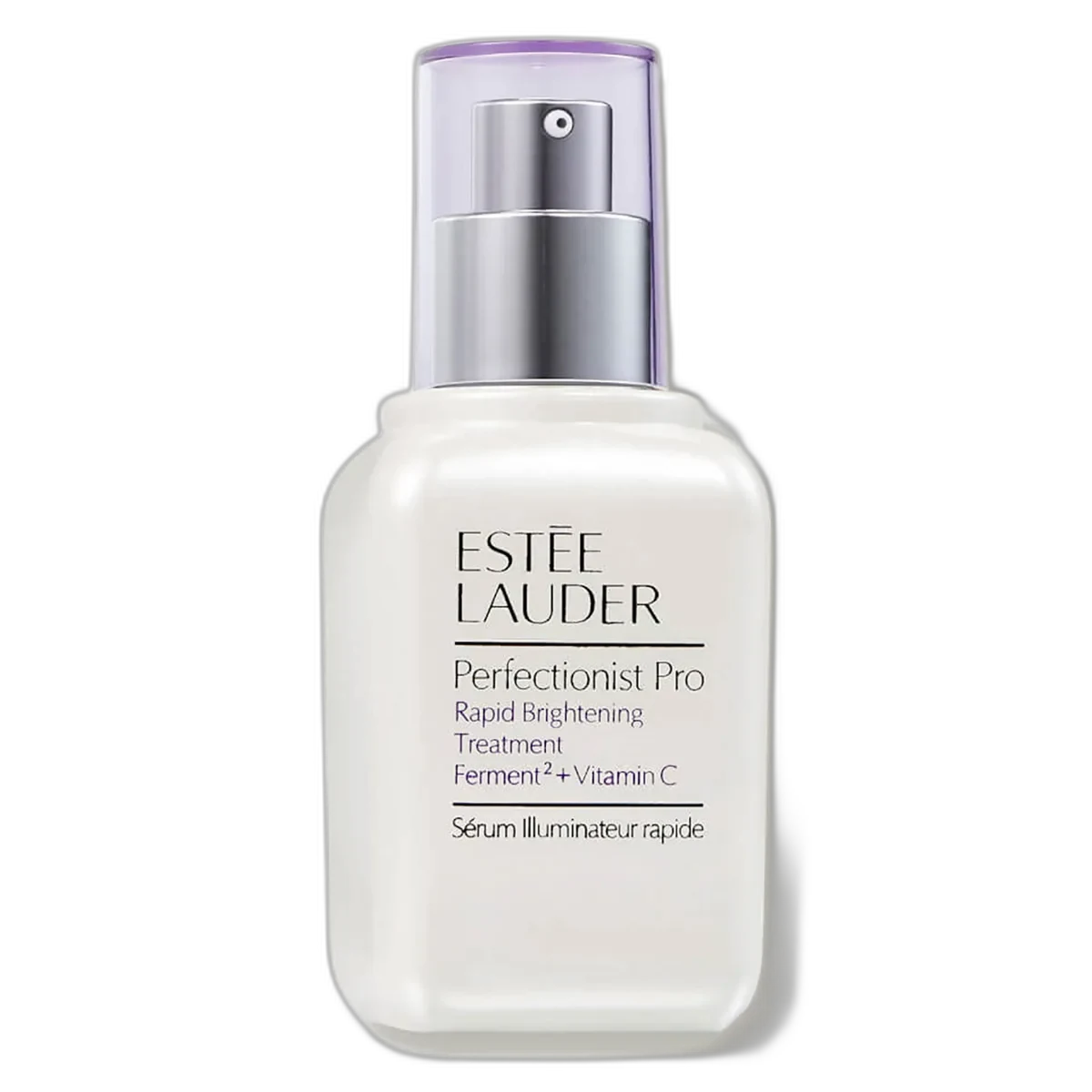
Perfectionist Pro Rapid Brightening Treatment with Ferment² + Vitamin C
Luxury Brightening Powerhouse
 Verified reviewer
Pros & cons.
- +Multi-pathway brightening approach targets pigmentation through vitamin C, ferments, and acetyl glucosamine simultaneously
- +Stable ascorbyl glucoside form means no oxidation worries and a long shelf life
- +Zero adjustment period — can be used twice daily from day one without irritation
- +Elegant, fast-absorbing texture that layers beautifully under makeup and moisturizer
- +Immediate visible radiance boost provides satisfying day-one results before deeper brightening kicks in
- +Rich humectant system delivers genuine all-day hydration alongside the brightening actives
- +Resveratrol and licorice root derivatives provide comprehensive antioxidant and anti-inflammatory support
- −Contains fragrance, which excludes sensitive and fragrance-reactive skin types unnecessarily
- −Premium pricing for a serum built around ascorbyl glucoside rather than more potent L-ascorbic acid
- −Brightening results are gradual — not ideal for those seeking rapid, dramatic dark spot correction
- −Proprietary ferment blends lack independent, peer-reviewed clinical validation
- −Limited efficacy against deep or long-standing hyperpigmentation compared to prescription-strength options
The full review.
When most people think of Estée Lauder’s fermentation expertise, their mind goes straight to Advanced Night Repair — that iconic brown bottle that’s been a nightstand staple since the 1980s. But the Perfectionist Pro Rapid Brightening Treatment represents something arguably more interesting: the application of that same fermentation science to the specific problem of hyperpigmentation. It’s a serum that asks whether the path to brighter skin runs through a petri dish rather than a chemistry lab.
The formula’s central proposition is its Ferment² complex — a duo of yeast extract and molasses extract that Estée Lauder positions as a proprietary brightening engine. The yeast ferment contributes bioavailable amino acids and peptides designed to support skin cell renewal, while the molasses ferment specifically targets melanin overproduction. It’s an unusual pairing, and frankly a more creative approach than simply loading a serum with a high concentration of a single vitamin C derivative and calling it a day.
Speaking of vitamin C, the form used here is ascorbyl glucoside — a stable, water-soluble derivative that converts to active ascorbic acid via enzymes on the skin’s surface. This is both the formula’s strength and its limitation. The stability means you won’t deal with the oxidation issues that plague pure L-ascorbic acid serums (no turning orange in the cabinet), and the conversion mechanism provides a slow-release effect. But ascorbyl glucoside is generally considered less potent than L-ascorbic acid at equivalent concentrations, which means the brightening trajectory is more gradual. For someone with deep, stubborn melasma, this may feel like bringing a polite suggestion to a shouting match.
What elevates this formula beyond a simple vitamin C serum is the supporting cast. Acetyl glucosamine — the same ingredient that made waves in certain clinical formulations — inhibits tyrosinase through a completely different mechanism than vitamin C, effectively creating a two-front approach to pigment production. Dipotassium glycyrrhizate from licorice root adds a third anti-pigmentation pathway while simultaneously calming any irritation. And resveratrol contributes both antioxidant protection and its own modest tyrosinase-inhibiting properties. This layered strategy is where the formulation earns its stripes — it’s not relying on any single ingredient to do all the heavy lifting.
The texture is genuinely lovely. It’s a lightweight, slightly golden liquid that spreads effortlessly and absorbs in about thirty seconds without any sticky aftermath. There’s an immediate luminosity effect — partly optical, partly from the hydrating ingredients hitting the skin — that makes it satisfying to use from day one. The humectant system of sodium hyaluronate, glycerin, and sodium PCA delivers on the 48-hour hydration claim in practice, though you’ll still want a moisturizer on top if you run dry.
The fragrance, however, is a choice. It’s light and pleasant enough — a soft floral that dissipates quickly — but its presence in a product marketed as a treatment serum feels unnecessary. Fragrance-sensitive users are immediately excluded from a formula that would otherwise be quite gentle. For a brand with Estée Lauder’s resources, a fragrance-free option seems like an obvious move they haven’t made.
Performance-wise, the serum delivers on its promises, albeit on its own timeline. The radiance boost is immediate and consistent. Dark spots begin to show measurable improvement in tone and contrast around the two-week mark, with more significant changes accumulating over six to eight weeks. It won’t produce the dramatic before-and-after results you might see from a high-concentration L-ascorbic acid product, but the trade-off is virtually zero irritation or adjustment period. You can start using it twice daily from day one without the tingling, flushing, or flaking that more aggressive brightening products sometimes demand.
The packaging deserves a nod — the midnight-blue glass bottle with its gold accents feels appropriately premium, and the dropper delivers controlled, even amounts. The 1 oz size runs through in about two to three months of twice-daily use. The 1.7 oz bottle offers better value per ounce and comes with a pump instead of a dropper, which some users may prefer.
Value is where this serum invites scrutiny. At $86 for 1 oz, you’re paying luxury prices for a formula built around ascorbyl glucoside — a derivative that appears in products at a fraction of this cost. What you’re really paying for is the proprietary ferment technology, the elegant delivery system, and the multi-target formulation strategy. Whether that’s worth it depends on how much you value the experience and the gentle approach. If you want maximum brightening potency per dollar, this isn’t it. If you want a refined, daily-comfortable brightening serum from a brand that’s been studying fermentation since before it was trendy, it delivers exactly what it promises.
The serum works best as part of a consistent routine — paired with sunscreen in the morning (non-negotiable for any brightening product) and a nourishing moisturizer at night. It plays well with retinol in a PM routine, since the ascorbyl glucoside won’t create the pH conflicts that pure L-ascorbic acid sometimes does. It’s not the fastest route to even-toned skin, but it might be one of the most pleasant.
Texture
The texture is genuinely lovely. It’s a lightweight, slightly golden liquid that spreads effortlessly and absorbs in about thirty seconds without any sticky aftermath. There’s an immediate luminosity effect — partly optical, partly from the hydrating ingredients hitting the skin — that makes it satisfying to use from day one. The humectant system of sodium hyaluronate, glycerin, and sodium PCA delivers on the 48-hour hydration claim in practice, though you’ll still want a moisturizer on top if you run dry.
Scent
The fragrance, however, is a choice. It’s light and pleasant enough — a soft floral that dissipates quickly — but its presence in a product marketed as a treatment serum feels unnecessary. Fragrance-sensitive users are immediately excluded from a formula that would otherwise be quite gentle. For a brand with Estée Lauder’s resources, a fragrance-free option seems like an obvious move they haven’t made.
Packaging
The packaging deserves a nod — the midnight-blue glass bottle with its gold accents feels appropriately premium, and the dropper delivers controlled, even amounts. The 1 oz size runs through in about two to three months of twice-daily use. The 1.7 oz bottle offers better value per ounce and comes with a pump instead of a dropper, which some users may prefer.
Best for
The serum works best as part of a consistent routine — paired with sunscreen in the morning (non-negotiable for any brightening product) and a nourishing moisturizer at night. It plays well with retinol in a PM routine, since the ascorbyl glucoside won’t create the pH conflicts that pure L-ascorbic acid sometimes does. It’s not the fastest route to even-toned skin, but it might be one of the most pleasant.
Ingredient analysis.
Full INCI list
Water, Butylene Glycol, Glycerin, Glycereth-26, Isononyl Isononanoate, Dimethicone, Propanediol, Ascorbyl Glucoside, Algae Extract, Sucrose, Acetyl Glucosamine, Hydroxyethyl Urea, Lens Esculenta Fruit Extract, Citrullus Lanatus Fruit Extract, Pyrus Malus Fruit Extract, Molasses Extract, Myrtus Communis Leaf Extract, Avena Sativa Kernel Extract, Triticum Vulgare Germ Extract, Hordeum Vulgare Extract, Cladosiphon Okamuranus Extract, Salicylic Acid, Hydrolyzed Prunus Domestica, Caffeine, Sodium Lactate, Dipotassium Glycyrrhizate, Squalane, Oryzanol, Resveratrol, Sodium Hyaluronate, Sodium PCA, Ethylhexylglycerin, Bis-PEG-18 Methyl Ether Dimethyl Silane, Tocopheryl Acetate, PEG-75, Oleth-3 Phosphate, Sorbitol, Caprylyl Glycol, Oleth-3, Sodium Polyaspartate, Oleth-5, Acrylates/C10-30 Alkyl Acrylate Crosspolymer, Propylene Glycol Caprylate, Dextrin, Yeast Extract, Choleth-24, Carbomer, Sodium Hydroxide, Ceteth-24, Xanthan Gum, Fragrance, Glyceryl Acrylate/Acrylic Acid Copolymer, Citric Acid, Sodium Citrate, Disodium EDTA, BHT, Potassium Sorbate, Sodium Benzoate, Phenoxyethanol
Skin match.
The science.
The Science
The formula brightens skin by targeting melanin regulation through multiple pathways. Ascorbyl glucoside, the main active, undergoes hydrolysis by alpha-glucosidase enzymes on skin cell membranes to release free ascorbic acid where needed. A 2024 study in PMC ("Treatment with Ascorbyl Glucoside–Arginine Complex Ameliorates Solar Lentigos") shows that topical ascorbyl glucoside application significantly improved solar lentigos appearance over 24 weeks in a double-blind, half-face trial, proving the ingredient's clinical relevance for pigmentation.
Acetyl glucosamine adds a second mechanism: it inhibits pro-tyrosinase glycosylation, which reduces the active tyrosinase available to produce melanin. A study in Experimental Dermatology (Bissett et al., 2007) shows that combining N-acetyl glucosamine with niacinamide significantly reduced hyperpigmentation in a controlled trial, confirming acetyl glucosamine as a brightening active.
The ferment complex works through a different pathway. Yeast-derived ferment lysates contain amino acids, vitamins, and small peptides that support skin cell turnover and barrier function. Estée Lauder's specific proprietary ferment blend lacks independent peer-reviewed publications, but yeast ferment lysates broadly show skin-conditioning and renewal-promoting properties in cosmetic science research.
Dipotassium glycyrrhizate, from licorice root, provides anti-inflammatory modulation and mild tyrosinase inhibition. Its anti-inflammatory properties mitigate post-inflammatory hyperpigmentation by reducing the inflammation that triggers excess melanin production—a preventive approach rather than a purely corrective one.
Resveratrol adds antioxidant protection against UV-induced oxidative damage, a primary driver of acquired hyperpigmentation. In vitro studies show resveratrol inhibits melanogenesis through direct tyrosinase inhibition, though topical clinical efficacy depends on formulation stability and penetration.
References
- Treatment with Ascorbyl Glucoside–Arginine Complex Ameliorates Solar Lentigos — PMC / Cosmetics (2024)
- Reduction in the appearance of facial hyperpigmentation by topical N-acetyl glucosamine — Experimental Dermatology (2007)
Dermatologist Perspective
Dermatologists view this formula's multi-active approach as a sound strategy for acquired hyperpigmentation. Combining ascorbyl glucoside with acetyl glucosamine targets melanin production via complementary enzymatic pathways; dermatologists note this can be more effective than using a single brightening agent at higher concentration. Board-certified dermatologists often recommend stable vitamin C derivatives like ascorbyl glucoside for patients who cannot tolerate pure L-ascorbic acid formulations. Including anti-inflammatory ingredients (licorice root derivative, squalane) follows dermatological guidance that managing inflammation is as important as inhibiting melanin production. However, dermatologists caution that this serum is a cosmetic-grade treatment—patients with significant melasma or deep post-inflammatory hyperpigmentation may need prescription-strength options like hydroquinone or tretinoin for meaningful results.
Where it fits in your routine.
Cleanse and tone skin. Press 2-3 drops into your face and neck, avoiding the eye area. Use morning and evening. Follow with moisturizer. In the morning, finish with a broad-spectrum SPF 30 or higher sunscreen; brightening products require this to work. Wait 30 seconds for absorption before layering the next product. In the evening, use this serum before retinol.
At $86 for 1 oz, this serum sits in the luxury tier. The formula is more complex than a basic vitamin C serum; the multi-pathway approach using ferments, acetyl glucosamine, and supporting antioxidants justifies the premium. However, the primary active is ascorbyl glucoside, which works in effective formulations at much lower prices. The 1.7 oz size at $126 offers better value ($74/oz vs $86/oz). You pay for Estée Lauder's proprietary ferment technology and a polished sensory experience. For a legacy brand with decades of fermentation research, the price reflects Estée Lauder's R&D investment and prestige positioning.
This serum is for people who want a gentle, daily brightening option that builds results slowly without irritation. It works for normal to dry skin with mild to moderate hyperpigmentation, sun damage, or dullness. It suits those who like luxury skincare and want a low-maintenance way to reach more even-toned skin.
People with deep, stubborn hyperpigmentation needing fast, aggressive results should use a higher-concentration L-ascorbic acid serum or prescription treatment instead. Skip this if you are fragrance-sensitive; the added fragrance adds an unnecessary irritation risk to an otherwise gentle formula.
Product details.
Lightweight, silky serum with a slight golden hue. It absorbs fast and leaves no sticky or greasy residue.
Light floral fragrance, noticeable upon application but fades within a minute.
Estée Lauder's signature midnight-blue glass bottle uses a dropper applicator. The 1.7 oz size has a pump dispenser.
The serum gives an immediate luminosity boost; the first application shows a subtle glow under makeup. The silky texture absorbs within 30 seconds. It does not sting or tingle. Dark spot improvement shows around week two.
2-3 months with twice-daily use for the 1 oz size
12 months
All Year
The backstory.
The Perfectionist Pro line represents Estée Lauder's push into science-forward, results-driven skincare. The original Ferment² formula launched around 2020, building on the brand's decades of fermentation research — the same technology behind their iconic Advanced Night Repair. The addition of the third algae ferment in the reformulated version reflects growing clinical interest in marine-derived brightening compounds.
About Estée Lauder
Legacy Brand (20+ years)Estée Lauder launched in 1946 and is now one of the world's largest prestige beauty companies. The brand invests in proprietary research, such as its fermentation-based skincare technology. Its products sell in department stores, specialty retailers, and dermatologist offices globally.
Common myths.
Ascorbyl glucoside lacks the strength to brighten skin effectively.
Ascorbyl glucoside has less potency per molecule than pure L-ascorbic acid, but the skin enzymatically converts it to active vitamin C. Published clinical data shows it brightens skin, especially when used with complementary actives like acetyl glucosamine, as in this formula.
Fermented ingredients are a marketing trend that offers no real benefit.
Fermentation breaks molecules into smaller, more bioavailable forms and creates new peptides and amino acids. Yeast ferment lysates show evidence for skin barrier repair and renewal, but the specific proprietary blends in this serum lack independent peer-reviewed studies.
FAQ.
Does the Estée Lauder Perfectionist Pro Brightening Treatment actually reduce dark spots?
Yes — ascorbyl glucoside, acetyl glucosamine, and the triple-ferment complex target pigmentation through multiple pathways. Clinical testing shows visible dark spot reduction in intensity and contrast within two weeks, and improves further over 8 weeks. Deep or long-standing hyperpigmentation shows slower results.
Can I use this serum with retinol?
Yes. This serum uses ascorbyl glucoside, a stable vitamin C derivative. It avoids the pH conflicts pure L-ascorbic acid and retinol often cause. Apply this serum in the morning and retinol at night, or use both in one PM routine: apply this serum first, wait one minute, then apply retinol.
Is the Estée Lauder Perfectionist Pro Brightening serum worth the price?
The formula uses a multi-target brightening approach that exceeds a basic vitamin C serum. However, it uses ascorbyl glucoside instead of the more potent L-ascorbic acid, and the proprietary ferment blends lack independent peer-reviewed validation. It delivers gradual, gentle brightening and an elegant experience, but more aggressive brightening options exist at lower price points.
Is this serum safe for sensitive skin?
Dermatologists tested this non-acnegenic formula. The ascorbyl glucoside form of vitamin C is gentler than pure L-ascorbic acid. It contains fragrance, the main concern for sensitive or reactive skin types. Patch test first if fragrance is a known trigger for you.
What's the difference between the Ferment² and Ferment³ versions?
The original Ferment² version used yeast and molasses ferments. The reformulated Ferment³ version adds a proprietary Cladosiphon okamuranus (brown algae) ferment to soothe skin. The vitamin C and overall formula structure are similar, but the third ferment increases the serum's calming and anti-inflammatory profile.
How long does a bottle of Perfectionist Pro Brightening Treatment last?
The 1 oz bottle lasts about 2-3 months if you use 2-3 drops twice daily. The 1.7 oz size has better per-ounce value and lasts 4-5 months with the same usage.
Can I use this serum during the day?
Ascorbyl glucoside is photostable and provides antioxidant protection against UV-generated free radicals. Use it with a broad-spectrum SPF 30+ sunscreen to maximize brightening and prevent new dark spots.
Community
What the community says.
"Noticeable brightening and radiance within the first two weeks"
"Lightweight, fast-absorbing texture that layers well under makeup"
"Visible reduction in dark spots with continued use"
"Luxurious packaging and elegant application experience"
"Hydrating without feeling greasy or heavy"
"Premium price point feels steep for a vitamin C derivative serum"
"Contains fragrance which may irritate very sensitive skin"
"Limited effect on deeper or more stubborn hyperpigmentation"
"Results on fine lines and wrinkles are modest"
Featured in.
People also looked at.