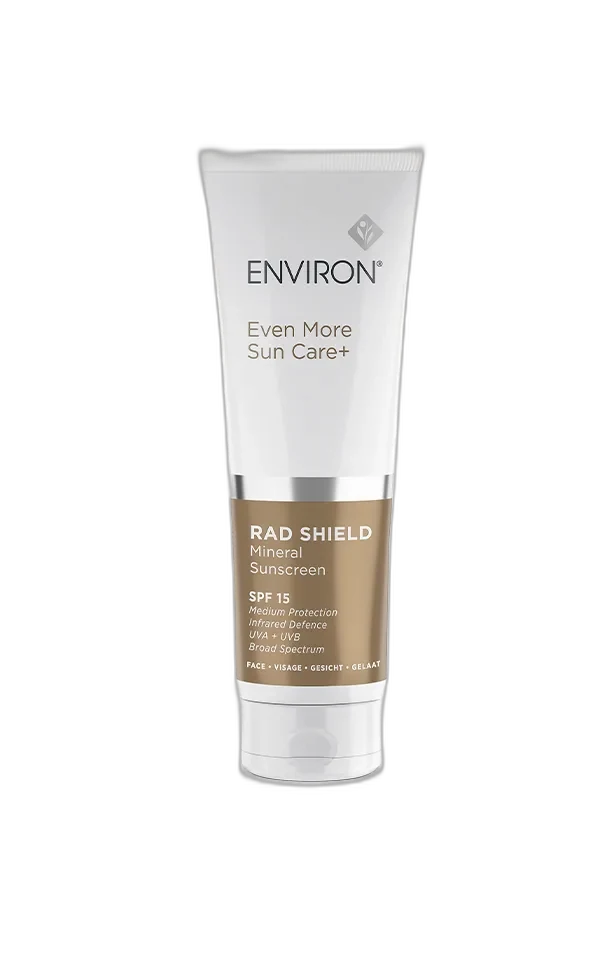
RAD Shield Mineral Sunscreen SPF 15
Clinical Antioxidant Shield
 Verified reviewer
Pros & cons.
- +Multi-layered photoprotection combining UV filters with IR defense and antioxidants
- +Genuinely lightweight texture that defies mineral sunscreen stereotypes
- +Completely fragrance-free — ideal for post-procedure and reactive skin
- +Generous 125 mL tube lasts three to four months with daily face application
- +Developed by a plastic surgeon with over 35 years of photoprotection research
- +Squalane and glycerin base provides hydration without heaviness
- −SPF 15 falls below dermatologist-recommended minimum of SPF 30 for daily protection
- −Contains potentially comedogenic ingredients like shea butter and isostearyl isostearate
- −Professional distribution model makes purchasing inconvenient for many consumers
- −Limited availability in the US where the SPF 30 version is preferred
- −Faint white cast still visible on medium to dark skin tones
The full review.
About Environ
A Cape Town plastic surgeon founded it in 1990.
Myth
Most sunscreens are single-purpose products — apply filter, block rays, done.
Reality
The RAD Shield uses layered defense.
Texture
The texture is creamy and light. It absorbs quickly and settles into a finish that feels like a lightweight moisturizer rather than a sunscreen.
Scent
This product is fragrance-free, which is rare even for sensitive skin products. It contains no essential oils, no synthetic fragrance, and no perfuming agents.
Packaging
The 125 mL tube is large for a sunscreen and lasts three to four months with daily facial use.
Best for
Low-UV environments, incidental exposure, or as a supplement to other photoprotective behaviors (hats, shade, clothing).
Works for
Post-procedure skin, freshly retinized skin, or anyone with actively irritated skin.
Not ideal for
Acne-prone skin.
Common Complaints
The SPF 15 rating weakens the protection mission that inspired the brand.
Pairs Well With
Vitamin A serum and a peptide treatment.
Conflicts With
N/A
AM routine
Apply over a vitamin A serum and a peptide treatment.
PM routine
N/A
Ingredient analysis.
Full INCI list
Aqua (Water), Zinc Oxide (Nano), Caprylic/Capric Triglyceride, Butylene Glycol, Glycerin, Butyrospermum Parkii (Shea) Butter, Isostearyl Isostearate, Steareth-2, Thermus Thermophillus Ferment, Decyl Isostearate, Steareth-21, Dimethicone, Polyurethane-34, Polyhydroxystearic Acid, Citric Acid, Tocopheryl Acetate, Titanium Dioxide (Nano), Solanum Lycopersicum (Tomato) Fruit Extract, Squalane, Xanthan Gum, Magnesium Aluminum Silicate, Alumina, Aluminum Stearate, Ethylhexylglycerin, Phenylpropanol, BHT, Caprylyl Glycol, Disodium EDTA, Isostearic Acid, Methylpropanediol, Potassium Bitartrate, Propanediol, Phenoxyethanol, Potassium Sorbate
Skin match.
The science.
The Science
The RAD Shield uses a multi-target approach to photoprotection that exceeds conventional SPF. The mineral filters — zinc oxide and titanium dioxide — absorb UV radiation rather than reflecting it, as shown by Cole et al. (Photodermatology, Photoimmunology & Photomedicine, 2016). This matters because protection does not require an opaque white layer; nano-sized particles disperse into a cosmetically elegant film while still absorbing UV photons effectively.
The inclusion of Thermus Thermophillus Ferment (marketed as Venuceane by Sederma) enters a newer frontier in photoprotection. This extract from an extremophile bacterium from volcanic hot springs has a patent for protecting against infrared radiation damage. UV radiation accounts for about 5% of solar energy reaching the skin, but infrared radiation accounts for approximately 50%. Research published in 2024 (PubMed: 39161108) on Thermus thermophilus ferment extracts shows potent skin benefits, including protection against environmental aging in vitro.
The antioxidant strategy — tocopheryl acetate (vitamin E) paired with tomato fruit extract (lycopene) — addresses the free radical cascade UV exposure triggers even with physical filters. No sunscreen blocks 100% of UV, so the antioxidant layer acts as a secondary defense, neutralizing reactive oxygen species before they damage cellular DNA and collagen.
The SPF 15 rating blocks approximately 93% of UVB radiation. Combining antioxidants and IR protection means the total photoprotective benefit may exceed the SPF number alone, though standard SPF testing methodology does not capture this broader protection.
References
- Metal oxide sunscreens protect skin by absorption, not by reflection or scattering — Photodermatology, Photoimmunology & Photomedicine (2016)
- Novel Thermus thermophilus and Bacillus subtilis mixed-culture ferment extract provides potent skin benefits in vitro and protects skin from aging — PubMed (2024)
Dermatologist Perspective
Dermatologists generally like the multi-target photoprotection concept in the RAD Shield, but the SPF 15 rating causes concern. Board-certified dermatologists note that while antioxidant and infrared protection add value beyond standard SPF, these benefits do not compensate for lower UVB blocking capacity compared to SPF 30 or 50 formulas. The fragrance-free, mineral-only formulation works for post-procedure patients needing gentle UV protection during healing. Dermatologists familiar with the Environ system often recommend this as part of a vitamin A protocol where the sunscreen complements the brand's retinoid step-up system.
Where it fits in your routine.
Apply a thick layer as your last morning skincare step, after serums and moisturizer. Smooth it evenly over the face, neck, and exposed areas. Let it set for a few minutes before you apply makeup. Reapply every 90 minutes to two hours during long sun exposure. On days with high outdoor time, use a higher-SPF product or add protective clothing and shade.
At about $45 for 125 mL, the per-milliliter price competes with many premium sunscreens — the volume is more than double most $40 sunscreens. This size lasts three to four months with daily use, making the monthly cost around $12-$15. The Venuceane and antioxidant complex formulation justifies a premium over basic mineral formulas. However, the SPF 15 limitation means you may need a second, higher-SPF sunscreen for meaningful sun exposure, which doubles your sunscreen budget. The professional distribution model also limits price competition.
Environ devotees who want a sunscreen that fits the brand's vitamin A step-up system. People with sensitive, reactive, or post-procedure skin needing a fragrance-free mineral formula with extra antioxidant support. Skincare enthusiasts interested in photoprotection concepts like infrared defense and low to moderate daily sun exposure.
SPF 15 is inadequate for long outdoor exposure or high-UV environments. Acne-prone skin types should be cautious because some ingredients are comedogenic. Environ's professional distribution model frustrates those who prefer buying skincare through mainstream retailers.
Product details.
Fragrance-free. No detectable scent beyond a very faint neutral cream base.
Squeeze tube with a flip-top cap. The 125 mL size is large for a professional-grade sunscreen. The clean, clinical design matches Environ's medical aesthetic.
It applies smoothly and absorbs within minutes to a comfortable, non-tacky finish. It causes no stinging, burning, or adjustment period. The lightweight feel is immediate — it doesn't feel like wearing sunscreen. Some users with deeper skin tones may see a faint white cast from the mineral filters.
3-4 months with once-daily face and neck application
12 months
All Year
The backstory.
Dr. Des Fernandes lost two young melanoma patients before age 23, which set him on a lifelong mission to develop better photoprotection. The original RAD sunscreen line debuted in the 1990s as one of the first formulations to combine UV filters with topical antioxidants. The 2020 RAD Shield reformulation modernized the concept with nano mineral filters and extremophile-derived infrared protection, reflecting three decades of evolving skin science.
About Environ
Legacy Brand (20+ years)Dr. Des Fernandes, a Cape Town-based plastic surgeon and skin needling pioneer, founded Environ in 1990. The brand has over 35 years of clinical-grade skincare development centered on vitamin A science. Authorized skincare professionals sell Environ in 70+ countries.
Common myths.
SPF 15 protects enough for a full day of sun exposure.
SPF 15 blocks about 93% of UVB rays, while SPF 30 blocks 97% and SPF 50 blocks 98%. SPF 15 works for brief incidental exposure, but most dermatologists recommend SPF 30 or higher for daily protection. This product works best within a comprehensive sun-avoidance strategy.
Nano-sized mineral sunscreen particles are unsafe because they penetrate the skin.
Multiple studies show nano zinc oxide and titanium dioxide particles do not penetrate the outermost stratum corneum into living tissue. Nano sizing improves cosmetic elegance without compromising safety.
FAQ.
Is Environ RAD Shield safe for sensitive and post-procedure skin?
Yes — the mineral-only formula with zinc oxide and titanium dioxide stays on the skin surface instead of absorbing. This makes it suitable for sensitive, reactive, and post-procedure skin. The fragrance-free formulation also reduces irritation risk.
What is Thermus Thermophillus Ferment in the Environ RAD Shield?
Also known as Venuceane, this patented extract comes from an extremophile bacterium found in volcanic hot springs. In this sunscreen, it protects against infrared radiation damage—an environmental stress standard UV filters do not address—and prevents IR-induced collagen breakdown.
Where can I buy Environ RAD Shield sunscreen?
Authorized skincare professionals, clinics, and select online retailers sell Environ products. UK and EU retailers widely stock the SPF 15 version internationally. The SPF 30 version is more common in the US. Check Environ's website for authorized stockists.
Is Environ cruelty-free?
Environ states it never tests on animals and will not in the future. The brand lacks official Leaping Bunny or PETA certification because Environ considers these claims redundant under EU cosmetic regulations that prohibit animal testing.
What the community says.
"Lightweight texture that doesn't feel like a typical mineral sunscreen"
"Fragrance-free and gentle on sensitive skin"
"Works beautifully under makeup without pilling"
"Moisturizing without being heavy or greasy"
"Suitable for post-treatment and post-procedure skin"
"SPF 15 is below the recommended minimum of SPF 30 for daily sun protection"
"Difficult to purchase without an authorized skincare professional"
"Contains potentially comedogenic ingredients like shea butter"
"Premium price for a lower SPF rating"
"Limited availability in the United States"
Featured in.
People also looked at.