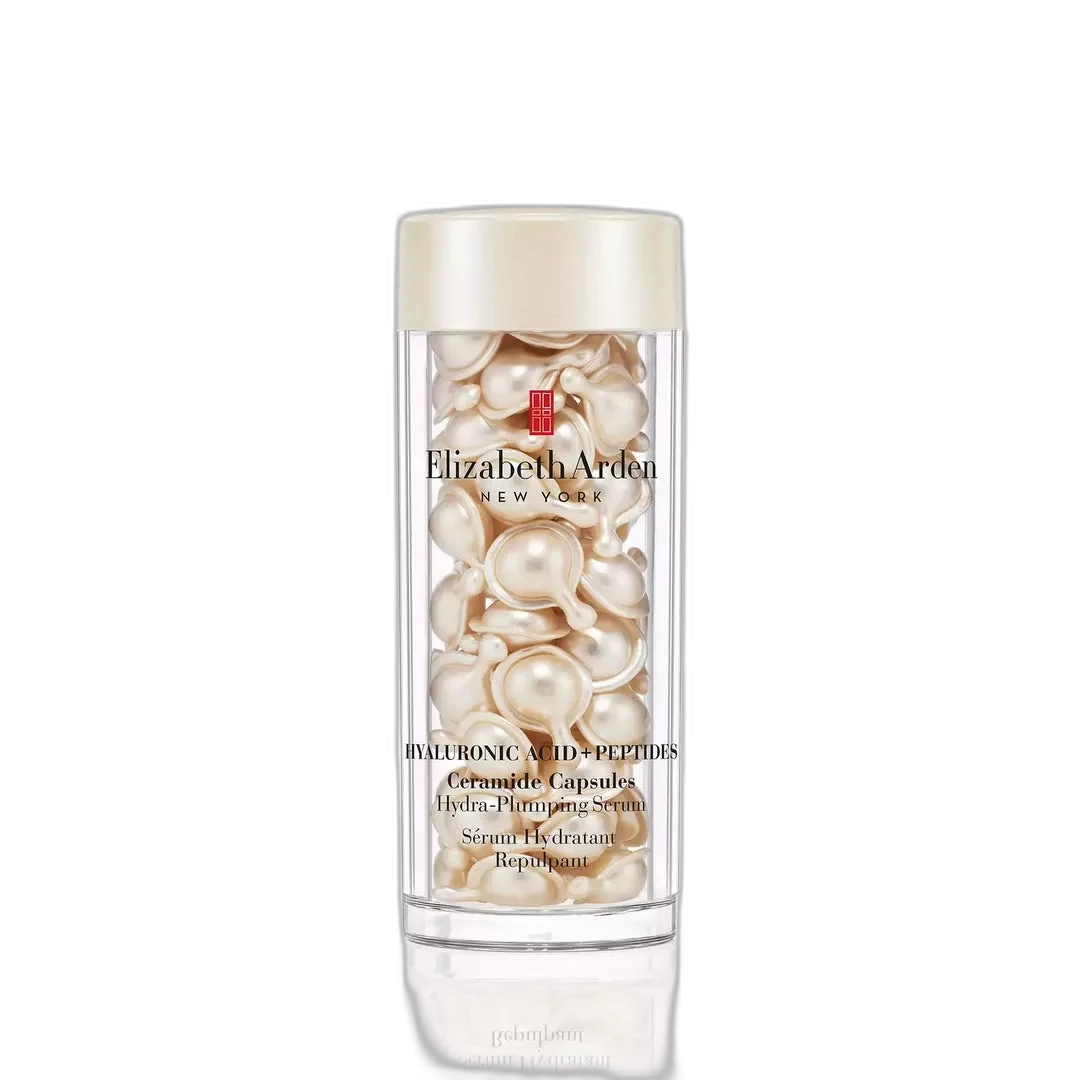
Hyaluronic Acid Ceramide Capsules Hydra-Plumping Serum
Derm-Office Capsule Classic
 Verified reviewer
Pros & cons.
- +Three ceramide subtypes plus phytosphingosine in one step
- +Two molecular weights of hyaluronic acid for surface and depth
- +Silicone-oil base seals in HA instead of letting it evaporate
- +Single-dose capsules protect actives from oxidation
- +Immediate visible plumping of dehydration lines
- +Well tolerated on sensitive and post-procedure skin
- −Per-milliliter cost is high versus pump serums
- −Capsules can pill under sunscreen if over-applied
- −Contains avocado and olive oil in the mid-list
- −Single-dose packaging generates more waste than a bottle
The full review.
In 1990, Elizabeth Arden did something unique in prestige skincare: it put flagship anti-aging actives into single-dose capsules. The logic is simple—ceramides and fatty acids oxidize easily, and air or light degrades them, so a sealed capsule solves both. This gold capsule format outlasted trends, reformulations, parent-company changes, and three generations of beauty editors to become one of the longest-running delivery systems in the prestige aisle. This Hyaluronic Acid Ceramide Capsules Hydra-Plumping Serum addresses the late 2010s hyaluronic acid boom. It is an interesting HA product because of a counterintuitive formulation choice. Most hyaluronic acid serums are water-based. They must be, as HA is a humectant that binds water; the logic says a water-rich base delivers that bound water to the skin. But using a water-based HA serum in a dry apartment in February shows the downside: if the ambient environment lacks water, the HA pulls water from your skin instead, leaving it drier and tighter. This capsule uses a different architecture. Elizabeth Arden puts sodium hyaluronate and hydrolyzed sodium hyaluronate inside a base of dimethicone, caprylic/capric triglyceride, and plant oils, with three ceramides—NG, NP, and NS—alongside phytosphingosine, phytosterols, and a palmitoyl hexapeptide-12. The capsule acts as a humectant alongside an occlusive cap that seals in water from your previous step. To use it correctly, apply one capsule after a hydrating toner or essence while skin is still damp. The HA binds that water while the ceramides and silicones prevent evaporation. This method makes the HA do its job and avoids its common pitfalls. On the skin, the capsule feels different from a traditional HA serum. It is thicker and silkier, like a pressed serum or lightweight oil, with a satin finish that sinks in within about a minute and leaves a slightly cushy softness. Most users see immediate visible softening of fine dehydration lines—specifically under-eye, nasolabial, and cheek—on the first application. This is typical for well-formulated HA products, but the lipid cap makes it more durable here. Over a few weeks, the three ceramides and the peptide work differently: skin tolerates actives better, looks bouncier in the morning, and the face has a ‘well-moisturized skin’ glow. It is not a glorified moisturizer, nor a peptide or vitamin C serum; it functions as a barrier-and-hydration step, which most prestige serums rarely do this cleanly. The tradeoffs are economic and environmental. At roughly $82 for 60 capsules—about 12.6 ml total—the per-ml cost is high, and the capsules create more packaging waste than a pump serum despite Arden marketing them as biodegradable. Oil-sensitive and acne-prone skin should note the olive and avocado oils in the mid-list; they are not in large quantities, but avoid this serum if you react to them. Under sunscreen, the capsule can pill if you over-apply or do not let it absorb for a full minute—this is usually user error, but worth noting. Regarding who will love this: if you build a minimalist prestige routine around barrier health and hydration, this capsule is one of the most well-integrated HA-and-ceramide deliveries on the luxury shelf. Its long market history means it has been tested by many users. If you want a water-light ‘glass skin’ HA serum or have a strict drugstore budget, fine alternatives exist for less. Elizabeth Arden does not compete on price, but on barrier sophistication. For the right buyer, that trade makes sense in 2026, over thirty years after the first gold capsule launched.
Ingredient analysis.
Full INCI list
Dimethicone, Caprylic/Capric Triglyceride, Dimethicone/Vinyltrimethylsiloxysilicate Crosspolymer, Silica, Ethylhexyl Palmitate, C12-15 Alkyl Benzoate, Dimethiconol, Butylene Glycol, Ceramide NG, Ceramide NP, Ceramide NS, Cyclopentasiloxane, Diethylhexyl Syringylidenemalonate, Ethylhexyl Cocoate, Helianthus Annuus (Sunflower) Seed Oil, Hydrogenated Castor Oil, Hydrolyzed Sodium Hyaluronate, Lactic Acid, Lecithin, Olea Europaea (Olive) Fruit Oil, Palmitoyl Hexapeptide-12, PEG-10 Phytosterol, Pentylene Glycol, Persea Gratissima (Avocado) Oil, Phytosphingosine, Phytosterols, Propylene Glycol Dicaprylate/Dicaprate, Ricinus Communis (Castor) Seed Oil, Silica Dimethyl Silylate, Sodium Hyaluronate, Tribehenin
Skin match.
The science.
The Science
This capsule's case rests on a combination of barrier-lipid science and hyaluronic acid's well-documented humectant properties. Ceramides are the dominant lipid class in the stratum corneum, and landmark work by Peter Elias and later groups established that replacing depleted ceramides reduces trans-epidermal water loss and speeds recovery of compromised skin. The specific ceramides here — NG, NP and NS — are physiologic subtypes found in native skin. Phytosphingosine is a sphingoid base the skin uses to build its own ceramides, which makes it a useful complement rather than a redundant addition. Hyaluronic acid's humectant profile is similarly well-established: studies consistently show improvements in skin hydration and fine-line appearance with topical HA, and formulations using multiple molecular weights tend to outperform single-weight versions because they address different depths of the skin. The palmitoyl hexapeptide-12 here sits in the 'promising' category — peptide research broadly supports their role in signaling fibroblasts and supporting collagen expression, but specific named peptides often lack large independent trials, so treat the firming claim as a reasonable bet rather than a proven one. The most interesting formulation insight is how this product stacks those pieces: by delivering HA in an anhydrous silicone-oil base alongside lipid-repair ingredients, it uses the occlusive character of dimethicone and plant oils to slow water loss after application, which partially addresses the well-known complaint that HA serums can backfire in low-humidity conditions. That's a formulation strategy, not a clinical claim, but it matches how the capsule actually performs in cold dry climates.
Dermatologist Perspective
Dermatologists frequently cite Elizabeth Arden's Ceramide Capsule franchise as one of the early prestige adopters of barrier-lipid thinking in skincare, and this hyaluronic variant is often described in dermatology commentary as a well-composed hydration step suitable for patients with compromised, dehydrated or peri-menopausal skin. Board-certified dermatologists note that combining hyaluronic acid with barrier lipids in a single step is more aligned with modern understanding of barrier repair than water-based HA alone, and the capsule's fragrance-free, dye-free profile makes it an easy recommendation for sensitive and post-procedure patients. Dermatologists caution that acne-prone patients should evaluate how their skin tolerates the plant oils in the base, and that this product is a complement to, not a replacement for, a moisturizer with niacinamide or additional occlusives for patients with significant barrier dysfunction.
Where it fits in your routine.
Use one capsule once or twice daily on clean skin after water-based toners or essences. Twist off the tip, squeeze the capsule onto your fingertips, and press the serum onto damp face and neck skin. Wait one minute for the serum to settle before applying moisturizer or sunscreen. Do not stretch one capsule across two applications; the oxidation protection requires the full dose. In the AM, use a sunscreen that layers cleanly over silicones; in the PM, use your usual moisturizer or a ceramide cream.
At roughly $82 for a 60-capsule tray, the per-milliliter cost is high compared to pump serums with similar formulation depth. Arden sells 90 and 180-count formats, which offer better per-capsule value. If you like the product, the larger tray is the sensible buy. Value depends on if the single-dose format matters to you. Travelers, people who dislike drawing down a bottle, or those sensitive to serum oxidation justify the premium. For value hunters, a CeraVe or Skinceuticals HA serum plus a good ceramide cream covers most of the same ground for less money.
Dry, dehydrated, mature, or peri-menopausal skin needs an HA step that doesn't feel like water evaporating off the face. The fragrance-free formula is well tolerated, making it a good match for sensitive skin that reacts to most serums.
Oily or acne-prone users who react to olive or avocado oil, anyone on a strict drugstore budget who gets similar hydration from a pump HA serum plus a ceramide cream, and users who want a lightweight water-serum feel instead of a pressed-serum texture.
Product details.
fall winter
The backstory.
Arden's Ceramide Capsule format launched in 1990 as a way to keep unstable actives protected from air and light in single doses. Three decades later, the franchise added this hyaluronic-focused variant to answer consumer demand for HA serums, while staying faithful to the barrier-lipid DNA that made the original capsule a beauty-editor staple.
About Elizabeth Arden
Legacy Brand (20+ years)Elizabeth Arden launched the single-dose Ceramide Capsule format in 1990. It is one of prestige skincare's most durable delivery systems. This hyaluronic variant arrived in 2020 as a new version of that long-running franchise.
Common myths.
Hyaluronic acid serums must be water-based to work.
HA works when delivered with water the skin can bind it to. This capsule's silicone-oil base pairs it with a hydrating toner step underneath, which reduces the classic 'HA drying me out' problem on low-humidity days.
Single-dose capsules only exist to justify luxury pricing.
Capsules protect oxidation-sensitive ingredients — the peptide and ceramide blend — from air exposure between uses. This improves stability, but increases the per-ml cost.
FAQ.
How is this different from Arden's original Advanced Ceramide Capsules?
The original Advanced Ceramide Capsules focus on pure barrier repair using ceramides and a lighter base. This hyaluronic version keeps the three ceramides and adds sodium hyaluronate and a peptide. It targets hydration and plumping instead of just barrier repair.
Is one capsule really enough for my whole face?
Yes. Each capsule contains about 0.21 ml. This amount covers the face and neck if you apply it to slightly damp skin. Using more product often leads to pilling.
Can I use this with retinol or vitamin C?
Yes. The capsule has no actives that conflict with vitamin C or retinol. It works well as a buffer on retinol nights, as the ceramide and HA blend offsets dryness.
Does it pill under sunscreen?
Over-applying or layering it too soon under silicone-heavy SPF causes issues. One capsule and one minute of absorption time lets it sit cleanly under most sunscreens, including mineral.
Are the capsules recyclable?
Arden calls the capsules biodegradable, but the cardboard carton recycles easiest. You will see more packaging waste than with a single serum bottle.
Is it fragrance-free enough for sensitive skin?
Yes. The INCI has no added fragrance or essential oils near the top, and most users report the base tolerates even compromised, post-procedure skin.
What the community says.
"Skin looks plumper immediately"
"Travel-friendly single-dose format"
"No sting on compromised skin"
"Works well over hydrating toners"
"Expensive per milliliter"
"Can pill under SPF if over-applied"
"Capsules are fiddly to twist open"
"Silicone base isn't what some expect from an HA serum"
People also looked at.