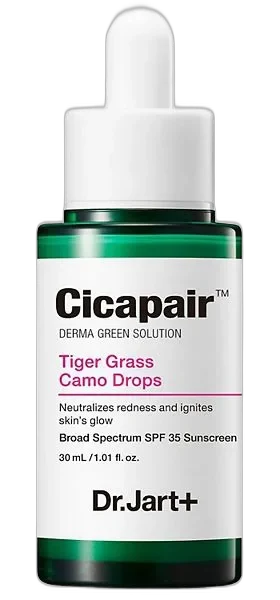
Cicapair Tiger Grass Camo Drops SPF 35
Redness-Relief Daily SPF
 Verified reviewer
Pros & cons.
- +Green-to-beige color correction effectively and instantly neutralizes redness and uneven tones
- +Centella asiatica as second ingredient provides therapeutic-level anti-inflammatory benefits
- +Mineral SPF 35 from zinc oxide and titanium dioxide is inherently gentle for sensitive skin
- +Serum-light texture replaces both sunscreen and primer in one step
- +Niacinamide and ceramide NP add cumulative skin-improving benefits with daily use
- +Natural finish looks like good skin, not like makeup or sunscreen
- −Limited shade range — best for light to medium skin tones, can appear ashy on deeper skin
- −May oxidize slightly darker or more yellow throughout the day
- −Contains essential oils (lavender, rosemary, grapefruit) unnecessary for sensitive skin
- −Dropper packaging can be messy and imprecise for dispensing
- −SPF 35 is adequate but not the highest protection for extended outdoor exposure
The full review.
People wondered if the virality stemmed from a gimmick—a color trick in pretty packaging—or genuine substance. The formula has substance.
Reality
The green-to-beige transformation uses color theory, not magic. Chromium oxide greens and iron oxides create the green base tint, which sits opposite red on the color wheel. When blended into the skin, green pigments neutralize red and pink tones. Mineral pigments (titanium dioxide and iron oxides) then provide subtle, skin-matching coverage that replaces neutralized redness with an even beige tone. It is optical science, executed well.
The centella asiatica concentration moves the Camo Drops from a cosmetic trick to a skincare product. It is the second ingredient—an unusually prominent position for a botanical extract. The formula includes all four centella triterpenoids individually (asiaticoside, asiatic acid, madecassoside, madecassic acid). This is a meaningful active dose that provides anti-inflammatory and skin-calming benefits while mineral filters handle UV protection.
Zinc oxide and titanium dioxide provide the mineral SPF 35 protection. Both are inherently soothing; zinc oxide has anti-inflammatory properties. Mineral filters are generally better for redness-prone skin than chemical alternatives, which can trigger flushing or irritation. The SPF 35 rating works for daily urban use, though sun worshippers need higher protection.
Niacinamide adds brightening and barrier-strengthening benefits over time. Daily use helps address the underlying skin tone unevenness that necessitates color correction. Ceramide NP appears in a small concentration near the end of the ingredient list, but adds barrier repair relevant for redness-prone skin with compromised barrier function.
Texture
The texture is serum-light and silicone-based. It has an effortless slip that makes blending intuitive for people who do not normally wear face products. Two to three drops cover the entire face. The finish is natural—dewy enough to look skin-like, but not greasy. Use it as a standalone tinted SPF on minimal-effort days or as a primer under foundation for more coverage.
Scent
The essential oils (lavender, rosemary, grapefruit) are unnecessary for a product that serves redness-prone, sensitive skin. Their concentrations are not concerning, but including them in a product for reactive skin types is a recurring frustration across the Dr. Jart+ line.
Common Praise
The Cicapair Camo Drops earned their viral moment. Behind the color transformation is a well-formulated mineral sunscreen with meaningful centella asiatica concentrations, supported by niacinamide and ceramide NP. The product conceals redness, protects from UV, and treats underlying inflammation without looking or feeling heavy. If your skin tone fits the range, it is an efficient AM product.
Common Complaints
Limitations center on shade range and longevity. The green-to-beige formula targets light to medium skin tones and struggles to adapt to deeper complexions, where the beige can appear ashy or leave a visible cast. Dr. Jart+ has not addressed this accessibility gap. Additionally, the product can oxidize slightly during the day—shifting darker or more yellow—which is common with mineral-based tinted products.
Ingredient analysis.
Full INCI list
Cyclopentasiloxane, Centella Asiatica Extract, Isononyl Isononanoate, Butylene Glycol, Titanium Dioxide, Zinc Oxide, Glycerin, Niacinamide, Polymethylsilsesquioxane, Methyl Methacrylate Crosspolymer, Water, Sodium Chloride, Disteardimonium Hectorite, Iron Oxides (CI 77492), Aluminum Hydroxide, Triethoxycaprylylsilane, Acrylates/Dimethicone Copolymer, Chromium Oxide Greens, Beeswax, Disodium EDTA, Asiaticoside, Hydrogenated Lecithin, Lavandula Angustifolia (Lavender) Oil, Asiatic Acid, Rosmarinus Officinalis (Rosemary) Leaf Oil, Centella Asiatica Leaf Water, Helianthus Annuus (Sunflower) Seed Oil, Houttuynia Cordata Extract, Alcohol, Caprylic/Capric Triglyceride, Phenoxyethanol, Anthemis Nobilis Flower Oil, Lecithin, Arnica Montana Flower Extract, Aniba Rosaeodora (Rosewood) Wood Oil, Ethylhexylglycerin, Madecassoside, Methyl Trimethicone, Butyloctyl Salicylate, Pentaerythrityl Tetraisostearate, Diphenylsiloxy Phenyl Trimethicone, Dipropylene Glycol, Isododecane, Lauryl PEG-10 (Trimethysiloxy) Trissilylethyl Dimethicone, Magnesium Sulfate, Polyglyceryl-4 Isostearate, Dipentaerythrityl Hexahydroxystearate/Hexastearate/Hexarosinate, 1,2-Hexanediol, Iron Oxides (CI 77491), Caprylyl Glycol, Synthetic Fluorphlogopite, Glyceryl Caprylate, Zein, Silica Dimethyl Silylate, Adenosine, Zea Mays (Corn) Starch, Citrus Paradisi (Grapefruit) Peel Oil, Dipotassium Phosphate, Calcium Stearate, Gossypium Herbaceum (Cotton) Seed Oil, Panthenol, Tocopherol, Anastatica Hierochuntica Extract, Pentylene Glycol, Magnesium Aspartate, Zinc Gluconate, Brassica Campestris (Rapeseed) Sterols, Leuconostoc/Radish Root Ferment Filtrate, Sucrose Laurate, Polyglyceryl-2 Caprate, Fragaria Vesca (Strawberry) Fruit Extract, Lysolecithin, Ceramide NP, Copper Gluconate, Sodium Ascorbyl Phosphate, Madecassic Acid
Skin match.
The science.
The Science
The Cicapair Camo Drops' efficacy rests on two well-established scientific foundations: mineral UV filtration and centella asiatica's triterpenoid complex.
Zinc oxide and titanium dioxide are the gold standard for mineral sun protection. Zinc oxide provides broad-spectrum coverage across both UVA and UVB wavelengths, while titanium dioxide excels particularly in UVB protection. A key advantage for redness-prone skin is that zinc oxide has inherent anti-inflammatory properties — it's been used in dermatology as a soothing agent for centuries, long before its UV-blocking properties were recognized.
Centella asiatica's position as the second ingredient is noteworthy. The extract contains four triterpenoid saponins — asiaticoside, asiatic acid, madecassoside, and madecassic acid — all of which are individually listed in the INCI, suggesting the formula uses a titrated extract (TECA) with standardized concentrations. A 2012 systematic review in the Indian Journal of Pharmaceutical Sciences confirmed that centella asiatica promotes collagen synthesis, inhibits inflammatory pathways, and accelerates wound healing. The asiaticoside and madecassoside components specifically have demonstrated anti-inflammatory activity by inhibiting the NF-kB signaling pathway.
Niacinamide at meaningful concentrations has been shown to reduce redness and improve skin barrier function. A pivotal 2005 study in the British Journal of Dermatology demonstrated that 5% niacinamide significantly reduced redness and improved skin tone in a double-blind trial. While the concentration in this formula is not disclosed, its position as the eighth ingredient suggests a potentially effective level.
The color-correcting mechanism is based on subtractive color theory. Green sits opposite red on the color wheel; when green pigments are applied over red-toned skin, they absorb the red wavelengths and neutralize the visible redness. The chromium oxide greens and iron oxides provide this green base, while the mineral filters and additional iron oxides contribute the beige tones that emerge as the product is blended into the skin.
References
- Centella asiatica in cosmetology: phytochemistry and applications — Indian Journal of Pharmaceutical Sciences (2012)
- The effect of niacinamide on reducing cutaneous pigmentation and suppression of melanosome transfer — British Journal of Dermatology (2005)
Dermatologist Perspective
Dermatologists frequently recommend mineral-based sunscreens for redness-prone and sensitive skin, and the Cicapair Camo Drops align well with this clinical guidance. Board-certified dermatologists note that the mineral-only SPF approach is less likely to trigger the flushing and irritation that chemical filters can cause in reactive skin. The centella asiatica content is clinically relevant for rosacea and general redness management, making this a product that dermatologists can support from both a protection and treatment perspective. The main dermatological concern is the limited shade range — dermatologists emphasize that sun protection should be accessible to all skin tones, and a tinted SPF that only works for lighter complexions misses a significant portion of the population.
Where it fits in your routine.
Shake the bottle well before use. After your AM skincare routine (cleanser, toner, serum, moisturizer), apply 2-3 drops to your fingertips. Dot onto the face and blend outward with fingers, patting until the green turns to a skin-matching beige. Let the product set for 1-2 minutes before applying makeup. Reapply every 2 hours for sustained SPF protection during extended sun exposure.
At $48 for 30 mL, Camo Drops sit at the high end of the K-beauty sunscreen market. They work as a hybrid, replacing both sunscreen and light coverage or primer, which halves the per-step cost. A 5 mL trial size is also available. For a product with mineral SPF, therapeutic centella asiatica, and color correction in one step, the value is fair. Daily use costs roughly $0.50-0.80, which competes with buying a separate mineral sunscreen and color corrector.
People with light to medium skin tones facing redness, uneven tone, or sensitivity can use this as a single AM product for sun protection, color correction, and skin-calming ingredients. It works well for those who dislike the look and feel of traditional sunscreens.
People with deeper skin tones may find the beige tint ashy or mismatched. It is not for those with essential oil sensitivities or anyone needing high-SPF protection (50+) for long outdoor activities. It also does not suit very oily skin types who want matte, powder-finish sunscreens.
Product details.
The centella and essential oils create a subtle herbal-botanical scent. It is not strong, but you can detect it upon application.
A glass dropper bottle uses a green-to-clear gradient design. The dropper controls dispensing but can be slightly messy. The 30 mL bottle is compact and travel-friendly. ***
The green-to-beige color change is satisfying on first use. The product blends easily with fingers, neutralizes redness instantly, and provides light, even-toned coverage. Results are cosmetically immediate with no adjustment period. The finish looks natural and skin-like, not cakey or mask-like. ***
2-3 months with daily use on face ***
12 months ***
All Year
The backstory.
The Cicapair Camo Drops went viral on social media around 2018-2019, with before-and-after videos showing the dramatic green-to-beige transformation becoming some of the most shared K-beauty content online. The product tapped into a growing awareness that mineral sunscreens could do more than just block UV — they could serve as lightweight, skin-benefiting alternatives to traditional color-correcting makeup.
About Dr. Jart+
Established Brand (5–20 years)Dr. Jart+ was founded in 2004 by dermatologist Jung Sung-jae in South Korea and is now owned by Estée Lauder Companies. The Cicapair line centers on centella asiatica (tiger grass) and has become one of K-beauty's most recognized color-correcting ranges.
Common myths.
The green color in Camo Drops indicates it contains harsh chemicals or artificial colorants that harm skin.
Chromium oxide greens and iron oxides create the green tint. These mineral pigments are some of the safest, most inert cosmetic colorants. Mineral makeup uses them often, and they have excellent safety profiles for sensitive skin.
SPF 35 is enough for a full day without reapplication.
No SPF product provides all-day protection. The SPF 35 rating means the product blocks about 97% of UVB rays if applied correctly, but sweat, touch, and UV exposure degrade this protection over time. Reapply every 2 hours for sustained protection, especially with a thin application like these drops.
FAQ.
How do Dr. Jart+ Cicapair Camo Drops work?
Green pigments (chromium oxide, iron oxides) use color theory to neutralize red and pink tones on contact. The drops blend into a skin-matching beige that provides light, natural coverage. Mineral SPF filters (zinc oxide and titanium dioxide) protect against UV damage, while centella asiatica triterpenoids calm underlying redness.
What skin tones do Cicapair Camo Drops work for?
The green-to-beige transformation works best on light to medium skin tones with pink or red undertones. On deeper skin tones, the beige looks ashy or blends poorly. The limited shade range is a notable drawback of the product.
Can I wear makeup over Cicapair Camo Drops?
Yes — the Camo Drops work well as a tinted primer under foundation or concealer. The silicone-based formula creates a smooth base for makeup application. For light-coverage days, many users wear the drops alone as a skin-tint-plus-SPF alternative to foundation.
Are Cicapair Camo Drops safe for sensitive skin?
Mineral SPF filters and centella asiatica suit sensitive skin. But the formula has essential oils (lavender, rosemary, grapefruit) and some alcohol that irritates very reactive skin. Patch test if you have known essential oil sensitivities.
Do I need to reapply Cicapair Camo Drops throughout the day?
Reapply every 2 hours for sustained SPF protection, especially in direct sun. The color-correcting effect lasts all day without reapplication. One morning application provides enough coverage for indoor days with minimal sun exposure.
What the community says.
"Green-to-beige transformation effectively neutralizes redness instantly"
"Lightweight enough to wear daily without feeling like heavy makeup"
"Mineral SPF 35 is gentle enough for sensitive, redness-prone skin"
"Can replace both primer and sunscreen in a morning routine"
"Limited shade range — best suited for light to medium skin tones"
"Can oxidize to a slightly darker shade throughout the day"
"Dropper packaging can be messy and imprecise"
"May emphasize dry patches if skin isn't well moisturized underneath"
People also looked at.