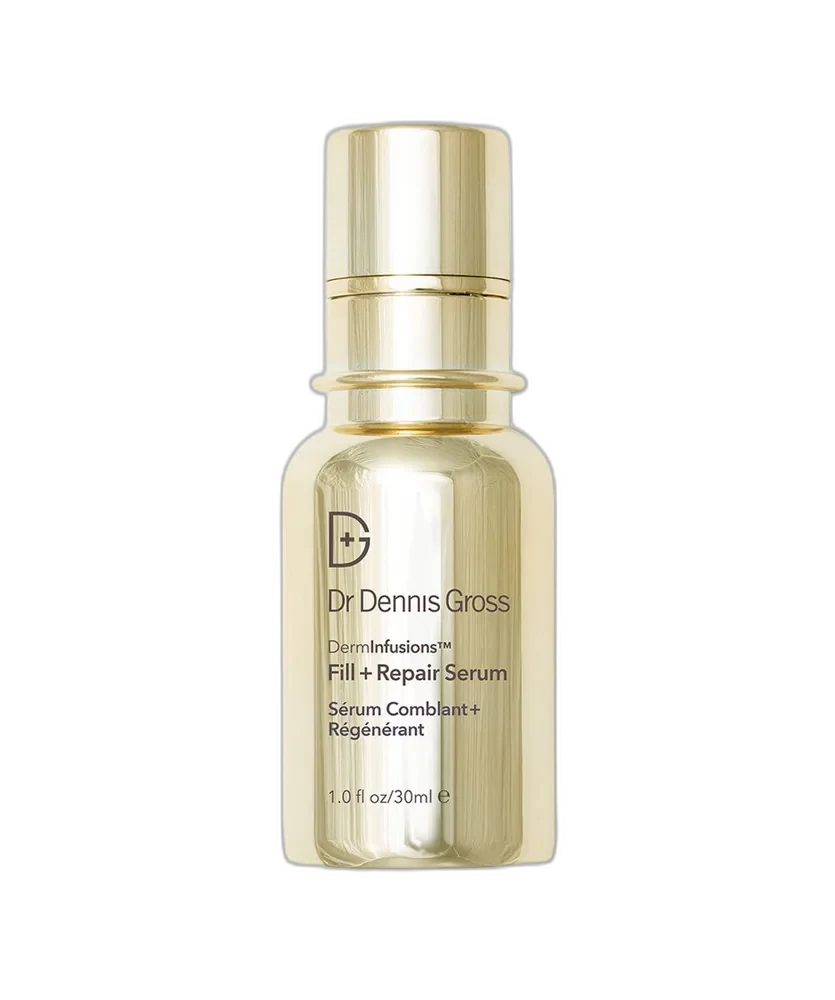
DermInfusions Fill + Repair Serum
Peptide Hydration Serum
 Verified reviewer
Pros & cons.
- +Multi-weight hyaluronic acid delivers layered hydration beyond basic HA serums
- +Four-peptide complex targets multiple anti-aging mechanisms
- +Niacinamide adds functional tone and barrier support
- +Ectoin and beta-glucan extend hydration and add environmental protection
- +Lightweight texture layers well under moisturizer and sunscreen
- +Alcohol-free and silicone-free
- +Pregnancy-friendly formulation without retinoids or salicylic acid
- −Expensive at $85 for 30ml
- −Contains added fragrance, a concession for a treatment serum
- −Peptide benefits develop gradually and can feel underwhelming short-term
- −Cheaper alternatives from The Ordinary and Naturium cover similar chemistry
- −Naming implies filler-like effects the formula cannot deliver
The full review.
The word ‘fill’ in the product name is doing a lot of work, and it’s worth unpacking what it actually means before judging whether the serum delivers. Injectable hyaluronic acid fillers — the kind dermatologists and plastic surgeons use — are crosslinked HA molecules placed into the deeper dermis to physically restore volume. They last months to years, they cost hundreds to thousands of dollars per syringe, and they produce anatomical changes. Topical hyaluronic acid, even the most sophisticated version, cannot do this. What topical HA does is sit in the upper layers of the stratum corneum, bind water from the environment and from deeper skin layers, and create a visible plumping effect that softens fine lines and improves radiance for as long as the skin stays hydrated. That effect is real, it’s useful, and it’s reversible as soon as the skin dries out again. When Dr. Dennis Gross uses the word ‘fill’ on this bottle, they’re describing the visual effect, not making a mechanical claim about filler-equivalent performance.
Once you’re past the naming, what’s in the bottle is actually a thoughtful peptide and hydration serum. The hyaluronic acid is delivered in multiple molecular weights, which matters because different HA weights penetrate to different depths — high-weight HA sits near the surface and forms a smoothing film, mid-weight HA hydrates the upper stratum corneum, and lower-weight HA can reach slightly deeper layers for a more persistent plumping effect. A multi-weight HA serum consistently outperforms a single-weight version in both immediate feel and sustained hydration, and this serum is built on that principle. Hydrolyzed HA, trehalose, glycerin, sodium PCA, and beta-glucan stack up a supporting humectant system that extends the hydration over several hours rather than fading within minutes.
The peptide complex is where the ‘repair’ part of the name comes in. The formula uses four signaling peptides, each with a different mechanism: palmitoyl tripeptide-1 supports collagen synthesis, palmitoyl tetrapeptide-7 has shown anti-inflammatory and wrinkle-softening effects in published research, acetyl hexapeptide-8 (sometimes called ‘argireline’) targets expression-related wrinkles by interfering with neurotransmitter release at the neuromuscular junction, and copper tripeptide-1 supports wound healing and collagen remodeling. No single peptide is a miracle ingredient, but the logic of combining them is sound — different peptides signal different cellular responses, and a layered approach can produce more measurable benefit than a single-peptide formula. The evidence base for peptides in topical skincare is still emerging compared to retinoids or AHAs, but it’s developed enough that a well-combined peptide serum can deliver meaningful, if gradual, anti-aging support.
The supporting cast is strong. Niacinamide adds barrier support, tone benefit, and pore appearance improvements at what appears to be a functional concentration. Ectoin, the extremolyte, stabilizes cellular structures under environmental stress and adds an antioxidant-adjacent layer. Bisabolol and panthenol provide comfort and calming, and tocopherol contributes vitamin E coverage. The formula is free of alcohol, free of silicones, and free of essential oils — a clean baseline for people building a layered treatment routine.
On the skin, the experience is pleasant and measurable. The serum pumps out of the dropper as a lightweight gel-serum with a slightly silky slip, spreads easily across damp skin, and absorbs within a minute with no tacky residue. Immediate plumping is visible, especially on dehydrated fine lines on the forehead and around the eyes, and the effect holds for several hours under moisturizer. Over two to four weeks of consistent use, fine lines look softer even when the skin is less hydrated, which is the point where the peptides and niacinamide start contributing beyond the pure hydration effect. Over eight to twelve weeks, the cumulative benefits on tone and texture become more apparent. These aren’t dramatic changes, and they shouldn’t be — peptide and HA serums work gradually and their visible effect is more about consistent improvement than sudden transformation.
The two concerns are price and fragrance. At $85 for 30ml, the serum sits firmly in prestige territory, and direct alternatives exist at much lower prices. The Ordinary’s peptide and HA serums cover the same chemistry for a small fraction of the cost. Naturium, Paula’s Choice, and The Inkey List offer mid-tier options that also deliver strong peptide or multi-weight HA formulas. What Dr. Dennis Gross adds is the specific peptide combination, the DermInfusions branding, and the integration with the brand’s broader Alpha Beta and wrinkle-defense ecosystem. Whether those extras justify the premium depends on what you value and how much you’re willing to pay for it. The fragrance inclusion is the other honest limitation — added fragrance in a serum positioned as a sensitive-skin-friendly treatment is a small but real concession that fragrance-sensitive users will notice immediately.
The serum earns a place in the database because, within its price tier, it’s a genuinely good peptide and hydration product. The formula is thoughtful, the brand has real dermatology credentials, and the integration with the Alpha Beta line gives Dr. Dennis Gross loyalists a reason to stay in the ecosystem. The reservation is that the prestige skincare market is more competitive than it used to be, and the case for spending $85 on a peptide serum when $15-30 alternatives cover most of the same chemistry is harder to make every year. For buyers who prioritize brand cohesion and simplicity, it’s a fit. For buyers optimizing for ingredient value, it’s worth comparing against the alternatives first.
Ingredient analysis.
Full INCI list · pH 5.5
Water, Glycerin, Butylene Glycol, Propanediol, Sodium Hyaluronate (multiple molecular weights), Hydrolyzed Hyaluronic Acid, Niacinamide, Palmitoyl Tripeptide-1, Palmitoyl Tetrapeptide-7, Acetyl Hexapeptide-8, Copper Tripeptide-1, Panthenol, Allantoin, Bisabolol, Ectoin, Trehalose, Beta-Glucan, Sodium PCA, Tocopheryl Acetate, Carbomer, Sodium Hydroxide, Phenoxyethanol, Ethylhexylglycerin, Disodium EDTA, Fragrance
Skin match.
The science.
The Science
Dermatology literature thoroughly documents hyaluronic acid as a topical humectant. Published research shows multi-weight HA formulas—which combine different molecular weights of HA in one product—outperform single-weight formulations in immediate hydration and sustained moisture retention. This happens because different HA weights reach different depths of the stratum corneum. Some studies show low-molecular-weight HA penetrates slightly deeper than larger weights, though researchers continue to study the exact extent of penetration. Topical peptides have an emerging evidence base. Palmitoyl tripeptide-1 and palmitoyl tetrapeptide-7 have published research in journals like the Journal of Cosmetic Dermatology. These show measurable improvements in fine lines, wrinkle depth, and inflammation markers after 4-12 weeks of consistent use at cosmetic concentrations. Research suggests Acetyl hexapeptide-8 can reduce the depth of dynamic expression wrinkles over several weeks, though the effect size is modest compared to neuromodulator injections. Copper tripeptide-1 has published evidence for supporting collagen remodeling and wound healing. This serum uses a combination approach based on the principle that different peptides signal different pathways and layered signaling produces additive results. Niacinamide has some of the most robust evidence in topical dermatology for sebum regulation, barrier function, and post-inflammatory hyperpigmentation. Multiple studies show measurable improvements at concentrations of 2-5% over 8-12 weeks.
Dermatologist Perspective
Dermatologists generally recommend hyaluronic acid serums for daily hydration and peptide serums as supportive anti-aging additions to routines that already include evidence-based actives like retinoids and sunscreen. Board-certified dermatologists note that retinoids and photoprotection produce the most dramatic anti-aging results; peptides are complementary rather than primary treatments. Doctors commonly suggest this type of serum for patients in their 30s and 40s who want to add hydration and gentle anti-aging support to a well-established routine, especially those using the Alpha Beta peel system and looking for a complementary hydration step.
Where it fits in your routine.
After cleansing and applying any toner, press 3-4 drops onto damp skin across the face and neck. Wait one minute for absorption, then apply moisturizer. In the morning, apply a broad-spectrum sunscreen last. Use twice daily. You can layer the serum under the Alpha Beta Peel in the evening — apply the serum after the Alpha Beta Peel Step 2, before moisturizer — and it pairs with retinol (applied separately, over the serum) for users building an anti-aging routine.
At $85 for 1 ounce, this serum is priced well above most comparable peptide and HA serums in the broader market. The Ordinary covers similar peptide and multi-weight HA chemistry at a fraction of the cost, and mid-range options from Naturium, The Inkey List, and Paula's Choice deliver comparable formulas in the $20-45 range. What Dr. Dennis Gross adds is the specific multi-peptide combination, the brand pedigree, and the integration with the Alpha Beta ecosystem. A bottle typically lasts two to three months with twice-daily use, working out to roughly $0.95 to $1.40 per day. The price is defensible if you specifically value the brand cohesion and formula simplicity; it's harder to defend if you're willing to layer more affordable single-active products.
Dry, dehydrated, or normal skin in the 30s-50s looking for a peptide and hydration serum with a credible dermatology-brand pedigree. Existing Dr. Dennis Gross users who want a hydration layer to complement the Alpha Beta Peel system. Anyone who prefers an all-in-one multi-active serum over building from separate single-ingredient products.
Budget-conscious buyers may prefer The Ordinary's peptide and HA serums. Fragrance-sensitive users should avoid this. Those expecting dramatic, filler-like results from a topical product should adjust expectations instead of using this specific formula.
Product details.
Lightweight gel-serum with a slightly silky feel
Light fragranced scent
Frosted glass bottle with dropper, 1oz
First use provides immediate plumping and a dewy finish. It does not tingle or warm. Skin feels smoother within minutes of application.
2-3 months with twice-daily use
12 months
All Year
The backstory.
Dr. Dennis Gross launched the DermInfusions line in 2021 as the brand's entry into peptide-focused anti-aging beyond the exfoliation philosophy of Alpha Beta. The line was developed as a complement to the peel system, addressing concerns that exfoliation alone doesn't fully resolve.
About Dr. Dennis Gross Skincare
Established Brand (5–20 years)A board-certified Manhattan dermatologist founded Dr. Dennis Gross Skincare in 2000. The DermInfusions line uses peptides and hyaluronic acid to treat anti-aging concerns not covered by the Alpha Beta system.
Common myths.
Hyaluronic acid serums fill wrinkles like an injectable
Topical hyaluronic acid hydrates the upper stratum corneum and provides temporary plumping, but it does not replicate the structural volume of injectable HA fillers. The 'fill' in this product's name refers to visual hydration, not anatomical filling.
All peptides work the same way
Peptides signal different cellular responses. Copper tripeptide-1 supports wound healing and collagen remodeling, acetyl hexapeptide-8 targets expression-related wrinkles, and palmitoyl tripeptide-1 and tetrapeptide-7 signal collagen synthesis and anti-inflammatory effects. These actives work together rather than being interchangeable.
FAQ.
Does this replace injectable fillers?
No. Topical hyaluronic acid hydrates and temporarily plumps the upper skin layers, but it does not replicate the volume restoration of injectable HA fillers. The name describes the visual effect, not the mechanism.
Can I use it with retinol?
Yes. Apply this serum first as a hydrating and peptide step, then apply retinol on top. The niacinamide and bisabolol also buffer retinol irritation.
Is it safe for sensitive skin?
The formula is alcohol-free and uses gentle ingredients, but it has added fragrance. This can irritate reactive skin. Patch test first if you have fragrance sensitivity.
How long until I see peptide results?
Hydration and plumping effects happen immediately. Peptide-driven improvements in fine lines and texture show up over 8-12 weeks of consistent twice-daily use.
Can I use it under sunscreen?
Yes. The serum layers cleanly under any moisturizer and sunscreen without pilling.
Is it pregnancy safe?
The formula lacks retinoids or salicylic acid and is generally pregnancy-safe, but consult your doctor to confirm.
Community
What the community says.
"Immediately plumps fine lines"
"Layers well under moisturizer"
"Comfortable texture"
"Pairs well with the Alpha Beta line"
"Expensive for 1oz"
"Contains fragrance"
"Slower long-term results than expected"
Featured in.
People also looked at.