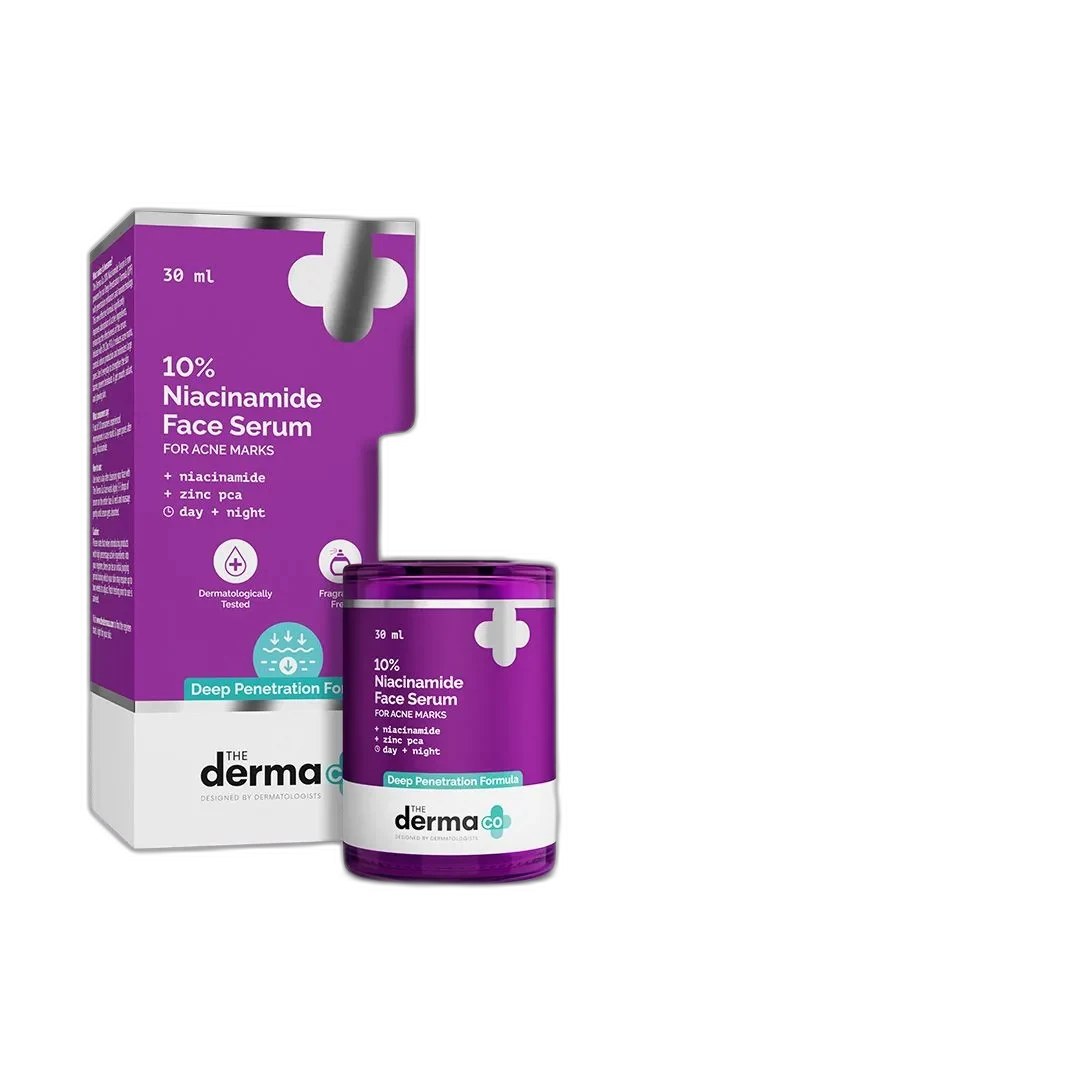
10% Niacinamide Face Serum
Budget Niacinamide Staple
 Verified reviewer
Pros & cons.
- +Genuine 10% niacinamide at the second position on the INCI list
- +Paired with 2% zinc PCA for meaningful sebum regulation
- +Centella asiatica buffers the active load for better tolerance
- +Fragrance-free, silicone-free, and fungal-acne safe
- +Absorbs quickly and layers well under any moisturizer or sunscreen
- +Pregnancy-safe for users who need retinoid alternatives
- +One of the best-value niacinamide serums in the global market
- +Over 50,000 verified reviews support its real-world performance
- −Mild initial flush possible in the first week at 10% concentration
- −Not suitable for highly reactive or rosacea-prone skin
- −Dropper packaging can become messy with repeated use
- −Not enough hydration alone for dry skin types
- −Can't replace a retinoid for wrinkle or textural concerns
The full review.
When The Derma Co’s 10% Niacinamide Serum launched in 2020, the Indian direct-to-consumer skincare shelf looked very different than it does today. Most of the niacinamide serums available were either expensive imports aimed at the upper middle class or cheap formulations that listed niacinamide prominently on the front of the bottle but tucked it far down the INCI. The Derma Co did something that, at the time, felt almost rude in its simplicity: it put niacinamide at the second position on the ingredient list, added 2% zinc PCA, tucked in some centella to soothe, and sold the whole thing for less than the price of a single café breakfast. That positioning is why the product has over fifty thousand reviews and a permanent spot on “beginner skincare” recommendation lists across Indian social media.
The formulation is functional rather than fancy, and that’s the point. Aqua, niacinamide, 1,3-propanediol for slip, glycerin and pentylene glycol for humectant support, zinc PCA for sebum regulation, centella asiatica for anti-inflammatory buffering, a modest gelling system, and standard preservation. There’s no retinol, no peptide dressing, no fragrance masking, and no silicone slip. It’s a straight niacinamide serum that does one category of things well: sebum regulation, post-acne mark fading, pore appearance refinement, and modest brightening. If that’s what you need, this is genuinely one of the better value picks in the category worldwide, not just in India.
Texture
Texture is where the cheap-serum suspicion tends to break. This is a clear, slightly viscous water-serum that absorbs in under a minute and leaves no residue — the kind of base that disappears under any moisturizer or sunscreen without pilling. The dropper pulls the right amount for a full face in one fill, and the amber glass bottle does a reasonable job protecting the formula from light, though the dropper itself can be messy after a few months of regular use.
Common Complaints
The flush factor is worth talking about honestly. At 10%, niacinamide occasionally triggers a warm, slightly pink flush during the first week of use, especially on skin that’s never been exposed to niacinamide at that concentration before. This is not an allergic reaction and it’s not harmful — it’s a vasoactive response that typically subsides within a few days as tolerance builds. For most oily and combination skin users, the flush is either unnoticeable or fleeting. For users with very reactive or rosacea-prone skin, it can be uncomfortable, and those users are often better served by a 5% formulation to start.
Works for
The results timeline is predictable enough to plan around. Sebum control and a fresh, less-shiny finish in the T-zone tend to show up within the first two to three weeks. Post-acne mark fading — the flat red and brown marks that retinoids and niacinamide both address — starts emerging between weeks four and eight, and compounds over the following months. Pore appearance refinement is subtle but real with consistent use. None of these effects are retinoid-level dramatic, but they accumulate into a notably cleaner, more even skin surface over three to six months of daily use, which is a reasonable return on a serum that costs less than most people’s coffee budget.
Not ideal for
Where this serum falls short is also worth being clear about. It is not a hyperpigmentation treatment for melasma or deep dark spots — niacinamide is a supporting act in those cases, not a headline performer. It is not a moisturizer, despite some users treating it that way, and it’s not enough on its own for dry skin. And it is not a retinoid substitute for wrinkles, fine lines, or textural concerns that need turnover-level intervention. If you bought this expecting it to replace your full skincare routine, you’ll be disappointed. If you bought it to add a high-quality, well-priced niacinamide step to a routine that already includes cleansing, moisturizing, and SPF, you’ll probably be impressed.
The bigger story of this serum is really a story about what direct-to-consumer pricing can do when a brand gets its formulation right. Before 2020, getting a 10% niacinamide and 2% zinc serum at this price point in India simply wasn’t possible. The Derma Co proved that the math worked, and pulled the entire budget segment of the Indian skincare market up a rung in the process. That’s a meaningful contribution to a category where the majority of users are still building their first real routine, and it’s the reason this product deserves to be taken seriously despite its unremarkable appearance on the shelf.
Ingredient analysis.
Full INCI list · pH 5.5
Aqua, Niacinamide, 1,3-Propanediol, Ethoxydiglycol, Glycerin, Zinc PCA, Dimethyl Isosorbide, Pentylene Glycol, Xanthan Gum, Hydroxyethyl Cellulose, Algin, Phenoxyethanol, Sodium Benzoate, Ethylhexylglycerin, Centella Asiatica Leaf Extract, Calcium Gluconate, Citric Acid
Skin match.
The science.
The Science
Niacinamide at 10% has strong clinical support in dermatological literature. Studies show cosmetic niacinamide affects sebum production, barrier function, post-inflammatory hyperpigmentation, and pore appearance at 2% to 5% concentrations, with more benefits at concentrations up to 10%. The Bissett et al. 2005 split-face study is a top citation for niacinamide's effect on hyperpigmentation, skin yellowing, and fine lines over 12 weeks at a 5% concentration.
Adding zinc PCA at approximately 2% is a standard choice for oily and acne-prone skin. Older dermatological research shows zinc regulates sebum and has mild antibacterial activity. The combination of niacinamide and zinc is popular globally through formulations like The Ordinary's 10% Niacinamide + Zinc 1% serum; The Derma Co's version uses a similar formulation with a slightly higher zinc load.
Centella asiatica extract — sometimes listed as cica or tiger grass — contains asiaticoside and madecassoside. These triterpenoid compounds show anti-inflammatory and wound-healing activity in studies. Its inclusion here buffers the mild vasoactive response that higher-percentage niacinamide can trigger and supports the barrier during the sebum-regulation phase.
Reported testing shows the finished serum has a pH around 5.5. This is the optimal range for niacinamide stability and matches the skin's natural acid mantle. Niacinamide converts to niacin (the vasoactive form) at extreme pH or temperature, so well-made niacinamide serums keep a pH close to the skin's native range.
References
- Niacinamide: A B vitamin that improves aging facial skin appearance — Dermatologic Surgery (2005)
Dermatologist Perspective
Dermatologists often recommend 10% niacinamide serums as a foundation for patients with oily skin, post-acne hyperpigmentation, and large-pore concerns, especially on a budget. Board-certified dermatologists note niacinamide is one of the best-tolerated actives in skincare and works with almost every other ingredient in a typical routine, including retinoids, vitamin C, and AHAs. Dermatologists practicing in India often name The Derma Co's version, Minimalist's, and The Ordinary's as good starting points for patients building their first niacinamide-based routine. Patients with flushing, rosacea, or extreme sensitivity usually start on a lower concentration before moving to 10%. Its pregnancy-safety profile also makes it a common recommendation for patients who must pause retinoids but still want to address pigmentation and sebum concerns.
Where it fits in your routine.
Apply 4-5 drops to clean, dry skin morning and evening, before heavier serums or moisturizer. Pat gently until absorbed, about one minute. In the AM, follow with moisturizer and broad-spectrum sunscreen. In the PM, follow with moisturizer and your retinoid or exfoliant in the appropriate slot. For cleanest results, do not layer with pure L-ascorbic acid vitamin C at the same time — use one in the morning and the other at night. If your skin has never used 10% niacinamide, start with once-daily use for the first week.
At roughly $7 for 30 ml, this serum is a top-value niacinamide product globally, not just in India. The larger pack-of-two option on The Derma Co's website lowers the per-ml cost for regular users. The formulation is comparable to The Ordinary's or Paula's Choice's price points and is slightly more thoughtful in some ways (zinc load, centella buffering). For budget-conscious users needing a foundational niacinamide step, few cheaper options perform at this level.
Oily, combination, and acne-prone skin types can use this affordable foundational serum to address sebum, pores, and post-acne marks. It works for beginners building a first active routine and for pregnant users needing a retinoid alternative for pigmentation concerns.
People with highly reactive skin, rosacea, or niacinamide-induced flushing should use a lower concentration first. Dry skin types need more than this for hydration, and those seeking dramatic anti-aging results for wrinkles must add a retinoid to the routine.
Product details.
Clear, slightly viscous watery serum that absorbs in under a minute
Neutral — fragrance-free
30 ml amber glass dropper bottle
Some users feel mild warmth or a light flush during the first few applications. This is normal at 10% niacinamide and usually stops within a week as skin tolerance builds. Sebum reduction shows up first, often within 2-3 weeks.
About 2 months with twice-daily full-face application
12 months
All Year
The backstory.
The 10% Niacinamide Serum was part of The Derma Co's original 2020 launch lineup and quickly became the brand's most-reviewed SKU. It filled the gap that The Ordinary's 10% Niacinamide + Zinc filled internationally, but at an even lower Indian-market price point and with the added credibility of in-house dermatologist positioning.
About The Derma Co
Emerging Brand (2–5 years)The Derma Co launched in 2020 as a dermatologist-led brand from Indian parent company Honasa Consumer. Its 10% Niacinamide Serum was an early SKU and is now a staple recommendation in Indian skincare communities.
FAQ.
How long until I see results from this serum?
Sebum reduction and changes in pore-appearance show up within 2-3 weeks. Post-acne mark fading and subtle tone-evening emerge between weeks 4 and 8. Full benefits compound over 12+ weeks of consistent twice-daily use.
Can I use this with my vitamin C serum?
Yes, but the cleanest method uses vitamin C in the AM and this niacinamide serum in the PM. To use both in one routine, apply them minutes apart and follow with moisturizer.
Is this fungal acne safe?
Yes — the formula lacks common Malassezia-feeding fatty acids, oils, and polysorbates at problematic positions. It works for fungal-acne-prone routines, but always patch test.
Will it dry out my skin?
The serum uses glycerin and pentylene glycol for surface hydration, so most users won't find it drying. Dry skin types should use a thicker moisturizer to offset niacinamide's mild sebum-regulating effect.
Is it safe during pregnancy?
Dermatologists often recommend niacinamide as a pregnancy-safe alternative to retinoids for pigmentation and sebum concerns. This specific formula contains no ingredients flagged in pregnancy protocols.
What the community says.
"Visible oil control"
"Improvement in post-acne marks"
"Affordable"
"Lightweight feel"
"Some users report initial flushing"
"Dropper packaging can be messy"
"Strong on first use for sensitive skin"
People also looked at.