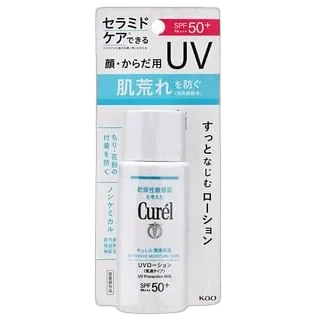
UV Protection Milk SPF 50+
Sensitive Skin SPF Champion
 Verified reviewer
Pros & cons.
- +Mineral-only SPF 50+ PA+++ provides broad-spectrum protection with the gentlest UV filter technology
- +Pseudo-ceramide and eucalyptus extract actively repair skin barrier while protecting from UV
- +Minimal white cast for a mineral sunscreen thanks to 2023 reformulated encapsulation technology
- +Anti-inflammatory Stearyl Glycyrrhetinate soothes sensitive skin during sun exposure
- +Silky primer-like texture works beautifully as a makeup base without pilling
- +Completely fragrance-free, alcohol-free, and paraben-free formulation
- +Pregnancy-safe mineral-only UV filters suitable for expectant mothers
- −Small 60mL bottle lasts only 4-6 weeks with proper daily application amounts
- −Premium pricing per milliliter compared to larger-format sunscreens
- −Satin finish may be too dewy for very oily skin types seeking matte protection
- −Not water-resistant — unsuitable for swimming, heavy exercise, or beach use
- −Silicone-heavy base may not suit those who avoid silicone-based products
The full review.
Dermatologists say the best sunscreen is the one you actually use. This is hard for sensitive skin that stings, burns, or breaks out. For years, the sensitive-skin sunscreen market had two bad choices: gentle formulas with low protection, or high-SPF products that felt like punishment. Curél UV Protection Milk rejects both.
This is a mineral sunscreen using zinc oxide and titanium dioxide to achieve SPF 50+ PA+++ without the chalky, drying, white-cast catastrophe common in high-protection mineral sunscreens. This works through chemistry and engineering. Kao’s 2023 reformulation uses improved particle encapsulation technology to disperse mineral filters more uniformly. The result is a more consistent, less visible UV-blocking film than the previous generation.
The silicone-based vehicle gives it a smooth, primer-like slip. If you use Japanese sunscreens, the texture feels familiar—lighter and more cosmetically elegant than most Western mineral SPFs. It spreads easily, sets to a satin finish, and leaves skin soft rather than coated. Under makeup, it works well as a base, creating a smooth canvas without pilling or separation.
Texture is only half the story. Curél does more below the UV-blocking surface. Their signature pseudo-ceramide—Cetyl-PG Hydroxyethyl Palmitamide—is in the formula with eucalyptus extract, creating the same barrier-repair system used in their moisturizers. While zinc oxide and titanium dioxide shield skin from UV radiation, the pseudo-ceramide maintains lipid barrier integrity below. It builds a roof and reinforces the walls at the same time.
Stearyl Glycyrrhetinate, a licorice-derived anti-inflammatory, is the designated active ingredient in this Japanese quasi-drug formulation. For sensitive skin that reddens or stings from sun exposure—or sunscreen ingredients—this provides a built-in soothing mechanism. This addresses why sensitive-skin people often skip sunscreen.
Daily use is unremarkable. Squeeze out a generous amount—you need a generous amount of any sunscreen for adequate protection—and blend it. Within thirty seconds, you have a smooth, non-greasy base that doesn’t sting, smell, or leave a white mask. Throughout the day, it maintains a comfortable satin finish without migrating into eyes or breaking down into an oily film.
Limitations are practical. At 60 milliliters, this is a small bottle for a product used liberally every day. If you apply the dermatologist-recommended amount for face and neck, this bottle lasts roughly four to six weeks. This makes the monthly cost higher than larger-format sunscreens. For a daily essential, the expense adds up.
The finish may not be matte enough for oily skin. The silicone base creates a satin sheen that dry and normal skin types will like, but if you have midday oil, it may contribute to shine rather than control it. This sunscreen targets Curél’s core demographic—dry, sensitive skin.
This is not a water-resistant formula. For beach days, pools, or heavy sweating, use a more robust sport sunscreen. This is for daily urban protection—commuting, office work, errands—where cosmetic elegance and skin comfort matter more than sweat-proof endurance.
The 2023 reformulation solves the white cast problem from earlier versions. Previous iterations left a noticeable white tint, especially on medium to deep skin tones. The improved encapsulation technology produces a finish close to transparent on most skin tones—though people with deeper complexions should test it first, as mineral filters carry more white-cast risk than chemical alternatives.
At approximately twenty-four dollars for 60 milliliters, this is in the upper-middle range of the Japanese sunscreen market. You pay for Kao’s ceramide technology, mineral UV filters processed for cosmetic elegance, and a formula that protects and repairs simultaneously. For sensitive skin that has tried dozens of sunscreens without success, the stability of this product justifies the per-milliliter cost. But for budget-conscious daily use, the small format is a drawback.
Curél UV Protection Milk does not win awards for packaging or price. But it may win the daily compliance of people who stopped using sunscreen because it hurt. A sunscreen sensitive skin wants to wear is better than one sitting unused in a drawer. This Japanese milk is both protective and pleasant.
Formula
Ingredient analysis.
Full INCI list
Stearyl Glycyrrhetinate, Zinc Oxide, Dimethicone, Water, Butylene Glycol, Titanium Dioxide, Trisiloxane, Hydrogenated Polyisobutene, Dipropylene Glycol, Thujopsis Dolabrata Branch Extract, Neopentyl Glycol Dicaprate, Cetyl-PG Hydroxyethyl Palmitamide, PEG-10 Dimethicone, Talc, PEG-32, Glycerin, Aluminum Hydroxide, Stearic Acid, Eucalyptus Globulus Leaf Extract, Dextrin Palmitate, Isoceteth-25, Xylitol, Betaine, Polysorbate 60, Xanthan Gum
Skin match.
The science.
The Science
This sunscreen uses two mineral UV filters — zinc oxide and titanium dioxide — to protect skin by reflecting and scattering UV radiation instead of absorbing it chemically. Zinc oxide provides broad-spectrum UVA and UVB coverage, while titanium dioxide primarily boosts UVB protection. Mineral filters benefit sensitive skin because they sit on the skin surface instead of penetrating the stratum corneum, which reduces irritation and allergic contact dermatitis risks.
Kao's 2023 reformulation uses improved particle encapsulation technology to fix the main mineral sunscreen issue: white cast. Coating and dispersing the UV filter particles more uniformly creates a thinner, more even UV-blocking film. Research on nanoparticle zinc oxide and titanium dioxide shows that smaller, better-dispersed particles reduce visible whitening while maintaining photoprotective efficacy, as long as particles stay above the regulatory size threshold that prevents transdermal penetration.
Adding Cetyl-PG Hydroxyethyl Palmitamide (pseudo-ceramide) to a sunscreen is scientifically rational because UV exposure depletes skin barrier lipids. A 2020 study in the Journal of Dermatological Science shows UV radiation triggers ceramide degradation in the stratum corneum by upregulating ceramidase enzymes. By supplying a ceramide functional ingredient during UV exposure, this formula mitigates a downstream effect of the radiation it blocks. Combined with eucalyptus extract, which Kao's research shows enhances endogenous ceramide synthesis, the formula replaces lipids and stimulates the skin's own repair pathways.
Dermatologist Perspective
Board-certified dermatologists often recommend mineral sunscreens for patients with sensitive, reactive, or rosacea-prone skin, because zinc oxide and titanium dioxide rarely cause contact irritation or allergic reactions. Dermatologists say adding ceramide-functional ingredients to a daily sunscreen is clinically sensible — it addresses UV-induced barrier disruption while providing photoprotection. For patients recovering from procedures, managing retinoid-induced sensitivity, or treating eczema or rosacea, a mineral SPF with built-in barrier support is a practical all-in-one daytime step that improves compliance. The anti-inflammatory active provides extra reassurance for skin that reacts to sunscreen application.
Where it fits in your routine.
Shake gently before use. Apply a thick layer to the face and neck after moisturizer as your final morning step. Use at least a nickel-sized amount (approximately 1/4 teaspoon) on the face alone; under-applying sunscreen reduces effective SPF. Let it set for one to two minutes before applying makeup. Reapply every two hours during direct or prolonged sun exposure. Remove thoroughly in the evening using an oil-based cleanser and then a gentle foaming wash.
At about $24 for 60 mL, this Japanese sunscreen costs more per milliliter than most, but stays well below luxury Western mineral SPF products with similar protection. The main cost issue is duration—proper application lasts only four to six weeks, bringing annual sunscreen costs to $200-300. For sensitive skin that spent more on sunscreens that caused irritation, breakouts, or abandonment, this reliability premium makes sense. The barrier-repair ingredients also allow for a simpler morning routine, which can offset the sunscreen cost.
Dry or sensitive skin types need high SPF protection without irritation—especially those seeking a mineral sunscreen that isn't heavy, chalky, or drying. It works well for rosacea-prone skin, post-procedure recovery, retinoid users needing gentle daily UV protection, and pregnant individuals wanting mineral-only sun protection with barrier-support benefits.
This satin-finish formula may not control shine enough for very oily skin needing a matte-finish sunscreen. Skip this if you need water-resistant protection for outdoor sports or swimming. The 60mL format also lacks maximum value per milliliter; it is expensive for a daily essential product.
Product details.
Completely fragrance-free. No detectable scent.
Small white squeeze tube with blue branding. The 60mL size is travel-friendly but feels small for daily sunscreen use. The tube design controls dispensing. Finish satinnon-greasylightweight
This mineral sunscreen blends well without a heavy white cast or chalky residue. The silicone-based vehicle feels smooth like a primer and layers well under makeup. Skin feels protected without the tight, dry sensation common with mineral SPFs.
1-2 months with daily facial application at recommended SPF amount
12 months
All Year
The backstory.
Sunscreen compliance is notoriously poor among people with sensitive skin — many skip it because conventional formulas sting, dry, or trigger breakouts. Curél developed this UV milk specifically to solve that compliance problem, reasoning that a sunscreen enriched with their barrier-repair technology would be one sensitive skin actually wants to wear daily. The 2023 reformulation with Day Barrier Technology refined the UV filter dispersion for better protection and cosmetic elegance.
About Curél
Established Brand (5–20 years)Kao Corporation launched Curél in 1999 as Japan's first skincare line for dry, sensitive skin. Kao's ceramide research began in 1987, and the UV Protection Milk received a 2023 reformulation with improved Day Barrier Technology. Curél has been Japan's #1 dry/sensitive skin brand since 2008.
Common myths.
Mineral sunscreens leave a heavy white cast, especially at SPF 50+.
Kao's particle encapsulation technology creates finely dispersed zinc oxide and titanium dioxide particles. These particles spread evenly across skin, reducing the white cast of mineral sunscreens while providing full SPF 50+ PA+++ protection.
Sunscreen and barrier repair are different concerns that require different products.
UV exposure depletes skin barrier lipids. Curél adds pseudo-ceramide to the sunscreen formula to protect and repair at once. The ceramide functional ingredient maintains barrier integrity all day while mineral filters block UV damage.
FAQ.
Is Curél UV Protection Milk safe during pregnancy?
Yes — this uses only mineral UV filters (zinc oxide and titanium dioxide). These sit on the skin surface instead of absorbing into the bloodstream. These are the safest sunscreen options during pregnancy. The formula lacks retinoids, chemical UV filters, and other ingredients commonly flagged during pregnancy.
Can I use Curél UV Protection Milk with retinol?
This is an excellent daytime companion for retinol users. The mineral SPF 50+ provides the high-level UV protection retinol-sensitized skin requires. The built-in pseudo-ceramide helps maintain the barrier retinol can temporarily compromise. Apply retinol at night and this sunscreen in the morning for a complementary routine.
How long does a 60mL bottle of Curél UV Protection Milk last?
With proper application amounts (approximately 1/4 teaspoon for face alone, applied daily), a 60mL bottle lasts roughly four to six weeks. If you're applying to face and neck, it may last closer to three to four weeks. This is one of the product's main drawbacks — the small format runs out quickly for a daily essential.
Is Curél UV Protection Milk water-resistant?
No — this formula works for daily urban wear, not outdoor sports or water activities. Use a water-resistant sunscreen for swimming, heavy sweating, or prolonged direct sun exposure. Save this one for daily commuting and office wear to use its cosmetic elegance and barrier-support benefits.
What the community says.
"No white cast despite being a mineral sunscreen"
"Doesn't sting or irritate sensitive skin"
"Silky lightweight texture that works well under makeup"
"Skin feels moisturized rather than dried out"
"Fragrance-free and alcohol-free"
"Small 60mL bottle runs out quickly with daily use"
"Pricey per milliliter compared to larger sunscreens"
"Can feel slightly silicone-heavy on some skin"
"Not water-resistant for heavy outdoor activity"
"May not be matte enough for very oily skin"
Featured in.
People also looked at.