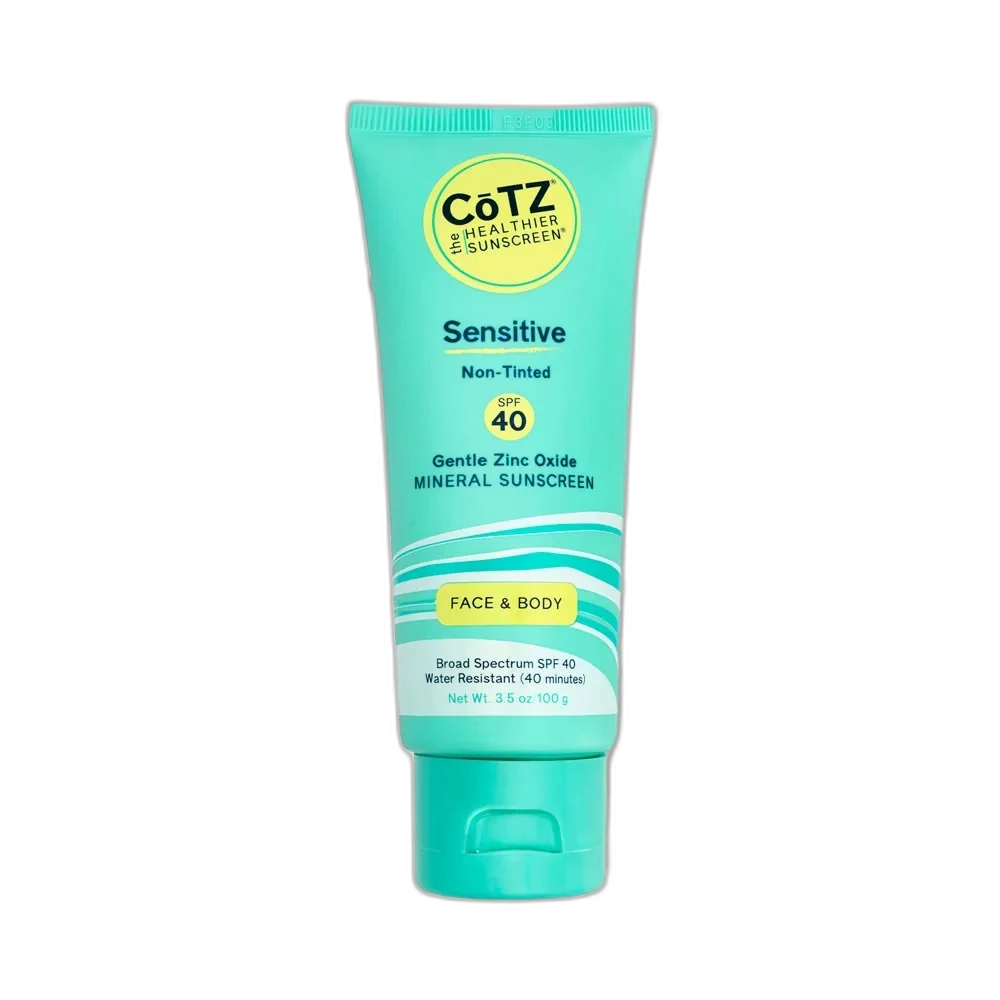
Sensitive SPF 40
Ultra-Sensitive Derm Pick
 Verified reviewer
Pros & cons.
- +13.5% mineral filter load for broad-spectrum SPF 40 without chemical filters
- +Genuinely stripped-back inactive deck optimized for contact-dermatitis-prone skin
- +Larger 3 oz size suitable for face-and-body daily use
- +No fragrance, essential oils, plant extracts, or denatured alcohol
- +Pregnancy and breastfeeding safe
- +Well-tolerated on rosacea, eczema, and post-procedure skin
- +Reasonable price for a dermatologist-recommended mineral sunscreen
- −Noticeable white cast, particularly on deeper skin tones
- −Thick texture requires patient blending
- −Not water-resistant for swimming or athletic use
- −No tint means no visible-light protection for melasma users
The full review.
Over the last decade, the word ‘sensitive’ on sunscreen labels has lost its meaning. Formulas for sensitive skin often include fragrance, essential oils, plant extracts, botanical actives, and chemical UV filters. These ingredients work for most people, but they trigger reactions in users with actual contact dermatitis, fragrance allergy, or chemical filter intolerance. People who need a non-reactive sunscreen struggle to find one because products target the middle of the sensitivity bell curve rather than the reactive end. Cotz Sensitive SPF 40 treats ‘sensitive’ as a formulation constraint rather than a marketing category. This approach earns it a place in dermatology and allergist offices nationwide.
The formula uses only the minimum necessary ingredients. Ten percent zinc oxide and 3.5% titanium dioxide provide broad-spectrum SPF 40 protection without any chemical UV filters. The inactive list is equally restrained: dimethicone and related silicones form the base; C12-15 alkyl benzoate and butyloctyl salicylate act as cosmetic emollients; sodium chloride stabilizes the emulsion; tocopheryl acetate adds antioxidant support; phenoxyethanol preserves the formula; and disodium EDTA handles chelation. That is all. There is no fragrance, no essential oils, and no denatured alcohol. There are no plant extracts, no botanical actives, no niacinamide, no peptides, and no centella. It lacks anything that could trigger contact dermatitis. The philosophy is “add nothing that isn’t structurally necessary,” resulting in one of the cleanest ingredient decks for an FDA SPF 40 sunscreen.
The tradeoff for this minimalism is cosmetic. This is not an invisible or tinted sunscreen. It is a thick white mineral lotion that leaves a noticeable cast. It takes 30 to 60 seconds of blending to reach a more natural finish. On light and medium skin tones, the cast fades within minutes. On deeper skin tones, a faint ashy quality remains, which may be a dealbreaker. If cast is your main concern, use one of the tinted Cotz formulas with iron oxides for better cosmetics and visible-light protection. But if you need a sunscreen that reliably avoids problems, the cosmetic compromise is worth it.
Sensitive SPF 40 is larger than Cotz’s face-only formulas. At 3 ounces, it is twice the size of the 1.5 oz Face Moisture tubes, making it a practical face-and-body sunscreen. For reactive skin, one product for the face, neck, chest, arms, and other exposed areas simplifies daily routines. Most users prefer one sunscreen for both face and body, especially when both require high tolerability. The 3 oz size lasts four to six weeks of face-and-body use, keeping the monthly cost reasonable for a dermatologist-tier mineral option.
Application technique matters more here than with thinner sunscreens. Use a quarter-teaspoon for the face, and closer to a half teaspoon for the face, neck, and chest. For the body, use approximately one ounce—about a shot glass—for full coverage. This is a large amount, and most users underapply body sunscreen by 50% or more. If you buy Sensitive SPF 40 to prevent contact dermatitis flare-ups, you must use the full dose. Underapplication reduces SPF proportionally and makes choosing a well-tolerated formula pointless.
Cotz Sensitive SPF 40 is a reliable, boring, dermatologist-approved choice for contact dermatitis patients, allergist referrals, users sensitive to fragrance or essential oils, eczema-prone users needing a face-and-body option, and post-procedure patients using the cleanest possible formula. It will not win beauty awards for texture or finish. It simply provides broad-spectrum UV protection without increasing the user’s reactivity burden—which is its purpose.
Formula
Ingredient analysis.
Full INCI list
Active Ingredients: Zinc Oxide 10%, Titanium Dioxide 3.5%. Inactive Ingredients: Water, C12-15 Alkyl Benzoate, Cyclopentasiloxane, Butyloctyl Salicylate, Styrene/Acrylates Copolymer, PEG-10 Dimethicone, Sorbitan Sesquioleate, Dimethicone, Caprylyl Methicone, Sodium Chloride, Disteardimonium Hectorite, Hydrogen Dimethicone, Triethoxycaprylylsilane, Phenoxyethanol, Tocopheryl Acetate, Propylene Carbonate, Disodium EDTA
Skin match.
The science.
The Science
Mineral sunscreens based on zinc oxide and titanium dioxide are the best-tolerated UV filter systems for sensitive and reactive skin populations. The published literature consistently identifies chemical UV filters — particularly oxybenzone, avobenzone, and octocrylene — as more common causes of photocontact dermatitis and allergic contact dermatitis than physical filters. For patients with diagnosed contact sensitivity, mineral-only formulations are the clinically preferred choice. The 13.5% total mineral filter load in Cotz Sensitive SPF 40 delivers a labeled SPF 40, which blocks approximately 97.5% of UVB radiation when applied at the correct dose of two milligrams per square centimeter of skin. The difference between SPF 40 and SPF 50 is modest in practical terms — SPF 50 blocks about 98% of UVB, a 0.5 percentage point advantage that matters most for very high-exposure users and high-risk populations but is not meaningful for typical daily office and commute exposure. For sensitive-skin users, the more important factor is the formulation's minimization of potential triggers. Fragrance, essential oils, botanical extracts, preservatives other than phenoxyethanol, and chemical UV filters are the most common sunscreen sensitizers documented in the literature, and Sensitive SPF 40's inactive deck avoids all of them except for phenoxyethanol, which has a relatively low sensitization rate. Zinc oxide itself is among the most hypoallergenic UV filters available, and titanium dioxide has a similar profile. The dimethicone base is also low-reactivity, though a small subset of users with silicone sensitivity may need to consider alternative formulations.
Dermatologist Perspective
Dermatologists and allergists routinely recommend 100% mineral sunscreens for patients with diagnosed contact dermatitis, photo-allergic reactions, fragrance allergy, and chronic sensitivity. The clinical guidance typically emphasizes avoiding fragrance, essential oils, and chemical UV filters while maintaining adequate broad-spectrum coverage. Board-certified dermatologists note that the ingredient most commonly implicated in sunscreen reactions is fragrance, and that eliminating it dramatically reduces the rate of adverse reactions in reactive populations. Cotz Sensitive SPF 40 is frequently recommended in dermatology and allergist offices for this exact use case, and the larger tube size makes it practical as a unified face-and-body option for patients who need tolerability across their whole routine. Compliance — actually wearing sunscreen consistently — matters more than any single SPF comparison, and a formula that a sensitive patient can wear reliably outperforms one with better numbers that causes reactions.
Where it fits in your routine.
Apply as the final step of your morning routine after moisturizer. Use a quarter-teaspoon for the face, or a half teaspoon for face and neck combined. For body application, use approximately one ounce for full body coverage. Blend patiently for 30–60 seconds to work the product into a uniform film. Reapply every two hours during meaningful sun exposure, after swimming (though this is not a true water-resistant formula), or after heavy sweating. Use year-round, not just in summer months. ### Value Assessment Twenty-two dollars for 3 ounces is one of the better per-ounce values in the dermatologist-recommended mineral sunscreen category. Comparable hypoallergenic mineral sunscreens from Vanicream, Blue Lizard Sensitive, and Neutrogena Sheer Zinc exist at similar or slightly lower price points, though each has slightly different inactive ingredient philosophies. What Cotz offers is a longer track record in dermatology office retail and a formulation specifically optimized for contact-dermatitis-prone users. The 3 oz size gives it a practical advantage for face-and-body use that the smaller Cotz face formulas don't match. ### Who Should Buy People with diagnosed contact dermatitis, fragrance allergy, or chemical UV filter intolerance. Eczema-prone users needing a face-and-body sunscreen that won't trigger flares. Post-procedure patients under dermatologist guidance to use stripped-back formulations. Pregnant and breastfeeding users seeking a straightforward mineral option. ### Who Should Skip People with deep skin tones who can't tolerate cast — look at tinted alternatives. Users working on melasma who specifically need visible-light protection — the tinted Cotz formulas or a dedicated iron-oxide sunscreen are better choices. Swimmers and athletes needing genuine water resistance.
Product details.
All Year Background
The backstory.
Sensitive SPF 40 has lived in the Cotz lineup for well over a decade as the brand's stripped-back option for the most reactive users. It's frequently recommended by allergists and dermatologists for patients with contact dermatitis, fragrance allergy, or chemical UV filter intolerance, and the larger tube size reflects its intended role as a face-and-body sunscreen for daily use.
About Cotz
Established Brand (5–20 years)Cotz has 20 years of experience as a US mineral sunscreen specialist for reactive-skin patients. Sensitive SPF 40 is the brand's face-and-body formulation for the most reactive users. Dermatology and allergist offices frequently stock it for patients with contact dermatitis and fragrance intolerance.
Common myths.
Sensitive-skin sunscreens always have lower efficacy than regular sunscreens.
Sensitive SPF 40 uses a 13.5% mineral filter load, matching many mainstream mineral formulas. Removing potential triggers ensures tolerability for sensitive skin without lowering UV protection.
SPF 40 is meaningfully weaker than SPF 50.
SPF 40 blocks about 97.5% of UVB, while SPF 50 blocks 98%. This difference is small. Applying the correct dose of any SPF 30+ sunscreen matters more than the label number.
FAQ.
Is Cotz Sensitive SPF 40 good for contact dermatitis?
Yes — this is a primary use case. The formula removes fragrance, essential oils, plant extracts, and chemical UV filters that most often trigger contact dermatitis. Many dermatologists and allergists recommend it for patients with diagnosed contact sensitivities.
Can I use Cotz Sensitive SPF 40 on my body too?
Yes — that is why the tube is 3 oz instead of the 1.5 oz size used for face-only formulas. The texture and tolerability work for both face and body, making it a practical single-product choice for sensitive-skin routines.
Is Cotz Sensitive pregnancy safe?
Yes. Zinc oxide and titanium dioxide are safe physical UV filters during pregnancy and breastfeeding. The formula has no chemical filters, retinoids, or other ingredients of pregnancy concern.
What's the difference between Cotz Sensitive SPF 40 and Cotz Face Moisture SPF 35?
Sensitive SPF 40 uses a higher mineral filter load (13.5% vs 12%) for higher SPF. It comes in a larger 3 oz size for face-and-body use and has a stripped-back inactive deck for contact-dermatitis-prone skin. Face Moisture SPF 35 is for the face and has a more cosmetic feel.
Does Cotz Sensitive leave a white cast?
Yes, the cast is noticeable on first application but fades to mostly natural on light to medium skin tones. Deep skin tones show a more persistent cast. If cast concerns exist while treating pigmentation, the tinted Cotz formulas with iron oxides work better.
Is this sunscreen water resistant?
This formula is not for swimming or heavy sweat activity. Cotz makes a specific water-resistant formula for beach, pool, or athletic use.
What the community says.
"Genuinely non-reactive on allergy-prone skin"
"Larger size for face and body use"
"No stinging or burning"
"White cast on deeper skin tones"
"Thick texture needs patient blending"
"Not water-resistant for serious swim time"
People also looked at.