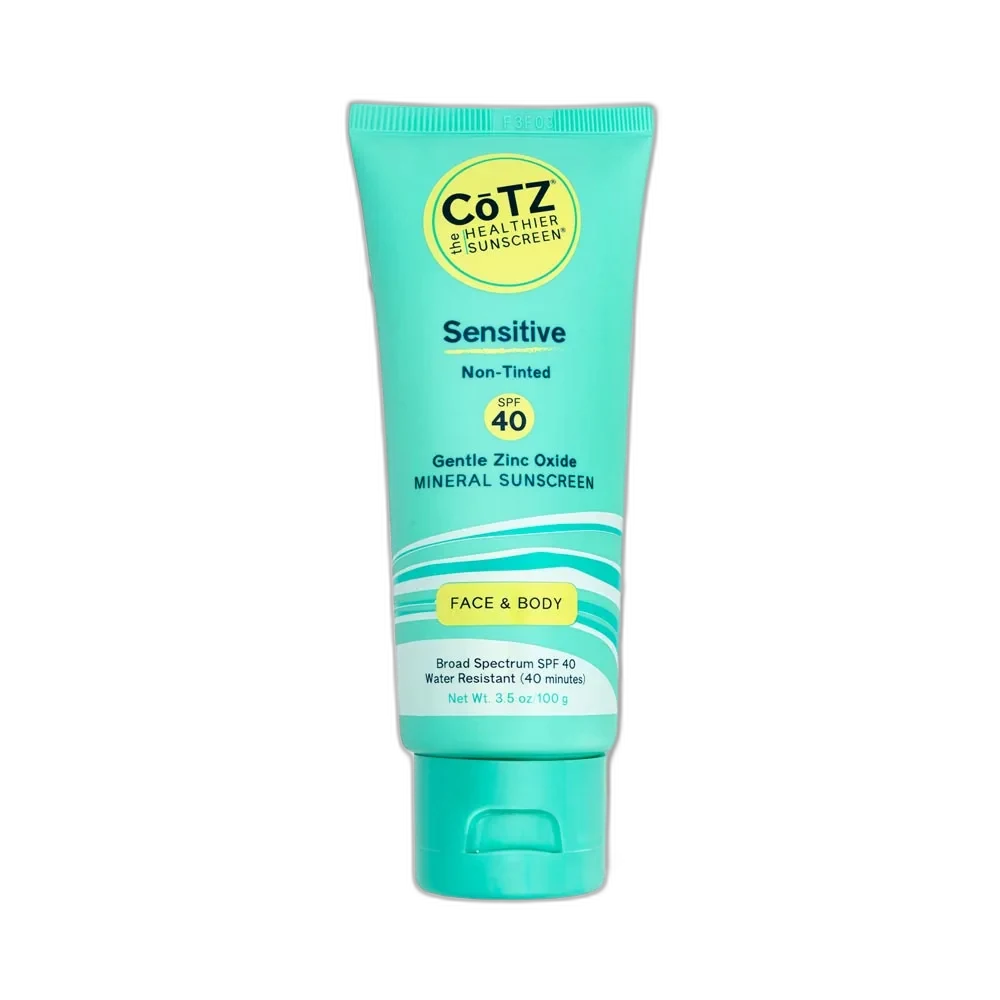
Sensitive SPF 40 Mineral Sunscreen
Derm Office Sensitive Skin Staple
 Verified reviewer
Pros & cons.
- +Maximum allowable 20% zinc oxide for true broad-spectrum protection
- +No chemical filters, titanium dioxide, or fragrance to trigger sensitive skin
- +Fragrance-free formulation appropriate for rosacea and post-procedure use
- +Skin Cancer Foundation Seal of Recommendation
- +Safe for children six months and older
- +Reef-safe and compliant with Hawaii and Key West sunscreen regulations
- +Fair price relative to dermatologist-office sensitive-skin sunscreens
- −Significant white cast on medium and deep skin tones
- −Thick texture requires firm rubbing to blend
- −Not the most cosmetically elegant option for everyday use
- −Only 40 minutes of water resistance
The full review.
Most sunscreens prioritize cosmetic elegance over skin tolerance. Formulators choose a finish—weightless, invisible, or glowy—to match trends, then fit UV protection into those constraints. This works for consumers with healthy, resilient skin. It fails the patients dermatologists see most: people with rosacea reacting to fragrance or certain filters, those recovering from lasers or chemical peels with compromised barriers, children whose thin skin absorbs chemical filters more easily than adults, and patients with photosensitive conditions needing maximum UV blocking. Cotz targets this second group. The name—an acronym for ‘Contains Only Titanium and Zinc’—defines the design brief, and the Sensitive SPF 40 formulation is the line’s most disciplined product. It uses 20% zinc oxide, the maximum FDA-allowed concentration, with no titanium dioxide and no chemical filters. Nothing else exists in the sunscreen actives profile. That simplicity is the value proposition. Twenty percent zinc oxide provides as much broad-spectrum protection as any commercial mineral sunscreen. Because it lacks chemical filters or blended titanium, nothing in the active profile triggers photosensitive or sensitive-skin reactions. Dermatologists recommend this for patients recovering from ablative lasers, chemical peels, or Mohs surgery. Rosacea patients whose skin flares from mild irritants can reliably tolerate it. For parents, it is fragrance-free, chemical-filter-free, and safe for daily use. The inactive ingredients follow this discipline. A silicone emollient matrix—dimethicone, cyclomethicone, and silicone crosspolymers—suspends the high zinc concentration evenly to prevent the clumping and patchiness 20% zinc often causes in aqueous emulsion bases. It includes trace amounts of tetrahexyldecyl ascorbate (a stable fat-soluble vitamin C) and tocopheryl acetate (vitamin E) for antioxidant support, which most pure mineral sunscreens omit. There is no fragrance, no essential oils, and no botanical extracts to trigger allergic reactions. The ingredient list reads like a dermatologist’s prescription, not a marketing deck. The user experience shows the tradeoffs. This is a thick, opaque white lotion. It does not blend weightlessly. You must dispense a generous amount—a quarter-teaspoon for the face to meet the SPF rating—warm it between fingertips, and work it into skin in sections. On fair to light skin, the white cast fades to a soft matte finish after one minute. Medium skin tones show a pale ghostiness that looks okay in natural daylight but may photograph oddly in flash. Deep skin tones show a significant white cast; use a tinted alternative like Cotz Face Natural Skin Tone or a different brand’s deep-tone mineral formula. This is the honest limitation of high-percentage zinc oxide sunscreens, and Cotz does not pretend otherwise. The price is reasonable. At $31 for 100g, you pay mid-market for a formulation that rivals dermatologist-office sunscreens costing twice as much. One tube lasts about two months with face-only daily use. This costs roughly $15 per month for maximum-zinc broad-spectrum protection—a good deal for prescription-adjacent sunscreens. Overall, this sunscreen earns the ‘if you need it, you really need it’ designation. It lacks cosmetic elegance and is not for those who dislike white cast. But for sensitive skin, post-procedure recovery, pediatric use, or anyone prioritizing maximum broad-spectrum protection over aesthetics, it is one of the best mineral sunscreens available—and it has held its place in dermatology offices for two decades.
Ingredient analysis.
Full INCI list · pH 7
Active: Zinc Oxide 20%. Inactive: Water, C12-15 Alkyl Benzoate, Cyclopentasiloxane, Cyclohexasiloxane, PEG-10 Dimethicone, Dimethicone, Dimethicone Crosspolymer, Glycerin, Polyhydroxystearic Acid, Dimethicone/Vinyl Dimethicone Crosspolymer, Dimethiconol, Cetyl PEG/PPG-10/1 Dimethicone, Triethoxycaprylylsilane, Hydrogen Dimethicone, Polyglyceryl-4 Isostearate, PEG-30 Dipolyhydroxystearate, Microcrystalline Wax, Stearyl Dimethicone, Polysorbate 20, Tetrahexyldecyl Ascorbate, Tocopheryl Acetate, Sodium Chloride, Caprylyl Glycol, Caprylhydroxamic Acid, Disodium EDTA, Triethanolamine
Skin match.
The science.
The Science
This formulation relies on one of dermatology's strongest evidence bases: zinc oxide as a broad-spectrum UV filter. Zinc oxide at 15% or higher provides broad-spectrum protection against UVB and the full UVA range, including UVA1, which causes most photoaging and escapes older chemical filters. Peer-reviewed research shows zinc oxide protects by reflecting, scattering, and absorbing UV radiation. At 20%, this formulation uses the maximum concentration allowed under FDA monograph regulations, reaching the highest protection a US over-the-counter mineral sunscreen can legally claim. The single-active approach—zinc oxide without titanium dioxide or chemical filters—prevents the interactions and compatibility issues found in blended filter systems, and it removes every known photosensitizer and potential allergen from the active profile. The silicone-based inactive formulation is a deliberate cosmetic chemistry choice. Dimethicone and cyclomethicone create an even dispersion matrix for the zinc oxide particles, which prevents clumping, patchy application, and inconsistent UV coverage. The silicone matrix also aids water resistance, though the product's 40-minute claim is modest compared to beach-specific formulations. Adding tetrahexyldecyl ascorbate and tocopheryl acetate provides supplemental antioxidant defense against residual UV-induced free radicals, matching dermatological recommendations for antioxidant-plus-sunscreen combinations. The absence of fragrance, essential oils, and botanical extracts minimizes allergen exposure, making this product one of the safest options for patients with contact sensitivities or compromised barriers. Clinical evidence for zinc oxide sunscreens in rosacea and post-procedure populations consistently favors high-zinc formulations over blended or chemical alternatives.
Dermatologist Perspective
Dermatologists widely recommend high-concentration zinc oxide sunscreens as first-line options for patients with sensitive skin, rosacea, post-procedure recovery needs, and pediatric photoprotection. Board-certified dermatologists note that 20% zinc oxide is the maximum mineral UV protection available in an over-the-counter formulation. This specific concentration is commonly prescribed for patients recovering from laser resurfacing, chemical peels, and other procedures where barrier compromise makes chemical filter sunscreens unsuitable. Cotz has earned dermatologist recommendation for nearly two decades because its formulation aligns with clinical needs—fragrance-free, single-active, and appropriate for the most reactive skin populations. For pediatric use, dermatologists frequently recommend this category of mineral sunscreen over chemical filter alternatives because children's thinner skin absorbs topical ingredients more readily and their endocrine systems are more sensitive to certain chemical filters. Patients most commonly cite the white cast as a limitation; dermatologists typically acknowledge it while emphasizing that maximum UV protection matters more than cosmetic elegance for clinical populations.
Where it fits in your routine.
Apply a generous amount to clean, moisturized skin as your last morning step. Use about a quarter-teaspoon for the face, or a full tablespoon for the face, neck, and décolletage. Warm the product between fingertips and rub into skin in sections, blending well to reduce white cast. Let it set for one to two minutes before applying makeup. Reapply every two hours when in the sun or after sweating, swimming, or towel drying. Consult a pediatrician before use for children under two years old. Do not apply to damaged or broken skin unless a dermatologist directs you to.
At $31 for 100g, this sunscreen sits in the middle of the mineral sunscreen market and offers good value for a 20% zinc oxide formulation. Cotz delivers more zinc for less money per milliliter than dermatology-office alternatives like EltaMD UV Pure ($33 for 56ml, lower zinc percentage) or SkinCeuticals Sheer Physical ($38 for 50ml, blended filters). Drugstore alternatives from Blue Lizard or Neutrogena Sheer Zinc cost less but usually use lower zinc concentrations and include titanium dioxide or additional filters. Cotz lacks a larger body-size version of this specific formulation, which limits value for extended outdoor use. The verdict: a good value for users who need maximum zinc concentration in a fragrance-free formulation; it is fairly priced against direct competitors.
Sensitive, rosacea-prone, or reactive skin types get maximum broad-spectrum protection without fragrance or chemical filters. It works well for users recovering from laser treatments, chemical peels, or other dermatological procedures. It is also a strong pick for parents seeking a pediatric-safe family sunscreen and for anyone prioritizing reef-safe, fragrance-free mineral protection over cosmetic elegance.
Users with medium to deep skin tones who dislike white cast should use tinted mineral alternatives like EltaMD UV Elements, ILIA Super Serum Skin Tint, or a Cotz tinted option. Skip this if you want weightless, invisible finishes for daily makeup. Skip this if you spend much time in water — the 40-minute water resistance is lower than beach-specific sunscreens.
Product details.
Thick opaque white lotion that requires firm rubbing to blend
Fragrance-free with faint neutral mineral note
White squeeze tube with flip cap
Apply about a quarter teaspoon to the face in sections, warming it between fingertips to spread. A visible white cast appears during application but settles into a lighter finish after one to two minutes; users with medium to deep skin tones will see residual ghostiness. The formula sets to a matte finish that works under makeup.
Use daily on the face for about 2 months, or apply to the full body for 3-4 weeks.
12 months
All Year
The backstory.
Cotz was founded in 2004 by a team focused specifically on mineral-only sunscreen for sensitive skin and photosensitive conditions. The brand name is an acronym — 'Contains Only Titanium and Zinc' — though this specific Sensitive formulation drops the titanium dioxide entirely in favor of a single-active 20% zinc approach for maximum gentleness.
About Cotz
Legacy Brand (20+ years)Dermatologists developed Cotz (which stands for 'contains only titanium and zinc') in 2004 as a dedicated mineral sunscreen brand. Dermatologists treating photosensitive skin, post-procedure patients, and pediatric users long recommend the line. Dermatology offices and medical distribution channels commonly stock it.
Common myths.
Mineral sunscreens are less effective than chemical sunscreens.
A 20% zinc oxide formulation like this provides broad-spectrum UVA and UVB protection that meets or exceeds most chemical sunscreens. The efficacy gap narrowed once high-concentration zinc formulations became widely available; today, differences are aesthetic, not protective.
Non-nano zinc oxide works less effectively than the nanoparticle version.
Non-nano and nano zinc oxide provide the same UV protection at equal concentrations. Particle size affects appearance and spreadability, not efficacy. A white cast usually means the formulation uses larger non-nano particles for safety or aesthetics, not because it underperforms.
FAQ.
How does this compare to EltaMD UV Pure?
Both are zinc-plus-titanium or zinc-only mineral sunscreens for sensitive skin. Cotz Sensitive uses 20% zinc oxide alone. EltaMD UV Pure uses a 10% zinc oxide plus 5.5% titanium dioxide blend. Cotz has more zinc and no titanium; EltaMD has less white cast and a smoother feel. Choose based on whether you want maximum zinc or better aesthetics.
Is this safe for babies and children?
Yes — pediatric dermatologists often recommend this fragrance-free, chemical-filter-free formulation for children six months and older. Kids care less about cosmetic elegance than the thick texture and white cast.
Will this work under makeup?
Yes, if you are patient. Apply a thick layer, wait one to two minutes to set, then apply primer and foundation. The silicone matrix helps makeup layer cleanly. Darker foundations may need a drop of skin-tone moisturizer to balance the white cast.
How much white cast should I expect?
The 20% zinc oxide has no tint, so the white cast shows on medium to dark skin tones. Fair to light skin users see minimal residue after full blending; medium tones see pale ghostiness; deep skin tones see a significant white cast that may not work for daily use without a tinted alternative.
Is this reef-safe?
Yes — the zinc-only, chemical-filter-free formulation meets most reef-safe sunscreen guidelines. Hawaii, Key West, and other jurisdictions that banned oxybenzone and octinoxate allow it.
How long will a 100g tube last?
Use on the face daily for about two months. Use on the face and neck for closer to six weeks. One tube covers two to three full-body applications for beach days or outdoor activities.
Can I use this on the beach?
Yes, but note the water resistance claim lasts only 40 minutes. Reapply every 40 minutes in water or after heavy sweating. Apply generously; mineral sunscreens show lower SPF ratings when applied sparingly.
What the community says.
"Zero irritation even on rosacea skin"
"Maximum zinc concentration for true broad-spectrum"
"No chemical filters or fragrance"
"Safe for post-procedure recovery"
"Reliable family sunscreen"
"Noticeable white cast on medium and dark skin tones"
"Thick texture requires patience to blend"
"Not as cosmetically elegant as tinted or chemical alternatives"
Featured in.
People also looked at.