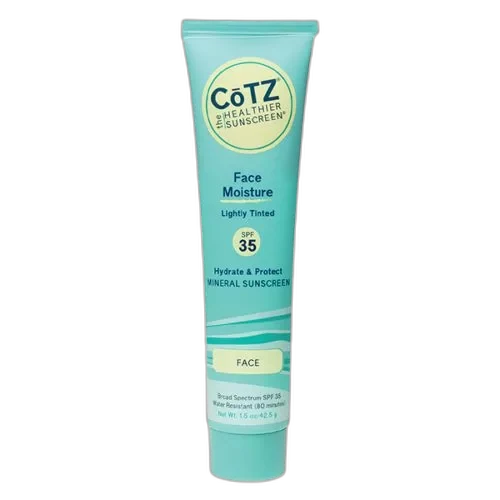
Face Moisture SPF 35
Derm Office Mineral Standby
 Verified reviewer
Pros & cons.
- +100% mineral formulation with 9.1% zinc oxide and 2.9% titanium dioxide
- +No fragrance, essential oils, or common sensitizers
- +Reliably well-tolerated on rosacea and post-procedure skin
- +Doesn't sting around the eyes the way chemical sunscreens often do
- +Pregnancy safe and appropriate for long-term daily use
- +Reasonable price for a dermatologist-recommended mineral formula
- +Layers adequately under foundation and tinted moisturizers
- −Noticeable white cast on deeper skin tones
- −Older-generation texture compared to newer mineral formulas
- −Not water-resistant enough for swimming or heavy sweating
- −Thicker feel than the latest invisible mineral sunscreens
The full review.
There’s a specific moment in a dermatology office where a product earns a recommendation or loses one forever. It’s the moment a patient who just had a chemical peel, a laser treatment, or a diagnosis-confirming rosacea flare is standing at the reception desk, asking what sunscreen they should wear tomorrow morning. The answer can’t be aspirational or trendy. It has to be reliable. It has to not sting. It has to not contain the ingredients that most commonly trigger reactions. It has to provide enough broad-spectrum protection to actually prevent the post-procedure pigmentation and flare-up cycle patients are most afraid of. Cotz Face Moisture SPF 35 is one of the products that’s been holding down that specific role in dermatology offices for nearly two decades, and understanding what makes it fit for that job tells you most of what you need to know about whether it’s right for you.
The formulation is intentionally unambitious. Zinc oxide at 9.1% does the heavy lifting — it’s the broader-spectrum of the two mineral filters, handling UVA1 wavelengths that cause the majority of photoaging damage plus a substantial chunk of the UVB range. Titanium dioxide at 2.9% reinforces the UVB side of the curve where zinc is slightly less efficient. The two together give a broad-spectrum profile that doesn’t depend on any chemical filters whatsoever. The inactive ingredient list is equally restrained. Dimethicone and related silicones form the base, which is what gives the product enough slip to spread evenly rather than dragging across the skin like traditional zinc paste. C12-15 alkyl benzoate and butyloctyl salicylate are cosmetic emollients that improve texture. Tocopheryl acetate adds antioxidant support. There’s no fragrance, no denatured alcohol, no essential oils, no plant extracts, no niacinamide, no actives of any kind beyond the UV filters themselves. That restraint is the whole point.
The trade-off for that clean profile is that the texture is a generation behind the most modern mineral sunscreens. Newer formulas from brands like Supergoop and EltaMD and ISDIN have achieved a lighter, more invisible application through refined zinc particle sizes and newer silicone-dispersion technology. Cotz Face Moisture is not invisible. On first application, it sits slightly white, and takes thirty to sixty seconds of patient blending to settle into a mostly natural finish. On light to medium skin tones, the cast fades to something most users find acceptable. On deeper skin tones, a faint ashy quality remains visible, which will be a dealbreaker for some users and a reasonable compromise for others. If seamless invisibility is your priority, this isn’t the formula for you.
What Cotz trades in cosmetic elegance, it gets back in tolerability. The stinging that’s common with chemical sunscreens on rosacea-prone skin or around the eyes simply doesn’t happen with this formula. Post-procedure patients who’ve just had a peel or a laser session can apply it the next morning without flaring. People whose skin reacts to fragrance, essential oils, or common preservatives can use it without working through a checklist of potential triggers. That reliability is why dermatologists keep recommending it despite newer options being technically more elegant — the specific patient population it serves prioritizes not-reacting over looking-invisible.
Application technique matters more with this sunscreen than with a chemical alternative. The correct dose for the face is a quarter-teaspoon, and for face plus neck, about half a teaspoon. This is considerably more product than most people instinctively use, and underapplication is the most common reason users feel a sunscreen ‘isn’t working.’ If you apply Cotz at the correct dose, you’ll get the SPF 35 protection on the label. If you apply it at the two-finger dab most people use, you’ll get substantially less, and the white cast complaint tends to disappear because there’s not enough product on your skin to show cast in the first place — which is the wrong way to solve the cast problem. The silicone base layers reasonably well under foundation and tinted moisturizers, though you’ll want to wait two to three minutes for it to set before applying makeup to avoid pilling.
Durability and reapplication are where SPF 35 has a practical disadvantage for some use cases. At 1.5 ounces in a squeeze tube, a single tube will last most users six to eight weeks of daily face application, which puts the per-month cost in a reasonable range. The water resistance isn’t rated for swimming or intense sweat-driven activities — for beach and pool use, Cotz makes a separate water-resistant formula that’s a better pick. For daily office, commuting, and moderate outdoor exposure, Face Moisture SPF 35 is adequate with reapplication every two hours when sun exposure is meaningful.
For the rosacea patient, the post-procedure client, the fragrance-reactive user, the pregnant or breastfeeding person looking for a straightforward mineral option, the parent who wants a sunscreen that won’t sting when it migrates into their eyes during chaotic mornings, Cotz Face Moisture SPF 35 is a reliable, boring, non-aspirational choice — and boring is exactly what the use case calls for.
Ingredient analysis.
Full INCI list
Active Ingredients: Zinc Oxide 9.1%, Titanium Dioxide 2.9%. Inactive Ingredients: Water, C12-15 Alkyl Benzoate, Cyclopentasiloxane, Butyloctyl Salicylate, Styrene/Acrylates Copolymer, PEG-10 Dimethicone, Sorbitan Sesquioleate, Dimethicone, Caprylyl Methicone, Sodium Chloride, Disteardimonium Hectorite, Hydrogen Dimethicone, Triethoxycaprylylsilane, Phenoxyethanol, Tocopheryl Acetate, Propylene Carbonate, Disodium EDTA
Skin match.
The science.
The Science
Broad-spectrum UV protection is a top-validated dermatological intervention for preventing photoaging, skin cancer, and pigmentation. Zinc oxide is the broadest-spectrum UV filter in topical formulations; it covers UVA1 through UVB by reflecting, scattering, and absorbing light. Titanium dioxide works slightly better in the UVB range and often pairs with zinc to balance the broad-spectrum curve. With 9.1% zinc and 2.9% titanium dioxide, this formula's filter load achieves a labeled SPF of 35 and meaningful UVA protection if applied at the correct dose—roughly two milligrams per square centimeter of skin, or about a quarter-teaspoon for the face. Published research shows consumers usually apply only one-third to one-half of this dose, which drops the actual SPF to a fraction of the labeled number. Mineral filters offer better tolerability than chemical filters for sensitive, reactive, and post-procedure skin, as chemical filters more often cause stinging, contact dermatitis, and allergic reactions. Cotz's formulation also excludes fragrance, essential oils, and plant extracts, which are common triggers for reactive skin. The ingredient deck cannot predict individual tolerance; even 100% mineral sunscreens can cause issues for users with specific preservative or silicone sensitivities, though the rate is very low.
Dermatologist Perspective
Dermatologists routinely recommend 100% mineral sunscreens for patients with rosacea, melasma, post-procedure recovery needs, chronic sensitivity, and known chemical UV filter intolerance. Clinical preference for mineral over chemical in these groups is well-established by tolerability data and mechanistic logic—zinc oxide and titanium dioxide do not absorb into the skin like some chemical filters, and they do not use plant or fragrance co-ingredients that trigger reactions. Board-certified dermatologists note that consistent daily use at the correct dose is the most important factor in sunscreen effectiveness; a sunscreen a patient actually wears beats one with better technical numbers that stays in the bottle. Cotz Face Moisture SPF 35 stays in derm office retail because patients tolerate it reliably and apply it consistently.
Where it fits in your routine.
Apply this as the final morning step after moisturizer. Use a quarter-teaspoon for the face or half a teaspoon for the face and neck. Blend for 30–60 seconds until it forms a uniform film. Wait 2–3 minutes before applying foundation or tinted moisturizer to prevent pilling. Reapply every two hours during sustained sun exposure, after swimming, or after heavy sweating. Use year-round because UVA exposure stays consistent across seasons.
Twenty-five dollars for 1.5 ounces puts Cotz Face Moisture SPF 35 in the mid-range for dermatologist-recommended mineral sunscreens. Comparable products from EltaMD, La Roche-Posay, and Neutrogena's Sheer Zinc line exist at similar or slightly lower price points, sometimes with more modern textures. What Cotz offers is a slightly cleaner inactive ingredient deck than some competitors and a long track record of use in dermatology offices. It's not the cheapest mineral sunscreen, but it's a fair price for the reliability.
People with rosacea, sensitivity, or chronic reactivity who want a non-irritating daily sunscreen. Post-procedure patients. Pregnant and breastfeeding users seeking a simple mineral option. Anyone who reacts to fragrance or essential oils in conventional sunscreens.
People with deep skin tones who cannot tolerate a cast will prefer a tinted mineral or newer-generation invisible formula. Users need water resistance for swimming or heavy sweat. Those prioritizing a completely invisible finish for wear under makeup will also prefer these.
Product details.
Medium-weight mineral lotion that spreads evenly with patience
Fragrance-free with a faint neutral silicone note
Squeeze tube — simple and functional, limits air exposure to protect the filters
Applying this takes 30–60 seconds to blend, longer than a chemical sunscreen. Once set, it leaves a mostly natural finish. A slight white cast fades on lighter skin tones and stays faintly visible on deeper tones.
Approximately 6–8 weeks with daily face application at proper usage levels
12 months
All Year
The backstory.
Cotz launched in 2005 as a US mineral sunscreen specialist at a moment when 'mineral' still meant thick white paste for most consumers. Face Moisture SPF 35 was one of the brand's early face-specific launches, engineered to deliver dermatologist-grade mineral coverage in a texture patients would actually wear. It has quietly held its place in derm office retail for close to two decades.
About Cotz
Established Brand (5–20 years)Cotz (Consumer Oriented Technologies Z) is a US-based sunscreen brand founded in 2005. It specializes in 100% mineral formulations for sensitive and reactive skin. Dermatologist offices widely carry Cotz (Consumer Oriented Technologies Z) and recommend it for post-procedure patients, even if the brand lacks mass market awareness.
Common myths.
Mineral sunscreens are always greasy or chalky.
Modern mineral formulas like this one use silicone bases and refined particle sizes to reduce cast and improve spread. Cotz Face Moisture isn't invisible, but it's a long way from the zinc-stick beach pastes of twenty years ago.
SPF 35 isn't high enough for daily use.
SPF 30 blocks 97% of UVB, while SPF 50 blocks 98%. This difference is smaller than the numbers show. Reapplication and using enough product matters more—use a quarter-teaspoon for the face.
FAQ.
Is Cotz Face Moisture SPF 35 good for rosacea?
Yes — this is a primary use case. The 100% mineral formulation has no fragrance, alcohol, or essential oils, which minimizes trigger risk for rosacea-prone skin. Many dermatologists recommend it as a daily sunscreen for rosacea patients.
Does Cotz leave a white cast?
A minor point. On light to medium skin tones, it fades to mostly natural within one or two minutes of application. On deeper skin tones, a faint ashy cast shows. Users with deep skin tones may prefer a tinted mineral formula.
Is Cotz safe after a chemical peel or laser treatment?
Yes. Dermatologists often recommend Cotz Face Moisture for post-procedure patients. Its fragrance-free, essential-oil-free mineral formula works well on compromised skin. Apply it as the final step in your morning routine.
Is Cotz Face Moisture pregnancy safe?
Yes. Zinc oxide and titanium dioxide are safe physical UV filters during pregnancy and breastfeeding. The formula contains no chemical UV filters or other ingredients of concern.
How much Cotz should I apply?
Use a quarter-teaspoon for the face, or about half a teaspoon for the face and neck. This amount reaches the labeled SPF. Most users apply half or less of this amount, which reduces actual protection.
Can I wear makeup over Cotz Face Moisture?
Yes. The silicone base plays well under most foundations and tinted moisturizers. Let Cotz set for 2–3 minutes before layering makeup to avoid pilling.
What the community says.
"Genuinely non-irritating on reactive skin"
"No stinging around eyes"
"Safe after procedures"
"Slight white cast on deeper skin tones"
"Thicker feel than modern mineral formulas"
"Not water-resistant enough for beach use"
Featured in.
People also looked at.