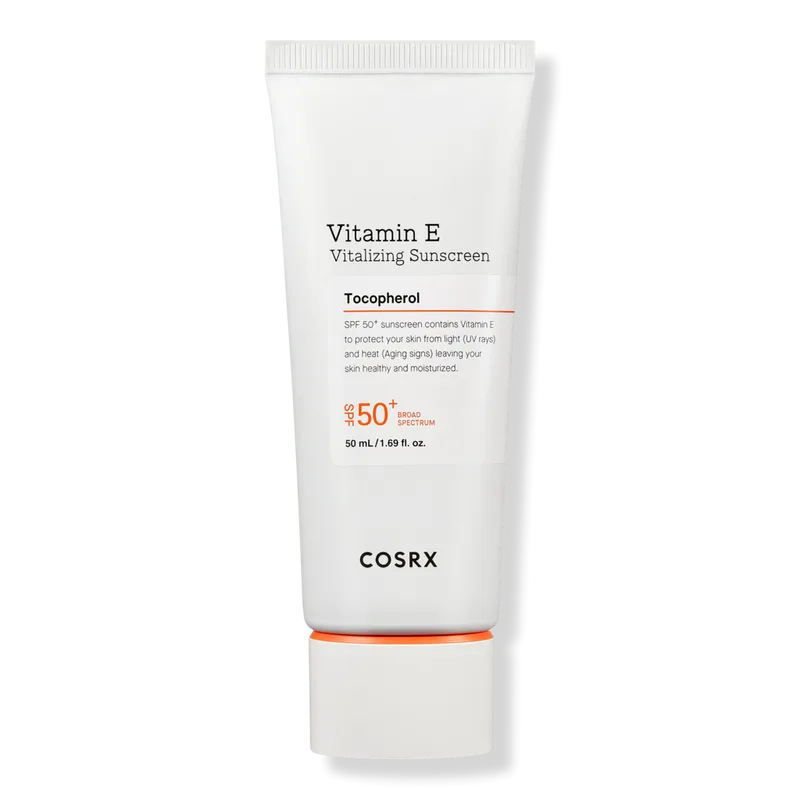
Vitamin E Vitalizing Sunscreen SPF 50
K-Beauty SPF Pick
 Verified reviewer
Pros & cons.
- +Reliable four-filter SPF 50 system with photostabilized avobenzone for genuine broad-spectrum protection
- +Absolutely zero white cast on all skin tones — truly invisible on the skin
- +Moisturizing enough to replace morning moisturizer for dry skin types
- +Vitamin E and cocoa extract antioxidants provide meaningful free radical defense beyond UV filtering
- +Smooth, creamy application with no pilling or balling up under makeup
- +Cruelty-free, vegan, and reef-friendly formulation
- +Sturdy, travel-friendly tube packaging with hygiene seal
- −Dewy finish is excessively shiny on oily and combination skin types
- −Contains added fragrance — a surprising choice for a brand built on minimalism
- −Small 50 mL tube runs out in 4-6 weeks with proper daily application
- −Can sting eyes if product migrates with sweat throughout the day
- −Takes noticeably long to absorb, leaving a heavy film during the wait
The full review.
COSRX built its reputation using snail secretion filtrate and minimal ingredient lists for no-nonsense skincare users. When the brand released a sunscreen in 2022, the question wasn’t if it would work—COSRX rarely misses on formulation basics—but if a brand known for treatment products could make a daily SPF worth using every morning.
The answer depends on your skin type.
Formula
The Vitamin E Vitalizing Sunscreen SPF 50 uses a four-filter chemical system: avobenzone at 2.5% handles UVA protection, while homosalate and octocrylene (both at 9%) plus octisalate at 4.5% cover the UVB spectrum. This combination is well-established. The octocrylene acts as both a UVB absorber and a photostabilizer for the UV-labile avobenzone, so your UVA protection doesn’t degrade as fast during use. It isn’t a cutting-edge filter system—you won’t find newer-generation filters like Tinosorb here—but it is proven, reliable, and FDA-approved.
Texture
This sunscreen differs from other SPF 50 options because it feels like skincare rather than sun protection. The base contains dimethicone, cyclopentasiloxane, and film-forming polymers that create a creamy, lotion-like application. It lacks the tight, plasticky feeling many chemical sunscreens have. Instead, it glides on like a lightweight moisturizer, absorbs (after a full two minutes), and leaves a dewy, luminous finish that dry skin types will find hydrating.
Works for
The vitamin E in this sunscreen is more than a label claim. Tocopherol appears toward the end of the ingredient list, so concentrations aren’t therapeutic, but its presence is strategically sound. Research in Molecular Carcinogenesis showed that alpha-tocopherol prevents UV-induced DNA damage through cellular uptake, not just surface-level UV absorption. Here, the vitamin E works with the chemical filters to mop up free radicals that the filters generate during UV absorption. It acts as a cleanup crew for the protection squad. Cocoa extract and cotton seed extract add botanical antioxidant support and polyphenols to the free-radical defense.
Best for
Opinions diverge on the texture. If you have dry or normal skin, this sunscreen feels like a warm hug for your moisture needs. It is thick without being heavy and protective without being oppressive, leaving skin looking healthy rather than greasy. Users with dry skin could skip their morning moisturizer because it is that emollient.
Not ideal for
This sunscreen tests the patience of those with oily or combination skin. The dewy finish dry skin types like translates to a persistent, glossy shine on oily complexions. Multiple users report looking like they applied a glaze to their face hours after application. Setting powder helps, but adding a sunscreen that contributes to midday shine isn’t ideal.
Scent
There is also a fragrance issue. COSRX includes Fragrance/Parfum in the formula, which is an odd choice for a brand built on skin-first minimalism. Users describe the scent as soapy, like old-fashioned lotion, or vaguely floral. It isn’t overwhelming and fades within a few minutes, but for a brand whose audience seeks low-irritant formulations, including unnecessary fragrance in a daily product is a miss.
Common Praise
The zero white cast is real. Chemical sunscreens don’t leave a white cast like mineral filters, but some formulas still look chalky or ashy on deeper skin tones. This one disappears completely. It is invisible on every skin tone, which is what you want from a daily SPF.
Packaging
The packaging is classic COSRX: a clean white tube that is sturdy enough for travel. However, the 50 mL size is small for a sunscreen. If you apply the dermatologist-recommended amount for face and neck (about a quarter teaspoon), you will use this tube in four to six weeks. At $23, that is roughly $5-6 per month on sunscreen—not outrageous, but not a value play, especially since many competing SPF 50 formulas offer 75-100 mL for similar prices.
Common Complaints
Some users report eye-stinging. Chemical UV filters, particularly avobenzone and homosalate, can migrate with sweat and irritate the eye area. This isn’t unique to the COSRX formula, but it is a known trade-off with chemical sunscreens to consider if you sweat or apply near the eyes.
Summary
This sunscreen provides reliable broad-spectrum protection in a moisturizing, dewy vehicle that dry skin types will enjoy wearing daily. The vitamin E and cocoa extract antioxidants add a layer of environmental defense. However, the fragrance, small size, and intense shine on non-dry skin prevent it from being a universal recommendation.
Ingredient analysis.
Full INCI list
Active Ingredients: Avobenzone 2.5%, Homosalate 9%, Octocrylene 9%, Octisalate 4.5%. Inactive Ingredients: Water, Propanediol, Butyloctyl Salicylate, Diphenylsiloxy Phenyl Trimethicone, Dimethicone, VP/Eicosene Copolymer, Silica, Trisiloxane, Cyclopentasiloxane, Trimethylsiloxysilicate, 1,2-Hexanediol, Behenyl Alcohol, Glyceryl Stearate, PEG-100 Stearate, C14-22 Alcohols, Cetyl Alcohol, Potassium Cetyl Phosphate, Polyacrylate-13, Polyisobutene, Fragrance/Parfum, C12-20 Alkyl Glucoside, Butylene Glycol, Disodium EDTA, Ethylhexylglycerin, Polysorbate 20, Sorbitan Isostearate, Dextrin, Theobroma Cacao (Cocoa) Extract, Gossypium Herbaceum (Cotton) Extract, Glucose, Tocopherol
Skin match.
The science.
The Science
The UV protection system in the COSRX Vitamin E Vitalizing Sunscreen relies on a classic four-filter chemical approach. Avobenzone at 2.5% absorbs UVA radiation in the 310-400 nm range, providing the critical long-wave UV protection that prevents photoaging and DNA damage. The key challenge with avobenzone — its photolability, meaning it degrades under the very UV light it's designed to absorb — is addressed by the 9% octocrylene in the formula. A 2023 review in Pharmaceutics examined drug delivery strategies for avobenzone and confirmed that octocrylene is an established photostabilizer, noting that avobenzone alone can degrade by approximately 60% after 60 minutes of UV exposure, while combination strategies incorporating photostabilizers and antioxidants show the most promising results for maintaining efficacy.
The tocopherol (vitamin E) in this formula plays a supporting but meaningful role. McVean and Liebler's 1999 study in Molecular Carcinogenesis demonstrated that alpha-tocopherol was the most effective vitamin E compound at preventing UV-induced DNA photodamage, and importantly showed that this protection requires cellular uptake and intracellular distribution — surface-level UV absorption alone is insufficient. In practical terms, the tocopherol here scavenges free radicals generated both by UV radiation itself and by the chemical filters during the absorption process, providing a secondary defense layer.
A comprehensive 2023 analysis published in Antioxidants (MDPI) that examined over 280 commercial sunscreens found that tocopherol is the most frequently used antioxidant in sunscreen formulations, appearing in 63.7% of products analyzed. The review confirmed that vitamin E scavenges UVA-induced free radicals, protects endogenous epidermal antioxidants from depletion, and inhibits UV-induced immunosuppression. The combination of tocopherol with cocoa extract (rich in catechins and procyanidins) in this formula creates a multi-pathway antioxidant approach — the tocopherol works primarily in the lipid phase of the skin while the water-soluble polyphenols from cocoa extract address the aqueous compartment.
References
- Prevention of DNA photodamage by vitamin E compounds and sunscreens: roles of ultraviolet absorbance and cellular uptake — Molecular Carcinogenesis (1999)
- Drug Delivery Strategies for Avobenzone: A Case Study of Photostabilization — Pharmaceutics (2023)
- Antioxidants in Sunscreens: Which and What For? — Antioxidants (MDPI) (2023)
Dermatologist Perspective
Dermatologists generally view four-filter chemical sunscreens like this as providing reliable broad-spectrum protection, with the avobenzone-octocrylene pairing being a time-tested combination in the US market. Board-certified dermatologists note that the moisturizing base can be beneficial for patients with dry skin or those who struggle with sunscreen compliance due to uncomfortable textures. However, dermatologists frequently caution that chemical filters, particularly avobenzone and homosalate, can cause periorbital irritation in susceptible individuals. The inclusion of fragrance is another point dermatologists commonly flag — while the concentration in sunscreens is typically low, daily application of fragranced products increases cumulative exposure, which is relevant for patients with contact dermatitis or sensitive skin.
Where it fits in your routine.
Apply a generous amount to your face and neck as the last step of your morning skincare routine, at least 15 minutes before sun exposure. Use about a quarter teaspoon for the face and neck — most people under-apply sunscreen. Spread the formula in gentle, even strokes instead of rubbing vigorously. Wait 1-2 minutes for the formula to absorb and settle before applying makeup. Reapply every two hours during continuous sun exposure, or immediately after swimming, sweating, or towel-drying. Remove thoroughly at night with an oil-based cleanser or micellar water — chemical sunscreens require double cleansing.
At $23 for 50 mL, this sunscreen costs mid-range for K-beauty SPF. The per-milliliter price exceeds many comparable chemical sunscreens that provide 75-100 mL for similar prices. Because proper sunscreen application requires generous amounts and daily reapplication, one tube lasts 4-6 weeks. This makes the annual cost $140-180. The vitamin E and botanical antioxidant additions justify a slight premium over the cheapest drugstore SPFs, and COSRX's 12-year track record adds formulation credibility. However, with only one size option and no larger economy size, value-conscious users may find better cost-per-ounce options elsewhere.
Dry to normal skin types want a dewy SPF 50 that works as a hydrating base layer. It suits people who dislike tight, uncomfortable sunscreen textures or want to simplify morning routines by combining moisture and UV protection.
Oily and combination skin types prone to midday shine will find the dewy finish amplifies oiliness instead of controlling it. People with fragrance sensitivities should avoid this. It also fails those needing large-volume sunscreen for body application or frequent reapplication.
Product details.
Thick, creamy texture spreads smoothly like a moisturizer. It takes time to settle into skin but does not pill.
Contains added fragrance — users say it smells like soap, old-fashioned lotion, or faintly floral. The scent is noticeable upon application but fades within minutes.
White plastic squeeze tube with a screw-on cap. The minimalist, clean design matches COSRX branding. A hygiene seal covers the nozzle. It is compact and travel-friendly.
The first application has a thick texture that absorbs in 1-2 minutes. The dewy finish shows immediately — dry skin types get the glow, but oily skin types may find the shine excessive. There is no white cast. The fragrance is noticeable at first but dissipates quickly.
1-2 months with daily face application
12 months
All Year
The backstory.
COSRX launched this sunscreen in 2022 as part of its push beyond treatment products into everyday essentials. The brand recognized that its largely dry-to-normal-skin customer base wanted a hydrating SPF that could double as a moisturizer, and the Vitamin E Vitalizing Sunscreen was designed to fill that exact gap — a dewy, nourishing SPF 50 that doesn't require a separate moisturizer underneath.
About COSRX
Established Brand (5–20 years)COSRX launched in South Korea in 2013. Its name combines 'Cosmetics' and 'RX' (prescription). The brand has a global following built over 12+ years through minimal, effective formulations. Amorepacific acquired COSRX in 2023, and its products sell in over 146 countries.
Common myths.
Chemical sunscreens provide less protection than mineral ones.
This formula uses a four-filter system (avobenzone, homosalate, octocrylene, octisalate) for SPF 50 broad-spectrum UVA and UVB protection. The octocrylene photostabilizes the avobenzone, which solves the main issue of chemical filter degradation.
Vitamin E in sunscreen is just a marketing gimmick.
Research in Molecular Carcinogenesis (1999) shows tocopherol prevents UV-induced DNA damage via cellular uptake, not just surface absorption. In this formula, it also stabilizes the avobenzone filter.
FAQ.
Does COSRX Vitamin E Sunscreen leave a white cast?
No. This chemical sunscreen uses avobenzone, homosalate, octocrylene, and octisalate. None of these leave a white cast. Users of all skin tones confirm an invisible finish.
Is COSRX Vitamin E Sunscreen good for oily skin?
It is not ideal. The emollient formula uses dimethicone, cyclopentasiloxane, and silicone resins to create a dewy, glowy finish that most oily skin types find too shiny. It works best for dry to normal skin that needs the extra hydration.
Is this sunscreen reef-safe?
COSRX calls it reef-friendly because it lacks octinoxate and oxybenzone, the two filters linked to coral damage. It does contain octocrylene, which some studies flag as harmful to marine life. No regulated definition exists for the term 'reef-safe'.
Can I use this sunscreen under makeup?
Yes, but results depend on skin type. Dry to normal skin types report smooth layering under makeup. Oily skin types find the dewy base creates too much slip, which causes foundation to slide. Setting with powder helps.
Does COSRX Vitamin E Sunscreen contain fragrance?
Yes. Fragrance/Parfum is in the inactive ingredients. It has a noticeable scent when applied — described as soapy or like old-fashioned lotion — that fades within a few minutes. People with fragrance sensitivities should be aware.
How often should I reapply this sunscreen?
Reapply every two hours during continuous sun exposure, or immediately after swimming, sweating, or towel-drying. The chemical filters in this formula degrade with UV exposure, so you must reapply to maintain protection.
Is COSRX Vitamin E Sunscreen pregnancy-safe?
Yes. The chemical UV filters in this formula (avobenzone, homosalate, octocrylene, octisalate) are FDA-approved and not on lists of ingredients typically cautioned against during pregnancy. However, always consult your healthcare provider for personalized advice.
What the community says.
"Zero white cast on all skin tones"
"Moisturizing and hydrating — works as a two-in-one for dry skin"
"Smooth, easy application with no pilling"
"Lightweight texture despite creamy consistency"
"Sturdy, travel-friendly tube packaging"
"Extremely shiny and greasy finish, especially on oily skin"
"Noticeable fragrance that many find off-putting"
"Can sting eyes if it migrates throughout the day"
"Small 50 mL size runs out quickly for the price"
"Takes a long time to fully absorb, leaves a heavy film"
Featured in.
People also looked at.