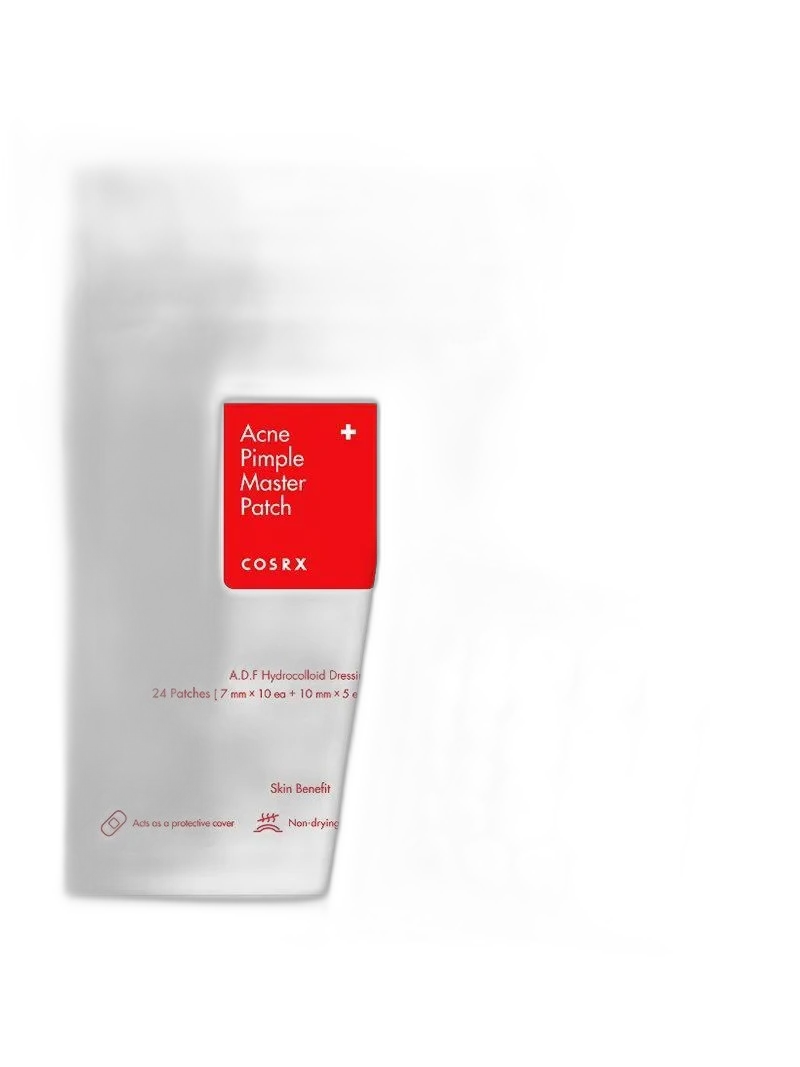
Acne Pimple Master Patch
The Original Pimple Patch
 Verified reviewer
Pros & cons.
- +Proven hydrocolloid technology absorbs fluid and visibly flattens whiteheads overnight
- +Physically prevents picking and touching — the most underrated anti-acne intervention
- +Nearly invisible thin patches can be worn discreetly during the day
- +Zero irritation risk — no active drug ingredients, fragrances, or common allergens
- +Three patch sizes accommodate different blemish sizes in every pack
- +Exceptional value at $6 per pack with even better per-patch pricing in multi-packs
- +Works for all skin types without exception
- −Ineffective on deep cystic acne, blind pimples, and blemishes that haven't surfaced
- −Only 24 patches per standard pack — frequent users need multi-packs
- −No active acne-fighting ingredients — purely mechanical absorption and protection
- −Requires perfectly clean, dry skin for proper adhesion — cannot apply over products
- −Medium-size patches run out first due to uneven size distribution
The full review.
Before COSRX sold hydrocolloid patches in a pink pouch for six dollars, people used Band-Aids or toothpaste on pimples—neither had much evidence. Hydrocolloid dressings existed for decades in medical wound care to manage burn exudate and post-surgical healing. But no one shrunk them, made them nearly invisible, or marketed them for acne. COSRX did this in 2015, changing the skincare world.
The product is simple. It has no active ingredients. No salicylic acid, no benzoyl peroxide, no tea tree oil, and no niacinamide. It uses a hydrocolloid matrix made mostly from cellulose gum, a polymer adhesive, and a thin polyurethane film. Peel one from the sheet, stick it on a pimple, and sleep. You wake up to a white patch—visual proof it absorbed the fluid, pus, and sebum from the blemish. Peel it off to find the pimple flatter, less red, and healing faster than if untreated.
The science is direct and validated. Hydrocolloid dressings use moist wound healing, a principle in dermatological literature for decades. By keeping a humid microenvironment over the blemish and absorbing excess exudate, the patch speeds cell migration and tissue repair while reducing scabs and scarring risk. A 2024 randomized controlled trial in the Journal of the American Academy of Dermatology confirmed hydrocolloid patches significantly improve smoothness, reduce erythema, and accelerate healing of inflammatory acne lesions versus untreated controls.
The clinical mechanism is only half the story; the other half is behavioral. These patches physically stop you from touching, picking, or squeezing your skin. For anyone who attacks a pimple in a mirror until it is three times its size and likely to scar, the patch acts as a tiny intervention therapist. It is both a treatment and a restraining order against your fingers.
The adhesion survives a full night of sleep, even face-down on a pillowcase, but requires clean, dry skin. If you apply it over a serum or moisturizer, it slides off within an hour. Apply it to freshly cleansed, unadorned skin and it stays until you peel it off in the morning. The polyurethane film is thin enough to wear in public without notice unless someone examines your face from six inches away.
Three sizes—7mm, 10mm, and 12mm—fit blemishes from small whiteheads to large inflamed spots. The size distribution is odd: ten small, five medium, and nine large, so you will run out of one size first. Most users find the medium patches most versatile and the first to deplete.
These patches do not work on everything. They work well for whiteheads, popped pimples, and surfaced blemishes with fluid. They are mediocre or useless for deep cystic acne, blind pimples, and closed comedones without a head. The hydrocolloid needs fluid to absorb; if the blemish is deep and sealed, the patch does nothing. COSRX’s Master Patch Intensive, which adds salicylic acid and tea tree oil, works better for those cases.
At six dollars for 24 patches—or less per patch in multi-packs—the value is exceptional. Spending more on other products does not meaningfully improve results. The dozen competitor brands that entered the market since 2016 use the same hydrocolloid technology at similar or higher prices, sometimes adding ingredients that may or may not work. The COSRX original remains the benchmark because it is sufficient.
It is fitting that an iconic K-beauty product is also one of its simplest. Amid twelve-step routines and complex ingredient lists, the Acne Pimple Master Patch is just a sticker that absorbs gunk. It requires only clean skin and patience. It makes no claims about anti-aging or brightening. It just makes pimples go away faster and stops you from making them worse. Sometimes effective skincare simply lets your skin heal itself.
Ingredient analysis.
Full INCI list
Cellulose Gum, Styrene Isoprene Styrene Block Copolymer, Polyisobutylene, Petroleum Resin, Polyurethane Film, Liquid Paraffin, Tetrakis Methane
Skin match.
The science.
The Science
Hydrocolloid dressings use moist wound healing. This principle dates to George Winter's 1962 research, which showed wounds heal faster in moist environments than when they dry and scab. The cellulose gum-based hydrocolloid matrix in these patches uses osmotic action to absorb wound exudate — pus, sebum, and inflammatory fluid. The matrix swells as it takes on moisture, forming a gel-like barrier over the blemish.
In a 2006 pilot study published in the Journal of the European Academy of Dermatology and Venereology, Sung et al. conducted a randomized, double-blind trial comparing hydrocolloid acne dressings to standard skin tapes. The hydrocolloid group had statistically significant greater reductions in acne severity, inflammation, redness, oiliness, and dark pigmentation over 3-7 days of treatment.
A 2024 randomized controlled trial in the Journal of the American Academy of Dermatology evaluated hydrocolloid patches for facial acne in subjects aged 12-35. Over a 14-day treatment period, the study showed significant improvements in smoothness, erythema reduction, lesion size, and elevation compared to untreated control sites. The researchers confirmed hydrocolloid patches are safe and effective non-pharmacological interventions for inflammatory acne.
The polyurethane film outer layer does two things: it creates an occlusive barrier to maintain the moist healing environment and protects the blemish from external bacterial contamination, mechanical irritation, and UV exposure. This barrier also reduces post-inflammatory hyperpigmentation risk by minimizing secondary trauma to the healing tissue.
References
- A pilot study on efficacy treatment of acne vulgaris using a new method: results of a randomized double-blind trial with Acne Dressing — Journal of the European Academy of Dermatology and Venereology (2006)
- The Science Behind a Viral Trend: Demonstrating Safety and Efficacy of Hydrocolloid Patch for Facial Acne — Journal of the American Academy of Dermatology (2024)
- Narrative Review of the Use of Hydrocolloids in Dermatology: Applications and Benefits — Journal of Clinical Medicine (2025)
Dermatologist Perspective
Board-certified dermatologists often recommend hydrocolloid patches as a safe, non-pharmacological intervention for surfaced acne lesions. Dermatologists value these patches because they prevent picking, which worsens scarring and post-inflammatory hyperpigmentation. The moist wound-healing environment of the hydrocolloid dressing is well-established in wound care literature and applies to acne management. Dermatologists note these patches work best on whiteheads and open blemishes; they do not substitute for systemic or topical prescription acne treatments for moderate to severe acne. They work best as a complementary tool within a broader acne management regimen.
Where it fits in your routine.
Cleanse your face and pat dry. Skip serums, moisturizers, or treatments on the application site so the patch adheres directly to the skin. Choose a patch size that covers the blemish plus a small margin. Peel the patch from the sheet and press it onto the blemish for 5-10 seconds. Leave it on for at least 6-8 hours (overnight is ideal). The patch turns white as it absorbs fluid. Peel it off gently in the morning. Apply a fresh patch if fluid remains. Continue until the blemish is flat and healing.
At $6 for 24 patches (about $0.25 per patch), this is one of the cheapest targeted acne treatments. Amazon multi-packs lower the per-patch cost—a 96-count pack at $18 costs about $0.19 per patch. The value is high for a product with over a decade of market validation and tens of thousands of positive reviews. Competitor patches using the same hydrocolloid technology often cost more per patch, while medicated alternatives with added actives usually cost $0.30-0.50+ per patch. The COSRX original is the price-performance benchmark for the category it helped create.
Use this if you get occasional whiteheads or popped pimples and want faster healing with less scarring. It provides a physical barrier for habitual pimple pickers to prevent self-sabotage. It works overnight as a gentle, drug-free spot treatment for teens and adults of any skin type.
Hydrocolloid patches do not work on deep cystic acne or blind pimples that have not surfaced. For medicated patches with active ingredients, use the COSRX Master Patch Intensive or similar products containing salicylic acid or tea tree oil.
Product details.
No scent whatsoever.
A flat, resealable clear plastic pouch holds one sheet with 24 patches in three sizes. Double packaging ensures sterilization. The compact, pocket-sized design works for portability.
Peel a patch from the sheet and press it onto a clean, dry blemish. The patch adheres immediately and looks nearly invisible on skin. Within a few hours — often overnight — the patch turns white as it absorbs fluid from the blemish. Removing the patch in the morning shows a flatter, less inflamed blemish. Peeling off a white, fluid-filled patch feels visceral and rewarding.
Variable — one pack lasts 8-24 blemishes depending on sizes used
24 months
All Year
The backstory.
COSRX launched this patch in 2015 as one of the brand's earliest products, adapting hydrocolloid wound dressing technology — used in hospitals for decades — into a cosmetically elegant acne treatment. The product found its audience through K-beauty communities before breaking into the American mainstream, where it became an Amazon best seller and helped create an entire product category. By 2019, pimple patches were a billion-dollar category, and this product was the one that started it all for most consumers.
About COSRX
Established Brand (5–20 years)COSRX launched in South Korea in 2013 and grew into a top global K-beauty brand. The Acne Pimple Master Patch is one of their first and most iconic products. It helped popularize the thin hydrocolloid pimple patch trend that entered mainstream skincare in the late 2010s.
Common myths.
Pimple patches 'draw out' acne from deep within the skin.
Hydrocolloid patches absorb fluid from surfaced blemishes; they do not extract impurities from deep pores. For the patches to work, the blemish must have a head or be lanced. Deep cystic acne requires different treatment.
Pimple patches with active ingredients like salicylic acid work better.
Plain hydrocolloid patches work well for surfaced whiteheads. They absorb fluid and create a moist healing environment. Medicated patches with salicylic acid or tea tree oil help closed comedones or early-stage blemishes, but hydrocolloid does the work to drain a whitehead.
FAQ.
Do COSRX Pimple Patches actually work?
Yes — on the right type of blemish. These hydrocolloid patches work well on whiteheads and popped pimples. They absorb fluid and flatten blemishes overnight. They use proven moist wound-healing technology used in medical settings for decades. They do not work on deep cystic acne or blind pimples that haven't surfaced.
How long should I leave a COSRX pimple patch on?
Keep the patch on for at least 6-8 hours; overnight works best. The patch turns white as it absorbs fluid. Use a fresh patch if the blemish still has fluid after removing the first one. Some blemishes resolve in one overnight application, while others need 2-3 consecutive applications.
Can I wear COSRX pimple patches under makeup?
Yes — the patches are thin and nearly transparent, so they stay discreet during the day. Some users apply light makeup over the patch. However, the patch works best on clean skin for direct adhesion; applying over heavy foundation may reduce adhesion.
Should I pop a pimple before applying the patch?
The patches work best on blemishes that have naturally come to a head. Some users lance blemishes with a sterilized needle before application, but dermatologists advise against popping pimples because of infection and scarring risk. The patch absorbs fluid from an intact whitehead, though drainage is faster from an open blemish.
What sizes are included in a COSRX Pimple Master Patch pack?
Each standard pack has 24 patches in three sizes: 10 small (7mm), 5 medium (10mm), and 9 large (12mm). This variety fits different blemish sizes, from small whiteheads to larger inflamed spots.
Are COSRX pimple patches safe for sensitive skin?
Yes — these patches have no active drug ingredients, fragrances, or common irritants. They work via hydrocolloid absorption and physical barrier protection. Rarely, people with adhesive sensitivities experience mild irritation from the polymer adhesive, but this is uncommon.
What is the difference between COSRX Master Patch and Master Patch Intensive?
The original Acne Pimple Master Patch uses plain hydrocolloid to absorb fluid from surfaced blemishes. The Master Patch Intensive adds salicylic acid and tea tree oil to the hydrocolloid. This makes it better for early-stage or closed blemishes that haven't fully come to a head.
What the community says.
"Effectively absorbs pus and fluid overnight — visibly flattens whiteheads"
"Nearly invisible and thin enough to wear discreetly during the day"
"Prevents picking and touching blemishes — a lifesaver for habitual pickers"
"Helps blemishes heal faster with less scarring than untreated spots"
"Excellent value — especially in multi-pack options"
"Gentle and non-irritating with no harsh chemicals"
"Three sizes accommodate different blemish sizes"
"Does not work on deep cystic acne or blind pimples that haven't surfaced"
"Only 24 patches per pack — runs out quickly for frequent breakouts"
"No active acne-fighting ingredients unlike some competitor patches"
"Adhesion can fail if skin is not perfectly clean and dry before application"
"Can leave sticky residue on surrounding skin upon removal"