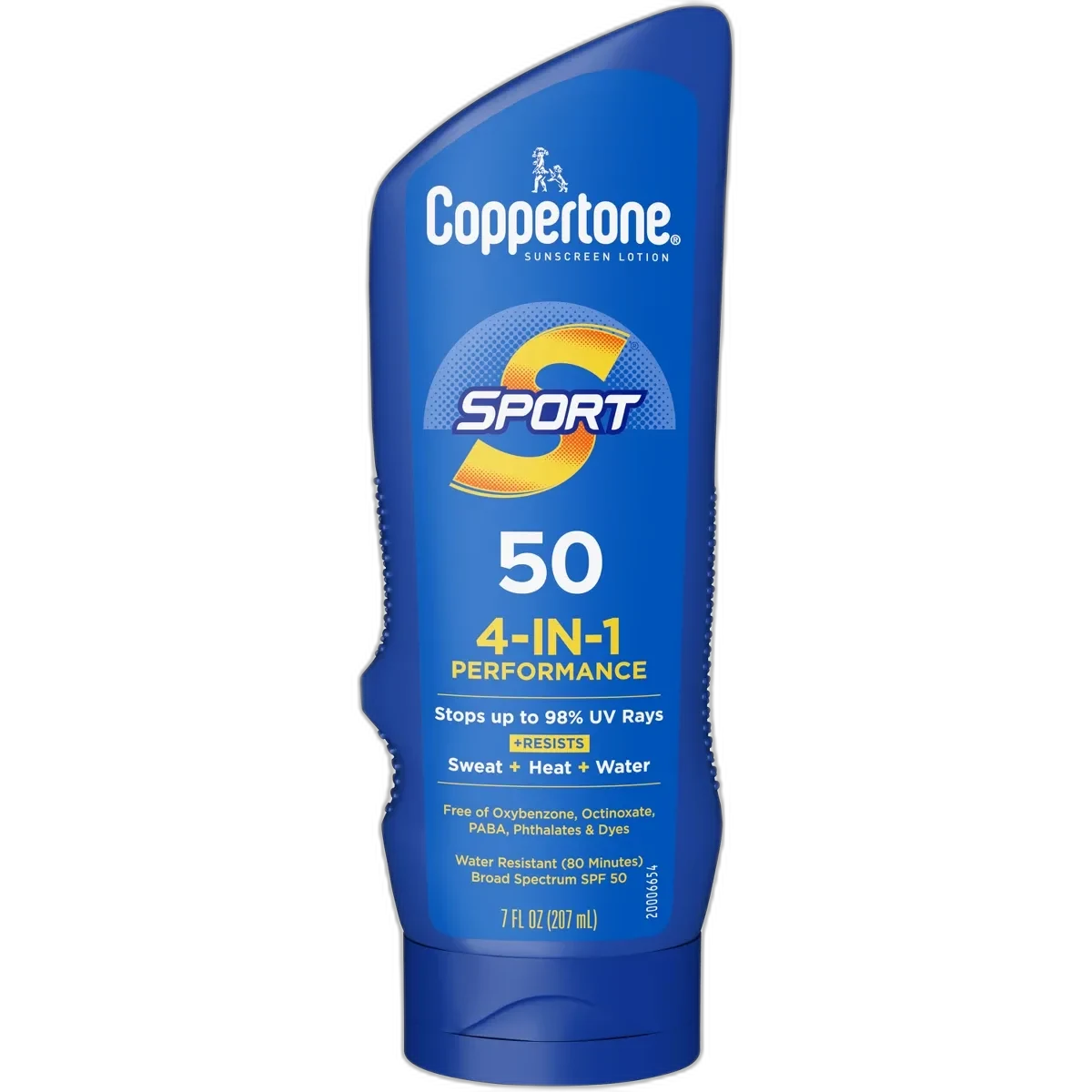
Sport Sunscreen Lotion SPF 50
Beach Day Workhorse
 Verified reviewer
Pros & cons.
- +Four photostabilized UV filters provide robust broad-spectrum protection at 25.5% total active concentration
- +Maximum 80-minute water resistance rating holds up during swimming and intense sweating
- +Exceptional value at under $10 for 7 oz encourages generous reapplication
- +Includes vitamin E and vitamin C derivative for antioxidant backup most sport sunscreens omit
- +Proven reliability backed by 80+ years of brand history and 16,000+ user reviews
- +Oxybenzone-free and octinoxate-free reformulation addresses common environmental concerns
- +HSA/FSA eligible as an FDA-regulated OTC drug product
- −Thick, waxy texture requires significant rubbing and is not cosmetically elegant
- −Strong classic sunscreen fragrance is a dealbreaker for fragrance-sensitive users
- −Can feel greasy on oily skin and is poorly suited for daily facial use
- −Stings noticeably if it migrates into eyes during heavy sweating
- −Leaves white powdery residue on dark clothing and swimwear
The full review.
In 1944, a Miami pharmacist named Benjamin Green cooked up a sunscreen in his kitchen, originally intended to protect soldiers from the brutal tropical sun of the Pacific theater. That formula became Coppertone, and over eighty years later, the blue and yellow bottle remains as recognizable as any product in the sunscreen aisle. The Sport SPF 50 lotion is the direct descendant of that pragmatic, protection-first philosophy — and it has absolutely no interest in being pretty about it.
Let’s talk about what’s inside. The formula deploys four chemical UV filters at a combined 25.5% active concentration, which is substantial. Avobenzone handles the UVA side at 3%, while homosalate (10%), octisalate (4.5%), and octocrylene (8%) stack up UVB coverage with overlapping absorption spectra. The clever bit is the octocrylene-avobenzone relationship: octocrylene quenches avobenzone’s excited triplet state through energy transfer, preventing the photodegradation that makes standalone avobenzone progressively less effective under sustained UV exposure. This isn’t theoretical — it’s a mechanism documented in peer-reviewed photochemistry research. The result is UV protection that doesn’t quietly abandon you after the first hour.
Coppertone also tucked in tocopherol and sodium ascorbyl phosphate — vitamins E and C, respectively — as antioxidant backup. These won’t transform your skin or reverse damage, but they mop up free radicals that slip through the UV filter net during intense exposure. It’s a thoughtful inclusion that most sport sunscreens at this price point don’t bother with.
Texture
The texture is where function and cosmetic elegance part ways entirely. This lotion goes on thick, with a slightly waxy resistance that’s the tactile signature of film-forming polymers doing their job. Styrene/acrylates copolymer and polyester-27 create the durable film that earns the 80-minute water resistance claim — the maximum the FDA allows. You can feel it forming on your skin, a thin armor that says “I’m here to work, not to look good on your Instagram story.” Application requires commitment: you’ll need to rub for a solid thirty seconds per body area to get even coverage without white streaks.
Once it sets, the finish is somewhere between satin and slightly shiny. On normal to dry skin, it’s perfectly acceptable. On oily skin, particularly on the face, it can tip into greasy territory. This is emphatically a body sunscreen, and while the formula is technically safe for facial use, the thick texture and noticeable fragrance make it a poor candidate for daily facial wear. Save your elegant Japanese or Korean sunscreens for your face; let Coppertone handle the shoulders, arms, and legs.
Scent
Ah, the fragrance. There is no subtle way to say this: Coppertone Sport smells like sunscreen. Not like a light botanical mist or an unscented invisible shield — like capital-S Sunscreen, the kind you remember from childhood beach trips. For many people, this scent is pure nostalgia, as evocative as the first day of summer vacation. For others, it’s an unwelcome olfactory announcement that you are wearing SPF. It’s also worth noting that the fragrance makes this a skip for anyone with fragrance sensitivity or reactive skin.
Common Praise
Performance in actual outdoor conditions is where Coppertone Sport justifies its existence. Users consistently report surviving full-day outdoor events — beach volleyball, lake days, marathon training runs, kids’ soccer tournaments — without burning. The water resistance genuinely holds up during swimming, though you should still reapply after toweling off (mechanical rubbing defeats even the best film-forming technology). The formula doesn’t drip into eyes as readily as thinner sunscreens during heavy sweating, but when it does migrate, it stings. This is a common complaint and one worth acknowledging: if you’re running or cycling in intense heat, sweat will eventually carry some product toward your eyes.
Common Complaints
One practical annoyance: the lotion can leave white powdery residue on dark clothing and swimwear. It’s not a white cast in the traditional mineral sunscreen sense — it’s product transfer from the thick formula. A quick rinse usually handles it, but it’s something to be aware of if you’re wearing a black swim shirt.
Works for
The formula has evolved over the years, most recently dropping oxybenzone and octinoxate in response to environmental and regulatory concerns. The current filter lineup — while not marketed as reef safe — at least avoids the two most scrutinized ingredients. Coppertone deserves credit for reformulating without sacrificing SPF performance, even if the remaining filters (particularly octocrylene and homosalate) still face ongoing FDA review for GRASE status.
Best for
At roughly nine dollars for seven ounces, the value proposition is hard to argue with. Dermatologists consistently emphasize that the best sunscreen is the one you’ll actually reapply, and Coppertone Sport makes generous reapplication financially painless. A family of four going through a bottle a day at the beach won’t break the budget — and that accessibility matters more than any luxury sunscreen’s ingredient list if the alternative is skipping reapplication because the product is too expensive to use liberally.
Coppertone Sport SPF 50 isn’t trying to be the most elegant sunscreen on the market. It’s trying to be the most reliable one in the toughest conditions, at a price that lets you squeeze out a palmful every two hours without wincing. On those terms, it delivers.
Ingredient analysis.
Full INCI list
Active Ingredients: Avobenzone 3%, Homosalate 10%, Octisalate 4.5%, Octocrylene 8%. Inactive Ingredients: Water, Aluminum Starch Octenylsuccinate, Styrene/Acrylates Copolymer, Glycerin, Polyester-27, Silica, Phenoxyethanol, Isododecane, Arachidyl Alcohol, Beeswax (Cera Alba), Ethylhexylglycerin, Neopentyl Glycol Diheptanoate, Behenyl Alcohol, Tocopherol, Acrylates/C10-30 Alkyl Acrylate Crosspolymer, Arachidyl Glucoside, Glyceryl Stearate, PEG-100 Stearate, Potassium Hydroxide, Fragrance (Parfum), Disodium EDTA, Sodium Ascorbyl Phosphate
Skin match.
The science.
The Science
Coppertone Sport SPF 50 uses a four-filter system based on a documented photostabilization strategy. Avobenzone (butyl methoxydibenzoylmethane) is the most common UVA1 filter globally, but it has a weakness: UV exposure causes photodegradation via keto-enol tautomerization, which reduces its UVA absorption. A 2010 study in Photochemical & Photobiological Sciences shows that octocrylene stabilizes avobenzone through triplet-triplet energy transfer—it absorbs the excited-state energy that drives avobenzone's breakdown. A 2014 study in Photochemistry and Photobiology characterized this mechanism, confirming that energy transfer from avobenzone's triplet state to UVB absorbers like octocrylene is the main pathway preventing photodegradation.
Film-forming technology supports the water resistance claim. A 2015 study in the International Journal of Cosmetic Science examined two main ways sunscreens fail on skin: physical wash-off from water and UV-induced chemical degradation. The study found that robust film-forming polymers (like the styrene/acrylates copolymer in this formula) significantly reduce wash-off during water immersion, keeping SPF efficacy for the labeled resistance period.
Regarding systemic absorption: two landmark JAMA studies (2019 and 2020) tested all four of Coppertone Sport's active ingredients under maximal-use conditions. They found plasma concentrations above the FDA's 0.5 ng/mL threshold for all four filters. However, the FDA and the American Academy of Dermatology both state that exceeding this threshold requires more safety data—it does not mean the ingredients are harmful. Clinical consensus holds that the known risks of UV exposure outweigh the theoretical risks of sunscreen absorption.
References
- Filter-filter interactions. Photostabilization, triplet quenching and reactivity with singlet oxygen — Photochemical & Photobiological Sciences (2010)
- Triplet-triplet energy transfer from a UV-A absorber butylmethoxydibenzoylmethane to UV-B absorbers — Photochemistry and Photobiology (2014)
- Water-resistant sunscreens for skin protection: an in vivo approach to the two sources of sunscreen failure — International Journal of Cosmetic Science (2015)
- Effect of Sunscreen Application Under Maximal Use Conditions on Plasma Concentration of Sunscreen Active Ingredients — JAMA (2019)
- Effect of Sunscreen Application on Plasma Concentration of Sunscreen Active Ingredients: A Randomized Clinical Trial — JAMA (2020)
Dermatologist Perspective
Dermatologists recommend broad-spectrum SPF 50 sunscreens for outdoor athletics, and Coppertone Sport's 80-minute water resistance rating makes it a practical choice for swimmers and athletes. Board-certified dermatologists note the four-filter system provides reliable UVA and UVB coverage, though they advise patients with sensitive or rosacea-prone skin to use fragrance-free mineral alternatives. The American Academy of Dermatology maintains that chemical sunscreens like this one are safe and effective, and that consistent application and reapplication matter more than the filter type. Dermatologists also note that the affordability of products like Coppertone Sport removes a barrier to use—patients reapply more generously when the product does not cost $40 a bottle.
Where it fits in your routine.
Apply a thick layer to all exposed skin 15 minutes before sun exposure. Use about one ounce (a shot glass full) for full body coverage — most people apply too little. Rub until the lotion distributes evenly with no visible white streaks. Reapply every two hours, and immediately after swimming, towel drying, or heavy sweating, even though the formula is water resistant for 80 minutes. For best results on the face, use a dedicated facial sunscreen and use Coppertone Sport for body application.
At roughly $9 for 7 fl oz, Coppertone Sport SPF 50 is a highly cost-effective body sunscreen. The $1.28 per-ounce price makes generous application easy, which is how dermatologists recommend using sunscreen. A 3 oz travel size costs about $5.50 for on-the-go use. For a legacy brand with FDA-regulated active ingredients, verified water resistance testing, and antioxidant inclusions, the price-to-protection ratio is excellent. You do not pay for brand hype or aesthetic packaging here — every dollar buys functional sun protection.
Active outdoor enthusiasts need a sunscreen that survives swimming, sweating, and all-day sun exposure on a budget. Families want a reliable, affordable body sunscreen for beach vacations and summer sports. This suits anyone who prioritizes proven UV protection over cosmetic elegance.
People with fragrance sensitivity, rosacea, or reactive skin need a fragrance-free alternative. The thick texture and strong scent make this unsuitable for daily facial sunscreen under makeup or for office wear. Those prioritizing reef-safe certifications should use mineral-only formulas.
Product details.
Medium-thick lotion that resists initial spread but blends with sustained rubbing. Film-forming polymers for water resistance create a slightly waxy feel during application. It absorbs within 1-2 minutes.
Classic Coppertone sunscreen fragrance smells sweet and slightly chemical. Many associate this scent with summer and beach days. It is nostalgic for some and overpowering for others.
Blue and yellow squeeze bottle with a flip-top cap. It comes in 3 oz travel and 7 oz standard sizes. The packaging is sturdy for a beach bag but lacks elegance.
The formula is thick and takes time to absorb. A white cast appears during application but fades as the formula sets. The film-forming agents create a noticeable protective layer you can feel. No adjustment period is required; protection starts immediately.
One 7 oz bottle provides 4-8 full-body applications, or about 2-4 weeks of regular summer outdoor use with proper reapplication.
12 months
spring summer
The backstory.
Born from pharmacist Benjamin Green's 1944 formula originally developed to protect soldiers from tropical sun exposure during WWII, Coppertone became America's sunscreen brand. The Sport line launched in the 1990s as one of the first sunscreens specifically engineered for athletic use, prioritizing water resistance and durability over cosmetic elegance — a design philosophy it maintains today under Beiersdorf's ownership.
About Coppertone
Legacy Brand (20+ years)Coppertone was founded in 1944 by pharmacist Benjamin Green and has been a household name in sun protection for over 80 years. Now owned by Beiersdorf AG, the brand's products are FDA-regulated OTC drugs and have been tested in Consumer Reports sunscreen evaluations.
Common myths.
Chemical sunscreens like this one are unsafe because they enter the bloodstream.
FDA studies found these UV filters in plasma above the 0.5 ng/mL threshold, but the FDA says this does not mean they are unsafe; it means more safety data is needed. The American Academy of Dermatology still recommends chemical sunscreens as safe and effective for daily use.
SPF 50 provides significantly more protection than SPF 30.
SPF 50 blocks about 98% of UVB rays, while SPF 30 blocks 97%—a small difference. The real benefit of SPF 50 is a larger margin of error: most people under-apply sunscreen, so SPF 50 acts as a safety buffer when you use less than the recommended amount.
FAQ.
Is Coppertone Sport SPF 50 water resistant?
Yes — Coppertone Sport SPF 50 has the maximum FDA-allowed 80-minute water resistance rating. This means Coppertone Sport SPF 50 keeps its labeled SPF protection during 80 minutes of water immersion or heavy sweating. Reapply immediately after swimming, towel drying, or every two hours of continuous sun exposure.
Can I use Coppertone Sport SPF 50 on my face?
This formula is safe for the face, but its thick texture, strong fragrance, and tendency to sting eyes when sweating make it less than ideal for daily facial sunscreen. It works well for occasional outdoor sports days. For daily facial use, choose a sunscreen formulated for the face with a lighter texture and no fragrance.
Does Coppertone Sport SPF 50 contain oxybenzone?
No. Coppertone reformulated this product to exclude oxybenzone and octinoxate—the two chemical UV filters facing environmental and health scrutiny. The current formula uses avobenzone, homosalate, octisalate, and octocrylene as its four active sunscreen filters.
Is Coppertone Sport SPF 50 reef safe?
Coppertone does not market this product as reef safe. The formula lacks oxybenzone and octinoxate (the two ingredients restricted by Hawaii's coral reef bill), but it contains octocrylene and homosalate, which some environmental groups flag. If reef safety is a priority, use a mineral sunscreen with only zinc oxide and/or titanium dioxide.
How often should I reapply Coppertone Sport SPF 50?
Reapply every two hours of continuous sun exposure, and immediately after swimming, heavy sweating, or towel drying — even though the formula is water resistant for 80 minutes. The 80-minute rating means the SPF holds during water exposure, but reapplication ensures consistent protection throughout the day.
Does Coppertone Sport SPF 50 leave a white cast?
This chemical (organic) sunscreen does not leave the persistent white cast found in mineral zinc oxide sunscreens. The thick lotion texture creates a temporary white appearance during application, which fades as you rub it in. Some users report white residue transfers onto dark clothing.
What the community says.
"Effective sun protection — no sunburn even during all-day outdoor activity"
"Strong water and sweat resistance holds up during sports and swimming"
"Affordable price point offers excellent value per ounce"
"Trusted family brand that has been a summer staple for generations"
"Blends in reasonably well for a chemical body sunscreen"
"Can feel greasy or oily, especially when used on the face"
"Leaves white powdery residue on dark clothing and swimwear"
"Strong classic sunscreen scent that some users find unpleasant"
"Stings if it migrates into eyes during sweating"
"Thick texture requires effort to spread evenly across large areas"
People also looked at.