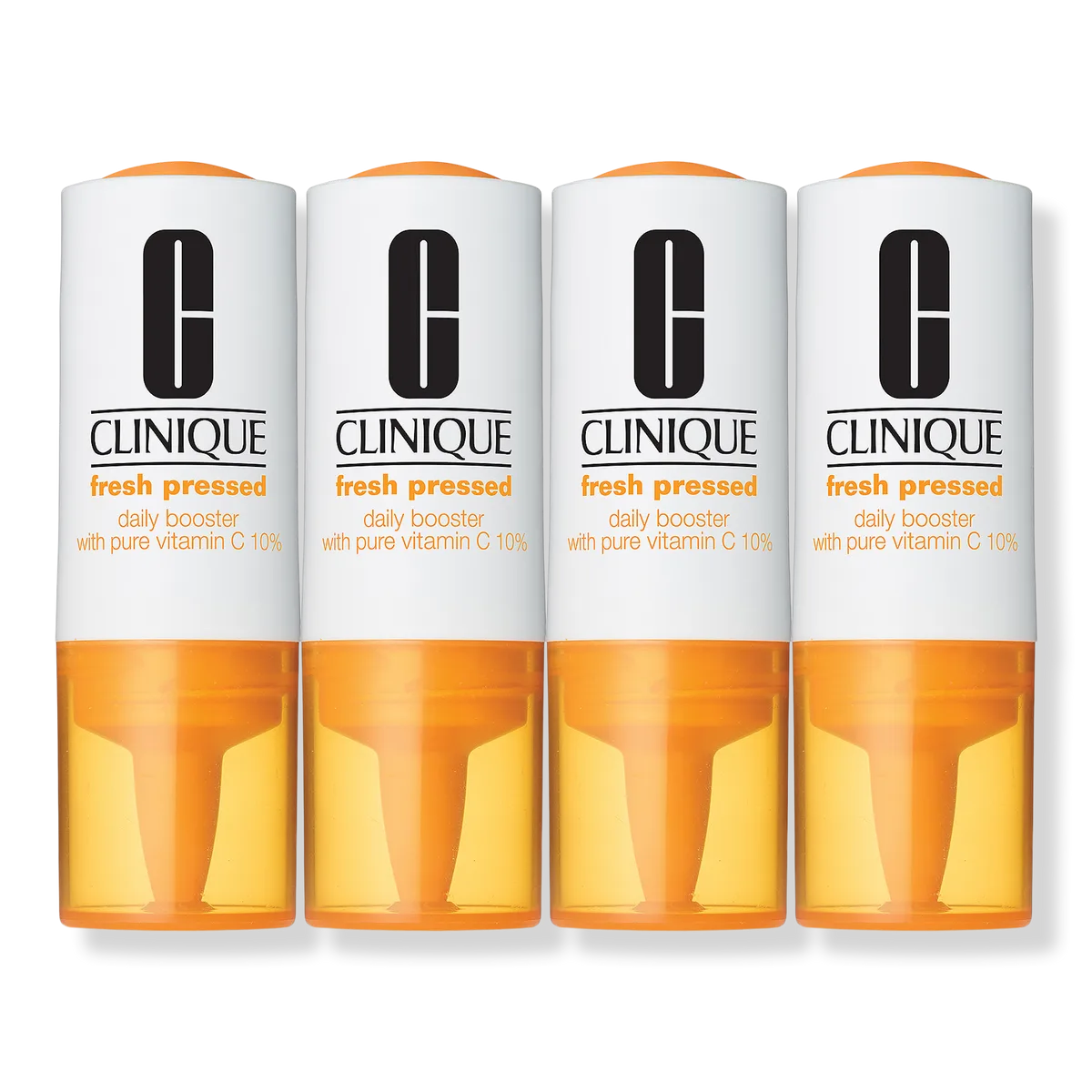
Fresh Pressed Daily Booster with Pure Vitamin C 10%
Freshness-First Vitamin C Pioneer
 Verified reviewer
Pros & cons.
- +Sealed vial system guarantees genuinely fresh, potent vitamin C with every activation
- +Multi-peptide complex adds anti-aging benefits beyond typical vitamin C serums
- +Fragrance-free and allergy-tested — consistent with Clinique's clinical standards
- +Mixes seamlessly into any moisturizer without pilling or residue
- +Immediate brightening glow visible from the very first application
- +Acetyl glucosamine provides a second brightening mechanism alongside vitamin C
- +Lightweight liquid format works under sunscreen without heaviness or greasiness
- −At $81 per month, it's significantly more expensive than most vitamin C serums
- −Individual glass vials generate more packaging waste than a single bottle
- −Pure ascorbic acid at 10% may cause tingling or irritation on sensitive skin
- −Seven-day window per vial means you must use it consistently or waste product
- −Contains soy and whey proteins, which are potential allergens for some users
The full review.
In 2017, Clinique did something quietly radical. While every other brand was busy stabilizing vitamin C with derivatives, encapsulations, and pH buffers, Clinique looked at the problem from the opposite direction. What if, instead of trying to keep ascorbic acid alive in a bottle for months, you just kept it sealed until the moment you needed it? The Fresh Pressed Daily Booster was the answer — and it remains one of the more honest approaches to vitamin C delivery in prestige skincare.
The concept is disarmingly simple. Each box contains four small glass vials. Inside each vial, a powder containing pure L-ascorbic acid sits separated from a liquid emulsion base. You twist the cap, the powder drops into the liquid, you shake, and you have a freshly activated vitamin C booster that stays potent for seven days. No guessing whether your serum has oxidized. No checking for that telltale amber tint. Just fresh vitamin C, every week.
The formula itself is more sophisticated than the packaging gimmick might suggest. Ascorbic acid at 10% is the headliner, sitting comfortably in the concentration range that research supports as effective without being unnecessarily aggressive. But Clinique didn’t stop there. Acetyl glucosamine provides a complementary brightening pathway by interfering with melanin production through a different mechanism than vitamin C — think of it as a one-two punch against dark spots. A quartet of peptides, including palmitoyl tripeptide-1 and acetyl hexapeptide-8, adds collagen-stimulating and expression-line-smoothing benefits that elevate this beyond a simple vitamin C delivery vehicle.
Squalane and sodium hyaluronate round out the supporting cast, providing the moisture and barrier-supportive elements that keep the ascorbic acid from feeling harsh on application. This matters more than you might think — pure vitamin C at this concentration can be drying, and the hydrating backbone of this formula prevents that tight, stripped feeling some vitamin C products leave behind.
Using the booster is straightforward and oddly satisfying. You dispense two drops into your palm, add your moisturizer, blend them together, and apply. The liquid is lightweight with a barely-there golden tint, and it disappears completely into whatever cream or lotion you pair it with. There’s no residue, no pilling, no film. It plays remarkably well with other products, which is exactly what a booster should do.
The brightening results are real and relatively fast. Most users report a visible luminosity boost from the very first application — that immediate glow that pure ascorbic acid delivers when it’s actually fresh and potent. Over four to eight weeks of consistent use, dark spots and post-inflammatory marks visibly lighten, and overall skin tone becomes more even. The peptide benefits take longer to manifest, but after two to three months, fine lines around the eyes and forehead do appear softer.
Here’s where honesty matters, though: this is an expensive way to use vitamin C. At roughly $81 for a 28-day supply, you’re paying a significant premium for the freshness delivery system. That’s substantially more per month than even other prestige vitamin C serums, and dramatically more than effective drugstore options. The question isn’t whether the formula works — it clearly does — but whether the sealed-vial approach delivers enough additional benefit to justify the markup.
The freshness argument has real scientific merit. Ascorbic acid in aqueous solution does degrade, sometimes within weeks of opening. If your vitamin C serum has been sitting on your bathroom shelf for three months, it’s probably delivering significantly less than the concentration on the label. Fresh Pressed sidesteps this entirely. But it’s also true that well-formulated vitamin C serums with proper pH, appropriate packaging, and stabilizing ingredients can maintain potency for reasonable periods. You’re paying for a guarantee of freshness, and you need to decide what that guarantee is worth to you.
The single-use vial format also generates more packaging waste than a traditional bottle, which may matter to environmentally conscious consumers. Each month produces four glass vials plus caps, versus one bottle from a conventional serum.
On skin tolerance, the 10% ascorbic acid is well-tolerated by most skin types, but sensitive skin should approach with caution. The formula is fragrance-free and allergy-tested — hallmarks of Clinique’s long-standing commitment to minimizing irritation — but pure vitamin C at meaningful concentrations will always carry some sting risk. Starting with once-daily use and building up is the prudent path.
Clinique’s legacy in dermatologist-developed skincare lends credibility here. This isn’t a brand chasing trends — it’s a brand that has spent over fifty years building products around clinical principles. The Fresh Pressed system reflects that philosophy: identify a genuine problem (vitamin C instability), engineer a practical solution (sealed activation vials), and support it with a formula that goes beyond the minimum. Whether the premium price earns its keep depends on how much you value that engineering — but the product itself delivers exactly what it promises.
Ingredient analysis.
Full INCI list
Water, Ascorbic Acid, Glycerin, Dimethicone, Squalane, Butylene Glycol, Dipropylene Glycol, Acetyl Glucosamine, Cucumis Sativus (Cucumber) Fruit Extract, Hordeum Vulgare (Barley) Extract, Morus Nigra (Mulberry) Root Extract, Molasses Extract, Laminaria Digitata Extract, Scutellaria Baicalensis Root Extract, Acetyl Hexapeptide-8, Vitis Vinifera (Grape) Fruit Extract, Algae Extract, Palmitoyl Hexapeptide-12, Palmitoyl Tripeptide-1, Palmitoyl Tetrapeptide-7, Alcaligenes Polysaccharides, Caffeine, Sucrose, Whey Protein, Betaine, Salicylic Acid, Glycine Soja (Soybean) Protein, Sodium Hyaluronate, Caprylyl Glycol, Sigesbeckia Orientalis (St. Paul's Wort) Extract, Bis-PEG-18 Methyl Ether Dimethyl Silane, Propylene Glycol Dicaprate, Helianthus Annuus (Sunflower) Seedcake, Allyl Methacrylates Crosspolymer, Carbomer, Glyceryl Polymethacrylate, Tromethamine, Xanthan Gum, Potassium Sorbate, PEG-8, Polysorbate 20
Skin match.
The science.
The Science
The core active in Fresh Pressed is L-ascorbic acid at 10%, the most extensively studied form of topical vitamin C. A systematic review published in the Journal of Cosmetic Dermatology in 2023 by Correia et al. confirmed that topical vitamin C is effective for both melasma and photoaging, with ascorbic acid concentrations between 5% and 20% showing the most consistent results. The 10% concentration in this formula sits in the sweet spot — high enough for meaningful clinical effect, low enough to minimize irritation.
The instability problem that Fresh Pressed's packaging addresses is well-documented. A landmark review by Pullar, Carr, and Vissers published in Nutrients in 2017 detailed how ascorbic acid in aqueous solution rapidly oxidizes when exposed to air, light, and heat, losing its biological activity. Standard serums attempt to mitigate this with low pH formulations, airless pumps, and opaque packaging, but degradation remains inevitable once the product is opened. Clinique's approach of physically separating the ascorbic acid from the liquid base until activation bypasses this problem entirely.
Acetyl glucosamine, the secondary brightening active, has demonstrated anti-pigmentation effects through a mechanism distinct from ascorbic acid. While vitamin C inhibits tyrosinase enzyme activity directly, acetyl glucosamine interferes with the glycosylation process required for proper tyrosinase function. A study published in the British Journal of Dermatology in 2007 showed that topical N-acetyl glucosamine reduced the appearance of hyperpigmentation, and the effect was enhanced when combined with niacinamide — suggesting that multi-pathway approaches to brightening yield superior results.
The peptide complex adds a collagen-stimulating dimension supported by emerging evidence. Palmitoyl tripeptide-1 and palmitoyl tetrapeptide-7, marketed together as Matrixyl 3000, have shown potential for stimulating collagen synthesis in in-vitro studies, though robust clinical trial data in humans remains limited. The combination with ascorbic acid, which has its own well-established collagen-stimulating properties, creates a multi-pronged anti-aging approach.
References
- Efficacy of topical vitamin C in melasma and photoaging: A systematic review — Journal of Cosmetic Dermatology (2023)
- The Roles of Vitamin C in Skin Health — Nutrients (2017)
- A randomized controlled trial of the effect of topical N-acetyl glucosamine on skin hyperpigmentation — British Journal of Dermatology (2007)
Dermatologist Perspective
Dermatologists frequently recommend vitamin C as a cornerstone of daytime antioxidant protection, and the Fresh Pressed delivery system addresses a concern that many clinicians share — that patients' vitamin C products may have lost significant potency by the time they're halfway through the bottle. Board-certified dermatologists note that L-ascorbic acid at 10% is an effective and generally well-tolerated concentration for brightening and photoprotection. The fragrance-free, allergy-tested formulation aligns with dermatological best practices for minimizing sensitization risk. Clinicians would typically advise pairing this booster with a broad-spectrum SPF 30+ sunscreen to maximize the synergistic photoprotective benefits of vitamin C and UV filters.
Where it fits in your routine.
Twist off the activation cap on a fresh vial; a click means the vitamin C powder dropped into the liquid. Shake gently to mix. Dispense 2 drops into your palm, blend with your preferred moisturizer, and apply to clean, dry skin. Use morning and evening. Each vial lasts 7 days once activated. Always follow with broad-spectrum sunscreen SPF 30 or higher in the morning. Store unused vials in a cool, dry place away from direct sunlight.
Fresh Pressed costs about $81 for a 28-day supply — roughly $2.90 per day, or $972 annually if used year-round. This is much more than effective vitamin C serums at lower price points. You pay for guaranteed freshness at each activation, the multi-peptide supporting formula, and Clinique's history of dermatologist-developed, allergy-tested products. The engineering justifies the price for users who struggle with oxidized vitamin C serums or want every drop to be maximally potent. The formulation quality is high, but the cost-per-use is high for budget-conscious consumers.
Choose this if vitamin C serums oxidize too fast or if you want a brightening booster with anti-aging peptide support. It works for normal, combination, and oily skin types with dullness, dark spots, or early signs of aging.
People with sensitive skin or compromised barriers who react to pure ascorbic acid, those on a tight skincare budget, or eco-conscious consumers concerned about single-use packaging waste.
Product details.
A lightweight, slightly viscous liquid with a faint golden tint. It mixes into creams and lotions without changing their texture or leaving residue.
Fragrance-free with no detectable scent.
Four sealed glass vials provide a 7-day supply each. A twist-off activation cap separates the pure ascorbic acid powder from the liquid base until use. The emulsion dropper dispenses 2 drops at a time.
The first use provides an immediate brightening glow; skin looks more luminous within minutes. Some users feel a mild tingling sensation during the first few applications, but this subsides as skin acclimates. No purging period occurs.
28 days (one 4-pack) with twice-daily use, or up to 56 days if used once daily
1 months
All Year
The backstory.
Clinique launched Fresh Pressed in 2017 to solve the fundamental problem with vitamin C skincare: oxidation. Rather than adding stabilizers or switching to vitamin C derivatives, they engineered packaging that keeps pure L-ascorbic acid fresh until activation. It was one of the first prestige products to acknowledge openly that most vitamin C serums degrade on the shelf.
About Clinique
Legacy Brand (20+ years)Clinique launched in 1968 as the first prestige skincare brand created by dermatologists. It pioneered allergy-tested, fragrance-free formulations. Dermatologists oversee product development, and the brand has used clinical positioning for over five decades.
Common myths.
Vitamin C and niacinamide cancel each other out, so do not use them together.
This outdated concern stems from a study using extreme conditions not found in skincare. The ascorbic acid in Fresh Pressed layers safely with niacinamide products. Modern formulation pH and concentration ranges do not cause the flushing reaction described in the old research.
The vitamin C in this product increases skin sensitivity to the sun.
Ascorbic acid is photoprotective; it neutralizes UV-generated free radicals. Fresh Pressed increases sunscreen effectiveness instead of increasing sun sensitivity. You still need sunscreen because vitamin C alone does not block UV rays.
FAQ.
Can you use Clinique Fresh Pressed Vitamin C with retinol?
Yes, but separate them by time of day. Mix the Fresh Pressed booster with your day cream and sunscreen in the morning, then apply your retinol product at night. This prevents irritation from combining two potent actives and lets the vitamin C provide daytime antioxidant protection.
Why does Clinique Fresh Pressed come in individual vials?
Pure L-ascorbic acid is unstable and degrades as soon as it dissolves in liquid. The sealed vial system keeps the vitamin C powder separate from the liquid base until activation. This ensures each 7-day supply delivers fresh, fully potent vitamin C instead of a partially oxidized version.
Is Clinique Fresh Pressed Vitamin C good for dark spots?
Yes — the 10% pure ascorbic acid inhibits melanin production directly, while acetyl glucosamine provides a second brightening pathway. Most users see visible improvement in dark spots and uneven tone within 4-8 weeks of daily use. Some notice a brighter overall complexion within the first week.
How long does one pack of Clinique Fresh Pressed last?
Each 4-pack lasts 28 days if you use it twice daily (morning and evening). Using it once a day makes a single pack last up to 56 days. Use a vial within 7 days of activation for maximum potency.
Can sensitive skin use Clinique Fresh Pressed Vitamin C?
Use with caution. The formula is fragrance-free and allergy-tested, but 10% pure ascorbic acid causes tingling or irritation on sensitive skin. Start by using it once daily mixed with a thick moisturizer. If irritation persists after a week, this concentration is too strong for your skin type.
What the community says.
"Visible brightening from first use"
"Noticeable improvement in dark spots over time"
"Fresh packaging keeps vitamin C potent"
"Lightweight and easy to mix with any moisturizer"
"No strong scent or residue"
"Price is high for a 28-day supply"
"Individual vials create packaging waste"
"Can cause tingling on sensitive skin"
"Wish it lasted longer than 7 days per vial"
People also looked at.