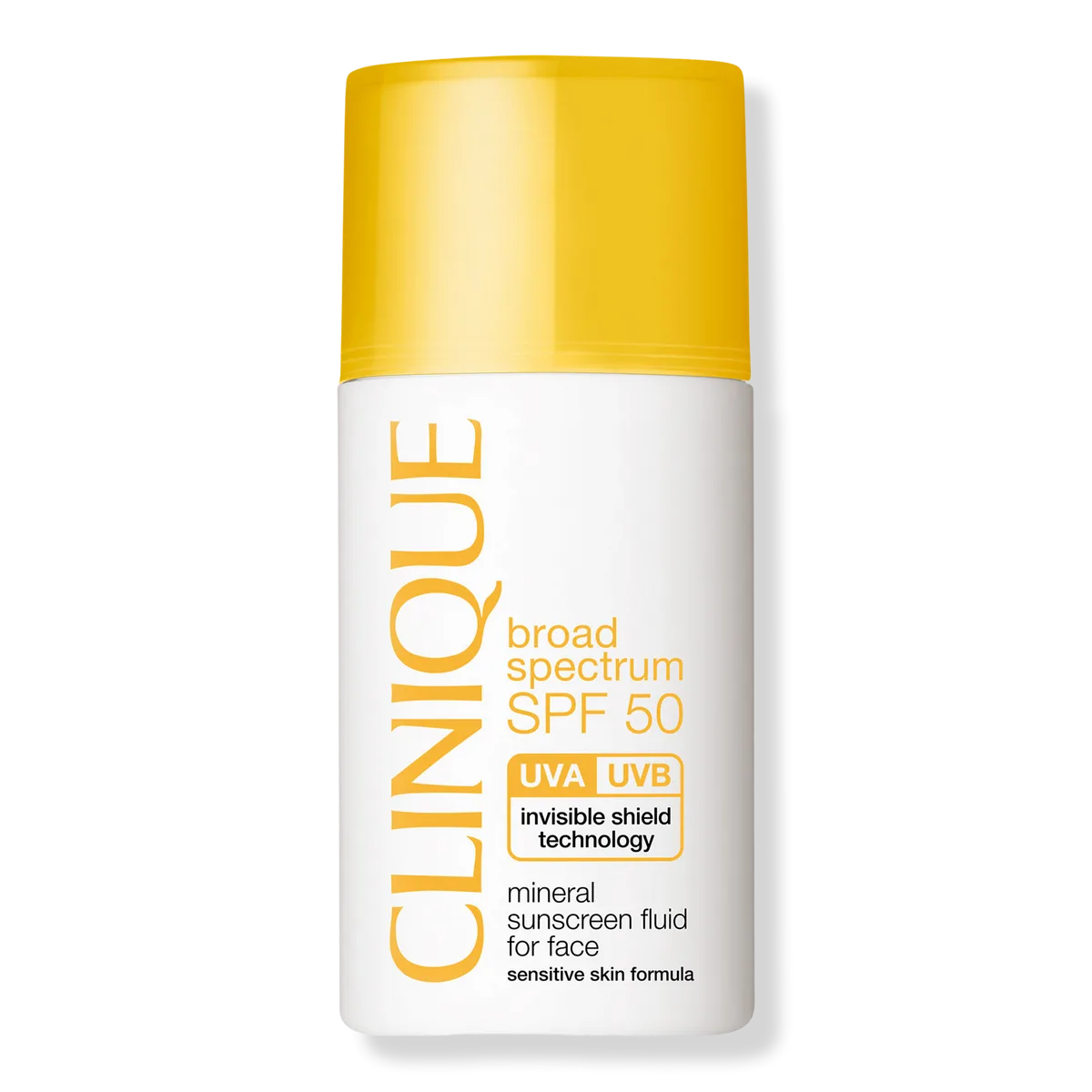
Broad Spectrum SPF 50 Mineral Sunscreen Fluid For Face
Sensitive Skin Sun Shield
 Verified reviewer
Pros & cons.
- +100% mineral UV filters provide broad-spectrum SPF 50 without chemical filter sensitivities
- +Impressively gentle — allergy, dermatologist, ophthalmologist, and pediatrician tested
- +Lightweight fluid texture is a major improvement over traditional thick mineral sunscreens
- +Iron oxides add visible light protection and help reduce white cast
- +Safe for use around the eye area without stinging or watering
- +Fragrance free, oil free, and non-acnegenic — suits virtually all skin concerns
- +Approved for use on children ages 6 months and older
- −Noticeable white cast on medium to deeper skin tones despite iron oxide tinting
- −Premium $38 price for only 1 ounce — expensive for a daily-use product needing frequent reapplication
- −Can feel tight and drying once set, especially for those with dry skin
- −Some users report a slightly tacky finish that doesn't fully settle
- −Not hydrating — requires a separate moisturizer underneath for dry skin types
The full review.
Creating a sunscreen that almost no one reacts to is harder than maximizing SPF. The Clinique Broad Spectrum SPF 50 Mineral Sunscreen Fluid For Face addresses this directly. Its credentials prove it: allergy tested, dermatologist developed, ophthalmologist tested, pediatrician tested, non-acnegenic, and fragrance free. This formula was engineered by dermatological, ophthalmological, and pediatric experts, which defines its strengths and character.
The dual-mineral filter system uses 6.3% titanium dioxide and 4.0% zinc oxide to create a physical UV barrier across the full ultraviolet spectrum. Titanium dioxide covers UVB and short-wave UVA, while zinc oxide protects against longer UVA wavelengths—the ones that penetrate deep into skin to drive photoaging and hyperpigmentation. Together, they provide broad-spectrum SPF 50 protection without any chemical UV filters.
This fluid format improves on the chalky, thick, hard-to-blend experience of many mineral sunscreens. The consistency is more like a lightweight serum than a cream. Shake the bottle to suspend the mineral particles, then apply the milky liquid; it spreads thin across skin. The silicone-rich vehicle—featuring dimethicone and several specialty silicones—distributes mineral particles more evenly than a water-or-oil base. The finish is not invisible, but it is more wearable than traditional zinc oxide pastes.
The iron oxides are important. They are not just cosmetic tints; research shows iron oxides protect against visible light and high-energy blue light, which chemical and mineral UV filters do not fully block. Because visible light can induce hyperpigmentation, especially in darker skin tones, iron oxides provide functional protection rather than just aesthetic tinting. The subtle tint also helps reduce the white cast, though it does not eliminate it.
Daily wear is mostly positive. The fluid applies easily and dries to a matte finish within minutes. It layers under makeup without significant pilling or balling, a feat for a mineral formula at this SPF level. It causes no stinging or watering around the eyes, which the ophthalmologist testing confirms.
The limitations are predictable. White cast is a standard mineral sunscreen issue; while this formula minimizes it with particle technology and iron oxide tinting, it does not solve it. On lighter skin tones, the cast looks like a subtle brightening effect. On medium to deeper skin tones, the cast is more noticeable and may require careful blending or tinted products to look natural.
Some users feel a tight, slightly dry sensation as the sunscreen sets. This happens because the matte-finish formulation prioritizes a non-greasy look over hydration. This is not a moisturizing sunscreen; users with dry skin should layer a proper moisturizer underneath. The oil-free formula works well for oily and combination skin types who want to avoid shine.
The price is high. Thirty-eight dollars for one ounce is a significant investment, especially since proper application requires generous amounts and daily reapplication. At recommended usage—a nickel-sized amount for the face and neck, reapplied every two hours—this bottle finishes quickly. Daily commuters applying once in the morning will use it for four to six weeks, but outdoor users will finish it much faster.
However, the price buys peace of mind. You can give this sunscreen to someone with rosacea, eczema, post-laser skin, or a six-month-old baby and trust it won’t cause a reaction. In a category where UV filters, fragrances, and chemical additives often cause irritation, this level of universal tolerability has value. For sensitive, reactive, post-procedure, or pediatric skin, the Clinique Mineral Sunscreen Fluid is worth the premium.
Ingredient analysis.
Full INCI list
Active: Titanium Dioxide 6.3%, Zinc Oxide 4.0%. Inactive: Water, Dimethicone, Butyloctyl Salicylate, Polydiethylsiloxane, C12-15 Alkyl Benzoate, Isononyl Isononanoate, Diethylhexyl Succinate, Neopentyl Glycol Diheptanoate, Methyl Trimethicone, Butylene Glycol, Ethylhexyl Methoxycrylene, Lauryl PEG-9 Polydimethylsiloxyethyl Dimethicone, Silica, Dipentaerythrityl Tri-Polyhydroxystearate, Laureth-4, Cetyl PEG/PPG-10/1 Dimethicone, Dimethicone/PEG-10/15 Crosspolymer, Dimethicone Silylate, Hydrolyzed Wheat Protein/PVP Crosspolymer, Triethoxycaprylylsilane, Dimethicone Crosspolymer-3, Isostearic Acid, Caprylyl Glycol, Polyhydroxystearic Acid, Dipropylene Glycol, Phenoxyethanol, Iron Oxides (CI 77492, CI 77491)
Skin match.
The science.
The Science
This sunscreen uses a dual-mineral filter system of titanium dioxide (6.3%) and zinc oxide (4.0%) for broad-spectrum coverage. Titanium dioxide absorbs and scatters UVB radiation (290-320nm) and short-wave UVA (320-340nm). Zinc oxide extends protection to the long-wave UVA range (340-400nm). A 2019 review in the Journal of the American Academy of Dermatology confirmed that combining both mineral filters provides better broad-spectrum protection than using either filter alone.
Iron oxides add photoprotection beyond traditional UV filters. A 2010 study in Photodermatology, Photoimmunology & Photomedicine showed that iron oxide-containing sunscreens protect better against visible light-induced pigmentation than sunscreens without iron oxides. This matters for people prone to melasma and post-inflammatory hyperpigmentation, because visible light (400-700nm) triggers melanogenesis through mechanisms independent of UV exposure.
Mineral UV filters work immediately upon application. Chemical filters require 15-20 minutes of absorption to reach full efficacy. The photostability of titanium dioxide and zinc oxide is inherently superior to many chemical filters; they do not degrade under UV exposure and maintain consistent protection. Decades of use confirm the safety profile of mineral filters for sensitive, reactive, and pediatric skin.
Dermatologist Perspective
Board-certified dermatologists often recommend mineral sunscreens for patients with sensitive, rosacea-prone, or post-procedure skin, and this Clinique formulation meets those needs. The titanium dioxide and zinc oxide concentrations provide clinically meaningful broad-spectrum protection. Dermatologists note that iron oxides offer an advantage over standard mineral sunscreens by addressing visible light-induced hyperpigmentation—a key factor for patients treating melasma. Extensive safety testing makes this a common post-procedure recommendation in dermatology practices, as it provides high-level protection without the irritation chemical filters can cause on freshly treated skin.
Where it fits in your routine.
Shake the bottle vigorously before each use to redistribute mineral particles. Dot a nickel-sized amount onto your forehead, cheeks, nose, and chin. Blend outward with gentle sweeping motions until even. Apply to ears, neck, and any exposed areas. Apply at least 15 minutes before sun exposure for best adhesion, though mineral filters work immediately. Reapply every 2 hours during sun exposure, or after swimming, sweating, or towel-drying. Layer it over moisturizer and under makeup.
At $38 for 1 ounce, this is a prestige sunscreen. The single size means no economy-size option for better value. Daily face-only use lasts four to six weeks per bottle, costing roughly $6-10 per week for sun protection. This costs more than drugstore mineral sunscreens with similar filter combinations. The price reflects multi-specialty testing, the elegant fluid vehicle, and the Clinique brand assurance. For sensitive-skin individuals who reacted to cheaper alternatives, the reliability justifies the cost. Budget-conscious users can find effective mineral sunscreens at half this price.
People with sensitive, reactive, rosacea-prone, or post-procedure skin need high-SPF mineral protection without chemical filters. Parents want a safe, pediatrician-tested sunscreen for young children. Contact lens wearers avoid eye stinging from other sunscreens. People with chemical filter sensitivities can still get prestige cosmetic elegance.
People with medium to deep skin tones who cannot tolerate a white cast under tinted makeup. Budget-conscious daily sunscreen users who use product quickly. Anyone seeking a moisturizing or hydrating sunscreen — this provides protection only, not a two-in-one.
Product details.
Ultra-lightweight mineral fluid with a thin, watery consistency. Shakes into a milky suspension before application. Blends easier than typical mineral sunscreens but requires effort to work in fully.
Fragrance-free. No detectable scent.
Small white bottle with a screw cap. Compact and travel-friendly. The fluid consistency requires shaking before each use to redistribute the settled mineral particles.
The first application shows a thinner texture than expected for a mineral sunscreen. It blends well but leaves a slight white cast depending on skin tone. It dries to a matte-to-satin finish within a few minutes. Some users feel a slight tightness or dryness as it sets. It causes no stinging or irritation, even around the eye area.
4-6 weeks with daily face and neck application using recommended amount
12 months
All Year
The backstory.
Mineral sunscreens have long suffered from a cosmetic elegance problem — the very particles that make them gentle also make them chalky and visible. Clinique's fluid format was an attempt to solve this by suspending the minerals in a lightweight, silicone-rich vehicle that spreads thinner and more evenly than traditional mineral creams. The iron oxide addition was a smart move, providing both visible light protection and a subtle tint that counteracts the ghostly cast.
About Clinique
Legacy Brand (20+ years)Clinique launched in 1968 as the first prestige skincare brand developed by dermatologists. All products are fragrance free, allergy tested, and made under dermatologist oversight. Clinique has included sun protection in its portfolio for decades.
Common myths.
Chemical sunscreens outperform mineral sunscreens every time.
This mineral formula uses only titanium dioxide and zinc oxide to reach SPF 50 with broad-spectrum UVA/UVB coverage. These two mineral filters cover the full UV spectrum. Chemical filters spread more thinly, but mineral filters work immediately without a 15-20 minute activation wait.
Mineral sunscreens are too thick for daily wear
This fluid format has a consistency closer to a serum than a cream. The silicone-based vehicle spreads mineral particles thinly and evenly for a finish that works under makeup. It is not like the thick, white zinc oxide pastes of previous generations.
FAQ.
Does Clinique Mineral Sunscreen leave a white cast?
The formula uses iron oxides to minimize white cast, and the fluid texture blends easier than traditional mineral sunscreens. However, some users — especially those with medium to deep skin tones — report a noticeable white or ashy cast. The tinted iron oxides help but do not fully eliminate the cast on darker skin.
Is this sunscreen reef safe?
This formula uses only mineral UV filters — titanium dioxide and zinc oxide — which are generally reef-safer than chemical filters like oxybenzone and octinoxate. However, 'reef safe' is not a regulated term, and the formula has other synthetic ingredients. Its mineral-only UV filter system meets most reef-safe criteria.
Can I use this sunscreen on my child?
Yes — pediatricians tested and approved this sunscreen for children ages 6 months and older. The mineral-only filter system and fragrance-free, allergy-tested formula make it a gentle option for young skin. Apply generously and reapply every two hours or after water exposure.
Do I need to wait before applying makeup over this sunscreen?
Wait 2-3 minutes for the sunscreen to set before you apply primer or foundation. The matte finish creates a good base for makeup, but some users find it slightly tacky right after application. Press a setting powder over the sunscreen before foundation to create a smoother base.
Why does this sunscreen feel drying even though it contains dimethicone?
The matte-finish formulation absorbs surface moisture to avoid a greasy or dewy look. Dry skin types should apply a thicker moisturizer underneath and let it absorb fully before layering the sunscreen on top. The silicone base protects skin but does not hydrate.
What the community says.
"Lightweight fluid texture blends well for a mineral sunscreen"
"Safe for sensitive skin and around the eye area"
"No fragrance or irritating ingredients"
"Works well under makeup"
"Suitable for children ages 6 months and up"
"Leaves a noticeable white cast, especially on darker skin tones"
"Can feel tacky or tight after drying"
"Expensive for only 1 ounce of product"
"Some users report it feels drying throughout the day"
Featured in.
People also looked at.