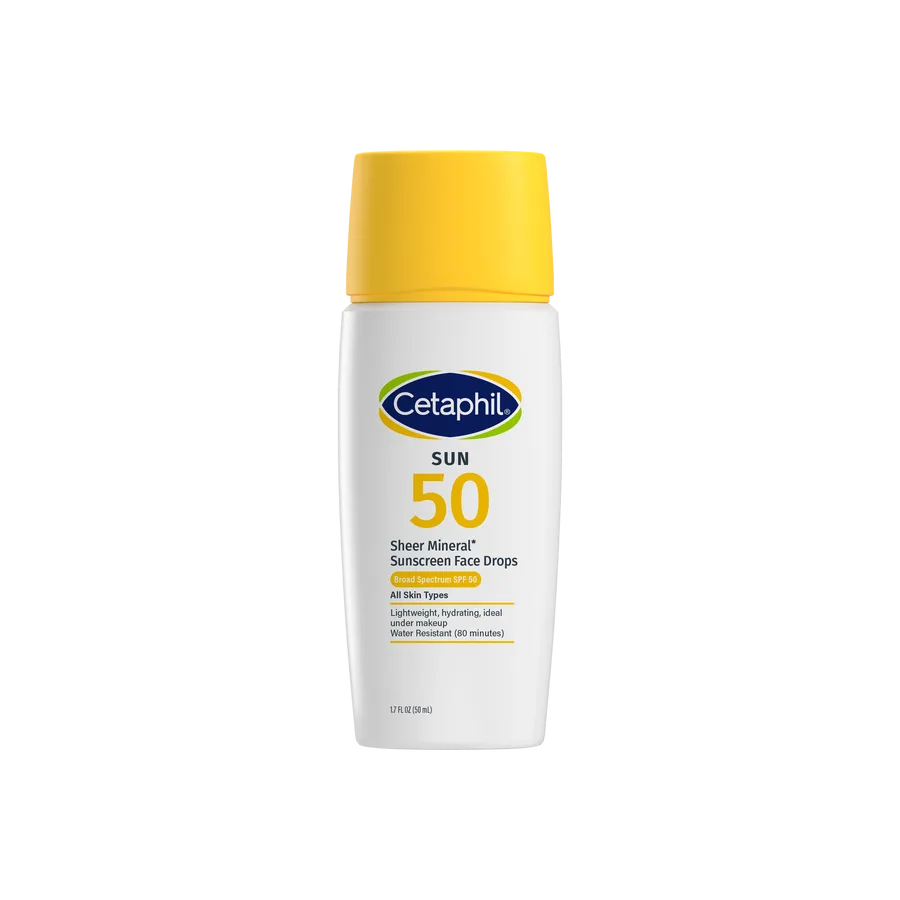
Sheer Mineral Face Sunscreen SPF 50
Sensitive Skin SPF Champion
 Verified reviewer
Pros & cons.
- +Independent lab testing confirms 99.9% UVA and 98.5% UVB protection — exceptional for a single-filter mineral
- +Zinc oxide-only formula is the gentlest possible UV filter option for sensitive and eczema-prone skin
- +Lightweight liquid format absorbs faster and feels less heavy than typical mineral sunscreen creams
- +National Eczema Association Seal of Acceptance validates safety for eczema-compromised skin
- +Water-resistant 80 minutes (FDA maximum) for active daily protection
- +Under $13 for SPF 50 mineral protection — exceptional drugstore value
- +Reef-safe formulation without oxybenzone or octinoxate
- −White cast remains visible on medium-to-dark skin tones despite improved formulation
- −Dropper dispenser requires multiple fills for adequate facial coverage — can be fiddly
- −Not moisturizing enough for dry skin — requires a separate moisturizer underneath
- −Silicone-heavy base may not appeal to those avoiding dimethicone and similar ingredients
- −Small 1.7 oz bottle means frequent repurchasing for daily users
The full review.
Mineral sunscreens have an image problem. Mention “zinc oxide SPF 50” and most people imagine a thick white cream like a 1990s cricket player. For decades, this category traded cosmetic elegance for UV protection, as if looking decent and being protected were mutually exclusive.
Cetaphil’s Sheer Mineral Face Liquid Sunscreen SPF 50 proves that trade-off is a formulation failure, not a physical inevitability. Independent lab data confirms this.
About the Product
The test results are remarkable. The Sunscreen Tester lab — an independent facility that evaluates real-world UV protection — tested this exact formula and measured 99.9% UVA blockage and 98.5% UVB blockage. This equals a Global Sun Index of 99.83%, meaning virtually no UV radiation gets through. This comes from a sunscreen using only one active ingredient — zinc oxide at 12%. No titanium dioxide. No chemical boosters. Just well-formulated zinc oxide.
How it Works
How does 12% zinc oxide rival or exceed multi-filter systems? Formulation engineering. Silicone-based spreading agents (dimethicone, caprylyl methicone, and specialized silicone crosspolymers) precisely size and disperse the zinc oxide particles to create an even, uniform film. Uneven distribution kills sunscreen efficacy; a product can have a high SPF on paper but fail because active ingredients clump instead of spread. The liquid format of Cetaphil’s Sheer Mineral Face Liquid Sunscreen SPF 50 is fluid enough to form a uniform protective layer.
Texture
The liquid consistency is a revelation. It comes out of the bottle like a lightweight serum — milky, fluid, and thin. It spreads across the face with almost no resistance and absorbs within one to two minutes. The finish is satin — not matte, not dewy, just smooth and natural. Physics demands some white cast when you put mineral particles on skin. However, it is much less than traditional mineral creams; on light-to-medium skin tones, it is barely noticeable after blending. Deeper skin tones see more cast, which remains this product category’s persistent limitation.
Ingredients
Beyond the zinc oxide, the formula includes effective ingredients. Niacinamide provides antioxidant defense against UV-generated free radicals and stimulates ceramide production for barrier support. Bisabolol — a chamomile derivative — delivers anti-inflammatory soothing to help the skin tolerate daily zinc oxide wear. Allantoin adds a skin-protectant layer. Tocopherol (vitamin E) provides lipid-soluble antioxidant protection. These ingredients turn this from a simple sunscreen into a daily skin-health product.
Good to Know
The National Eczema Association seal is significant. Most sunscreens — even mineral ones — contain ingredients that irritate eczema-compromised skin. NEA acceptance means the entire formulation, not just the zinc oxide, passed evaluation for eczema compatibility. Ophthalmologist testing adds confidence, especially for people whose eyes sting from sunscreen.
Water Resistance
The 80 minutes water resistance rating (the FDA maximum) makes this viable for active days, not just office commutes. Reapplication is still necessary every two hours in direct sun, but the water resistance means a walk in the rain or a light workout won’t immediately compromise protection.
Packaging
The dropper dispenser divides opinion. It allows precise application; you control exactly how much you use, which matters because over-application increases white cast in a mineral sunscreen. However, dispensing enough for a full face (roughly a quarter teaspoon) requires multiple dropper-fills, and some users find it more fiddly than a pump or squeeze tube.
Price
At approximately $13 for 1.7 oz, this is affordable for a mineral SPF 50 with this level of formulation sophistication. Comparable lightweight mineral sunscreens from prestige brands cost $30-50 for similar volumes. The per-use cost for daily facial application is roughly 20-25 cents — accessible for anyone needing daily SPF, which dermatologists insist is everyone.
Summary
This sunscreen does not solve the white cast problem entirely. It does not replace the cosmetic elegance of the best chemical sunscreens. Instead, it pushes the mineral sunscreen category forward by proving that zinc oxide alone, formulated intelligently, delivers exceptional protection in a format people will use every day. For sensitive, reactive, and eczema-prone skin, that daily compliance is everything. A perfect sunscreen left in a drawer is worth less than a good sunscreen worn every morning.
Ingredient analysis.
Full INCI list
Active Ingredient: Zinc Oxide 12%. Inactive Ingredients: Allantoin, Bisabolol, Butyloctyl Salicylate, C12-15 Alkyl Benzoate, Caprylyl Glycol, Caprylyl Methicone, Dimethicone, Dimethiconol/Propylsilsesquioxane/Silicate Crosspolymer, Ethylhexylglycerin, Hexylene Glycol, Isododecane, Lauryl PEG-10 Tris(Trimethylsiloxy)Silylethyl Dimethicone, Lauryl PEG-8 Dimethicone, Niacinamide, Octyldodecyl Neopentanoate, PEG-10, Phenoxyethanol, Polymethylsilsesquioxane, Propanediol, Sodium Chloride, Sodium Hydroxide, Tetrasodium Glutamate Diacetate, Tocopherol, Trilaureth-4 Phosphate, Water
Skin match.
The science.
The Science
Zinc oxide is the only single ingredient that provides broad-spectrum protection across both UVA (320-400nm) and UVB (290-320nm) wavelengths. Pinnell et al. (2000) established this in Dermatologic Surgery, showing that zinc oxide's reflective and absorptive properties cover the entire UV spectrum reaching earth's surface.
This specific formula's independent protection metrics (99.9% UVA, 98.5% UVB) match the theoretical broad-spectrum coverage of properly formulated zinc oxide. Particle size and distribution uniformity are the deciding factors—studies show micronized zinc oxide particles (100-300nm) provide better UV attenuation than larger particles and reduce the visible white cast. The silicone-based vehicle in this formula ensures uniform distribution across the skin surface.
Niacinamide adds biochemical photoprotection to the physical UV blocking. A 2005 study by Hakozaki et al. in the British Journal of Dermatology showed niacinamide reduces UV-induced immunosuppression and inhibits melanosome transfer, protecting against photodamage through pathways independent of UV absorption. In a sunscreen, niacinamide addresses residual photodamage that even high-SPF products cannot completely prevent.
Bisabolol works by inhibiting cyclooxygenase and 5-lipoxygenase pathways, which reduces the prostaglandins and leukotrienes that drive UV-induced skin inflammation. A 2014 review in the International Journal of Molecular Sciences confirmed bisabolol's use in topical formulations for sensitive and irritation-prone skin.
Marine biological studies show zinc oxide has a safe reef profile with minimal toxicity to coral larvae compared to chemical UV filters like oxybenzone and octinoxate, which cause coral bleaching at concentrations found in recreational swimming areas.
References
- Topical application of niacinamide reduces yellowing, wrinkling, red blotchiness, and hyperpigmented spots in aging facial skin — British Journal of Dermatology (2005)
Dermatologist Perspective
Board-certified dermatologists frequently recommend this product and mineral sunscreens for patients with sensitive, reactive, or eczema-prone skin. Dermatologists note that the zinc oxide-only formula removes the risk of allergic or irritant reactions to chemical UV filters while providing the broad-spectrum coverage essential to prevent photoaging and skin cancer. Ophthalmologist testing adds confidence for application near the eyes, where sunscreen-related irritation is common. Clinicians advise applying a generous amount (approximately 1/4 teaspoon for the face) and reapplying every 2 hours during sun exposure, regardless of the SPF rating.
Where it fits in your routine.
Finish your morning skincare routine (cleanser, serum, moisturizer), then use the dropper to dispense about 1/4 teaspoon onto your fingertips. Dot the formula onto your forehead, cheeks, nose, and chin, then blend with gentle, upward strokes. Let it set for 1-2 minutes before applying makeup. Reapply every 2 hours during extended sun exposure, or after swimming, sweating heavily, or toweling off. Remove at night with a double cleanse — use an oil-based cleanser first, then a gentle water-based cleanser.
At about $13 for 1.7 oz, this is one of the cheapest mineral SPF 50 sunscreens. La Roche-Posay, EltaMD, and Supergoop charge $30-45 for similar lightweight mineral formulas. Daily facial use of the 1.7 oz bottle lasts 6-8 weeks, costing roughly $7-9 per month. This offers great value for a product with NEA acceptance, ophthalmologist testing, and independently verified exceptional UV protection. The Galderma pharmaceutical heritage means the formulation science is clinical-grade at a drugstore price.
People with sensitive, reactive, or eczema-prone skin needing daily mineral SPF. Users seeking reef-safe sunscreen with high UV protection. Budget-conscious consumers wanting clinical-grade mineral sunscreen at a drugstore price. Pregnant or breastfeeding individuals looking for a non-chemical SPF. People who find traditional mineral sunscreens too thick or heavy.
People with deeper skin tones who dislike white cast may still see residue from this improved formula. People who want silicone-free formulations may also avoid it. Dropper dispensers frustrate some users. Those with very dry skin need a hydrating moisturizer underneath.
Product details.
Thin, fluid liquid with a milky-white appearance. It is much lighter than traditional mineral sunscreen creams and has a serum-like consistency. A dropper or fingertips spread it easily. It absorbs faster than expected for a zinc oxide sunscreen.
Fragrance-free with no detectable scent
Small bottle uses a dropper dispenser for precise application. The dropper controls amounts, but some users find it awkward to dispense enough for full-face coverage. The compact size works for travel.
This mineral sunscreen is thinner than expected. The liquid format surprises users used to thick zinc oxide creams. It absorbs within 1-2 minutes and leaves a subtle satin finish instead of the heavy white mask typical of mineral sunscreens. Some white cast shows on medium-to-dark skin tones, but it is significantly less than most mineral SPF 50 products.
6-8 weeks with daily facial application
12 months
All Year
The backstory.
Cetaphil developed this sunscreen to prove that mineral UV protection doesn't require sacrificing cosmetic elegance. The liquid drop format was designed to overcome the two biggest complaints about mineral sunscreens — heavy texture and white cast — while maintaining the gentle, non-reactive protection that sensitive and eczema-prone skin requires. Independent lab testing validated that the formulation achieves exceptional real-world UV protection despite using only one active filter.
About Cetaphil
Legacy Brand (20+ years)Cetaphil launched in 1947 and has dermatologist-recommended status for over 75 years. This sunscreen has the National Eczema Association Seal of Acceptance and independent lab tests show high UV protection.
Common myths.
--- Mineral sunscreens lack SPF 50 without a white paint appearance ---
Modern formulation technology improves mineral sunscreen elegance. This liquid format uses micronized zinc oxide particles and silicone-based spreading agents to reach SPF 50 in a sheer, lightweight vehicle. Some white cast remains, especially on deeper skin tones, but it is less than traditional mineral creams produce.
Broad-spectrum protection requires both zinc oxide and titanium dioxide.
Zinc oxide alone provides broad-spectrum UVA and UVB protection. It is the only single sunscreen ingredient that covers the full UV spectrum. This formula shows that 12% zinc oxide, when properly formulated, achieves near-perfect UV protection scores without titanium dioxide.
FAQ.
Is Cetaphil Sheer Mineral Sunscreen reef-safe?
Yes — this formula uses only zinc oxide as its UV filter. It lacks oxybenzone and octinoxate, the two sunscreen ingredients most commonly restricted by reef-protection legislation. Zinc oxide is safe for marine environments.
Can I use this sunscreen on eczema-prone skin?
Yes — this sunscreen has the National Eczema Association Seal of Acceptance. The zinc oxide-only formula uses bisabolol and allantoin to avoid irritation on sensitive and eczema-prone skin. Ophthalmologists also tested it for safety around the eye area.
How does this compare to chemical sunscreens for UV protection?
Independent lab testing shows this formula blocks 99.9% of UVA and 98.5% of UVB radiation. This matches or exceeds many chemical SPF 50 sunscreens. The single zinc oxide active provides broad-spectrum protection across the entire UV range, which some chemical filter combinations do not cover.
Is Cetaphil Sheer Mineral Sunscreen water-resistant?
Yes — it is water-resistant for 80 minutes, the FDA's maximum rating. Reapply after swimming, heavy sweating, or toweling off. For daily non-athletic use, reapply every 2 hours during prolonged sun exposure.
Is this sunscreen safe during pregnancy?
Yes — zinc oxide is a mineral/physical UV filter. It sits on the skin surface and does not absorb systemically. It is one of the safest sunscreen options during pregnancy and breastfeeding. The formula is also fragrance-free, paraben-free, and lacks chemical UV filters.
What the community says.
"Lightweight liquid format absorbs better than cream sunscreens"
"No stinging around eyes"
"Excellent UV protection for a single-filter mineral sunscreen"
"Affordable for a mineral SPF 50"
"Layers well under makeup"
"White cast on deeper skin tones"
"Chalky residue if over-applied"
"Dropper dispenser can be messy"
"Not moisturizing enough for dry skin on its own"
Featured in.
People also looked at.