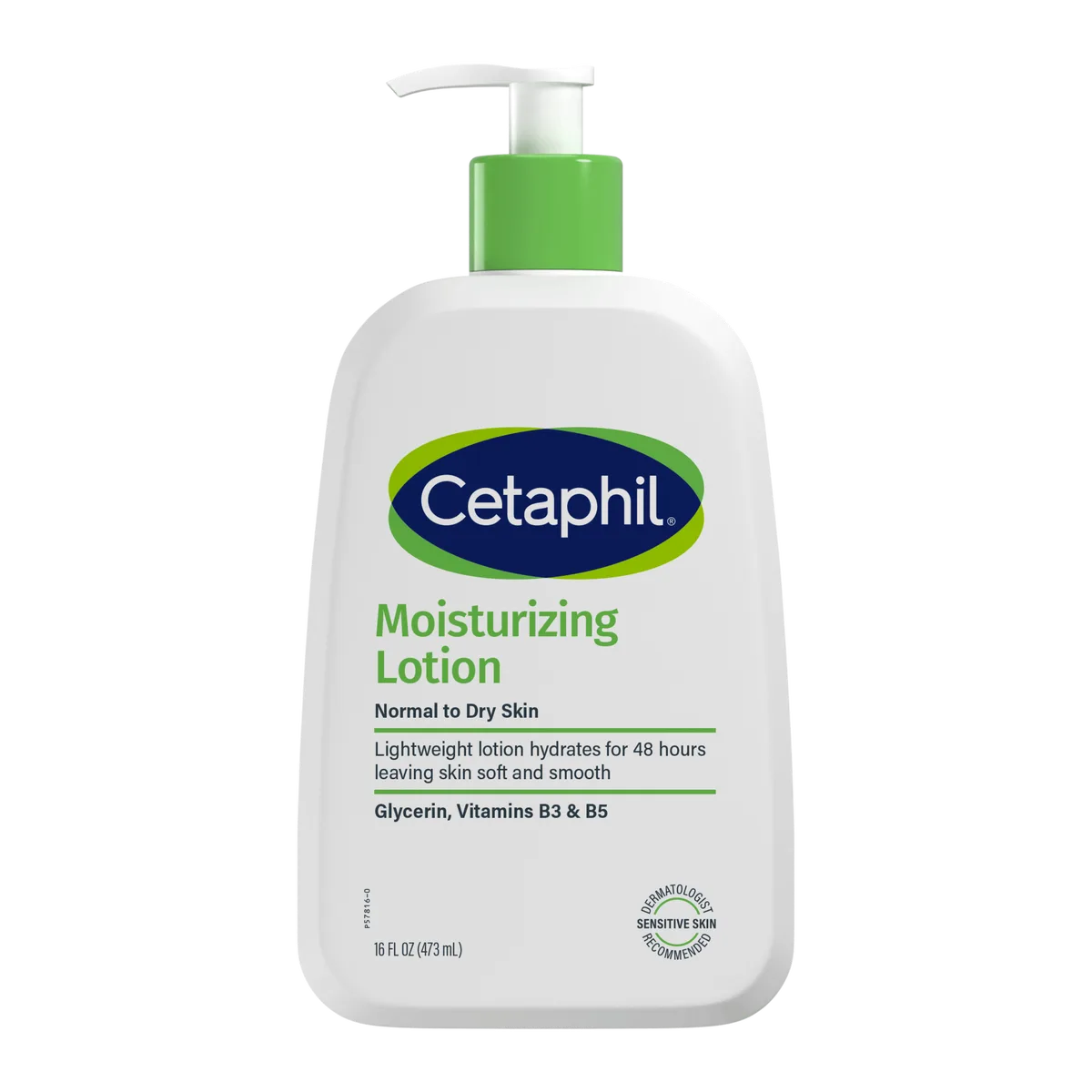
Moisturizing Lotion
The Everyday Essential
 Verified reviewer
Pros & cons.
- +National Eczema Association Seal of Acceptance validates safety for the most sensitive skin
- +Niacinamide-panthenol system actively repairs barrier function rather than just coating the surface
- +Lightweight, fast-absorbing texture is practical for daily full-body and facial use
- +Seven size options from 2 oz to 1 liter accommodate every budget and use case
- +Completely fragrance-free with no masking fragrance or botanical scent additives
- +Approximately four decades of continuous production and dermatologist recommendation history
- +2021 reformulation removed parabens and sulfates while adding modern barrier-repair actives
- −Contains isopropyl palmitate which scores 4/5 on classic comedogenicity testing
- −May not be occlusive enough for severely dry or cracked skin in harsh winter conditions
- −Contains dimethicone and ceteareth-20 that some consumers prefer to avoid
- −2021 reformulation caused adverse reactions for a small percentage of longtime users
- −Not suitable for fungal acne due to isopropyl palmitate and fatty alcohol content
The full review.
Some products win by being exciting. This one won by being boring—reliably, consistently, decades-of-dermatologist-recommendations boring. The Cetaphil Moisturizing Lotion has sat on pharmacy shelves for approximately forty years. For most of that time, it was exactly what it looked like: a simple, gentle, fragrance-free lotion that moisturized skin without issues. It wasn’t transformative or exciting. It was just good.
Then in September 2021, Cetaphil did something unusual for a stable brand: they changed the formula. This wasn’t a minor tweak; it was a substantive reformulation. They added niacinamide, panthenol, vitamin E, avocado oil, and sunflower seed oil while removing parabens, sulfates, and animal-derived ingredients. The old formula was a passive moisturizer. The new formula is an active barrier-repair product in the same clinical white-and-teal uniform.
The niacinamide addition is the most consequential change. Research in the British Journal of Dermatology shows that niacinamide stimulates biosynthesis of ceramides, free fatty acids, and cholesterol in the epidermis—the three lipid classes that make up the skin’s moisture barrier. Each application of the reformulated lotion doesn’t just coat the skin with temporary moisture; it incrementally rebuilds the skin’s capacity to retain its own moisture. For eczema patients with barrier dysfunction, this shift from passive to active moisturization is clinically meaningful.
The panthenol-pantolactone B5 system adds anti-inflammatory benefits. A study in the Journal of Cosmetic Science shows that panthenol formulations significantly decrease transepidermal water loss after consistent application. These anti-inflammatory properties are valuable for eczema-prone skin where irritation and dryness create a cycle.
The texture makes this lotion a daily driver. It is lightweight enough to use on the entire body twice a day without feeling heavy. It absorbs in about a minute, leaves no greasy film, doesn’t transfer to clothing, and sits comfortably under professional attire. The pump bottle makes application efficient—a few pumps, spread, absorb, done. For a product used 365 days a year on the entire body, this frictionless routine is its most important feature.
The face-and-body versatility is real, not just marketing. The 16-ingredient formula is simple and the texture is light enough to work on facial skin without feeling heavy or causing problems for most users. It lacks the sophistication of a dedicated face product, but for the minimalist wanting one product for everything, it works.
The National Eczema Association Seal of Acceptance carries weight. This isn’t self-awarded; it requires formal submission of sensitivity testing data, safety studies, and formulation analysis to the NEA’s scientific advisory committee. The seal tells eczema patients—who often face irritation from products claiming gentleness—that this formula has independent validation for their needs.
The limitation is the same as it has been for forty years: this is a lotion, not a cream, and it moisturizes like one. In harsh winter, on severely dry or cracked skin, or on thick eczema plaques, it may not be occlusive enough alone. The dimethicone provides some occlusive protection, but it isn’t the heavy-duty seal that petrolatum or a thick cream delivers. In those cases, layering this lotion under Cetaphil’s Healing Ointment or Moisturizing Cream is better.
The isopropyl palmitate in the formula needs discussion. Classic comedogenicity testing (the rabbit ear assay) gives it a score of 4 out of 5. However, the finished product is tested and labeled non-comedogenic, and real-world data from tens of thousands of reviews shows no pattern of breakouts. Individual ingredient comedogenicity scores don’t reliably predict how an ingredient behaves in a complete formulation—concentration, surrounding ingredients, and vehicle all change the effect. Anyone with extremely acne-prone skin should patch test.
The size range is impressive. From a 2 oz travel tube to a 33.8 oz (one-liter) economy bottle, the Moisturizing Lotion offers seven size options for every use case and budget. The per-ounce cost drops at larger sizes, and Costco’s two-packs of 20 oz bottles cost roughly five cents per application for full-body use. For a product with the NEA seal, niacinamide barrier repair, and four decades of dermatologist backing, the pricing is unbeatable.
The 2021 reformulation was more than a formula update; it was a statement. Cetaphil could have relied on brand recognition and clinical trust with the old formula. Instead, they made it better while preserving what earned that trust. The Moisturizing Lotion didn’t become exciting in 2021. It became excellent—and for a daily body lotion, that is the better outcome.
Formula
Texture
The texture makes this lotion a daily driver. It is lightweight enough to use on the entire body twice a day without feeling heavy. It absorbs in about a minute, leaves no greasy film, doesn’t transfer to clothing, and sits comfortably under professional attire. The pump bottle makes application efficient—a few pumps, spread, absorb, done. For a product used 365 days a year on the entire body, this frictionless routine is its most important feature.
Best for
The face-and-body versatility is real, not just marketing. The 16-ingredient formula is simple and the texture is light enough to work on facial skin without feeling heavy or causing problems for most users. It lacks the sophistication of a dedicated face product, but for the minimalist wanting one product for everything, it works.
Works for
The National Eczema Association Seal of Acceptance carries weight. This isn’t self-awarded; it requires formal submission of sensitivity testing data, safety studies, and formulation analysis to the NEA’s scientific advisory committee. The seal tells eczema patients—who often face irritation from products claiming gentleness—that this formula has independent validation for their needs.
Not ideal for
The limitation is the same as it has been for forty years: this is a lotion, not a cream, and it moisturizes like one. In harsh winter, on severely dry or cracked skin, or on thick eczema plaques, it may not be occlusive enough alone. The dimethicone provides some occlusive protection, but it isn’t the heavy-duty seal that petrolatum or a thick cream delivers. In those cases, layering this lotion under Cetaphil’s Healing Ointment or Moisturizing Cream is better.
Conflicts With
The isopropyl palmitate in the formula needs discussion. Classic comedogenicity testing (the rabbit ear assay) gives it a score of 4 out of 5. However, the finished product is tested and labeled non-comedogenic, and real-world data from tens of thousands of reviews shows no pattern of breakouts. Individual ingredient comedogenicity scores don’t reliably predict how an ingredient behaves in a complete formulation—concentration, surrounding ingredients, and vehicle all change the effect. Anyone with extremely acne-prone skin should patch test.
Packaging
The size range is impressive. From a 2 oz travel tube to a 33.8 oz (one-liter) economy bottle, the Moisturizing Lotion offers seven size options for every use case and budget. The per-ounce cost drops at larger sizes, and Costco’s two-packs of 20 oz bottles cost roughly five cents per application for full-body use. For a product with the NEA seal, niacinamide barrier repair, and four decades of dermatologist backing, the pricing is unbeatable.
About
The 2021 reformulation was more than a formula update; it was a statement. Cetaphil could have relied on brand recognition and clinical trust with the old formula. Instead, they made it better while preserving what earned that trust. The Moisturizing Lotion didn’t become exciting in 2021. It became excellent—and for a daily body lotion, that is the better outcome.
Ingredient analysis.
Full INCI list
Water, Glycerin, Isopropyl Palmitate, Cetearyl Alcohol, Ceteareth-20, Panthenol, Niacinamide, Tocopheryl Acetate, Dimethicone, Persea Gratissima (Avocado) Oil, Helianthus Annuus (Sunflower) Seed Oil, Pantolactone, Glyceryl Stearate, Sodium Benzoate, Benzyl Alcohol, Citric Acid
Skin match.
The science.
The Science
The 2021 reformulation shifted this lotion's hydration strategy from simple emolliency to barrier-repair science — a clinical evolution for eczema-prone populations using it daily.
Tanno et al. established niacinamide's barrier-strengthening mechanism in the British Journal of Dermatology (2000). They showed that nicotinamide increases biosynthesis of ceramides, free fatty acids, and cholesterol in the epidermis. This effect works through upregulation of serine palmitoyl transferase — the rate-limiting enzyme in the ceramide synthesis pathway. Thus, the niacinamide in this lotion trains the skin to produce more of its own barrier lipids, improving the barrier cumulatively with each application.
Research presented at the American Academy of Dermatology (2022) studied the panthenol-glycerin-niacinamide trio directly. In a 54-subject study evaluating barrier recovery after tape-stripping, a formulation with this trio showed superior skin barrier restoration compared to ceramide-containing products over 14 days. This finding applies to this lotion's clinical promise — the same three ingredients work synergistically.
Draelos et al. published a study in Cutis (2005) showing that niacinamide-containing facial moisturizers significantly improve skin barrier function in rosacea patients. This supports niacinamide barrier repair for various inflammatory skin conditions.
The dual plant oil system (avocado oil and sunflower seed oil) supplies essential fatty acids. Sunflower seed oil has linoleic acid, which integrates into the stratum corneum's lipid bilayers. Clinical research shows linoleic acid improves barrier integrity in atopic dermatitis patients. Avocado oil adds oleic acid and phytosterols, which complement the linoleic acid pathway with different barrier-supporting lipid classes.
Glycerin does more than act as a humectant. Research shows glycerin modulates aquaporin-3 channels in keratinocytes, moving water through the epidermis and improving hydration at a cellular level rather than just at the surface.
References
- Nicotinamide increases biosynthesis of ceramides as well as other stratum corneum lipids to improve the epidermal permeability barrier — British Journal of Dermatology (2000)
- A moisturizing cream with panthenol, glycerin, and niacinamide provides superior skin barrier recovery — Journal of the American Academy of Dermatology (2022)
- Niacinamide-containing facial moisturizer improves skin barrier and benefits subjects with rosacea — Cutis (2005)
Dermatologist Perspective
Dermatologists have recommended this lotion for decades; the 2021 reformulation strengthened those reasons. Board-certified dermatologists value the NEA Seal of Acceptance as independent validation that simplifies patient conversations — recommending an NEA-approved product provides clinical confidence that brand marketing lacks. Clinicians managing eczema patients especially value the niacinamide addition, as it provides barrier-repair benefits in a daily-use product patients already use. The fragrance-free, hypoallergenic formula remains a default recommendation for post-procedure care, as a companion to topical prescription treatments, and as a safe baseline moisturizer for patients with contact dermatitis who have limited trigger-free options.
Where it fits in your routine.
Apply a generous amount to slightly damp skin right after bathing; the humectant system binds surface moisture most effectively. For body use, pump several times into your palm and spread across each area, focusing on dry-prone spots like shins, forearms, and hands. For facial use, apply a thin layer and follow with sunscreen. Use morning and evening. On very dry areas, layer under Cetaphil Moisturizing Cream or Healing Ointment to increase occlusion. Store at room temperature away from direct sunlight.
The Cetaphil Moisturizing Lotion offers great value across all sizes. The 16 oz pump bottle costs about $15.99 and lasts 2-3 months with daily full-body use. The 20 oz size and Costco two-packs lower the per-ounce cost, while the 33.8 oz economy bottle maximizes savings. At roughly five to eight cents per full-body application, the value is unmatched for a product with the NEA Seal, niacinamide barrier repair, and four decades of clinical backing. Seven size options — from a $3.19 travel tube to the economy liter — provide an entry point for every budget.
People seeking evidence-based daily moisturizers for dry, normal, or sensitive skin on the face and body. Eczema patients needing an NEA-approved, fragrance-free daily lotion. Families wanting one safe product for everyone. Budget-conscious consumers wanting pharmacy-grade quality and low per-ounce pricing on larger sizes.
Oily skin types that do not need this much moisture. People with severe acne who avoid isopropyl palmitate. Consumers who avoid silicones or ethoxylated emulsifiers. Those with very dry or cracked skin who need the heavier-duty Moisturizing Cream or Healing Ointment instead of a lotion.
Product details.
This is fragrance-free and has no masking fragrance. Users report no detectable scent, noting only a faint neutral undertone from the base ingredients.
The 16 oz and 20 oz sizes use white plastic pump bottles; smaller sizes (2 oz, 3.4 oz, 4 oz, 8 oz) use squeeze tubes. Cetaphil uses clean, clinical teal-and-white branding. A 33.8 oz (1 liter) economy size with pump is also available. The pump dispenser is hygienic and works well for daily full-body use. ***
The first use feels comfortable immediately. The lotion absorbs in one or two minutes without stickiness or heaviness. Skin feels softer and more supple right away. There is no tingling, stinging, or adjustment period. The lightweight texture surprises users expecting Cetaphil's moisturizers to be thick and heavy. ***
2-3 months with daily full-body application at the 16 fl oz size ***
12 months ***
All Year ***
The backstory.
The Moisturizing Lotion has been part of the Cetaphil lineup for approximately four decades, serving as the daily maintenance counterpart to the Gentle Skin Cleanser. The September 2021 reformulation was Cetaphil's most significant product evolution — adding niacinamide, panthenol, and vitamin E while removing parabens, sulfates, and animal-derived ingredients. The update reflected Galderma's strategy to modernize their legacy products with active barrier-repair science without losing the simplicity that made them dermatology staples.
About Cetaphil
Legacy Brand (20+ years)Cetaphil was created by pharmacist Erwin S. Whiting in 1947 and is owned by Galderma, a Swiss dermatological pharmaceutical company. The Moisturizing Lotion has been a dermatology staple for approximately four decades, carries the National Eczema Association Seal of Acceptance, and was significantly reformulated in 2021 to add niacinamide and panthenol while removing parabens.
Common myths.
Cetaphil Moisturizing Lotion has parabens and is outdated.
The 2021 reformulation removed all parabens, using sodium benzoate and benzyl alcohol for preservation instead. The updated formula adds niacinamide, panthenol, and vitamin E—modern barrier-repair ingredients the original lacked.
Lightweight lotions do not provide enough moisture for dry skin; use a thick cream instead.
This formula provides clinically tested 48-hour hydration through three mechanisms: glycerin draws water in, niacinamide strengthens the barrier to retain it, and dimethicone provides an occlusive seal. The lightweight texture comes from the delivery system, not a lack of hydrating power.
FAQ.
Can I use Cetaphil Moisturizing Lotion on my face?
Yes — the fragrance-free, non-comedogenic formula works for both face and body. Apply a thin layer to the face, then use sunscreen in the morning. The lightweight texture absorbs under makeup and sunscreen without pilling.
Is Cetaphil Moisturizing Lotion good for eczema?
Yes — it has the National Eczema Association Seal of Acceptance, earned through formal review of safety data and sensitivity testing. The niacinamide stimulates ceramide production to repair the barrier, and the fragrance-free, hypoallergenic formula reduces irritation triggers for eczema-prone skin.
Did Cetaphil reformulate the Moisturizing Lotion?
Yes — Cetaphil updated the formula in September 2021. This reformulation adds niacinamide, panthenol, vitamin E, avocado oil, and sunflower seed oil. It removes parabens, sulfates, and animal-derived ingredients. The new formula is more sophisticated but keeps the lightweight, gentle character of the original.
Is Cetaphil Moisturizing Lotion safe during pregnancy?
The formula lacks retinoids, salicylic acid, or other pregnancy-flagged ingredients. Its niacinamide, panthenol, and glycerin are pregnancy-safe. Cetaphil hasn't tested this product on pregnant populations, but dermatologists commonly recommend it as a safe moisturizer during pregnancy.
What is the difference between Cetaphil Moisturizing Lotion and Moisturizing Cream?
The Lotion is lightweight and absorbs fast, for daily use on the face and body. The Cream is thicker and more occlusive, for very dry skin and targeted application on dry areas. Both are fragrance-free and have the NEA Seal, but the Lotion has more size options and a lighter texture.
Does Cetaphil Moisturizing Lotion contain isopropyl palmitate — is that comedogenic?
Yes, the formula contains isopropyl palmitate, which scores a 4 on the classic comedogenicity scale. However, the finished product is tested and labeled non-comedogenic. Isolated ingredient comedogenicity ratings do not always predict how an ingredient behaves in a complete formula. People with highly acne-prone skin may want to patch test.
How long does Cetaphil Moisturizing Lotion keep skin hydrated?
Cetaphil claims clinically tested 48-hour hydration. Most users find one application provides comfortable all-day moisture, but very dry skin works better with twice-daily use. The niacinamide builds cumulative barrier strength over weeks, so hydration lasts longer with continued use.
What the community says.
"Lightweight and fast-absorbing without leaving a greasy residue"
"Provides effective long-lasting hydration throughout the entire day"
"Gentle enough for eczema-prone and sensitive skin with NEA seal validation"
"Fragrance-free formula with no detectable scent"
"Versatile for both face and body use in a single product"
"Excellent value across multiple size options from travel to economy"
"Can feel too light for very dry or cracked skin in harsh winter conditions"
"Some users report slight tackiness before full absorption"
"2021 reformulation caused burning or redness for some longtime users"
"Contains isopropyl palmitate which has a high comedogenicity rating in classic testing"
"Not moisturizing enough as a standalone for severe eczema patches"