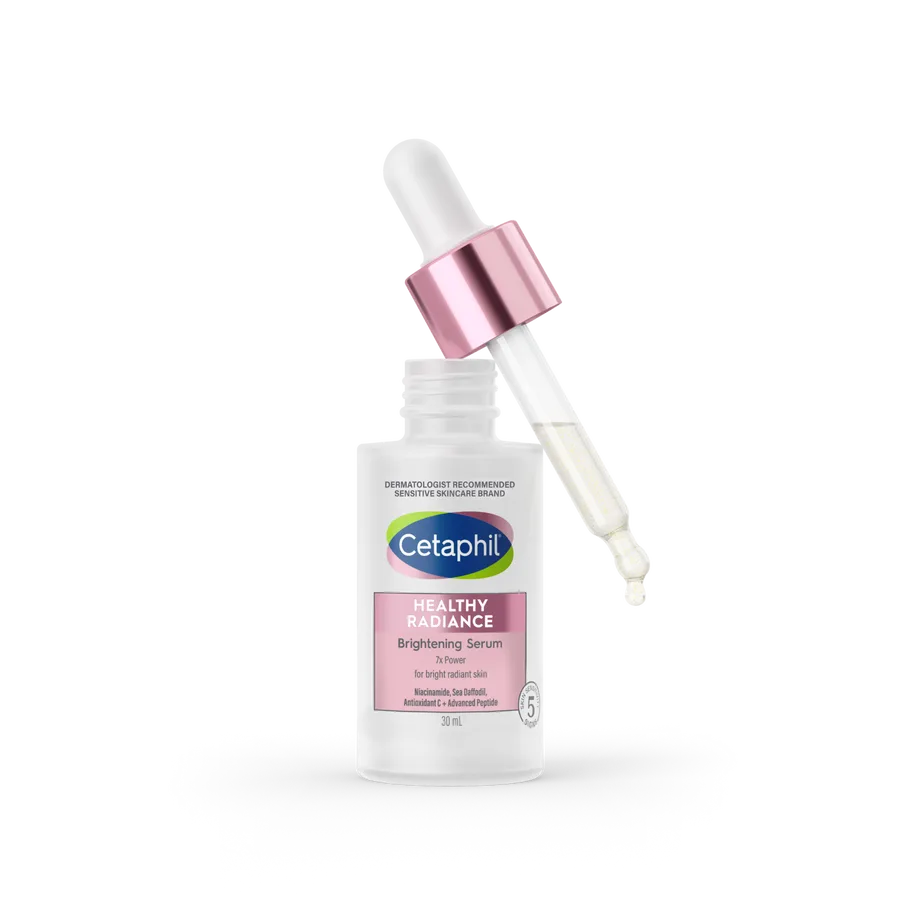
Bright Healthy Radiance Brightening Perfecting Serum
Triple-Path Brightener
 Verified reviewer
Pros & cons.
- +Triple anti-pigmentation pathway combines niacinamide, stable vitamin C, and sea daffodil extract
- +3-O-Ethyl ascorbic acid resists oxidation unlike L-ascorbic acid, maintaining potency throughout shelf life
- +Light-reflecting particles provide immediate luminosity while long-term actives work
- +Lightweight gel-serum absorbs in seconds and layers seamlessly under moisturizer and sunscreen
- +Fragrance-free, hypoallergenic formulation suitable for sensitive and reactive skin types
- +Pump dispenser protects formula integrity and provides precise, hygienic application
- −Not widely available in US and Western markets — requires import purchasing
- −Brightening results for deep or long-standing dark spots are gradual and limited
- −Small 30 ml size turns over quickly at approximately eight to ten weeks per bottle
- −Some users with niacinamide sensitivity experienced redness despite the gentle formulation
- −Not moisturizing enough on its own — requires a moisturizer layered over it
The full review.
Skincare myths claim vitamin C and niacinamide cannot coexist in one formula. This idea stems from a 1963 study using conditions irrelevant to modern cosmetic chemistry, yet it persists on social media and skincare forums. The Cetaphil Bright Healthy Radiance Brightening Perfecting Serum ignores this myth by building its identity around this exact combination.
Niacinamide is third in the INCI list, making it the highest concentration active in the formula. As the GentleBright Technology workhorse, it inhibits melanosome transfer from melanocytes to keratinocytes—the step where excess pigment becomes visible on the skin surface. Below it, 3-O-ethyl ascorbic acid targets tyrosinase, the enzyme that starts melanin synthesis. Sea daffodil extract adds a third mechanism by inhibiting melanin transferase. Three pathways, three mechanisms, one serum.
Choosing 3-O-ethyl ascorbic acid over L-ascorbic acid is the product’s most revealing formulation decision. L-ascorbic acid is the gold standard for potency, but it is the most unstable vitamin C form. It oxidizes rapidly when exposed to light, air, or water, turns orange, and loses effectiveness. For a brand prioritizing reliability and gentleness, stability beats peak potency. The ethyl group bonded to the ascorbic acid molecule protects it from oxidation and maintains efficacy throughout its shelf life. A 2021 study in Molecules confirmed that 3-O-ethyl ascorbic acid reduces UV-induced DNA damage and melanin synthesis while stimulating collagen production; it works through a gentler, more stable pathway.
The light-reflecting particles—CI 77891 and tin oxide—are a smart cosmetic addition. Brightening serums often face a perception problem: they promise results but deliver them over weeks, leaving users unsure of progress. These mineral particles create immediate, subtle luminosity upon application. This healthy-skin glow provides cosmetic satisfaction while the active ingredients perform their slower, invisible work. It is a psychologically clever feature rather than a treatment feature.
The texture is a lightweight gel-serum that absorbs within thirty seconds. It has no stickiness, residue, or heaviness. It layers seamlessly under moisturizer and sunscreen—a practical necessity since users must apply SPF to prevent the UV-triggered pigmentation this product treats. The pump dispenser allows clean, controlled application, and the tube packaging protects the formula from light exposure that could degrade less stable actives.
The formula targets sensitive skin and delivers on that promise for most users. The niacinamide-vitamin C combination uses a compatible pH, and the absence of fragrance, alcohol, and harsh preservatives minimizes irritation risk. However, some users with specific niacinamide sensitivity report redness and roughness, showing that even gentle actives are not universally tolerated. A patch test is wise for reactive skin.
Results follow typical patterns for gentle brightening products: immediate luminosity from the particles, subtle improvements in skin texture and radiance within the first week, visible brightening at two to four weeks, and meaningful dark spot reduction at eight to twelve weeks. Deep, long-standing hyperpigmentation responds slowly or not at all. This serum works best on recent dark spots, post-inflammatory marks, and general dullness. It supplements professional treatment for severe melasma or years-old sun damage rather than replacing it.
The 30 ml size is standard for a facial serum but turns over quickly at two to three drops twice daily—roughly eight to ten weeks per bottle. At approximately twenty dollars in primary markets, the value competes with similar gentle brightening serums. For US consumers using import channels, costs and value vary.
Availability is the product’s main practical limitation. The Perfecting Serum sells primarily in Asia-Pacific, UK, and Australian markets. US consumers can access Cetaphil’s Healthy Radiance Antioxidant-C Serum, but it is a different formulation. To get the GentleBright Technology platform with stable vitamin C, users must import the Perfecting Serum.
The Cetaphil Brightening Perfecting Serum makes a deliberate trade: it chooses stability over potency, gentleness over aggression, and multi-pathway redundancy over single-active concentration. For sensitive skin types who struggled with traditional vitamin C serums—the stinging, oxidation, and instability—this approach is a solution, not a compromise.
Formula
Ingredient analysis.
Full INCI list
Aqua, Glycerin, Niacinamide, Dimethicone, 3-O-Ethyl Ascorbic Acid, Acetyl Glycyl Beta-Alanine, Sodium Polyacryloyldimethyl Taurate, Phenoxyethanol, Undecane, Xanthan Gum, Tridecane, Xylitylglucoside, Anhydroxylitol, Calcium Aluminum Borosilicate, Xylitol, Hydrolyzed Hyaluronic Acid, Sodium Hydroxide, Pancratium Maritimum Extract, CI 77891, Tin Oxide, Tocopherol, Helianthus Annuus Seed Oil
Skin match.
The science.
The Science
The Perfecting Serum uses a triple-pathway brightening approach. It targets melanin at three lifecycle points, creating redundant intervention that maximizes efficacy without using aggressive concentrations of any single active.
Niacinamide inhibits melanosome transfer—the final step where completed melanin granules move from melanocytes to surrounding keratinocytes. A 2002 British Journal of Dermatology study shows 5% niacinamide significantly decreased facial hyperpigmentation after four weeks via this mechanism. Because niacinamide does not suppress melanin production itself, it works synergistically when paired with tyrosinase inhibitors.
3-O-Ethyl ascorbic acid targets tyrosinase, the rate-limiting enzyme in melanogenesis. A 2021 Molecules study shows this stable vitamin C derivative reduced UV-B-induced DNA damage and melanin synthesis in reconstructed human epidermis while increasing collagen production. A separate 2021 study in Free Radical Biology and Medicine shows 3-O-ethyl ascorbic acid inhibits tyrosinase expression and activity through Nrf2-mediated pathways, suppressing alpha-MSH-induced melanin synthesis in UVA-irradiated keratinocytes. Its stability is a major advantage: the ethyl group prevents the rapid oxidation that makes L-ascorbic acid ineffective within weeks of opening.
Pancratium Maritimum (sea daffodil) extract provides the third mechanism by inhibiting melanin transferase—a target distinct from both niacinamide and vitamin C. This botanical inhibits melanin synthesis by 29-65% in skin models, depending on stimulation conditions. Together, the three actives create a sequential blockade: tyrosinase inhibition reduces melanin production, melanin transferase inhibition limits melanosome assembly, and melanosome transfer inhibition stops remaining pigment from reaching visible skin cells.
The light-reflecting particles (CI 77891 and tin oxide) are cosmetic, not therapeutic. They create immediate luminosity through light diffusion while the active ingredients regulate melanin over weeks.
References
- The effect of niacinamide on reducing cutaneous pigmentation and suppression of melanosome transfer — British Journal of Dermatology (2002)
- The Anti-Ageing and Whitening Potential of a Cosmetic Serum Containing 3-O-ethyl-l-ascorbic Acid — Molecules (2021)
- The anti-melanogenic effects of 3-O-ethyl ascorbic acid via Nrf2-mediated alpha-MSH inhibition in UVA-irradiated keratinocytes and autophagy induction in melanocytes — Free Radical Biology and Medicine (2021)
Dermatologist Perspective
Dermatologists see the Perfecting Serum as the most potent product in the Bright Healthy Radiance line, combining the GentleBright Technology platform with a stable vitamin C derivative for enhanced brightening. Board-certified dermatologists note that 3-O-ethyl ascorbic acid solves a common clinical challenge: patients who want vitamin C benefits but cannot tolerate the irritation and instability of L-ascorbic acid formulations. The triple-pathway approach follows clinical guidance that multi-active brightening regimens work better than single-agent approaches. Dermatologists advise pairing this serum with daily SPF 30 or higher to prevent the UV-triggered melanogenesis the formula corrects.
Where it fits in your routine.
Apply two to three drops to clean, dry skin after cleansing and toning but before moisturizer. Spread it evenly over the face, targeting dark spots, uneven tone, or dullness. Wait thirty seconds to a minute for absorption before applying moisturizer. In the morning, follow with broad-spectrum SPF 30 or higher because the brightening actives increase photosensitivity. Use morning and evening for optimal results. If you have sensitive skin, introduce it gradually by starting once daily and increasing to twice daily as tolerance confirms.
At about twenty dollars for 30 ml in primary markets, the Perfecting Serum is a competitive value for a multi-active brightening serum with stable vitamin C, niacinamide, and botanical brighteners. One bottle lasts about eight to ten weeks with twice-daily use. This makes the monthly cost roughly eight to ten dollars — much less than premium brightening serums with similar or fewer active ingredients. US import pricing varies and can change the value. The pump packaging reduces waste and air exposure.
This serum works for people with mild to moderate hyperpigmentation, dark spots, or uneven skin tone who want gentle multi-active brightening. It suits sensitive skin types that react to traditional L-ascorbic acid serums with irritation or instability. It provides immediate luminosity and long-term brightening without harsh ingredients.
People with severe, deep hyperpigmentation or melasma needing prescription-strength intervention. US consumers who want easy domestic availability. Users seeking the maximum potency of L-ascorbic acid who can manage its instability — this serum chooses stability and gentleness over peak potency.
Product details.
Fragrance-free with a faint, neutral scent. It has no added fragrance or essential oils.
White and teal 30 ml tube with pump dispenser. The clean, clinical design matches Cetaphil's pharmacy-brand aesthetic. The pump dispenses controlled amounts for precise application.
Light-reflecting particles make skin look subtly more luminous immediately after application. The serum absorbs in thirty seconds to a minute and leaves no sticky or heavy residue. Most users feel no tingling or irritation. The stable vitamin C derivative prevents the oxidation smell typical of L-ascorbic acid serums. Brightening effects build over weeks beyond the initial luminosity.
8-10 weeks with twice-daily use of 2-3 drops ***
12 months ***
All Year ***
The backstory.
When Cetaphil expanded the Bright Healthy Radiance line in 2022-2023, the Perfecting Serum represented the most concentrated expression of their GentleBright Technology. By adding 3-O-ethyl ascorbic acid to the existing niacinamide-sea daffodil platform, Cetaphil created a triple-pathway brightening approach — a formulation philosophy that prioritizes multiple gentle interventions over a single aggressive one. The light-reflecting particles were a strategic addition that addresses a common consumer frustration with brightening serums: the weeks-long wait for visible results.
About Cetaphil
Legacy Brand (20+ years)Galderma, a global dermatological company, founded Cetaphil in 1947. This serum uses Cetaphil's GentleBright Technology and a stable vitamin C derivative. It is the brand's most advanced brightening formulation.
Common myths.
Vitamin C and niacinamide cannot be used together
This skincare myth persists. The concern stems from a 1963 study using conditions irrelevant to modern formulations. In this serum, 3-O-ethyl ascorbic acid and niacinamide use a compatible pH to work together. They complement each other: vitamin C inhibits melanin production and niacinamide blocks its transfer.
All vitamin C serums turn orange and become ineffective
3-O-Ethyl ascorbic acid is more stable than L-ascorbic acid because the ethyl group protects the molecule from oxidation. This serum keeps its potency throughout its shelf life without the color changes and degradation common in traditional vitamin C products.
FAQ.
Can I use the Cetaphil Brightening Serum with other active ingredients?
The serum's gentle formulation works with most skincare actives. It pairs well with ceramide moisturizers, hyaluronic acid, and sunscreen. Use caution when combining with other exfoliating acids or retinoids — introduce one product at a time to check tolerance. The niacinamide and vitamin C derivative in this formula use a compatible pH.
How does this serum compare to a pure vitamin C serum?
Pure L-ascorbic acid serums brighten more at high concentrations, but they are unstable, pH-sensitive, and irritate sensitive skin. This serum uses stable vitamin C, niacinamide, and sea daffodil extract to prioritize stability, gentleness, and a multi-pathway approach over peak potency. It is a more accessible alternative for sensitive skin or those who have experienced vitamin C irritation.
Is the Cetaphil Brightening Serum available in the US?
The Perfecting Serum with GentleBright Technology sells mostly in Asia-Pacific, UK, and Australian markets. The US Cetaphil line has a different product — the Healthy Radiance Antioxidant-C Serum — with a distinct formulation. Online import retailers sell The Perfecting Serum, but availability and pricing vary.
What do the light-reflecting particles in this serum do?
CI 77891 (titanium dioxide) and tin oxide are light-reflecting minerals. They create a subtle, immediate luminosity upon application. These minerals provide an instant healthy glow while the active brightening ingredients — niacinamide, vitamin C, and sea daffodil extract — reduce dark spots over weeks. The particles are cosmetic, not therapeutic, but they bridge the gap between application and results.
What the community says.
"Noticeably brightens skin and reduces dark spots within two to four weeks"
"Lightweight, non-greasy serum absorbs quickly without residue"
"Gentle enough for sensitive skin with no irritation or breakouts"
"Subtle luminosity effect from light-reflecting particles on first application"
"Non-sticky formula layers well under moisturizer and sunscreen"
"Good for evening out overall skin tone and fading post-acne marks"
"Small 30 ml size runs out quickly for the price"
"Results for deep or long-standing dark spots are gradual and limited"
"Some users with niacinamide sensitivity experienced redness and roughness"
"Occasional reports of oxidation — serum turning orange or developing unusual smell"
"Not moisturizing enough on its own for dry skin types"
"Not widely available in all markets, making repurchase difficult"
Featured in.
People also looked at.