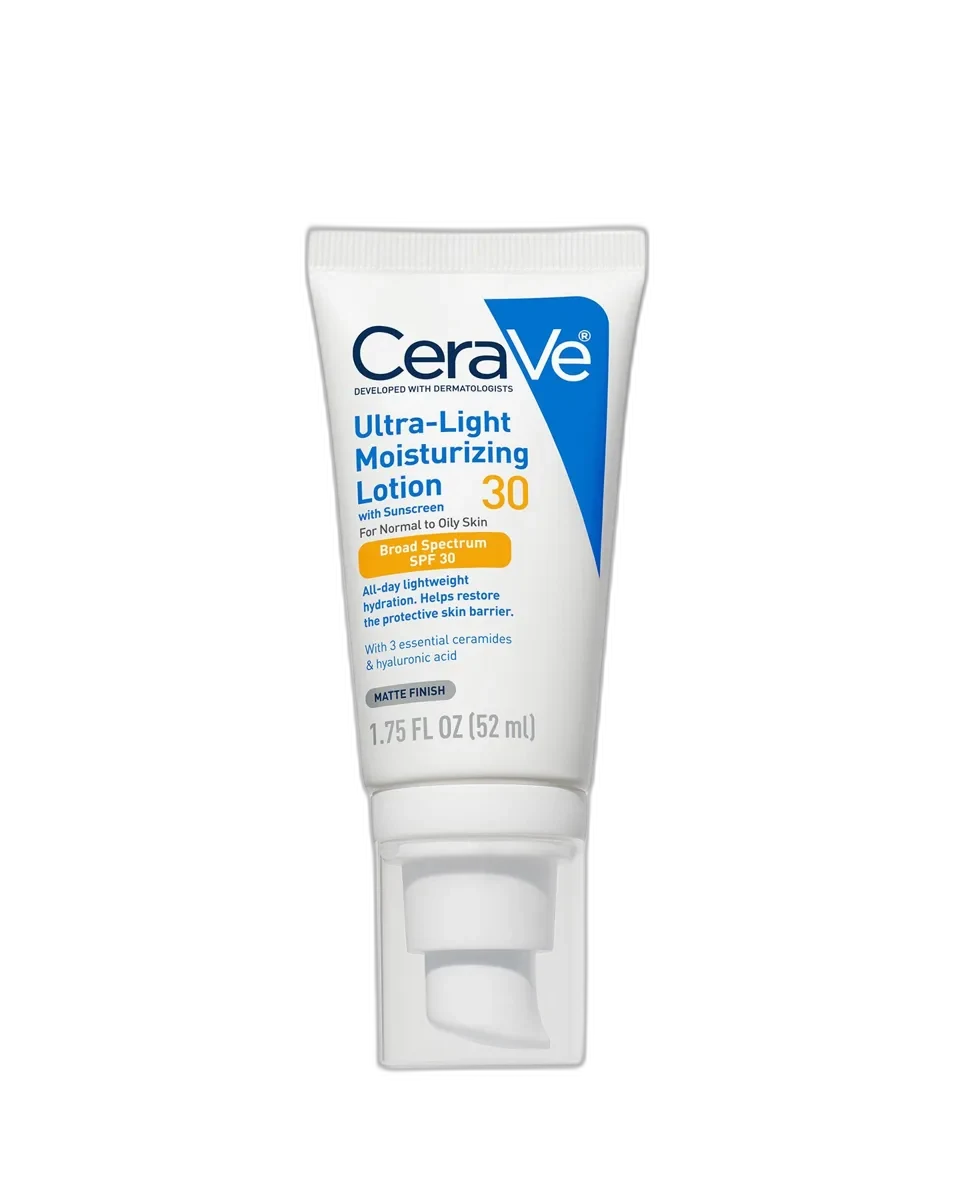
Ultra-Light Moisturizing Lotion SPF 30
Matte SPF Daily Driver
 Verified reviewer
Pros & cons.
- +Genuinely matte finish from oil-absorbing microspheres that controls shine throughout the day
- +Three essential ceramides provide barrier repair that most SPF moisturizers lack entirely
- +No white cast — chemical UV system absorbs completely into all skin tones
- +Doubles as a makeup primer with a smooth, velvety base for foundation
- +Fragrance-free, oil-free, non-comedogenic formula suitable for acne-prone skin
- +Skin Cancer Foundation Seal of Recommendation confirms broad-spectrum efficacy
- −Chemical UV filter scent is noticeable during application despite fragrance-free labeling
- −Can sting or tingle on sensitive, rosacea-prone, or barrier-compromised skin
- −Small 1.7 oz size at sixteen dollars offers limited value for a daily-use product
- −Not water-resistant — unsuitable for swimming, exercise, or extended outdoor exposure
- −Not moisturizing enough for dry skin types as a standalone morning moisturizer
The full review.
Dermatologists have been saying it for decades: the most important anti-aging product you own is your sunscreen. The problem was never the advice — it was the products. For oily and combination skin types, daily sunscreen meant choosing between a greasy film that turned your face into a reflective surface by noon, or a mattifying formula so drying it flaked off by mid-afternoon. CeraVe set out to end this compromise in 2018, and the Ultra-Light Moisturizing Lotion SPF 30 is the result.
The formula is a four-filter chemical sunscreen system: avobenzone for UVA protection, homosalate and octisalate for UVB coverage, and octocrylene pulling double duty as a UVB absorber and avobenzone stabilizer. This combination provides reliable broad-spectrum protection — the Skin Cancer Foundation’s Seal of Recommendation confirms it meets their efficacy standards. The protection is real, even if the SPF 30 number feels modest in an era of SPF 50 and SPF 100 products. For daily commuting and indoor work, SPF 30 applied correctly blocks approximately 97 percent of UVB rays. The extra percentage points from higher SPFs matter for beach days and outdoor sports, but for your Tuesday morning drive to the office, this is more than sufficient.
The matte finish is the product’s defining feature and its strongest selling point. Methyl methacrylate crosspolymer — tiny, oil-absorbing microspheres — create a velvety, shine-free surface that genuinely controls oil throughout the day. This is not a sunscreen that promises matte and delivers semi-gloss. It absorbs in under two minutes and sets to a finish that doubles as a primer. Foundation and concealer glide over it smoothly, and the oil control extends into the afternoon in a way that most SPF moisturizers cannot match.
What distinguishes this from competing lightweight SPFs is the ceramide complex. CeraVe’s three essential ceramides — NP, AP, and EOP — along with cholesterol, phytosphingosine, and sodium hyaluronate provide genuine barrier-supportive hydration beneath the UV shield. This matters more than it might appear. Chemical UV filters can subtly disrupt the skin barrier with daily use, and most SPF moisturizers do nothing to address this. By building barrier repair into the SPF itself, CeraVe created a product that protects from the sun while maintaining the skin’s own defenses — a quietly important dual function.
The texture is impressively lightweight. It pours from the tube like a thin lotion and spreads with none of the resistance or whiteness associated with heavier sunscreens. There is no white cast — the chemical filters absorb UV rather than reflecting it, so the formula disappears into all skin tones. For the application experience alone, this product converts sunscreen skeptics into daily users.
Honesty requires addressing the scent. This formula is fragrance-free in the sense that no perfume has been added, but homosalate at 10 percent has a distinctive chemical sunscreen smell that is noticeable during application. It fades within a few minutes, but if you are particularly sensitive to sunscreen scent, it may be a barrier to enjoyment. This is an inherent limitation of chemical UV filters, not a formulation failure.
Sensitive skin types should approach with awareness. The chemical UV filter system — particularly avobenzone — can cause stinging or tingling on reactive, rosacea-prone, or barrier-compromised skin. This is not a universal reaction, but it is common enough that CeraVe offers mineral sunscreen alternatives for those who experience it. If your skin tolerates chemical filters without issue, this product performs excellently. If chemical filters reliably irritate you, no amount of ceramides will change that dynamic.
The 1.7-ounce size is the product’s most notable shortcoming. At roughly sixteen dollars, the per-ounce cost is steep by CeraVe standards, and a bottle lasts only four to six weeks with daily facial application at the recommended amount. For a product designed to be used every single morning, a larger format would substantially improve the value proposition. The fact that no larger size is available suggests either a formulation stability limitation or a pricing strategy — neither of which benefits the consumer.
For dry skin types, this lotion may not provide sufficient hydration as a standalone moisturizer. The ultra-light formula prioritizes matteness over moisture, and dry skin users often find they need a hydrating serum or lightweight moisturizer underneath. This is a fine approach for combination or dry skin users willing to layer, but it means the product does not fully deliver on the two-in-one moisturizer-sunscreen promise for all skin types.
The CeraVe Ultra-Light Moisturizing Lotion SPF 30 succeeds at its core mission: making daily sun protection painless for oily and combination skin. The matte finish is real, the protection is certified, the ceramides are a bonus that most competitors do not offer, and the texture eliminates every excuse to skip SPF. If the best sunscreen is the one you actually use, this is the best sunscreen for a lot of people.
Ingredient analysis.
Full INCI list
Active Ingredients: Avobenzone 3%, Homosalate 10%, Octisalate 5%, Octocrylene 2.7%. Inactive Ingredients: Water, C12-15 Alkyl Benzoate, Glyceryl Stearate SE, Methyl Methacrylate Crosspolymer, Glycerin, Pentylene Glycol, Ceramide NP, Ceramide AP, Ceramide EOP, Phytosphingosine, Sodium Acryloyldimethyltaurate/VP Crosspolymer, Sodium Lauroyl Lactylate, Cholesterol, Xanthan Gum, Carbomer, Hydroxyacetophenone, Disodium EDTA, Citric Acid, Sodium Hyaluronate
Skin match.
The science.
The Science
This formula uses a four-filter chemical system for broad-spectrum UV protection against UVA and UVB wavelengths. Avobenzone at 3% is the main UVA absorber, peaking at 357nm to cover the UVA1 range that causes photoaging and DNA damage. Octocrylene at 2.7% does two things: it absorbs UVB and photostabilizes avobenzone, which degrades under UV exposure without a stabilizer.
A 2020 randomized clinical trial in JAMA by Matta et al. showed that all four chemical UV filters in this product — avobenzone, homosalate, octisalate, and octocrylene — exceeded the FDA's 0.5 ng/mL threshold for systemic absorption after maximal application. The study authors and the FDA say this finding doesn't mean sunscreens are unsafe, but that more safety data is needed. Decades of epidemiological research still support the skin cancer prevention benefits of daily broad-spectrum sunscreen use.
The ceramide component handles a side effect of daily sunscreen use. Chemical UV filters interact with stratum corneum lipids, and daily use can cause subtle barrier disruption. Research in the Journal of the American Academy of Dermatology (1997) showed that topical mixtures of ceramides, cholesterol, and fatty acids in optimal ratios speed up barrier recovery. By using all three barrier lipids — ceramides, cholesterol, and phytosphingosine — this SPF moisturizer maintains the barrier to counteract the potential disrupting effects of its own UV filters.
Sodium hyaluronate, the sodium salt of hyaluronic acid, has extensive data on its water-binding capacity in the stratum corneum. It ensures the matte, oil-absorbing finish doesn't sacrifice skin hydration — a common trade-off in mattifying sunscreen formulations.
References
- Effect of Sunscreen Application on Plasma Concentration of Sunscreen Active Ingredients: A Randomized Clinical Trial — JAMA (2020)
- Optimal ratios of topical stratum corneum lipids improve barrier recovery in chronologically aged skin — Journal of the American Academy of Dermatology (1997)
Dermatologist Perspective
Dermatologists view the CeraVe Ultra-Light Moisturizing Lotion SPF 30 as a practical daily sun protection option for patients with oily and combination skin who struggle with sunscreen compliance. Board-certified dermatologists note the matte finish and lightweight texture solve the main patient objection to daily sunscreen — that it feels greasy and uncomfortable. The ceramide complex provides barrier support that most competing SPF moisturizers lack. Dermatologists recommend this for daily commuting and indoor use, but advise patients to use a water-resistant SPF 50+ formula for extended outdoor activities, beach days, and exercise.
Where it fits in your routine.
Apply a nickel-sized amount to the face and neck. Use this as the final step of your morning skincare routine, after serums and treatments but before makeup. Spread it evenly to cover the hairline, ears, and jawline. Wait two minutes for the formula to set before applying makeup. Reapply every two hours during extended sun exposure or after sweating. One morning application works for indoor and commuter days, with incidental reapplication mid-afternoon.
At about $16 for 1.7 ounces, the CeraVe Ultra-Light SPF 30 costs more per ounce than most CeraVe products. Daily use at recommended amounts lasts four to six weeks, making the monthly cost roughly $11 to $16. This price is reasonable for a daily SPF moisturizer with ceramides; prestige brands with similar formulations cost two to four times more. However, the lack of a larger size misses an opportunity for better per-ounce value, and frequent users must replace the bottle more often.
Oily and combination skin types often struggle to find a daily SPF that isn't greasy, heavy, or pore-clogging. This works for anyone wanting a simple one-step morning moisturizer-sunscreen that also acts as a makeup primer. It also suits acne-prone skin that needs sun protection without breakouts from heavy, oily formulas.
People with sensitive or rosacea-prone skin who react to chemical UV filters should use a mineral sunscreen. Dry skin types need more hydration than this ultra-light formula provides. This formula lacks water-resistant sun protection for outdoor activities, swimming, or exercise.
Product details.
This lightweight, fluid lotion absorbs fast and sets to a smooth, matte finish. It feels more like a moisturizer than a sunscreen during application. The methyl methacrylate crosspolymer creates a velvety, oil-absorbing surface.
The formula is fragrance-free, but the chemical UV filters — specifically 10% homosalate — create a noticeable sunscreen scent that fades minutes after application.
White squeeze tube uses CeraVe's standard blue and white branding in a 1.7 oz format. It includes a cardboard outer carton. The tube size works for travel but is small for daily use.
The lotion applies smoothly without a white cast and sets to a matte finish within one to two minutes. Some users feel a brief tingling from the chemical UV filters, but this subsides quickly. The matte finish works well for oily skin types. Dry skin users may find the formula lacks hydration without a moisturizer underneath.
4-6 weeks with daily facial use at recommended application amounts
12 months
All Year
The backstory.
CeraVe launched the Ultra-Light Moisturizing Lotion SPF 30 in 2018 to address a specific gap: oily and combination skin types were skipping daily sun protection because available SPF moisturizers felt heavy and greasy. By engineering a matte-finish formula with their ceramide technology, CeraVe created a sunscreen that oily skin users would actually want to wear every day — removing the most common excuse for skipping SPF.
About CeraVe
Established Brand (5–20 years)Dermatologists helped develop CeraVe in 2005. It is the number-one dermatologist-recommended skincare brand in the United States. This SPF moisturizer has the Skin Cancer Foundation Seal of Recommendation and is a broad-spectrum sunscreen.
Common myths.
SPF 30 is not enough protection for daily use
SPF 30 blocks about 97% of UVB rays if applied correctly. SPF 50 blocks only 1% more than SPF 30. SPF 30 with proper application works for daily commuting and indoor work with incidental sun exposure. The Skin Cancer Foundation recommends SPF 30 as the daily use minimum.
Chemical sunscreens are dangerous because they enter the bloodstream.
A 2020 JAMA study shows chemical UV filters, including those in this formula, reach bloodstream levels above the FDA threshold. However, the study authors and the FDA state this does not mean sunscreens are unsafe; it means more research is needed. The proven skin cancer prevention benefits of daily sunscreen use outweigh theoretical systemic absorption concerns.
FAQ.
Is the CeraVe Ultra-Light SPF 30 good for oily skin?
This formula targets oily and combination skin. The methyl methacrylate crosspolymer microspheres absorb surface oil to create a matte finish and control shine all day. The oil-free, non-comedogenic formula does not clog pores or add grease. Many oily skin users say this is the first SPF product they wear daily.
Can I use the CeraVe Ultra-Light SPF 30 as a primer?
Yes — the matte, velvety finish works as a natural primer. Apply it as your last skincare step, wait two minutes to set, then apply makeup directly over it. The smooth surface helps foundation and concealer glide on evenly, while oil-absorbing microspheres keep makeup in place longer.
Does the CeraVe Ultra-Light SPF 30 leave a white cast?
No. This chemical sunscreen absorbs UV radiation instead of reflecting it, so it leaves no white cast on any skin tone. It absorbs fully into the skin and works for all complexions.
Is the CeraVe Ultra-Light SPF 30 water-resistant?
This formula is not water-resistant. It works for daily indoor and commuter use, not for swimming, heavy exercise, or long outdoor activities. For those situations, use a dedicated water-resistant SPF 50+ sunscreen and reapply every 80 minutes.
Why does the CeraVe Ultra-Light SPF 30 sting my skin?
Chemical UV filters, especially avobenzone, or pentylene glycol in the formula cause the stinging sensation some users experience. Chemical UV filters cause temporary irritation for those with a compromised skin barrier, sensitive skin, or active rosacea. If stinging persists, switch to a mineral sunscreen formula like CeraVe's Hydrating Mineral Sunscreen, which uses zinc oxide instead of chemical filters.
Is the CeraVe Ultra-Light SPF 30 enough for a day at the beach?
No — this product works for daily commuters and indoor use. It is not water-resistant. One application of SPF 30 does not protect against prolonged direct sun exposure. For beach days, outdoor sports, or extended sun exposure, use a dedicated water-resistant SPF 50+ sunscreen and reapply every 80 minutes or after swimming or sweating.
What the community says.
"Genuinely lightweight and non-greasy for a daily SPF moisturizer"
"No white cast — absorbs completely into all skin tones"
"Works well as a makeup primer with a smooth, matte finish"
"Good for oily and combination skin types that struggle with greasy sunscreens"
"Absorbs quickly without pilling for most users"
"Non-comedogenic and does not cause breakouts"
"Chemical sunscreen scent is noticeable from the UV filters, especially homosalate"
"Can sting or tingle on sensitive or reactive skin types"
"Only SPF 30 — some users want higher protection for extended outdoor use"
"Not water-resistant for swimming or heavy sweating"
"Small 1.7 oz size for the price — runs through quickly with daily use"
"Not moisturizing enough for dry skin types as a standalone moisturizer"