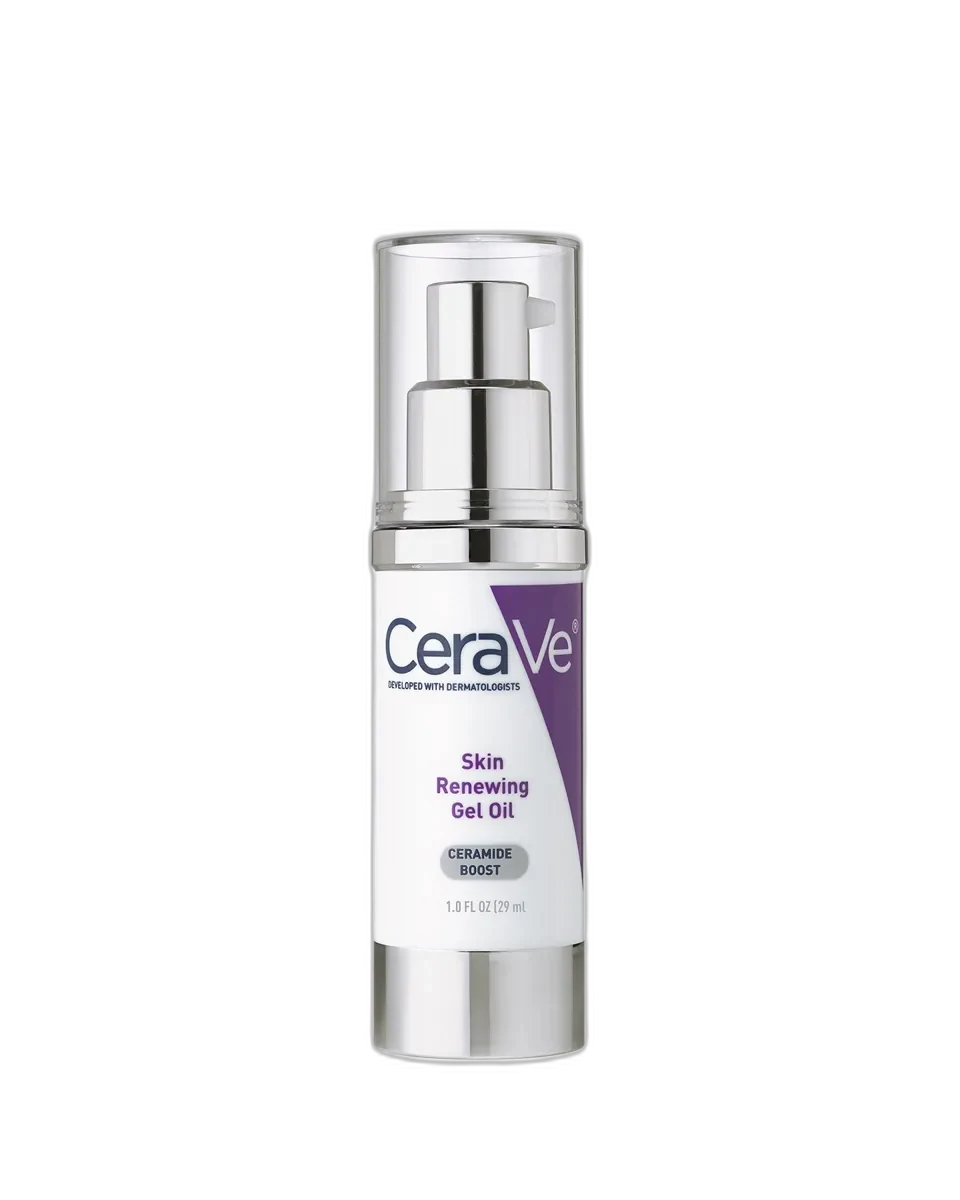
Skin Renewing Gel Oil
Dry Skin Glow-Getter
 Verified reviewer
Pros & cons.
- +Five-ceramide CeraPlex technology delivers more comprehensive barrier repair than standard three-ceramide formulas
- +Cross-linked hyaluronic acid provides sustained hydration even in an oil-based vehicle
- +Gel-to-oil texture feels luxurious and lightweight, absorbing without greasiness on dry skin
- +Immediate visible luminosity and relief from tightness on first application
- +Fragrance-free, paraben-free, and silicone-free with a clean ingredient profile
- +Excellent buffer layer under retinoids to mitigate dryness and irritation
- −One-ounce bottle at twenty-five dollars is smaller than CeraVe's typically generous sizing
- −Dewy finish is too shiny for oily and combination skin types
- −Can pill under certain silicone-heavy sunscreens or water-based gel moisturizers
- −Rosemary leaf extract may be a concern for very reactive or allergy-prone skin
- −Does not replace a moisturizer for most skin types despite the hydration benefits
The full review.
CeraVe’s 2017 facial oil announcement felt contradictory. The brand relies on clinical sobriety—white packaging, dermatologist endorsements, and ingredient lists like peer-reviewed abstracts—yet it entered the Instagram-friendly, glow-focused facial oil market. Skeptics questioned if CeraVe was chasing a trend, but the reality is more nuanced.
The Skin Renewing Gel Oil is not a concession to the beauty oil craze. CeraVe uses it to solve a specific problem: delivering ceramides to very dry skin via an absorbable vehicle. Water-based creams and lotions use emulsifiers to hold ceramides in suspension, which can sometimes interfere with lipid integration into the stratum corneum. An oil-based vehicle uses lipids to dissolve into lipids, matching the skin barrier’s native language.
This product introduced CeraVe’s CeraPlex technology, expanding the brand’s ceramic arsenal from three to five ceramides. Ceramides 1, 2, 3, and 6-II join caprooyl phytosphingosine and caprooyl sphingosine—sphingolipid precursors the skin converts into additional ceramides on site. The formula delivers finished ceramides and provides raw materials for the skin to manufacture more. Cholesterol and behenic acid complete the lipid trio required for proper lamellar structure formation.
The texture is the product’s standout feature. It dispenses as a cool, translucent gel—unlike typical “oil”—and becomes a weightless, silky slip when warmed between fingertips. Two to three drops cover the entire face with the glide of a serum and the nourishment of an oil. Within seconds, papery, tight, dry skin feels soft, plump, and comfortable. The effect is immediate and, for chronically dry skin, almost revelatory.
Sodium hyaluronate crosspolymer is a key ingredient. This is a cross-linked form of hyaluronic acid with greater water-binding capacity than ordinary hyaluronic acid. In an oil-dominant formula where standard water-loving HA struggles, this engineered form draws and holds moisture in the skin while the lipid phase prevents escape. This allows the product to hydrate rather than merely coat.
The finish is dewy. On dry skin, this looks like healthy, well-hydrated, well-rested luminosity. On combination or oily skin, it looks like excess oil rather than radiance. This is the product’s main limitation; it was made for dry skin. If your T-zone produces its own highlight, the Gel Oil will amplify it.
Sunflower extract and rice bran extract provide fatty acids and antioxidant support. Ascorbyl palmitate, an oil-soluble vitamin C derivative, offers mild antioxidant protection within the lipid matrix. These are functional inclusions rather than marquee ingredients. Rosemary leaf extract acts as a natural antioxidant for formula stability, but it is a potential irritant for very reactive skin.
The packaging is a compact one-ounce pump bottle. It is travel-friendly and precise, though the pump occasionally delivers more than intended. At twenty-five dollars, the per-ounce cost exceeds most CeraVe products. The small size means one bottle lasts roughly six to eight weeks with twice-daily use. This price is reasonable for a facial oil—luxury alternatives with less sophisticated formulations cost three to five times as much—but it departs from the brand’s reputation for value.
Layering is simple. Apply after cleansing and water-based serums, but before your moisturizer. It works well with ceramide-based creams to extend barrier repair. It also works as a buffer layer under retinoids, where the ceramide complex and cross-linked HA help mitigate dryness and sensitivity. You can also mix two drops into your night cream to reduce steps.
The Skin Renewing Gel Oil holds a unique position in CeraVe’s lineup. It suits people who want CeraVe science but find the brand’s moisturizers too clinical, matte, or functional. It shows that barrier repair can feel like a small luxury rather than a medical intervention. For dry skin, it is one of the smartest facial oils at any price point, especially at twenty-five dollars at the drugstore.
Formula
 ### Texture

 The texture is the product's standout feature. It dispenses as a cool, translucent gel—unlike typical "oil"—and becomes a weightless, silky slip when warmed between fingertips. Two to three drops cover the entire face with the glide of a serum and the nourishment of an oil. Within seconds, papery, tight, dry skin feels soft, plump, and comfortable. The effect is immediate and, for chronically dry skin, almost revelatory.
### Scent

*No content.*
### Packaging
The packaging is a compact one-ounce pump bottle. It is travel-friendly and precise, though the pump occasionally delivers more than intended. At twenty-five dollars, the per-ounce cost exceeds most CeraVe products. The small size means one bottle lasts roughly six to eight weeks with twice-daily use. This price is reasonable for a facial oil—luxury alternatives with less sophisticated formulations cost three to five times as much—but it departs from the brand's reputation for value.
### Best for

*No content.*
### Works for
*No content.*### Not ideal for
*No content.*### AM routine
*No content.*### PM routine
*No content.*Ingredient analysis.
Full INCI list
Caprylic/Capric Triglyceride, C12-15 Alkyl Benzoate, Ethylhexyl Palmitate, Glycerin, Propylheptyl Caprylate, Water, Sucrose Laurate, Sucrose Stearate, Helianthus Annuus (Sunflower) Extract, Oryza Sativa (Rice) Bran Extract, Rosmarinus Officinalis (Rosemary) Leaf Extract, Ceramide 6 II, Ceramide 1, Ceramide 2, Ceramide 3, Caprooyl Phytosphingosine, Caprooyl Sphingosine, Sodium Hyaluronate Crosspolymer, Ascorbyl Palmitate, Sucrose Palmitate, Tocopherol, Hydroxymethoxyphenyl Decanone, Cetyl Alcohol, Ceteareth-25, Pentylene Glycol, Behenic Acid, Cholesterol, Ethylhexylglycerin, Caprylyl Glycol, Chlorphenesin, Phenoxyethanol
Skin match.
The science.
The Science
The CeraPlex technology in this product evolves topical ceramide delivery. Research in the Journal of the American Academy of Dermatology (1997) shows that topical mixtures of ceramides, cholesterol, and fatty acids in optimal ratios accelerate barrier recovery in chronologically aged skin. This gel-oil formulates five ceramides with cholesterol and behenic acid to match the molar ratios from that foundational research.
The oil-based vehicle has a theoretical advantage over water-based ceramide delivery. Ceramides are lipid-soluble molecules that must integrate into the lamellar lipid bilayers of the stratum corneum to work. Using a lipid-compatible vehicle — caprylic/capric triglyceride and other lightweight oils — reduces the need for emulsifiers that can disrupt the structures the ceramides repair.
Sodium hyaluronate crosspolymer is an engineered hyaluronic acid. Chemically bonded HA chains create a three-dimensional network with much higher water-binding capacity than linear HA. This cross-linking also provides sustained hydration; moisture releases gradually instead of evaporating quickly from the skin surface. This is useful in an oil-based formula where conventional HA is difficult to incorporate effectively.
A 2017 review in the Journal of Clinical and Aesthetic Dermatology evaluated MVE ceramide-containing CeraVe formulations and confirmed they manage barrier dysfunction across multiple skin disorders. While the Gel Oil uses CeraPlex instead of MVE technology, the principle is the same: delivering ceramides in a vehicle optimized for sustained barrier integration.
References
- Optimal ratios of topical stratum corneum lipids improve barrier recovery in chronologically aged skin — Journal of the American Academy of Dermatology (1997)
- Multivesicular Emulsion Ceramide-containing Moisturizers: An Evaluation of Their Role in the Management of Common Skin Disorders — Journal of Clinical and Aesthetic Dermatology (2017)
Dermatologist Perspective
Dermatologists view the Skin Renewing Gel Oil as a well-formulated option for patients with dry, barrier-compromised skin who find traditional moisturizers insufficient or unappealing. Board-certified dermatologists note the five-ceramide complex addresses more barrier lipid deficiency than the standard three-ceramide formula. The oil-based vehicle suits mature or chronically dry skin where lipid depletion is a primary concern. Doctors often recommend this product as a pre-moisturizer booster in winter or as an adjunct to retinoid therapy where barrier support is critical.
Where it fits in your routine.
Apply two to three drops to clean, damp skin after cleansing and water-based serums. Warm the gel between fingertips for a few seconds, press gently into the face, and spread outward. Use a moisturizer to seal in hydration. For morning use, use two drops and let it absorb fully before applying sunscreen. For evening use, apply three to four drops more generously; you can layer the gel oil under retinoids or mix it into a night cream.
At $25 for one ounce, the Gel Oil costs more per unit than most CeraVe products, but it is cheaper than luxury facial oils with similar or worse ingredients. One bottle lasts about six to eight weeks using it twice daily. This makes the monthly cost roughly $13 to $17 — a fair price for a facial oil with five ceramides and cross-linked hyaluronic acid. The brand misses a chance for better per-ounce value by not offering a larger size.
Dry and very dry skin types can use this lightweight hydration booster for ceramide barrier repair and an immediate glow. It works well for mature skin, winter-depleted skin, and anyone whose moisturizer alone fails to stop dryness and tightness. Retinoid users also use it for barrier support without a heavy product.
Oily and combination skin types may find the dewy finish too shiny. People who layer multiple products in the morning may experience product pilling. Sensitive skin types with known reactions to rosemary extract should use caution.
Product details.
The pump dispenses a cool, translucent gel that turns into a lightweight, silky oil when warmed and spread on the skin. It is not thick or viscous; it has a serum-like feel with the slip of an oil.
Fragrance-free. It has no detectable scent except a faint, neutral base note from the plant extracts.
White pump bottle uses CeraVe's blue and green pharmacy-style branding. The compact one-ounce size works for travel, and the pump controls dispensing, though it sometimes over-dispenses.
Skin feels softer and more luminous after the first application. Dry, tight skin feels relief within minutes. The formula causes no adjustment period, stinging, or purging and provides immediate comfort. The dewy finish differs from matte or invisible finishes.
6-8 weeks with twice-daily use of 2-3 drops per application
12 months
fall winter
The backstory.
CeraVe launched the Skin Renewing Gel Oil in early 2017 as a departure from their clinical, pharmacy-counter aesthetic. It was an attempt to offer the sensorial pleasure of a facial oil — the glow, the ritual, the luxurious feel — without abandoning the brand's scientific foundation. By building it around a new five-ceramide complex rather than trendy botanical oils, CeraVe made a facial oil for people who care about what's actually repairing their barrier, not just what looks pretty in a dropper bottle.
About CeraVe
Established Brand (5–20 years)Dermatologists helped develop CeraVe in 2005. It is now the number-one dermatologist-recommended skincare brand in the United States. The Skin Renewing Gel Oil was the first CeraVe product to use CeraPlex technology, a five-ceramide complex that improves barrier repair.
Common myths.
Facial oils clog pores and cause breakouts
This non-comedogenic formula uses caprylic/capric triglyceride and lightweight emollients instead of heavy botanical oils. The dewy finish causes excess shine, which may be too much for oily skin types, but it does not clog pores.
Oils don't actually hydrate the skin — they just sit on top
This gel-oil contains sodium hyaluronate crosspolymer to bind water in the skin and glycerin to draw moisture from the environment. The oil phase seals that hydration. It hydrates and prevents moisture loss.
FAQ.
Is the CeraVe Skin Renewing Gel Oil good for dry skin?
This formula targets dry and very dry skin. The five-ceramide CeraPlex complex restores barrier lipids, and cross-linked hyaluronic acid provides sustained hydration. The oil-based vehicle delivers these ingredients in a format dry skin absorbs easily. Most dry skin users report immediate relief from tightness and flaking.
Can I use the CeraVe Gel Oil on oily skin?
This is not ideal for oily skin. The dewy, luminous finish dry skin users love looks excessively shiny on oily or combination skin types. If you have oily skin but want ceramide support, CeraVe's water-based moisturizers like the PM Facial Moisturizing Lotion deliver ceramides in a lighter, matte-finish vehicle.
When should I apply the CeraVe Gel Oil in my routine?
Apply this after cleansing and water-based serums, but before your moisturizer. The gel-oil boosts hydration, which your moisturizer then seals. Use two to three drops in the morning and three to four drops at night. You can also mix it into your moisturizer for a single-step application.
Does the CeraVe Gel Oil replace a moisturizer?
For most people, no. It provides excellent hydration and barrier repair but lacks the occlusive agents in a traditional moisturizer. Dry skin types get the best results layering it under a ceramide moisturizer. Very oily skin types in humid climates find it sufficient alone, but this product does not target that skin type.
Can I use the CeraVe Gel Oil with retinol?
Yes — the five-ceramide complex and cross-linked hyaluronic acid buffer retinoid-induced dryness and irritation. Apply your retinoid first, let it absorb, then layer the gel oil on top for protective hydration. The oil phase seals in the retinoid while the ceramides support the barrier against retinoid-induced sensitivity.
What the community says.
"Intensely hydrating without feeling heavy or greasy on dry skin"
"Unique gel-to-oil texture feels luxurious for a drugstore product"
"Gives immediate radiance and glow to dull, dehydrated skin"
"Fragrance-free and non-comedogenic formulation"
"Layers well under moisturizer and makeup for most users"
"Good value compared to luxury facial oils with similar ingredients"
"Can leave a shiny or oily-looking film especially in the T-zone"
"Small one-ounce size does not last long for the price"
"Too dewy for oily or combination skin types"
"Some users report pilling under certain moisturizers or sunscreens"
"Pump can dispense too much product at once"