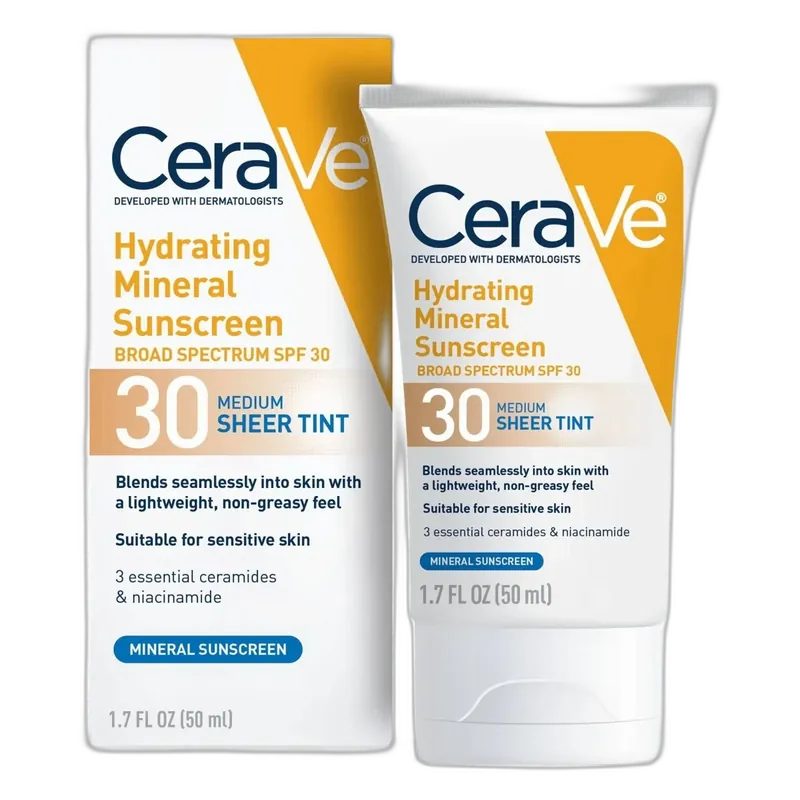
Hydrating Mineral Sunscreen SPF 30 Face Sheer Tint
Sensitive Skin's Daily Shield
 Verified reviewer
Pros & cons.
- +Iron oxide tint eliminates white cast while adding functional visible light and HEV blue light protection
- +100% mineral filters (zinc oxide + titanium dioxide) provide stable, broad-spectrum UV protection
- +CeraVe's three-ceramide complex transforms sun protection into active barrier support
- +Fragrance-free, gentle enough for post-procedure, rosacea-prone, and eczema-affected skin
- +Sheer tint provides a natural, healthy glow without looking like heavy makeup
- +Niacinamide supports oil control and helps prevent UV-triggered hyperpigmentation
- +Competitively priced at ~$17 for a tinted mineral sunscreen with skincare benefits
- −Only three shade options (Light, Medium, Deep) — insufficient for the full range of skin tones
- −May feel too dewy or greasy on very oily skin types by midday
- −SPF 30 may be insufficient for prolonged intense outdoor exposure — consider SPF 50 for beach days
- −Can pill over certain serums or moisturizers if not allowed adequate absorption time
- −Hydrating formula is not ideal for those seeking a fully matte finish
The full review.
For years, mineral sunscreen forced a choice: protect skin from the sun or look normal. You could not do both. Zinc oxide and titanium dioxide are the safest, most stable UV filters, but they sit on the skin as white particles that look like flour. The category had an aesthetics problem that dermatologist recommendations could not fix. If people do not wear the sunscreen, the SPF number is irrelevant.
CeraVe’s Hydrating Mineral Sunscreen SPF 30 Face Sheer Tint attempts to solve this problem and succeeds better than most competition. The solution is simple: add iron oxides. These mineral pigments do two things—they provide a sheer tint to counteract the white cast of the zinc and titanium particles, and they block visible light and high-energy visible blue light that standard UV filters miss. It is a formulation decision that makes you wonder why others did not do this sooner.
The practical difference is significant. While untinted CeraVe mineral sunscreens leave a white or gray film—especially on medium to deep skin tones—this tinted version blends into a natural, skin-like finish. It looks like healthy skin rather than a protective coating. Available in three shades (Light, Medium, Deep), the tint is sheer enough that exact shade matching matters less than with foundation. Most people can find a working shade within this range.
The UV protection is solid. Zinc oxide at 10% provides broad mineral UV coverage, filtering both UVA I and UVB rays. Titanium dioxide at 5.5% adds UVB protection and UVA II coverage. Together, they achieve SPF 30 broad-spectrum protection. Like all mineral filters, they have a stability advantage: they do not degrade in sunlight like chemical filters. Your SPF 30 at hour two remains SPF 30, unless you sweat or rub it off.
The visible light protection exceeds expectations. Research from the last decade shows that visible light—specifically high-energy violet and blue wavelengths—can worsen melasma, trigger hyperpigmentation, and contribute to photoaging through mechanisms different from UV damage. Standard sunscreens do not adequately filter these wavelengths. Iron oxides do. For the millions managing melasma, post-inflammatory hyperpigmentation, or sun-triggered dark spots, this is a clinically relevant advantage.
The CeraVe ceramide complex adds functionality, turning this into a barrier-supportive daily wear product. Ceramides NP, AP, and EOP replenish the lipids in the skin’s protective matrix. Niacinamide supports barrier function and reduces inflammation. Hyaluronic acid maintains hydration under the mineral filter layer. You are not just blocking UV; you are maintaining skin health.
Texture
The texture is creamy and hydrating, like a moisturizer. It spreads evenly without the drag or pull common in thicker mineral formulas. It sets in two to three minutes and dries to a satin, slightly luminous finish. This is not a matte sunscreen; oily skin types may find it too dewy by midday. For normal, dry, and sensitive skin, the finish is attractive.
Best for
This product works best for sensitive skin. It uses mineral-only UV filters, no fragrance, no chemical sunscreen actives, and no parabens. The formula suits reactive skin types—post-procedure patients, rosacea sufferers in remission, eczema-prone faces, and anyone whose eyes sting from chemical sunscreens. It is the sunscreen dermatologists use when other options cause problems.
Common Complaints
The shade range is the main criticism. Three shades is a starting point. While the sheer tint provides flexibility, some skin tones at the very fair or very deep ends of the spectrum will not blend ideally with these three options. CeraVe should expand toward more inclusive shade ranges.
Packaging
At approximately seventeen dollars for 1.7 ounces, this is competitively priced for a tinted mineral sunscreen with skincare benefits. You get UV protection, visible light filtering, barrier support, and light coverage in one product. Comparable tinted mineral sunscreens from prestige brands cost $30-50 for similar sizes. CeraVe delivers equivalent functionality with a cleaner ingredient story.
This sunscreen is not glamorous or trendy, and the packaging does not demand attention. It provides comprehensive protection—from UV, visible light, and barrier damage—in a format people will actually use every day. In sunscreen, consistent daily use is everything. A product people enjoy wearing beats a theoretically superior product they leave in a drawer.
Ingredient analysis.
Full INCI list
Active Ingredients: Titanium Dioxide (5.5%), Zinc Oxide (10%). Inactive Ingredients: Water, C12-15 Alkyl Benzoate, Isohexadecane, Isononyl Isononanoate, Dicaprylyl Ether, PEG-30 Dipolyhydroxystearate, Triethylhexanoin, Polyglyceryl-4 Isostearate, Dicaprylyl Carbonate, Ethylene/Acrylic Acid Copolymer, Triethanolamine, Silica, Poly C10-30 Alkyl Acrylate, Stearic Acid, Ceramide NP, Ceramide AP, Ceramide EOP, Carbomer, Niacinamide, Cetearyl Alcohol, Triethoxycaprylylsilane, Behentrimonium Methosulfate, Sodium Chloride, Salicylic Acid, Sodium Hyaluronate, Sodium Lauroyl Lactylate, Cholesterol, Aluminum Stearate, Alumina, Aluminum Hydroxide, Iron Oxides, Phenoxyethanol, P-Anisic Acid, Chlorphenesin, Tocopherol, Disodium EDTA, Disodium Stearoyl Glutamate, Propylene Carbonate, Citric Acid, Caprylyl Glycol, Capryloyl Salicylic Acid, Caprylic/Capric Triglyceride, Diethylhexyl Syringylidenemalonate, Disteardimonium Hectorite, Xanthan Gum, Phytosphingosine, Polyhydroxystearic Acid, Ethylhexylglycerin
Skin match.
The science.
The Science
This sunscreen uses a dual mineral filter system of zinc oxide (10%) and titanium dioxide (5.5%) to protect via physical reflection and scattering of UV radiation. Zinc oxide provides broad-spectrum coverage by absorbing and reflecting UVA and UVB wavelengths. Titanium dioxide targets UVB and provides moderate UVA II protection, which complements the zinc oxide.
Iron oxides add protection against visible light (400-700nm), a range zinc oxide and titanium dioxide do not filter well. A study in the Journal of the American Academy of Dermatology (Castanedo-Cazares et al., 2014) shows tinted sunscreens with iron oxides protect better against visible light-induced pigmentation than untinted SPF-matched controls. This matters for melasma management, as visible light triggers melanogenesis regardless of UV exposure.
A study in Photodermatology, Photoimmunology & Photomedicine (Dumbuya et al., 2020) confirms iron oxide-containing sunscreens prevent visible light-induced darkening in darker skin phototypes better than non-tinted mineral sunscreens. This evidence supports the clinical recommendation that tinted sunscreens are a better choice than untinted formulas for pigmentation-prone patients.
The ceramide component handles a different concern. UV exposure depletes stratum corneum lipids, which breaks down barrier function and increases trans-epidermal water loss. This formula replenishes ceramides NP, AP, and EOP during daytime UV exposure to counteract UV-induced barrier damage. Niacinamide also helps by stimulating endogenous ceramide synthesis in keratinocytes.
Dermatologist Perspective
Board-certified dermatologists often recommend this product to patients needing mineral-only sun protection plus visible light filtering. Dermatologists treating melasma note that iron oxide-tinted sunscreens are now part of the standard of care because visible light is an independent trigger for pigmentation. Dermatologists value the CeraVe ceramide system for maintaining barrier integrity during daytime sun exposure. This product is a common recommendation for post-procedure patients (after chemical peels, laser treatments, or microneedling) because mineral-only filters with no fragrance minimize irritation on compromised skin.
Where it fits in your routine.
Apply liberally to face and neck as the last step of your morning routine, once moisturizer and serums absorb. Use about two finger-lengths or 1/4 teaspoon for the face. Blend evenly with fingertips. Let it set for 2-3 minutes before applying makeup. Reapply every 2 hours during direct or prolonged sun exposure, or after swimming, sweating, or towel-drying. Double cleanse in the evening to remove all mineral filters.
At about $17 for 1.7 oz, this tinted mineral sunscreen provides high value by combining UV protection, visible light filtering, barrier support, and light cosmetic coverage. EltaMD, La Roche-Posay, and Australian Gold tinted mineral sunscreens cost $20-40 for similar sizes. The CeraVe ceramide complex adds skincare functionality most competitor sunscreens lack. Daily use requires a repurchase every month to six weeks, making annual costs $130-200 — a fair price for a product that works as both sunscreen and light-coverage base.
This mineral sunscreen works for daily use without a white cast. It suits sensitive, post-procedure, or hyperpigmentation-prone skin. Melasma patients get the visible light protection they need. It provides light coverage and SPF in one step.
Very oily skin types needing a matte-finish sunscreen. People requiring SPF 50+ for intense outdoor activities. Anyone whose skin tone falls outside the Light, Medium, and Deep shade range and needs a precise tint match.
Product details.
Thick, hydrating lotion with a visible tint that blends into a sheer, natural finish. It is thicker than typical chemical sunscreens but spreads evenly without clumping. It sets to a semi-matte finish within a few minutes.
No fragrance. Mild, neutral sunscreen scent that dissipates quickly.
Squeeze tube with flip-top cap. The opaque tube protects the formula from light. It dispenses the right amount easily. The shade is visible on the tube for easy identification.
Blends easily with a sheer wash of color that evens skin tone without heavy coverage. It causes no stinging, burning, or irritation on application and feels comfortable even on sensitive skin. The mineral filters create subtle luminosity instead of the flat, chalky finish found in older mineral sunscreens.
1-2 months with daily face application at recommended amount
12 months
All Year
The backstory.
CeraVe developed this tinted mineral sunscreen to solve two problems simultaneously: the white cast that made mineral sunscreens unwearable for many skin tones, and the lack of visible-light protection in most consumer sunscreens. Iron oxides were the elegant solution to both — they provide color that counteracts the white cast while blocking the visible light wavelengths that mineral filters miss.
About CeraVe
Legacy Brand (20+ years)Dermatologists helped develop CeraVe in 2005, and clinicians have recommended it for over two decades. The brand uses its patented MVE delivery technology and three essential ceramides in its formulations. CeraVe has National Eczema Association seals and is among the most frequently recommended brands by board-certified dermatologists in the United States.
Common myths.
SPF 30 lacks enough protection; use SPF 50 or higher.
SPF 30 blocks about 97% of UVB rays, and SPF 50 blocks about 98%. This protection difference is minimal. Application amount (1/4 teaspoon for the face) and reapplication every 2 hours during sun exposure matter more than the SPF number. This product's iron oxides also add visible light protection that SPF numbers do not capture.
Mineral sunscreens leave a white cast on darker skin tones.
Untinted mineral sunscreens often leave a white cast, especially with high zinc oxide concentrations. This product uses an iron oxide tint to counteract that effect. The sheer tint comes in three shades (light, medium, deep) to blend naturally with various skin tones.
FAQ.
Which shade of CeraVe tinted sunscreen should I choose?
CeraVe offers three sheer tint shades: Light, Medium, and Deep. The sheer tint means exact shade matching matters less than with foundation. Most users find their closest shade blends naturally. If you are between shades, the tint is transparent enough that either shade works without looking mismatched.
Does this sunscreen protect against blue light?
Yes — the iron oxides in this tinted formula block high-energy visible (HEV) blue light, which standard UV filters (both mineral and chemical) do not fully block. Research shows visible light worsens melasma and hyperpigmentation, so iron oxide-tinted sunscreens help manage pigmentation concerns.
Can I use this sunscreen after a chemical peel or procedure?
Dermatologists often recommend CeraVe tinted mineral sunscreen for post-procedure use. Mineral filters sit on the skin's surface instead of absorbing, which reduces irritation risk on compromised skin. The ceramides also support barrier recovery. However, always follow your specific dermatologist's post-procedure instructions.
Is SPF 30 enough for daily use?
SPF 30 applied at the correct amount provides excellent protection for daily activities with incidental sun exposure (commuting, walking to lunch), blocking about 97% of UVB rays. The iron oxides in this product also block visible light, so it offers broader protection than the SPF number alone suggests. Reapply every 2 hours for extended outdoor activities or use a higher-SPF product.
Will this sunscreen break me out?
This formula is non-comedogenic and lacks common pore-clogging ingredients. The niacinamide regulates oil production, and the zinc oxide has mild anti-inflammatory properties that benefit acne-prone skin. However, the thick emollient base feels heavy on very oily skin. Patch testing is recommended if you are breakout-prone.
What the community says.
"Sheer tint provides natural healthy glow without looking like makeup"
"Gentle enough for sensitive and post-procedure skin"
"No white cast — a major improvement over untinted mineral sunscreens"
"Ceramides keep skin hydrated throughout the day"
"Fragrance-free and non-irritating"
"Only three shade options may not match all skin tones perfectly"
"Can feel slightly greasy on very oily skin"
"SPF 30 may not be sufficient for prolonged outdoor exposure"
"Shade range could be more inclusive"
"Can pill if applied over certain products"