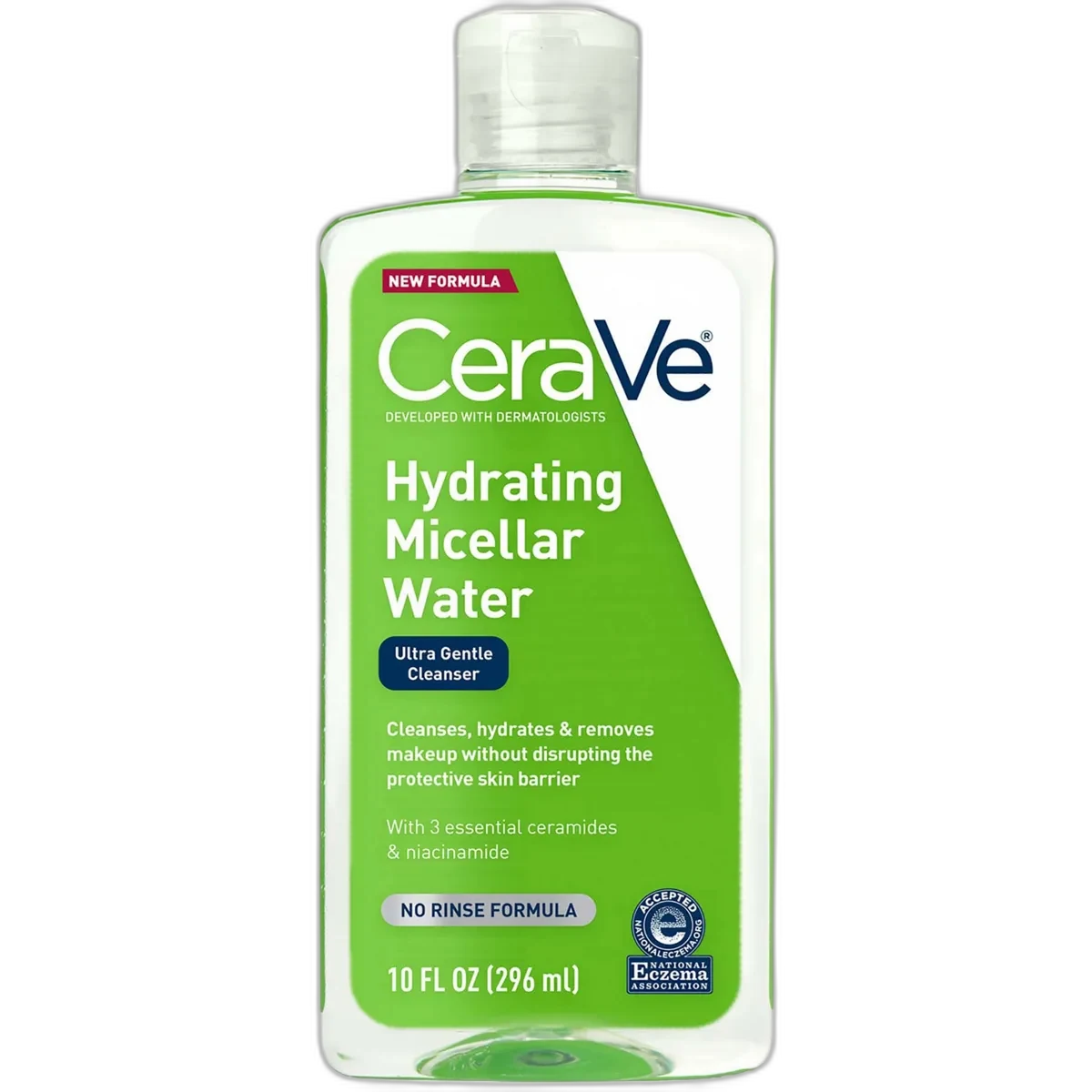
Hydrating Micellar Water
Gentle First Step
 Verified reviewer
Pros & cons.
- +No-rinse format allows ceramides and niacinamide to remain on skin for extended benefit
- +Ophthalmologist-tested for safe use around the sensitive eye area
- +Fragrance-free, paraben-free, oil-free, and sulfate-free formula
- +National Eczema Association Seal of Acceptance confirms suitability for reactive skin
- +Glycerin at high concentration provides genuine hydration during cleansing
- +Gentle poloxamer 184 surfactant avoids the lipid-stripping action of harsher cleansers
- −Struggles with heavy waterproof makeup and mineral sunscreen removal
- −Contains BHT and polyaminopropyl biguanide which some users prefer to avoid
- −Cotton pad requirement adds ongoing cost and environmental waste
- −Cannot fully replace a thorough rinse-off cleanser for deep cleansing
- −Only available in one size with no travel option
The full review.
The micellar water concept has a charming origin story. Parisian women, plagued by tap water so mineral-heavy it could calcify a showerhead, needed a way to cleanse their faces without turning on the faucet. The solution was micelles — tiny spheres of surfactant molecules suspended in soft water that attract and trap oil, dirt, and makeup on a cotton pad. It was elegant, it was gentle, and it required nothing more than a swipe and a toss. It was also, frankly, not very interesting from a formulation standpoint. Most micellar waters were little more than dilute surfactant solutions with a fancy French backstory.
CeraVe’s Hydrating Micellar Water does something that most products in this category do not bother attempting: it turns the no-rinse format into an advantage rather than a compromise. The logic is simple but clever. In a rinse-off cleanser, the ceramides, niacinamide, and glycerin in the formula have perhaps thirty to sixty seconds of skin contact before they wash down the drain. In a no-rinse micellar water, those same ingredients stay on the skin indefinitely. The cleansing step becomes a deposition step — you are not just removing what you do not want, you are leaving behind what your skin does want.
The surfactant doing the actual cleaning work is poloxamer 184, a nonionic block copolymer that is about as gentle as cleansing agents get. It forms micelles that are effective at dissolving everyday grime, sebum, and light-to-moderate makeup, but it lacks the aggressive lipid-stripping power of traditional anionic surfactants. This is why the product is ophthalmologist-tested and safe for the eye area — a claim that very few cleansers can credibly make.
Glycerin sits at position two in the INCI list, meaning it is present in substantial concentration. As a no-rinse humectant, this glycerin stays on the skin’s surface after you put down the cotton pad, continuously drawing moisture from the environment into the stratum corneum. It is a detail that transforms the post-cleansing experience from the usual tight dryness to something that feels genuinely hydrating.
The three ceramides — NP, AP, and EOP — along with cholesterol and phytosphingosine, get maximum benefit from the no-rinse format. In CeraVe’s other cleansers, these barrier-repair lipids do their best work in the brief window between application and rinsing. Here, they have unlimited contact time. For someone with a compromised barrier or eczema-prone skin, this extended exposure could meaningfully contribute to lipid matrix restoration over consistent use.
Niacinamide adds anti-inflammatory and barrier-strengthening benefits that, again, compound in a leave-on format. Research has consistently shown that niacinamide improves skin barrier function by stimulating ceramide synthesis within the skin itself — so the exogenous ceramides in this formula are reinforced by the niacinamide encouraging the skin to produce more of its own. It is a formulation strategy that creates a positive feedback loop between the product’s ingredients and the skin’s natural processes.
In practice, the experience is straightforward. Saturate a cotton pad, sweep it gently across the face, and watch as foundation, concealer, and mascara dissolve onto the pad with minimal pressure. The skin afterward feels clean, slightly moist, and remarkably un-irritated. There is no tightness, no stinging, no residue that feels like it needs to be washed off. For mornings when a full wash feels excessive — or for evenings when you are too exhausted for a proper double cleanse — this product legitimately simplifies the routine without sacrificing skin health.
The limitations are honest and inherent to the category. Heavy, waterproof, or long-wear makeup will require multiple passes and significant patience, and even then, a dedicated oil-based remover or balm cleanser will do the job faster and more completely. Sunscreen, particularly mineral sunscreens with zinc oxide, can be stubborn to remove with micelles alone. And for anyone who prefers the thoroughness of rinsing — the psychological and physical assurance that everything has been washed away — a no-rinse product will always feel like a half-measure.
The ingredient list includes BHT, a synthetic antioxidant preservative that some ingredient-conscious consumers prefer to avoid. It is present in a tiny concentration as a stabilizer, and regulatory assessments have consistently found it safe at cosmetic concentrations, but the inclusion may be a dealbreaker for certain shoppers. Polyaminopropyl biguanide, used as a preservative, is another ingredient that has faced scrutiny in the EU, though it remains approved for use in the U.S. at the concentrations found in this product.
At $14.99 for ten ounces, the pricing is reasonable but not exceptional for a micellar water. The cotton pad requirement adds an ongoing cost and environmental consideration that the product itself cannot solve — reusable cotton pads mitigate the waste issue but add a laundering step that some users find less convenient than disposables.
For its intended purpose — a gentle, hydrating, no-rinse cleansing step that deposits beneficial ingredients onto the skin — the CeraVe Hydrating Micellar Water is among the best in its category. It cannot replace a thorough cleanse, and it was never meant to. What it can do is make the first step of your routine, or the only step on your lazy nights, actively good for your skin rather than just adequate. In a category full of glorified surfactant water, that counts as genuine innovation.
Ingredient analysis.
Full INCI list
Aqua/Water/Eau, Glycerin, Hexylene Glycol, BHT, Ceramide NP, Ceramide AP, Ceramide EOP, Carbomer, Niacinamide, Sodium Lauroyl Lactylate, Cholesterol, Phenoxyethanol, Poloxamer 184, Disodium Cocoamphodiacetate, Disodium EDTA, Phytosphingosine, Xanthan Gum, Polyaminopropyl Biguanide, Ethylhexylglycerin
Skin match.
The science.
The Science
The CeraVe Hydrating Micellar Water cleanses using micelle technology. These spherical structures form from poloxamer 184, a nonionic block copolymer surfactant. The hydrophilic exterior faces the water while the lipophilic interior traps oils, makeup pigments, and debris. This method cleanses effectively at low surfactant concentrations, which reduces the lipid-stripping damage seen with traditional ionic surfactants.
The no-rinse format increases contact time for barrier-repair ingredients. Kono et al. published research in the Journal of Dermatology in 2021 showing that extended contact with ceramide-containing formulations improves water retention and barrier function. In a leave-on micellar water, the ceramides, cholesterol, and phytosphingosine have continuous access to the stratum corneum lipid matrix.
Niacinamide's barrier-supportive mechanism works well in a leave-on format. A study by Tanno et al. in the British Journal of Dermatology shows that niacinamide stimulates de novo ceramide synthesis within keratinocytes. This complements the exogenous ceramides in the formula by prompting the skin to produce its own. This dual pathway—external ceramide delivery and stimulated internal production—restores the barrier comprehensively.
Glycerin at position two acts as a sustained humectant. Research confirms glycerin stimulates aquaporin-3 expression in keratinocytes, which increases the skin's intrinsic water transport capacity beyond simple surface humectancy.
References
- Clinical significance of the water retention and barrier function-improving capabilities of ceramide-containing formulations: A qualitative review — The Journal of Dermatology (2021)
Dermatologist Perspective
Dermatologists often suggest micellar water as a gentle first cleansing step for patients with sensitive or eczema-prone skin who cannot tolerate mild traditional cleansers. Board-certified dermatologists note that the CeraVe Hydrating Micellar Water's ceramide and niacinamide content provides barrier-supportive value that plain micellar waters lack. The ophthalmologist-tested formula suits patients who experience eye irritation with other cleansing methods. Dermatologists typically advise using this as a first step followed by a gentle rinse-off cleanser for thorough evening cleansing, rather than as a sole cleanser for those who wear makeup or sunscreen daily.
Guidance
Where it fits in your routine.
Saturate a cotton pad with the micellar water and sweep it across the face and eye area until the pad is clean. Micelles remove debris, so do not rub or scrub. Use more pads for heavy makeup. No rinsing is required, but you can follow with a water-based cleanser to double cleanse. Use morning and evening. For eye makeup, hold a saturated pad against closed eyes for ten seconds, then wipe gently.
At $14.99 for ten ounces, this micellar water costs about the same as other ceramide-containing micellar waters and slightly more than basic pharmacy micellar waters. The value comes from the ceramide and niacinamide content — the price is justified if you use this as both a cleanser and a barrier-support treatment. Daily use lasts roughly two to three months per bottle; when you add the cost of cotton pads, the total ownership cost is modest but not negligible. The single-size offering limits trial or travel flexibility.
People with sensitive, dry, or eczema-prone skin seeking the gentlest cleansing step. Use it as a first cleanse in a double-cleansing routine, a quick morning refresh, or a standalone cleanser on light makeup days. It works well for people who find even gentle foaming cleansers irritating.
Daily waterproof makeup wearers need this powerful first-step remover. It is not the best choice for those avoiding BHT or polyaminopropyl biguanide, or anyone who finds cotton pads inconvenient or environmentally problematic.
Product details.
Completely fragrance-free and odorless.
Clear plastic bottle with a flip-top cap. The design is simple and functional, using CeraVe's standard blue and green branding. It dispenses easily onto cotton pads. Finish lightweight non-greasy invisible What to Expect on First Use The first use feels gentle. The micellar water sweeps across skin without stinging, even around the eyes. Makeup dissolves on the cotton pad with light pressure. Skin feels clean and slightly hydrated afterward, without the tightness or dryness common after other cleansing methods. No rinse is needed, and no residue remains.
2-3 months with once-daily use
12 months
All Year
The backstory.
Micellar water originated in France as a response to the notoriously harsh Parisian tap water, offering a gentle cleansing alternative that did not require rinsing. CeraVe adapted the format by adding their signature ceramide complex, transforming a simple convenience product into a barrier-supportive cleansing step that deposits beneficial ingredients rather than just removing unwanted ones.
About CeraVe
Legacy Brand (20+ years)Dermatologists helped develop CeraVe in 2005. It is the number-one dermatologist-recommended skincare brand in the U.S. Peer-reviewed research backs its ceramide-based formulations, and the brand has National Eczema Association seals across its core product line.
Common myths.
Micellar water can fully replace a regular face wash.
This micellar water works as a standalone cleanser for light daily grime and minimal makeup. Use a follow-up wash for heavy makeup, sunscreen, or after sweating. Micelles lift and suspend impurities, but some residue remains without rinsing — especially from waterproof or long-wear products.
No-rinse products leave harmful surfactant residue on the skin.
This formula uses poloxamer 184 because it is mild and ophthalmologist-tested for eye area safety. The low concentration leaves no residue that irritates most skin types, so no rinsing is required.
FAQ.
Do I need to rinse CeraVe Micellar Water off?
No — this no-rinse formula works by wiping with a cotton pad. The gentle poloxamer 184 surfactant and the beneficial ingredients (ceramides, niacinamide, glycerin) are safe to leave on the skin. If you wear heavy makeup, use a rinse-off cleanser next for a more thorough cleanse.
Can CeraVe Micellar Water remove waterproof mascara?
It removes light to moderate makeup, including non-waterproof mascara. For waterproof or long-wear eye makeup, hold a saturated cotton pad against the eye area for 10-15 seconds before wiping; you may still need multiple passes. A dedicated eye makeup remover works more efficiently for heavy waterproof formulas.
Is CeraVe Micellar Water good for acne-prone skin?
The formula is non-comedogenic and oil-free. This makes it suitable for acne-prone skin as a first cleansing step. However, not rinsing leaves a small risk of dissolved impurities on the skin. For acne-prone skin, follow this micellar water with a rinse-off cleanser to be safer.
Can I use CeraVe Micellar Water around my eyes?
Yes — ophthalmologist-tested, this formula is designed for safe use around the sensitive eye area. The poloxamer 184 surfactant is a gentle cleansing agent. No fragrance, alcohol, or harsh preservatives are used, which minimizes eye irritation risk.
Is CeraVe Micellar Water better than regular CeraVe cleansers?
They serve different purposes. The micellar water works as a fast, no-rinse first cleanse or a standalone gentle cleanser for light days. The Hydrating or Foaming Facial Cleansers provide a thorough water-based cleanse. Many users use the micellar water as step one and a CeraVe cleanser as step two in a double-cleansing routine.
What the community says.
"Removes makeup gently without irritating eyes"
"No rinsing required saves time in routines"
"Leaves skin feeling hydrated rather than stripped"
"Fragrance-free and gentle for sensitive skin"
"Good first step in double cleansing"
"Struggles with heavy waterproof makeup and mascara"
"BHT inclusion concerns some ingredient-conscious users"
"Not as thorough as a traditional cleanser for deep cleaning"
"Cotton pads required add ongoing cost and waste"