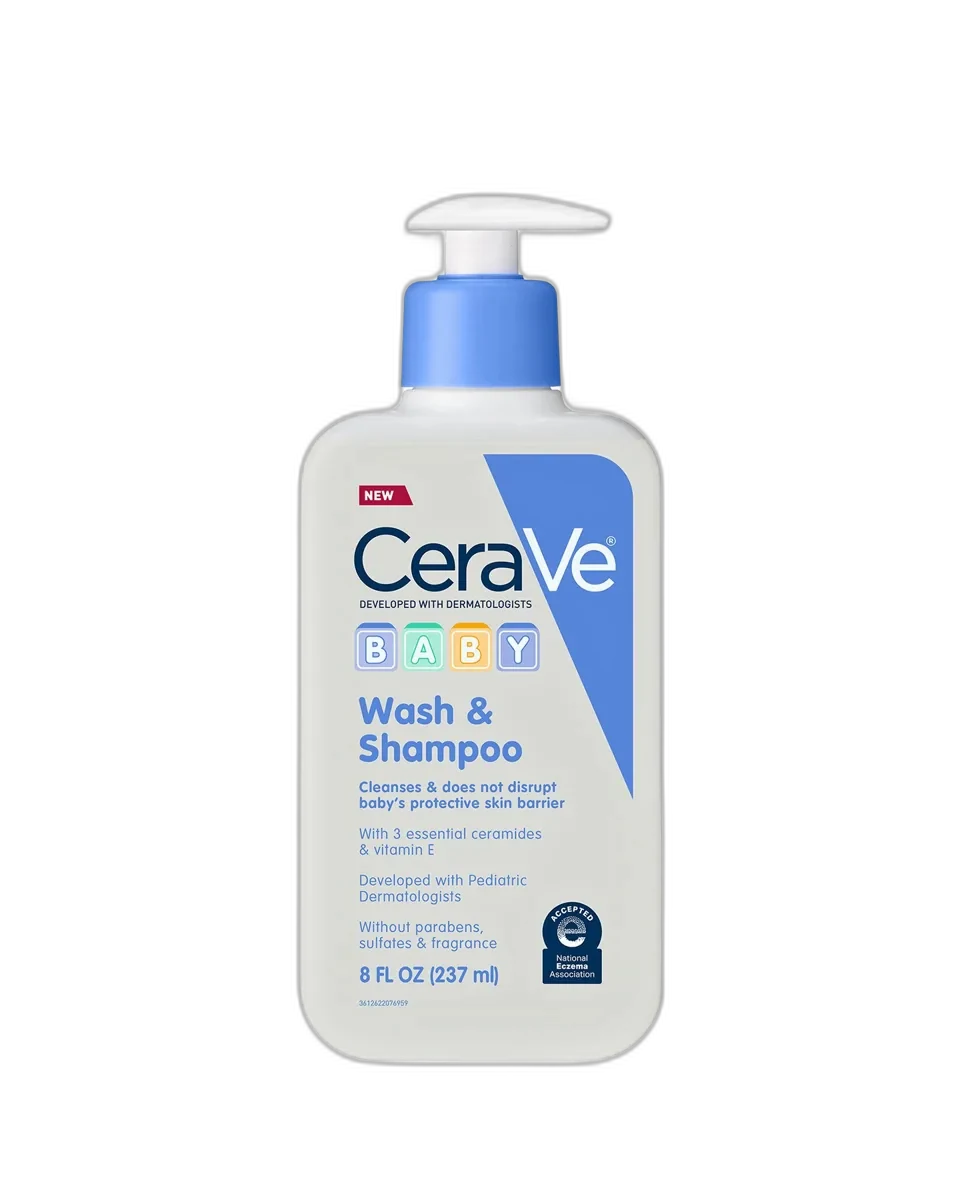
Baby Wash & Shampoo
Ceramide Baby Cleanser
 Verified reviewer
Pros & cons.
- +Three essential ceramides with cholesterol and phytosphingosine — a complete barrier lipid system in a baby wash
- +NEA Seal of Acceptance awarded at launch, validating suitability for eczema-prone infant skin
- +Ultra-gentle amphoteric and amino acid surfactant system — no sulfates, no soap
- +Tear-free formula confirmed across thousands of parent reviews
- +EWG Skin Deep score of 1 — the lowest possible hazard rating
- +Dual-purpose body wash and shampoo simplifies bath time
- +Under $10 for 8 oz — competitive with basic baby washes despite superior formulation
- −Thin, watery consistency means product dispenses quickly and the 8 oz runs out fast
- −Mild lather may feel insufficiently cleansing for parents accustomed to foamy baby washes
- −Can be slightly drying for babies with very dry or delicate skin
- −8 oz squeeze bottle requires two hands — 16 oz pump is more practical for bath time
- −Some reports of pump mechanism arriving broken or malfunctioning
The full review.
Baby bath products contain an inherent contradiction. We wash babies to clean them, but surfactants and water remove the lipids that keep infant skin healthy. For adult skin with a mature, self-replenishing barrier, this is a minor disruption. For infant skin, where the stratum corneum is thinner, ceramide levels are lower, and the barrier is still developing, every bath insults a system that hasn’t fully learned to defend itself.
CeraVe Baby Wash & Shampoo addresses this contradiction. Three essential ceramides — NP, AP, and EOP — join cholesterol and phytosphingosine, the co-lipids that help ceramides integrate into the stratum corneum’s lamellar structure. It uses the same biomimetic lipid approach found in CeraVe’s adult Moisturizing Cream, applied where it matters most.
Expert evidence supports this. Schachner et al. published two consensus statements — in 2020 in the Journal of Drugs in Dermatology and in 2022 in the Italian Journal of Dermatology and Venereology — recommending ceramide-containing cleansers and moisturizers for neonatal and infant skin care. The 2022 consensus shows that ceramide-containing emollients applied from the neonatal period may delay the onset and mitigate the severity of atopic dermatitis. A cleanser with ceramides aligns with current expert guidance on infant skin health.
The surfactant system is also intentional. Coco-betaine, the primary surfactant, is an amphoteric cleanser. It is among the gentlest categories, mild enough to be tear-free and effective enough to clean. Disodium cocoyl glutamate, the secondary surfactant, comes from coconut oil and the amino acid glutamic acid to produce mild cleansing. No sulfates. No soap. The result is a thin liquid that produces a light, airy lather instead of the thick foam parents expect from sulfate-based baby washes.
This leads to the most common complaint: it doesn’t feel like it’s doing much. The lather is so gentle it is almost invisible. Parents used to the foam of a Johnson’s or Aveeno baby wash may squeeze out more product to get a similar lather, so the 8 oz bottle runs out faster than expected. The cleansing works — amphoteric surfactants clean through micelle-based emulsification, not dramatic foaming — but the sensory experience is subtle.
The tear-free claim holds up across thousands of reviews. Most parents confirm contact with eyes during shampooing causes no crying. Rare exceptions exist due to individual sensitivity, but the consensus across over ten thousand reviews is strong. The fragrance-free formula means no aromatic compounds reach a baby’s eyes or nose during bath time.
Sodium hyaluronate acts as a humectant during cleansing to help maintain hydration while surfactants work. Vitamin E (tocopheryl acetate) adds mild antioxidant and conditioning properties. The ingredient list has 23 items — clean and intentional, with an EWG Skin Deep score of 1, the lowest hazard rating.
Practical use is straightforward. Dispense onto wet hands, work into a gentle lather, apply to a baby’s body and scalp, and rinse. The 16 oz pump bottle is the correct format for bath time; one-handed dispensing is essential when the other hand steadies a slippery infant. The 8 oz squeeze bottle works but requires two hands, a design limitation for its primary use.
Parents report that the wash handles cradle cap well. The gentle surfactants loosen flaky scales without irritating the sensitive underlying scalp. Combined with a soft brush and the ceramide-rich Baby Moisturizing Lotion afterward, it creates an effective cradle cap routine.
The adult crossover is interesting. Adults with rosacea, extreme sensitivity, or post-procedure skin use this wash as a facial cleanser because of the ceramide content and ultra-gentle surfactant system. If an adult facial cleanser makes skin feel tight or reactive, a baby wash designed for undeveloped infant barriers may be a better option. The formulation achieves its goals.
At $9.99 for 8 oz or around $14.99 for 16 oz, this is priced competitively with basic baby washes but offers better formulation science. The 16 oz pump is the recommended purchase — it has better per-ounce value, more practical dispensing, and lasts two to three months with daily bathing.
The limitation is that this is a wash. It contacts the skin briefly and rinses off. Ceramides have a limited window to deposit onto the skin. The barrier-repair benefits of the ceramides are more fully realized in the leave-on Baby Moisturizing Lotion. But even as a rinse-off, providing ceramides during cleansing is better than stripping them away — as the expert consensus states.
While most brands compete by listing what they’ve left out, CeraVe competes by explaining what they’ve put in and why. The NEA Seal of Acceptance at launch — awarded from day one, not earned retroactively — shows a formulation designed for eczema-prone infant skin, not just marketed toward it later.
Formula
### PM routineIngredient analysis.
Full INCI list
Aqua/Water/Eau, Coco-Betaine, Disodium Cocoyl Glutamate, Citric Acid, Cetyl Hydroxyethylcellulose, Ceramide NP, Ceramide AP, Ceramide EOP, Carbomer, Triethyl Citrate, Sodium Chloride, Sodium Cocoyl Glutamate, Sodium Phytate, Sodium Lauroyl Lactylate, Sodium Hyaluronate, Cholesterol, Disodium EDTA, Tocopheryl Acetate, Capryloyl Glycine, Caprylyl Glycol, Phytosphingosine, Xanthan Gum, Benzoic Acid
Skin match.
The science.
The Science
Experts agree on adding ceramides to infant cleansers. Schachner et al. (2020, Journal of Drugs in Dermatology, PubMed: 32845590) published eight consensus statements recommending infant skincare use mildly acidic or pH-neutral cleansers and moisturizers with ceramides and barrier lipids. A 2022 consensus (Italian Journal of Dermatology and Venereology, PubMed: 35005855) shows that daily ceramide-containing emollient use from the neonatal period may delay atopic dermatitis onset and reduce severity in high-risk infants.
A phase I safety study by Lowe et al. (2012, BMC Dermatology, PMC3368745) confirmed ceramide-dominant triple lipid mixtures caused no adverse skin reactions in neonates. 80% of mothers reported consistent daily application, showing both safety and compliance.
The surfactant system uses established safety data for amphoteric and amino acid-based cleansers. Coco-betaine is one of the mildest surfactant categories; clinical tests show it causes minimal disruption to stratum corneum lipids. Disodium cocoyl glutamate, from coconut oil and the amino acid glutamic acid, shows lower irritation potential than sulfate-based surfactants in comparative dermatological testing.
A 2024 systematic review (PubMed: 38443125) confirmed daily ceramide-containing moisturizer use reduces atopic dermatitis flare rates and the need for topical steroid treatment. This supports using ceramide-containing products for both cleansing and moisturizing.
References
- A Consensus About the Importance of Ceramide Containing Skincare for Normal and Sensitive Skin Conditions in Neonates and Infants — Journal of Drugs in Dermatology (2020)
- Expert consensus on ceramides containing skincare in newborns and infants and potential mitigation of atopic dermatitis — Italian Journal of Dermatology and Venereology (2022)
- A phase I study of daily treatment with a ceramide-dominant triple lipid mixture commencing in neonates — BMC Dermatology (2012)
Dermatologist Perspective
Pediatric dermatologists recommend this wash for ceramide-based infant skincare regimens, following expert consensus statements that advocate for ceramide-containing cleansers in neonatal care. Board-certified dermatologists note the surfactant system — amphoteric and amino acid-based instead of sulfate-based — preserves barrier lipids during cleansing instead of stripping them. The National Eczema Association endorsement follows formal evaluation. Dermatologists advise limiting baths to 5-10 minutes with lukewarm water, using this wash to cleanse without aggressive scrubbing, and applying a ceramide moisturizer to damp skin immediately after for optimal barrier support.
Where it fits in your routine.
Wet baby's skin and hair with lukewarm water. Dispense a small amount of wash into wet hands and gently lather. Apply to baby's body and scalp using hands or a soft washcloth — avoid scrubbing. Rinse thoroughly with lukewarm water. For cradle cap, gently massage into scalp, let sit for 1 minute, then use a soft brush to loosen scales before rinsing. Follow immediately with CeraVe Baby Moisturizing Lotion on damp skin. Limit bath time to 5-10 minutes.
At $9.99 for 8 oz or about $14.99 for 16 oz, the price competes with basic baby washes that lack ceramides and use harsher surfactant systems. The 16 oz pump bottle has better per-ounce value ($0.94/oz vs $1.25/oz) and lasts 2-3 months with daily bathing. For a product with three ceramides, cholesterol, phytosphingosine, hyaluronic acid, an NEA Seal of Acceptance, and an EWG score of 1, the price is excellent. Daily bathing costs approximately $50-60 annually with the 16 oz size.
Parents want a clinically-backed, gentle baby wash that supports developing skin barrier function instead of just cleansing. It works well for babies with eczema-prone or sensitive skin. It also works for adults with sensitive or reactive skin who find conventional facial cleansers too harsh.
Parents who prefer a thick, heavy lather may find this mild foam unsatisfying, though it works just as well. If your baby has very dry skin that worsens during baths despite using gentle products, reduce bath frequency instead of switching to a different wash.
Product details.
This thin, lightweight liquid makes a gentle, airy lather when rubbed between wet hands. It is not thick or gel-like. The water-like consistency spreads easily but yields less product per squeeze.
Fragrance-free — no detectable scent
8 fl oz white squeeze bottle or 16 fl oz pump bottle with teal/green CeraVe Baby branding. The 16 fl oz pump bottle allows one-handed use during bath time. The packaging is sturdy and practical.
Parents first notice this product lathers less than conventional baby washes. The light, airy foam is intentional; gentle amphoteric and amino acid surfactants replace sulfates. Skin rinses clean without feeling tight or dry. It has no fragrance and causes no stinging or reactions for most babies.
The 8 oz bottle lasts about 4-6 weeks with daily bathing. The 16 oz bottle lasts 2-3 months. The thin consistency causes fast dispensing.
12 months
All Year
The backstory.
Launched in March 2015 alongside the Baby Moisturizing Lotion and Diaper Rash Cream, all three products simultaneously received the National Eczema Association Seal of Acceptance — a strong opening statement. The wash was developed with pediatric dermatologists who recognized that bath time is paradoxically both necessary for hygiene and potentially damaging for infant skin barriers. By incorporating ceramides into the cleansing step, CeraVe applied its adult-product philosophy — that every skincare step should support barrier function — to the pediatric context.
About CeraVe
Established Brand (5–20 years)Dermatologists co-developed CeraVe in 2005, and it launched in 2006. Pediatric dermatologists developed the Baby line, which launched in March 2015; all three products earned the National Eczema Association Seal of Acceptance at once. CeraVe is the #1 dermatologist-recommended skincare brand in the US and was acquired by L'Oréal in 2017.
Common myths.
Effective baby wash produces plenty of foam to clean well.
Foam volume does not correlate with cleansing efficacy. The gentle amphoteric (coco-betaine) and amino acid (disodium cocoyl glutamate) surfactants in this formula clean via micelle-based emulsification instead of aggressive foaming. The mild lather shows gentle chemistry, not a limitation.
All baby washes are basically the same — gentle is gentle
Most baby washes focus on what they exclude, like sulfates, fragrance, or dyes. This formula focuses on what it includes: three ceramides with cholesterol and phytosphingosine that replenish barrier lipids lost during cleansing. Expert consensus (Schachner et al., 2020, 2022) recommends ceramide-containing cleansers for neonatal skin care, a standard most baby washes miss.
FAQ.
Is CeraVe Baby Wash safe for newborns?
Yes — pediatric dermatologists developed this product for infant skin, and it has the National Eczema Association Seal of Acceptance. Wait for the umbilical cord stump to fall off before bathing a newborn. The fragrance-free, sulfate-free, tear-free formula uses gentle amphoteric surfactants for the most delicate skin.
Can adults use CeraVe Baby Wash on their face?
Yes — many adults with sensitive, reactive, or rosacea-prone skin use this as a facial cleanser. This ceramide-rich, sulfate-free, fragrance-free formula is gentler than most adult facial cleansers. The EWG's lowest hazard rating of 1 confirms its low irritation potential.
Does CeraVe Baby Wash help with cradle cap?
Users report good results using this wash for cradle cap. The gentle surfactants loosen flaky scales on the scalp without irritating the sensitive underlying skin. For stubborn cradle cap, massage the wash into the scalp, let it sit for one minute, then use a soft brush to loosen scales before rinsing. The ceramides soothe the affected area.
Why doesn't CeraVe Baby Wash lather very much?
The mild lather is intentional. The formula uses coco-betaine and disodium cocoyl glutamate (amphoteric and amino acid surfactants) instead of sulfates. These gentler surfactants produce less foam but clean just as well. Thick lather comes from aggressive surfactant chemistry, not cleansing effectiveness.
Is CeraVe Baby Wash good for eczema-prone babies?
Yes — it has the National Eczema Association Seal of Acceptance, awarded at launch in 2015. The three-ceramide formula with cholesterol and phytosphingosine helps the skin barrier during cleansing. This matters for eczema-prone skin where the barrier is already compromised. Experts recommend ceramide-containing cleansers for eczema-prone infants.
What size CeraVe Baby Wash should I buy?
The 16 oz pump bottle ($14.99 or less) offers the best value and practicality. The pump allows one-handed dispensing during bath time, and the larger size lasts 2-3 months compared to 4-6 weeks for the 8 oz. The thin consistency makes product dispense quickly, so the smaller size runs out faster than expected.
What the community says.
"Extremely gentle on sensitive and eczema-prone baby skin"
"Tear-free formula works as advertised — no crying during bath time"
"Fragrance-free, sulfate-free, paraben-free — checks every safety box"
"Contains ceramides that actually support the skin barrier during cleansing"
"16 oz pump bottle is perfectly designed for one-handed bath time use"
"Thin, watery consistency means you go through the product quickly"
"Doesn't lather as richly as other baby washes — some parents feel they need more product"
"Can be slightly drying for babies with very dry or delicate skin"
"8 oz size runs out fast with daily bathing — 16 oz is more practical"
"Some reports of pump arriving broken or not functioning properly"