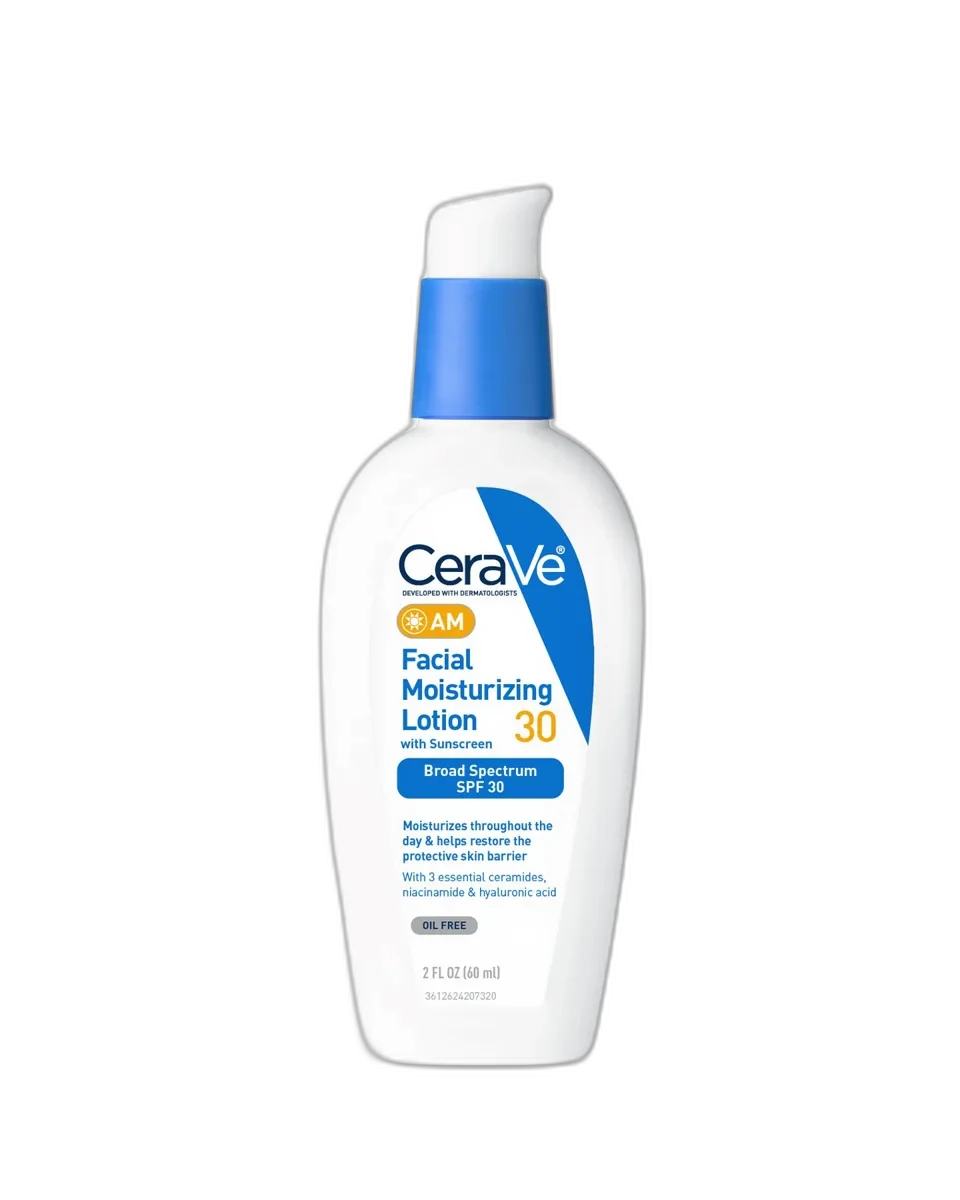
AM Facial Moisturizing Lotion SPF 30
Derm-Favorite Daily SPF
 Verified reviewer
Pros & cons.
- +Three essential ceramides with MVE time-release technology — genuine barrier repair in a sunscreen
- +Niacinamide boosts endogenous ceramide production alongside the exogenous ceramides supplied
- +Outstanding drugstore pricing for an SPF moisturizer with treatment-grade ingredients
- +Skin Cancer Foundation and National Eczema Association dual endorsement
- +Fragrance-free, non-comedogenic, allergy-tested — reliable for most skin types
- +Hybrid mineral-chemical UV system provides comprehensive broad-spectrum coverage
- +Nearly two decades of market history with 90,000+ reviews — extremely well-validated
- −Notorious pilling issue when layered under makeup or over other skincare products
- −White cast visible on medium to deep skin tones despite InVisibleZinc technology
- −Contains chemical UV filters (octocrylene, octinoxate) that concern ingredient-conscious consumers
- −Contains parabens (methylparaben, propylparaben) as preservatives
- −Can sting eyes when product migrates during the day or with sweating
The full review.
CeraVe’s AM Facial Moisturizing Lotion sits in more American medicine cabinets than almost any other SPF moisturizer because it solves a specific barrier to daily sunscreen use. The issue wasn’t awareness; dermatologists have recommended SPF for decades. The issue was the extra step. Using a separate moisturizer and sunscreen requires two products and two wait times, leading many to skip sunscreen. CeraVe combines them into one step with enough credibility for dermatologists to recommend it.
The formula uses CeraVe’s founding insight: three specific ceramides — NP, AP, and EOP — in a specific ratio with cholesterol and phytosphingosine can repair and maintain the skin’s lipid barrier. Most SPF moisturizers treat moisturization as an afterthought, using minimal glycerin or dimethicone to justify the label. This formula prioritizes barrier repair and sun protection.
The MVE (MultiVesicular Emulsion) technology differentiates its ceramide delivery from competitors. MVE encapsulates ingredients in concentric layers that open sequentially throughout the day for sustained release instead of a single burst. A 2016 study by Zeichner and Del Rosso in The Journal of Clinical and Aesthetic Dermatology validated this delivery system. It showed MVE ceramide moisturizers achieved 76% clearance rates in eczema patients when combined with treatment, proving the technology’s efficacy in barrier repair.
Niacinamide is the second-listed inactive ingredient, indicating a high concentration. It is functional: a landmark 2000 study by Tanno et al. in the British Journal of Dermatology showed niacinamide increases ceramide biosynthesis 4.1- to 5.5-fold in a dose-dependent manner. This formula doesn’t just supply ceramides; it stimulates the skin’s own ceramide production. It is the difference between delivering groceries and teaching someone to farm.
Hyaluronic acid and glycerin provide immediate hydration. While the ceramides work long-term, these humectants provide instant comfort. Dimethicone adds a non-occlusive layer to help prevent transepidermal water loss.
The sun protection is broad-spectrum SPF 30, using a hybrid system of four chemical filters and 6.3% zinc oxide. This UV filter system is more complex than most drugstore SPF moisturizers. The InVisibleZinc technology uses microfine zinc oxide particles to reduce the white cast typical of mineral sunscreens. This engineering effort does not fully eliminate the cast on deeper skin tones.
This product has a pilling problem, the most common complaint across ninety thousand reviews. Film-forming agents that keep sunscreen filters on the skin can interact poorly with underlying products or makeup, creating small balls of product. You can mitigate this by applying to dry skin, using minimal underlying products, and waiting several minutes between layers, but this turns a “simplify your routine” product into one requiring careful choreography.
The white cast is another reality. Despite InVisibleZinc, the 6.3% zinc oxide leaves a noticeable cast on medium to deep skin tones. It is minimal or invisible on fair to light skin. For others, it ranges from “noticeable if you look” to a “dealbreaker.” CeraVe offers tinted alternatives, but this original formula has not solved this.
The ingredient list contains methylparaben and propylparaben. These preservatives are safe per regulatory consensus but may deter ingredient-conscious consumers. Additionally, the chemical UV filters include octocrylene, which has increasing reports of photo contact allergy, and octinoxate, which raises environmental concerns regarding coral reef damage and hormonal activity. These filters make this product inadvisable during pregnancy.
Despite these limitations, the value is extraordinary. This is a barrier-repair moisturizer with three ceramides, niacinamide, hyaluronic acid, cholesterol, and phytosphingosine delivered via patented time-release technology. It is broad-spectrum SPF 30, fragrance-free, non-comedogenic, and endorsed by both the Skin Cancer Foundation and the National Eczema Association, costing roughly thirteen to twenty dollars. Competitors with comparable ingredient quality and clinical backing cost two to four times more.
Ninety thousand reviews and nearly two decades of market history provide certainty. This product has been tested on almost every skin type, condition, climate, and routine. The failures (pilling, white cast, occasional eye stinging) and successes (barrier repair, sustained hydration, reliable sun protection) are well-documented. There are few surprises left.
For anyone with normal to combination skin seeking barrier-repair ingredients and sun protection in one affordable step, this is the benchmark. Its weaknesses are cosmetic rather than clinical; it works better than it wears. Most dermatologists and patients accept this trade-off, and sales numbers suggest the market agrees.
Formula
Ingredient analysis.
Full INCI list
Active Ingredients: Homosalate 10%, Meradimate (Menthyl Anthranilate) 5%, Octinoxate (Ethylhexyl Methoxycinnamate) 5%, Octocrylene 2%, Zinc Oxide 6.3%. Inactive Ingredients: Water, Niacinamide, Cetearyl Alcohol, Glycerin, Dimethicone, Behentrimonium Methosulfate, Ceramide NP, Ceramide AP, Ceramide EOP, Hyaluronic Acid, Sodium Hydroxide, Aluminum Starch Octenylsuccinate, Hydroxyethylcellulose, Methylparaben, Disodium EDTA, Propylparaben, Sodium Lauroyl Lactylate, Phytosphingosine, Cholesterol, Carbomer, Xanthan Gum
Skin match.
The science.
The Science
The CeraVe AM Lotion formulation combines exogenous ceramide delivery with endogenous ceramide stimulation. Three essential ceramides (NP, AP, EOP), cholesterol, and phytosphingosine replicate the skin's natural lipid barrier in an optimal ratio. A 2018 study by Spada et al. in Clinical, Cosmetic and Investigational Dermatology (PMC6197824) shows that a ceramide cream mimicking this natural composition increases skin hydration at 24 hours more than three reference moisturizers and cuts transepidermal water loss by about 21-25%.
The MVE delivery system provides time-release ceramide delivery. Zeichner and Del Rosso (2016, The Journal of Clinical and Aesthetic Dermatology, PMC5300724) evaluated MVE ceramide-containing moisturizers and documented their sequential release mechanism—each vesicle in the multivesicular emulsion opens gradually to provide sustained ceramide availability instead of a single burst. In eczema patients, MVE ceramide moisturizers used with treatment achieved 76% clearance rates.
Niacinamide does more than provide direct skincare benefits. Tanno et al. (2000, British Journal of Dermatology, PubMed: 10971324) showed that niacinamide increases ceramide biosynthesis 4.1-5.5-fold in a dose-dependent manner, while also increasing glucosylceramide (7.4-fold) and sphingomyelin (3.1-fold) production. Topical niacinamide decreases transepidermal water loss, which improves barrier performance. This dual mechanism—supplying ceramides while stimulating endogenous production—creates a compounding barrier-repair effect found in formulations combining both ingredients.
References
- Nicotinamide increases biosynthesis of ceramides as well as other stratum corneum lipids to improve the epidermal permeability barrier — British Journal of Dermatology (2000)
- Multivesicular Emulsion Ceramide-containing Moisturizers: An Evaluation of Their Role in the Management of Common Skin Disorders — The Journal of Clinical and Aesthetic Dermatology (2016)
- Skin hydration is significantly increased by a cream formulated to mimic the skin's own natural moisturizing systems — Clinical, Cosmetic and Investigational Dermatology (2018)
Dermatologist Perspective
Dermatologists often rank CeraVe AM among their most-recommended daily SPF moisturizers. They cite the ceramide-niacinamide combination as beneficial for patients with compromised barriers needing sun protection. Board-certified dermatologists note the MVE delivery system offers an advantage over competitors that list ceramides without a comparable delivery mechanism. The Skin Cancer Foundation's Seal of Recommendation and the National Eczema Association's Seal of Acceptance reflect formal clinical evaluation. Dermatologists tell patients to apply a nickel-sized amount to the face and advise pregnant patients to use mineral-only alternatives because of the chemical UV filter content.
Where it fits in your routine.
Apply a nickel-sized amount to the face and neck every morning as your last skincare step. Use on dry, clean skin; damp skin increases pilling. Wait 2-3 minutes before applying makeup. Do not mix with other products in your palm before application. Reapply every 2 hours during prolonged sun exposure. For best results, use with CeraVe PM Facial Moisturizing Lotion for the evening routine.
At $13-20 for 3 fl oz, this ranks among the best values in the SPF moisturizer category. Prestige brands charge $40-80 for the same combination of three ceramides, niacinamide, hyaluronic acid, MVE technology, and broad-spectrum SPF 30. One tube lasts 2-3 months with daily use, so the annual cost is about $50-80 — a low price for a barrier-repairing daily sunscreen with dual foundation endorsements. The 2 fl oz size at lower price points is even more accessible. No other drugstore SPF moisturizer matches this ingredient quality and clinical backing at this price point.
This ceramide-niacinamide formula repairs and strengthens the skin barrier while providing UV protection. It works for anyone needing a reliable, affordable daily SPF moisturizer. This single product simplifies morning routines for normal to combination skin types.
People with deeper skin tones who dislike white cast, those who layer products and experience pilling, pregnant individuals seeking mineral-only sunscreens, and consumers who avoid chemical UV filters or parabens.
Product details.
This lightweight lotion feels slightly thick at first but absorbs to a comfortable finish. The hybrid mineral-chemical formula applies smoother than pure mineral sunscreens.
Fragrance-free — no added scent. UV filters cause a slight, typical sunscreen smell that fades fast.
3 fl oz plastic tube with pump dispenser. Clean white and blue CeraVe branding. Also available in a 2 fl oz squeeze tube.
Applies smoothly and absorbs in 1-2 minutes. It leaves a slight white cast on darker skin tones that fades as it sets. Pilling occurs if you layer it too fast over serums or under silicone-based makeup; waiting 2-3 minutes between layers prevents this. It provides immediate, non-greasy hydration.
The 3 fl oz tube lasts about 2-3 months if used on the face daily. The 2 fl oz size lasts 4-6 weeks.
12 months
All Year
The backstory.
When CeraVe launched in 2006 with its core moisturizer trio, dermatologists noted one missing piece: a morning formula that combined the ceramide barrier-repair approach with sun protection. The AM Facial Moisturizing Lotion was developed as the natural morning complement to the PM Facial Moisturizing Lotion, using the same MVE ceramide delivery system but adding broad-spectrum UV protection. It became one of CeraVe's best-selling products by solving the 'sunscreen skip' problem — giving people who resisted a separate sunscreen step a moisturizer that handled both.
About CeraVe
Established Brand (5–20 years)CeraVe was co-developed with dermatologists in 2005 and launched in 2006, pioneering the use of three essential ceramides with MVE (MultiVesicular Emulsion) time-release technology. Acquired by L'Oréal in 2017 for $1.3 billion, the brand has grown to over $2 billion in global sales and is one of the most recommended skincare brands by US dermatologists. CeraVe formulations are backed by peer-reviewed research on ceramide delivery systems.
Common myths.
SPF 30 isn't enough protection for daily use
SPF 30 blocks about 97% of UVB rays with correct application. The gap between SPF 30 and SPF 50 (98% blocking) is small for daily use. The Skin Cancer Foundation's Seal of Recommendation for Daily Use on this product confirms it provides adequate everyday protection. Applying SPF 30 daily works better than using higher SPFs sporadically.
Hybrid sunscreens with both chemical and mineral filters work less effectively than pure formulations
This product uses five UV filters — four chemical and one mineral — for complementary coverage across the UV spectrum. The zinc oxide provides broad UVA protection, while the chemical filters extend UVB coverage. This hybrid approach provides more complete protection than either type alone.
FAQ.
Why does CeraVe AM Lotion pill under makeup?
Pilling happens when film-forming agents in the product interact with silicones or polymers in makeup or serums applied underneath. To minimize pilling: apply to fully dry skin, use a small amount (nickel-sized), wait 2-3 minutes before applying makeup, pat instead of rub during application, and avoid layering too many products underneath.
Does CeraVe AM Lotion SPF 30 leave a white cast?
The 6.3% zinc oxide leaves a white cast, especially on medium to deep skin tones. CeraVe's InVisibleZinc technology uses microfine particles to minimize this, though some cast remains. Let the product absorb for 2-3 minutes to reduce the appearance. If white cast concerns you, use CeraVe's tinted sunscreen options.
Is CeraVe AM Lotion SPF 30 safe during pregnancy?
The chemical UV filters in this product (homosalate, octinoxate, octocrylene) raise concerns about hormonal activity during pregnancy. Most dermatologists recommend mineral-only (zinc oxide and/or titanium dioxide) sunscreens during pregnancy. CeraVe's Hydrating Mineral Sunscreen SPF 30 is a pregnancy-friendly alternative from the same brand.
Can you use CeraVe AM Lotion as your only moisturizer?
Yes — ceramides, niacinamide, hyaluronic acid, and glycerin provide enough hydration for normal to combination skin during the day. The MVE technology keeps skin moist all day. Very dry skin needs a hydrating serum underneath. Use a separate, thicker moisturizer (like CeraVe PM Lotion) at night.
How does CeraVe AM compare to CeraVe PM Facial Moisturizing Lotion?
Both contain niacinamide, hyaluronic acid, and the same three essential ceramides with MVE technology. The AM version adds broad-spectrum SPF 30, which makes it heavier and more prone to pilling. The PM version is lighter, absorbs faster, and layers better with nighttime treatments like retinol. They work as a complementary pair.
Does CeraVe AM Lotion contain parabens?
Yes — it uses methylparaben and propylparaben as preservatives. Parabens are safe in cosmetics and have worldwide regulatory approval, but some consumers prefer paraben-free formulations. If you have this concern, find alternative SPF moisturizers with different preservative systems.
What the community says.
"Excellent two-in-one moisturizer and sunscreen that simplifies the morning routine"
"Ceramide and niacinamide formula genuinely improves skin barrier over time"
"Fragrance-free and non-comedogenic — reliable for sensitive and acne-prone skin"
"Outstanding value at drugstore pricing for an SPF moisturizer with treatment ingredients"
"Lightweight texture that provides all-day hydration without heaviness"
"Notorious pilling when layered under makeup or over other products"
"White cast visible on medium to deep skin tones despite InVisibleZinc technology"
"Can sting eyes when product migrates during the day or with sweating"
"Contains parabens, which some users prefer to avoid"
"Chemical UV filters (homosalate, octinoxate, octocrylene) concern ingredient-conscious consumers"