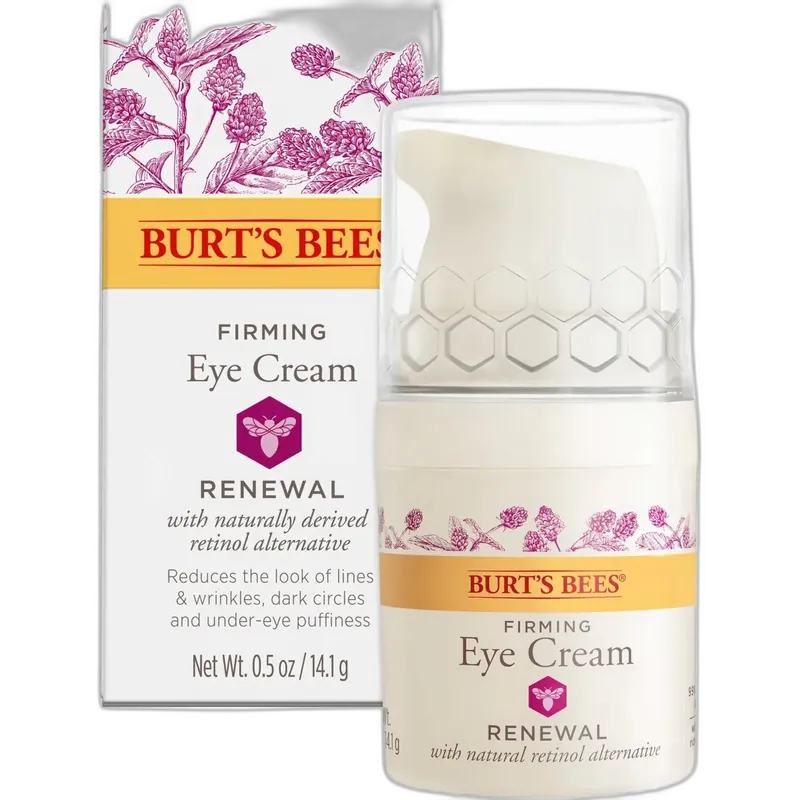
Renewal Smoothing Eye Cream
Natural Eye Firming Pick
 Verified reviewer
Pros & cons.
- +Bakuchiol positioned meaningfully in the formula as a gentle retinol alternative for the eye area
- +Fragrance-free and ophthalmologist tested — higher safety standard than the face cream
- +Dipotassium glycyrrhizate targets dark circles through tyrosinase inhibition and anti-inflammation
- +Multi-humectant system (glycerin, sodium PCA, sodium lactate) plumps dehydration lines
- +Pregnancy-safe anti-aging eye cream — bakuchiol doesn't carry retinol's pregnancy restrictions
- +99% natural-origin formula from a trusted 40-year-old brand
- −Expensive per ounce at approximately $40/oz compared to face moisturizers
- −Rich texture may be too heavy under concealer for some morning routines
- −Twelve botanical extracts at likely low concentrations may be more marketing than function
- −Faint earthy smell from botanical extracts that some users find off-putting
- −Results require 8-12 weeks of consistent use — patience is mandatory
The full review.
The skin around your eyes is roughly 0.5 millimeters thick — about ten times thinner than the skin on your cheeks. It has fewer oil glands, less collagen, and moves constantly through blinking, squinting, and emoting. It’s where aging shows up first, where dehydration becomes most visible, and where most active ingredients are too harsh to use safely. This is the testing ground where anti-aging claims go to be humbled.
Burt’s Bees built their Renewal Eye Cream around a simple but compelling logic: if retinol is too irritating for the eye area, and if bakuchiol produces retinol-like collagen stimulation without the irritation, then bakuchiol might be the ideal eye-area active. The research supports this reasoning. The 2019 British Journal of Dermatology study that put bakuchiol on the map specifically noted the ingredient’s superior tolerability — no scaling, less stinging, no photosensitivity. For an area that tolerates nothing well, an effective active that doesn’t sting, peel, or inflame is exactly what the formulator ordered.
Bakuchiol sits at position eight in this formula — below the emollient base and emulsifiers but well above the extensive botanical extract complex and preservatives. This placement suggests a concentration that’s more therapeutic than decorative. Given that the clinical study used 0.5% bakuchiol twice daily, and that cosmetic products typically include actives at or near their studied concentrations, there’s reason to believe this formula delivers a meaningful dose.
But bakuchiol isn’t the only active doing work here. Dipotassium glycyrrhizate — a licorice root derivative — addresses the dark circle problem that most anti-aging eye creams ignore entirely. Dark circles have multiple causes: hyperpigmentation, visible blood vessels through thin skin, and periorbital edema. Licorice derivatives tackle the first two by inhibiting tyrosinase (reducing melanin production) and providing anti-inflammatory activity that calms the vascular network beneath the eye. It’s a smart inclusion that gives this eye cream a broader mandate than pure wrinkle reduction.
The botanical extract list is extensive — twelve different plant extracts ranging from watermelon and apple fruit extracts to chlorella, plankton, and hibiscus. This is where the formula gets slightly crowded. Each of these extracts has some documented antioxidant or skin-conditioning property, but at the concentrations present in a formula that lists them after the emulsifiers and thickeners, their individual contributions are likely minimal. The blend probably provides a collective antioxidant and hydrating effect, but claiming specific benefits from any single extract at these concentrations would be overstating the case.
The humectant system, however, is genuinely well-designed. Glycerin provides the primary hydration pull. Sodium PCA — a component of the skin’s own natural moisturizing factor — adds physiologically compatible moisture binding. Sodium lactate contributes additional NMF-mimicking hydration. This three-pronged approach addresses the chronic dehydration that makes fine lines look deeper than they actually are. When the eye area is properly hydrated, some of those ‘wrinkles’ turn out to be dehydration lines that plump out naturally.
Ribose — a simple sugar involved in cellular energy production — is an interesting inclusion. Research suggests that topical ribose can support ATP synthesis in skin cells, potentially aiding cellular repair processes. In the context of aging skin with declining cellular energy, this is a theoretically sound addition, though the clinical evidence for topical ribose in anti-aging is still developing.
Texture is richer than many eye creams — more traditional cream than the lightweight gels that some brands prefer. This works in the eye cream’s favor for hydration purposes but may feel too thick under concealer for some morning routines. The key is technique: use a rice grain-sized amount and pat gently with the ring finger (the weakest finger, which applies the least pressure to the delicate eye area). Avoid pulling or dragging, and the cream absorbs within about sixty seconds.
The fragrance-free formulation is a clear win. The face cream in the Renewal line contains fragrance and multiple fragrance allergens. By stripping these from the eye cream, Burt’s Bees acknowledged that the periorbital area demands a higher safety standard. The ophthalmologist testing adds another layer of confidence — this has been specifically evaluated for eye safety, not just assumed safe because it’s ‘natural.’
Some users note an earthy, slightly garden-like scent from the botanical extracts — this isn’t fragrance, it’s the raw smell of twelve different plant extracts concentrated into a small formula. It’s not unpleasant, but it’s detectable, and users expecting a completely odorless product may notice it.
Value is where eye creams always get complicated. At roughly twenty dollars for half an ounce, the per-ounce cost is forty dollars — expensive by face cream standards but middle-of-the-road for eye creams. The small jar lasts two to three months with proper use, making the monthly investment about eight to ten dollars. For a fragrance-free, ophthalmologist-tested eye cream with a clinically validated active (bakuchiol), a proven brightener (licorice root), and a multi-humectant system — from a legacy brand with forty years of natural formulation expertise — the pricing is justified if not generous.
The real question with any eye cream is whether it does enough more than your regular moisturizer to warrant a separate purchase. In this case, the answer is a qualified yes. The fragrance-free formulation, the licorice root brightener, the ribose inclusion, and the ophthalmologist testing are all eye-area-specific decisions that the Renewal face cream doesn’t share. You’re paying for formulation choices tailored to the most demanding area on your face, not just a moisturizer in a smaller jar.
Formula
Ingredient analysis.
Full INCI list
Water, Caprylic/Capric Triglyceride, Glycerin, Stearyl Alcohol, Cetyl Alcohol, Glyceryl Stearate, Beeswax, Bakuchiol, Tocopherol, Beta Vulgaris (Beet) Root Extract, Citrullus Lanatus (Watermelon) Fruit Extract, Lens Esculenta (Lentil) Fruit Extract, Pyrus Malus (Apple) Fruit Extract, Glycine Soja (Soybean) Oil, Scutellaria Alpina Flower/Leaf/Stem Extract, Trifolium Pratense (Clover) Leaf Extract, Adansonia Digitata Fruit Extract, Hibiscus Sabdariffa Flower Extract, Chlorella Vulgaris Extract, Plankton Extract, Phragmites Communis Extract, Poria Cocos Extract, Stearic Acid, Ribose, Xanthan Gum, Lecithin, Hydrolyzed Corn Starch, Citric Acid, Dipotassium Glycyrrhizate, P-Anisic Acid, Potassium Stearate, Linoleic Acid, Linolenic Acid, Lactic Acid, Magnesium Aluminum Silicate, Sodium Lactate, Sodium PCA, Sodium Citrate, Sodium Benzoate, Potassium Sorbate, Phenoxyethanol
Skin match.
The science.
The Science
The eye cream's anti-aging strategy centers on bakuchiol, whose evidence base for periorbital use is particularly compelling. The 2019 British Journal of Dermatology study comparing 0.5% bakuchiol with 0.5% retinol found comparable wrinkle reduction after 12 weeks, with significantly less scaling and stinging in the bakuchiol group. For the periorbital area — where skin is thinnest and most reactive — this tolerability advantage is magnified. Retinol-induced irritation around the eyes can cause contact dermatitis, swelling, and paradoxically accelerate the appearance of aging through chronic inflammation.
Dipotassium glycyrrhizate, a salt of 18β-glycyrrhetinic acid from licorice root, addresses dark circles through dual mechanisms. Research published in the Journal of Drugs in Dermatology (2013) demonstrated that glycyrrhizin derivatives inhibit tyrosinase activity, reducing melanin deposition in hyperpigmented periorbital skin. Additionally, the compound's anti-inflammatory properties — mediated through inhibition of thromboxane A2 and prostaglandin E2 — can reduce the periorbital edema and vascular congestion that contribute to dark circle appearance.
The multi-humectant approach (glycerin, sodium PCA, sodium lactate) aligns with research on natural moisturizing factor (NMF) supplementation. A study in the International Journal of Cosmetic Science (2003) demonstrated that topical application of NMF constituents significantly improved hydration in barrier-compromised skin. The periorbital area, with its reduced sebaceous gland density, is effectively in a state of chronic NMF deficiency compared to the rest of the face.
Ribose, a pentose sugar involved in ATP and nucleotide synthesis, has shown preliminary promise in anti-aging applications. In vitro studies suggest that topical ribose can enhance cellular energy metabolism in dermal fibroblasts, potentially supporting collagen synthesis and cellular repair in aging skin.
References
- Prospective, randomized, double-blind assessment of topical bakuchiol and retinol for facial photoageing — British Journal of Dermatology (2019)
Dermatologist Perspective
Dermatologists recognize the periorbital area as one of the most challenging zones for anti-aging treatment due to the skin's extreme thinness and reactivity. Board-certified dermatologists would view bakuchiol as a well-reasoned choice for this area — it provides collagen stimulation without the irritation that makes retinol problematic around the eyes. The ophthalmologist testing and fragrance-free formulation meet the higher safety standards that dermatologists expect for periorbital products. Dermatologists would note the licorice root derivative as a sensible addition for dark circles and would likely recommend this product for patients who want to address eye-area aging without prescription options.
Where it fits in your routine.
Place a rice grain-sized amount on your ring finger. Pat (do not rub or drag) around the orbital bone, moving from the inner corner under the eye outward and across the brow bone. Use morning and evening after cleansing and eye serums, but before face moisturizer. Apply sunscreen over the entire eye area in the morning. Wait 60 seconds for absorption before applying concealer or makeup. Use twice daily for at least 12 weeks to evaluate anti-aging results.
At about $20 for 0.5 oz, the $40 per-ounce price is moderate for eye creams, as prestige products often cost $80-200 per ounce. One container lasts two-to-three months, making the monthly cost roughly $8-10. This fragrance-free, ophthalmologist-tested formula contains bakuchiol, licorice root, and a multi-humectant system, offering fair value. The main question is if the long list of botanical extracts adds value or just increases ingredient count — the core actives (bakuchiol, licorice root, vitamin E) provide most benefits in a simpler formula.
This eye treatment uses evidence-based actives for fine lines, crow's feet, or dark circles. It works for people who cannot tolerate retinol near the eyes, pregnant or breastfeeding individuals needing pregnancy-safe anti-aging, and clean beauty enthusiasts seeking an eye cream with genuine active ingredients.
Budget-conscious users can apply their face moisturizer to the eye area, though they lose specific periorbital benefits. Oily-skinned users who prefer lightweight gel textures will like this. Anyone expecting dramatic overnight results will be disappointed—bakuchiol requires the same patience as retinol.
Product details.
Fragrance-free. The extensive botanical extract complex has a faint earthy or herbal note for some users, but contains no added fragrance.
A small bottle or jar uses the Burt's Bees Renewal line branding. The 0.5 oz size is standard for eye creams but feels small for the price.
The formula provides immediate hydration and slight plumping to the under-eye area. It causes no stinging, burning, or irritation; the ophthalmologist-tested formula is gentle on delicate skin. The thick texture cosmetically smooths fine lines while actives work at the cellular level over time.
2-3 months with twice daily eye area application
12 months
All Year
The backstory.
The Renewal Eye Cream extended Burt's Bees' bakuchiol bet into the most challenging category in skincare: eye care. The periorbital area is where aging signs appear first and where skin is most sensitive to actives, making it the ultimate test of whether a gentle retinol alternative can deliver meaningful results. The formula's ophthalmologist testing and fragrance-free formulation reflect the higher safety standard that eye products demand.
About Burt's Bees
Legacy Brand (20+ years)Burt's Bees started in Maine in 1984 and led natural beauty in America. The Renewal eye cream is dermatologist and ophthalmologist tested. It uses bakuchiol, a clinically validated natural retinol alternative, as its star active ingredient.
Common myths.
Eye creams are face moisturizers in smaller, more expensive packaging.
Some eye creams are just overpriced face creams, but this formula differs from Burt's Bees' face moisturizers. It is fragrance-free (the face cream has fragrance), uses dipotassium glycyrrhizate for dark circles, and includes ribose for cellular energy support. It is ophthalmologist tested for eye safety. The botanical complex also targets periorbital concerns.
You can't use retinol or retinol alternatives around the eyes.
Bakuchiol works better for the eye area than retinol. It lacks the irritation, peeling, or dryness that makes retinol risky for thin periorbital skin. This gentler mechanism of action provides collagen-stimulating benefits without the side effects that limit retinol use near the eyes.
FAQ.
Does Burt's Bees Renewal Eye Cream work for dark circles?
The formula contains dipotassium glycyrrhizate (licorice root derivative). This ingredient has documented skin-brightening and anti-inflammatory properties that address dark circles from hyperpigmentation and vascular inflammation. Results are gradual; expect improvement over 6-12 weeks instead of overnight brightening.
Is this eye cream safe for contact lens wearers?
Yes. The formula is fragrance-free and ophthalmologist tested, so contact lens wearers can use it. Apply it around the orbital bone instead of directly on the eyelid to stop product migration into the eyes.
Can I use this eye cream with retinol face products?
Yes. Bakuchiol lacks the interaction concerns of retinol. Using a bakuchiol eye cream with a retinol face moisturizer works well. You get retinol's stronger anti-aging effects on resilient face skin and bakuchiol's gentler approach for the delicate eye area.
How long does Burt's Bees Renewal Eye Cream last?
The 0.5 oz container lasts 2-3 months if you apply it twice daily to both eyes. Use a rice grain-sized amount per eye; this concentrated formula is potent.
Is this eye cream pregnancy-safe?
Bakuchiol is safe during pregnancy, unlike retinol which is contraindicated. This makes the Renewal Eye Cream a practical choice for expectant mothers who want an anti-aging eye routine. Always consult your healthcare provider about specific products during pregnancy.
What the community says.
"Noticeably reduces fine lines and crow's feet with consistent use"
"Helps brighten dark circles and reduce under-eye puffiness"
"Fragrance-free and non-irritating around sensitive eye area"
"Rich but not heavy — absorbs well without migrating into eyes"
"Natural ingredients with a gentle, non-stinging formula"
"Expensive per ounce for the small 0.5 oz container"
"Earthy smell from botanical extracts that some users dislike"
"Results are gradual — requires patience for visible anti-aging effects"
"Jar/tube packaging could be improved for hygiene"
"Some users find the texture too thick for morning use under makeup"
People also looked at.